- Latest available (Revised)
- Original (As enacted)
Bankruptcy and Diligence etc. (Scotland) Act 2007
You are here:
- Acts of the Scottish Parliament
- 2007 asp 3
- Whole Act without Schedules

What Version
Advanced Features
- Show Geographical Extent(e.g. England, Wales, Scotland and Northern Ireland)
- Show Timeline of Changes
Opening Options
More Resources
Changes over time for: Bankruptcy and Diligence etc. (Scotland) Act 2007 (without Schedules)
Alternative versions:
- 15/01/2007- Amendment
- 16/01/2007- Amendment
- 08/03/2007- Amendment
- 31/03/2007- Amendment
- 19/02/2008- Amendment
- 01/04/2008- Amendment
- 22/04/2009- Amendment
- 23/11/2009- Amendment
- 01/07/2010- Amendment
- 31/01/2011- Amendment
- 01/04/2011- Amendment
- 04/04/2011- Amendment
- 06/11/2012- Amendment
- 04/10/2014- Amendment
- 08/12/2014- Amendment
- 01/04/2015- Amendment
- 28/06/2016- Amendment
- 30/11/2016- Amendment
- 27/04/2017- Amendment
- 31/10/2017- Amendment
- 01/12/2017- Amendment
- 31/01/2018- Amendment
- 06/03/2019- Amendment
- 31/12/2020- Amendment
- 01/10/2022- Amendment
Status:
This version of this Act contains provisions that are prospective.

Status
The term provision is used to describe a definable element in a piece of legislation that has legislative effect – such as a Part, Chapter or section. A version of a provision is prospective either:
- where the provision (Part, Chapter or section) has never come into force or;
- where the text of the provision is subject to change, but no date has yet been appointed by the appropriate person or body for those changes to come into force.
Commencement Orders listed in the ‘Changes to Legislation’ box as not yet applied may bring this prospective version into force.
Changes to legislation:
Bankruptcy and Diligence etc. (Scotland) Act 2007 is up to date with all changes known to be in force on or before 15 December 2024. There are changes that may be brought into force at a future date. Changes that have been made appear in the content and are referenced with annotations.
Changes to Legislation
Revised legislation carried on this site may not be fully up to date. Changes and effects are recorded by our editorial team in lists which can be found in the ‘Changes to Legislation’ area. Where those effects have yet to be applied to the text of the legislation by the editorial team they are also listed alongside the legislation in the affected provisions. Use the ‘more’ link to open the changes and effects relevant to the provision you are viewing.
Changes and effects yet to be applied to :
- Pt. 2 applied (with modifications) by S.I. 2015/428 art. 5(2) Sch. 2 (This amendment has effect from the day on which 2007 asp 3, s. 46 comes into force)
- Pt. 2 applied by 1967 c. 48 s. 3(1) (as inserted) by 2007 asp 3 s. 49(1)
- s. 40(1)-(3) modified by 1967 c. 48 s. 3(2) (as inserted) by 2007 asp 3 s. 49(1)
- s. 45(3)(c) modified by 1967 c. 48 s. 3(2) (as inserted) by 2007 asp 3 s. 49(1)
- s. 176(2A) inserted by 2024 asp 9 s. 19(2)
- s. 221 words substituted by 2008 c. 6 Sch. 7 para. 6
Changes and effects yet to be applied to the whole Act associated Parts and Chapters:
Whole provisions yet to be inserted into this Act (including any effects on those provisions):
- s. 176(2A) inserted by 2024 asp 9 s. 19(2)
Part 1SBankruptcy
Duration of bankruptcyS
F11Discharge of debtorS
. . . . . . . . . . . . . . . . . . . . . . . . . . . . . . . .
Textual Amendments
F1Ss. 1, 2 repealed (30.11.2016) by Bankruptcy (Scotland) Act 2016 (asp 21), s. 237(2), sch. 9 pt. 1 (with ss. 232, 234(3), 235, 236); S.S.I. 2016/294, reg. 2
Bankruptcy restrictions orders and undertakingsS
F12Bankruptcy restrictions orders and undertakingsS
. . . . . . . . . . . . . . . . . . . . . . . . . . . . . . . .
Textual Amendments
F1Ss. 1, 2 repealed (30.11.2016) by Bankruptcy (Scotland) Act 2016 (asp 21), s. 237(2), sch. 9 pt. 1 (with ss. 232, 234(3), 235, 236); S.S.I. 2016/294, reg. 2
Effect of bankruptcy restrictions orders and undertakingsS
3Disqualification from being appointed as receiverS
(1)Section 51 of the Insolvency Act 1986 (c. 45) (appointment of receiver) is amended as follows.
(2)In subsection (3), after paragraph (b), insert—
“(ba)a person subject to a bankruptcy restrictions order;”.
(3)In subsection (5), after “bankrupt” insert “or a person subject to a bankruptcy restrictions order”.
(4)In subsection (6), after “receivers” insert “; and
“bankruptcy restrictions order” means—
(a)a bankruptcy restrictions order made under section 56A of the Bankruptcy (Scotland) Act 1985 (c. 66);
(b)a bankruptcy restrictions undertaking entered into under section 56G of that Act;
(c)a bankruptcy restrictions order made under paragraph 1 of Schedule 4A to this Act; or
(d)a bankruptcy restrictions undertaking entered into under paragraph 7 of that Schedule.”.
4Disqualification for nomination, election and holding office as member of local authorityS
In section 31 of the Local Government (Scotland) Act 1973 (c. 65) (disqualifications for nomination, election and holding office as member of local authority)—
(a)after subsection (1)(b), insert—
“(ba)he is subject to a bankruptcy restrictions order;”; and
(b)after subsection (3A), insert—
“(3B)In subsection (1)(ba) above, “bankruptcy restrictions order” means—
(a)a bankruptcy restrictions order made under section 56A of the Bankruptcy (Scotland) Act 1985;
(b)a bankruptcy restrictions undertaking entered into under section 56G of that Act;
(c)a bankruptcy restrictions order made under paragraph 1 of Schedule 4A to the Insolvency Act 1986 (c. 45); or
(d)a bankruptcy restrictions undertaking entered into under paragraph 7 of that Schedule.”.
F25Orders relating to disqualificationS
. . . . . . . . . . . . . . . . . . . . . . . . . . . . . . . .
Textual Amendments
F2Ss. 5-32 repealed (30.11.2016) by Bankruptcy (Scotland) Act 2016 (asp 21), s. 237(2), sch. 9 pt. 1 (with ss. 232, 234(3), 235, 236); S.S.I. 2016/294, reg. 2
The trustee in the sequestrationS
F26Amalgamation of offices of interim trustee and permanent trusteeS
. . . . . . . . . . . . . . . . . . . . . . . . . . . . . . . .
Textual Amendments
F2Ss. 5-32 repealed (30.11.2016) by Bankruptcy (Scotland) Act 2016 (asp 21), s. 237(2), sch. 9 pt. 1 (with ss. 232, 234(3), 235, 236); S.S.I. 2016/294, reg. 2
F27Repeal of trustee's residence requirementS
. . . . . . . . . . . . . . . . . . . . . . . . . . . . . . . .
Textual Amendments
F2Ss. 5-32 repealed (30.11.2016) by Bankruptcy (Scotland) Act 2016 (asp 21), s. 237(2), sch. 9 pt. 1 (with ss. 232, 234(3), 235, 236); S.S.I. 2016/294, reg. 2
F28Duties of trusteeS
. . . . . . . . . . . . . . . . . . . . . . . . . . . . . . . .
Textual Amendments
F2Ss. 5-32 repealed (30.11.2016) by Bankruptcy (Scotland) Act 2016 (asp 21), s. 237(2), sch. 9 pt. 1 (with ss. 232, 234(3), 235, 236); S.S.I. 2016/294, reg. 2
F29Grounds for resignation or removal of trusteeS
. . . . . . . . . . . . . . . . . . . . . . . . . . . . . . . .
Textual Amendments
F2Ss. 5-32 repealed (30.11.2016) by Bankruptcy (Scotland) Act 2016 (asp 21), s. 237(2), sch. 9 pt. 1 (with ss. 232, 234(3), 235, 236); S.S.I. 2016/294, reg. 2
F210Termination of interim trustee's functionsS
. . . . . . . . . . . . . . . . . . . . . . . . . . . . . . . .
Textual Amendments
F2Ss. 5-32 repealed (30.11.2016) by Bankruptcy (Scotland) Act 2016 (asp 21), s. 237(2), sch. 9 pt. 1 (with ss. 232, 234(3), 235, 236); S.S.I. 2016/294, reg. 2
F211Statutory meeting and election of trusteeS
. . . . . . . . . . . . . . . . . . . . . . . . . . . . . . . .
Textual Amendments
F2Ss. 5-32 repealed (30.11.2016) by Bankruptcy (Scotland) Act 2016 (asp 21), s. 237(2), sch. 9 pt. 1 (with ss. 232, 234(3), 235, 236); S.S.I. 2016/294, reg. 2
F212 Replacement of trustee acting in more than one sequestrationS
. . . . . . . . . . . . . . . . . . . . . . . . . . . . . . . .
Textual Amendments
F2Ss. 5-32 repealed (30.11.2016) by Bankruptcy (Scotland) Act 2016 (asp 21), s. 237(2), sch. 9 pt. 1 (with ss. 232, 234(3), 235, 236); S.S.I. 2016/294, reg. 2
F213Requirement to hold money in interest bearing accountS
. . . . . . . . . . . . . . . . . . . . . . . . . . . . . . . .
Textual Amendments
F2Ss. 5-32 repealed (30.11.2016) by Bankruptcy (Scotland) Act 2016 (asp 21), s. 237(2), sch. 9 pt. 1 (with ss. 232, 234(3), 235, 236); S.S.I. 2016/294, reg. 2
Debtor applicationsS
F214Debtor applicationsS
. . . . . . . . . . . . . . . . . . . . . . . . . . . . . . . .
Textual Amendments
F2Ss. 5-32 repealed (30.11.2016) by Bankruptcy (Scotland) Act 2016 (asp 21), s. 237(2), sch. 9 pt. 1 (with ss. 232, 234(3), 235, 236); S.S.I. 2016/294, reg. 2
F215Debtor applications by low income, low asset debtorsS
. . . . . . . . . . . . . . . . . . . . . . . . . . . . . . . .
Textual Amendments
F2Ss. 5-32 repealed (30.11.2016) by Bankruptcy (Scotland) Act 2016 (asp 21), s. 237(2), sch. 9 pt. 1 (with ss. 232, 234(3), 235, 236); S.S.I. 2016/294, reg. 2
JurisdictionS
F216Sequestration proceedings to be competent only before sheriffS
. . . . . . . . . . . . . . . . . . . . . . . . . . . . . . . .
Textual Amendments
F2Ss. 5-32 repealed (30.11.2016) by Bankruptcy (Scotland) Act 2016 (asp 21), s. 237(2), sch. 9 pt. 1 (with ss. 232, 234(3), 235, 236); S.S.I. 2016/294, reg. 2
Vesting of estate and dealings of debtorS
F217Vesting of estate and dealings of debtorS
. . . . . . . . . . . . . . . . . . . . . . . . . . . . . . . .
Textual Amendments
F2Ss. 5-32 repealed (30.11.2016) by Bankruptcy (Scotland) Act 2016 (asp 21), s. 237(2), sch. 9 pt. 1 (with ss. 232, 234(3), 235, 236); S.S.I. 2016/294, reg. 2
Income received by debtor after sequestrationS
F218Income received by debtor after sequestrationS
. . . . . . . . . . . . . . . . . . . . . . . . . . . . . . . .
Textual Amendments
F2Ss. 5-32 repealed (30.11.2016) by Bankruptcy (Scotland) Act 2016 (asp 21), s. 237(2), sch. 9 pt. 1 (with ss. 232, 234(3), 235, 236); S.S.I. 2016/294, reg. 2
Debtor's home and other heritable propertyS
F219Debtor's home and other heritable propertyS
. . . . . . . . . . . . . . . . . . . . . . . . . . . . . . . .
Textual Amendments
F2Ss. 5-32 repealed (30.11.2016) by Bankruptcy (Scotland) Act 2016 (asp 21), s. 237(2), sch. 9 pt. 1 (with ss. 232, 234(3), 235, 236); S.S.I. 2016/294, reg. 2
Protected trust deedsS
F220Modification of provisions relating to protected trust deedsS
. . . . . . . . . . . . . . . . . . . . . . . . . . . . . . . .
Textual Amendments
F2Ss. 5-32 repealed (30.11.2016) by Bankruptcy (Scotland) Act 2016 (asp 21), s. 237(2), sch. 9 pt. 1 (with ss. 232, 234(3), 235, 236); S.S.I. 2016/294, reg. 2
...S
F221Modification of composition procedureS
. . . . . . . . . . . . . . . . . . . . . . . . . . . . . . . .
Textual Amendments
F2Ss. 5-32 repealed (30.11.2016) by Bankruptcy (Scotland) Act 2016 (asp 21), s. 237(2), sch. 9 pt. 1 (with ss. 232, 234(3), 235, 236); S.S.I. 2016/294, reg. 2
Status and powers of Accountant in BankruptcyS
F222Status of Accountant in Bankruptcy as officer of the courtS
. . . . . . . . . . . . . . . . . . . . . . . . . . . . . . . .
Textual Amendments
F2Ss. 5-32 repealed (30.11.2016) by Bankruptcy (Scotland) Act 2016 (asp 21), s. 237(2), sch. 9 pt. 1 (with ss. 232, 234(3), 235, 236); S.S.I. 2016/294, reg. 2
F223Accountant in Bankruptcy's power to investigate trustees under protected trust deedsS
. . . . . . . . . . . . . . . . . . . . . . . . . . . . . . . .
Textual Amendments
F2Ss. 5-32 repealed (30.11.2016) by Bankruptcy (Scotland) Act 2016 (asp 21), s. 237(2), sch. 9 pt. 1 (with ss. 232, 234(3), 235, 236); S.S.I. 2016/294, reg. 2
OffencesS
F224Modification of offences under section 67 of the 1985 ActS
. . . . . . . . . . . . . . . . . . . . . . . . . . . . . . . .
Textual Amendments
F2Ss. 5-32 repealed (30.11.2016) by Bankruptcy (Scotland) Act 2016 (asp 21), s. 237(2), sch. 9 pt. 1 (with ss. 232, 234(3), 235, 236); S.S.I. 2016/294, reg. 2
Miscellaneous and generalS
F225Debt limits in sequestrationsS
. . . . . . . . . . . . . . . . . . . . . . . . . . . . . . . .
Textual Amendments
F2Ss. 5-32 repealed (30.11.2016) by Bankruptcy (Scotland) Act 2016 (asp 21), s. 237(2), sch. 9 pt. 1 (with ss. 232, 234(3), 235, 236); S.S.I. 2016/294, reg. 2
F226Creditor to provide debt advice and information packageS
. . . . . . . . . . . . . . . . . . . . . . . . . . . . . . . .
Textual Amendments
F2Ss. 5-32 repealed (30.11.2016) by Bankruptcy (Scotland) Act 2016 (asp 21), s. 237(2), sch. 9 pt. 1 (with ss. 232, 234(3), 235, 236); S.S.I. 2016/294, reg. 2
F227Continuation of sequestration proceedingsS
. . . . . . . . . . . . . . . . . . . . . . . . . . . . . . . .
Textual Amendments
F2Ss. 5-32 repealed (30.11.2016) by Bankruptcy (Scotland) Act 2016 (asp 21), s. 237(2), sch. 9 pt. 1 (with ss. 232, 234(3), 235, 236); S.S.I. 2016/294, reg. 2
F228Abolition of summary administrationS
. . . . . . . . . . . . . . . . . . . . . . . . . . . . . . . .
Textual Amendments
F2Ss. 5-32 repealed (30.11.2016) by Bankruptcy (Scotland) Act 2016 (asp 21), s. 237(2), sch. 9 pt. 1 (with ss. 232, 234(3), 235, 236); S.S.I. 2016/294, reg. 2
F229Non-vested contingent interest reinvested in debtorS
. . . . . . . . . . . . . . . . . . . . . . . . . . . . . . . .
Textual Amendments
F2Ss. 5-32 repealed (30.11.2016) by Bankruptcy (Scotland) Act 2016 (asp 21), s. 237(2), sch. 9 pt. 1 (with ss. 232, 234(3), 235, 236); S.S.I. 2016/294, reg. 2
F230Debtor's requirement to give account of state of affairsS
. . . . . . . . . . . . . . . . . . . . . . . . . . . . . . . .
Textual Amendments
F2Ss. 5-32 repealed (30.11.2016) by Bankruptcy (Scotland) Act 2016 (asp 21), s. 237(2), sch. 9 pt. 1 (with ss. 232, 234(3), 235, 236); S.S.I. 2016/294, reg. 2
F231Restriction of debtor's right to appeal under sections 49(6) and 53(6) of the 1985 ActS
. . . . . . . . . . . . . . . . . . . . . . . . . . . . . . . .
Textual Amendments
F2Ss. 5-32 repealed (30.11.2016) by Bankruptcy (Scotland) Act 2016 (asp 21), s. 237(2), sch. 9 pt. 1 (with ss. 232, 234(3), 235, 236); S.S.I. 2016/294, reg. 2
F232Status of order on petition to convert protected trust deed into sequestrationS
. . . . . . . . . . . . . . . . . . . . . . . . . . . . . . . .
Textual Amendments
F2Ss. 5-32 repealed (30.11.2016) by Bankruptcy (Scotland) Act 2016 (asp 21), s. 237(2), sch. 9 pt. 1 (with ss. 232, 234(3), 235, 236); S.S.I. 2016/294, reg. 2
33Power to provide for lay representation in sequestration proceedingsS
In section 32(1) of the Sheriff Courts (Scotland) Act 1971 (c. 58) (power of Court of Session to regulate civil procedure in sheriff court), after paragraph (l) insert—
“(m)permitting a debtor appearing before a sheriff under section 12 of the Bankruptcy (Scotland) Act 1985 (c. 66) (award of sequestration) to be represented, in such circumstances as may be specified in the act of sederunt, by a person who is neither an advocate nor a solicitor.”.
34Treatment of student loans on sequestrationS
(1)In section 73B(12) of the Education (Scotland) Act 1980 (c. 44) (power to make provision in relation to treatment of student loans upon discharge under the 1985 Act), after “receive,” insert “before, on or”.
(2)In paragraph 6 of Schedule 2 to the Education (Student Loans) Act 1990 (c. 6) (treatment of student loans on sequestration), which, notwithstanding its repeal by section 44 of and Schedule 4 to the Teaching and Higher Education Act 1998 (c. 30), is saved by virtue of article 3 of the Teaching and Higher Education Act 1998 (Commencement No. 2 and Transitional Provisions) Order 1998 (S.I. 1998 No. 2004)—
(a)after “Where,” insert “before, on or”; and
(b)after “before” insert “, on”.
F335Certain regulations under the 1985 Act: procedureS
. . . . . . . . . . . . . . . . . . . . . . . . . . . . . . . .
Textual Amendments
F3Ss. 35, 36 repealed (30.11.2016) by Bankruptcy (Scotland) Act 2016 (asp 21), s. 237(2), sch. 9 pt. 1 (with ss. 232, 234(3), 235, 236); S.S.I. 2016/294, reg. 2
F336Minor and consequential amendments of the 1985 ActS
. . . . . . . . . . . . . . . . . . . . . . . . . . . . . . . .
Textual Amendments
F3Ss. 35, 36 repealed (30.11.2016) by Bankruptcy (Scotland) Act 2016 (asp 21), s. 237(2), sch. 9 pt. 1 (with ss. 232, 234(3), 235, 236); S.S.I. 2016/294, reg. 2
Part 2SFloating charges
Modifications etc. (not altering text)
C1Pt. 2 amendment to earlier affecting provision S.I. 2015/428, Sch. 2 (with application in accordance with art. 1(4) of the amending S.I.) by The Building Societies (Floating Charges and Other Provisions) Order 2016 (S.I. 2016/679), arts. 1(1)(2), 7(b)
C2Pt. 2 applied (prosp.) by 1967 c. 48, s. 3(1) (as substituted by Bankruptcy and Diligence etc. (Scotland) Act 2007 (asp. 3), ss. 49(1), 227 (with s. 223))
Registration and creation etc.S
37Register of Floating ChargesS
(1)The Keeper of the Registers of Scotland (in this Part, the “Keeper”) must establish and maintain a register to be known as the Register of Floating Charges.
(2)The Keeper must accept an application for registration of—
(a)any document delivered to the Keeper in pursuance of section 38, 41, 42, 43 or 44 of this Act; and
(b)any notice delivered to the Keeper in pursuance of section 39 or 45(2) of this Act,
provided that the application is accompanied by such information as the Keeper may require for the purposes of the registration.
(3)On receipt of such an application, the Keeper must note the date of receipt of the application; and, where the application is accepted by the Keeper, that date is to be treated for the purposes of this Part as the date of registration of the document or notice to which the application relates.
(4)The Keeper must, after accepting such an application, complete registration by registering in the Register of Floating Charges the document or notice to which the application relates.
(5)The Keeper must—
(a)make the Register of Floating Charges available for public inspection at all reasonable times;
(b)provide facilities for members of the public to obtain copies of the documents in the Register; and
(c)supply an extract of a document in the Register, certified as a true copy of the original, to any person requesting it.
(6)An extract certified as mentioned in subsection (5)(c) above is sufficient evidence of the original.
(7)The Keeper may charge such fees—
(a)for registering a document or notice in the Register of Floating Charges; or
(b)in relation to anything done under subsection (5) above,
as the Scottish Ministers may by regulations prescribe.
(8)The Scottish Ministers may by regulations make provision as to—
(a)the form and manner in which the Register of Floating Charges is to be maintained;
(b)the form of documents (including notices as mentioned in sections 39(1) and 45(2) of this Act) for registration in that Register, the particulars they are to contain and the manner in which they are to be delivered to the Keeper.
(9)Provision under subsection (8) above may, in particular, facilitate the use—
(a)of electronic communication;
(b)of documents in electronic form (and of certified electronic signatures in documents).
Commencement Information
I1S. 37 partly in force; s. 37 not in force at Royal Assent see s. 227; s. 37(7)(8) in force for certain purposes at 1.4.2008 by S.S.I. 2008/115, art. 3(4), Sch. 3 (with arts. 4-6, 10)
Prospective
38Creation of floating chargesS
(1)It continues to be competent, for the purpose of securing any obligation to which this subsection applies, for a company to grant in favour of the creditor in the obligation a charge (known as a “floating charge”) over all or any part of the property which may from time to time be comprised in the company's property and undertaking.
(2)Subsection (1) above applies to any debt or other obligation incurred or to be incurred by, or binding upon, the company or any other person.
(3)From the coming into force of this section, a floating charge is (subject to [F4subsection (3A) and]F4 section 39 of this Act) created only when a document—
(a)granting a floating charge; and
(b)subscribed by the company granting the charge,
is registered in the Register of Floating Charges.
[F5(3A)If a floating charge is granted in favour of a central institution, it is created only when the document granting the floating charge is executed by the company granting the charge.]
F5(4)References in this Part to a document which grants a floating charge are to a document by means of which a floating charge is granted.
Textual Amendments
F4Words in s. 38(3) inserted (21.2.2009) by Banking Act 2009 (c. 1), ss. 253(2)(a), 263(1)(2) (with s. 247); S.I. 2009/296, art. 3, Sch. para. 11
F5S. 38(3A) inserted (21.2.2009) by Banking Act 2009 (c. 1), ss. 253(2)(b), 263(1)(2) (with s. 247); S.I. 2009/296, art. 3, Sch. para. 11
Prospective
39Advance notice of floating chargesS
(1)Where a company proposes to grant a floating charge, the company and the person in whose favour the charge is to be granted may apply to have joint notice of the proposed charge registered in the Register of Floating Charges.
(2)Subsection (3) below applies where—
(a)a notice under subsection (1) above is registered in the Register of Floating Charges; and
(b)within 21 days of the notice being so registered, a document—
(i)granting a floating charge conforming with the particulars contained in the notice; and
(ii)subscribed by the company granting the charge,
is registered in the Register of Floating Charges.
(3)Where this subsection applies, the floating charge so created is to be treated as having been created when the notice under subsection (1) above was so registered.
[F6(4)This section does not apply where a company proposes to grant a floating charge in favour of a central institution.]F6
Textual Amendments
F6S. 39(4) added (21.2.2009) by Banking Act 2009 (c. 1), ss. 253(3), 263(1)(2) (with s. 247); S.I. 2009/296, art. 3, Sch. para. 11
Prospective
40Ranking of floating chargesS
(1)Subject to subsections (4) and (5) below, a floating charge—
(a)created on or after the coming into force of this section; and
(b)which has attached to all or any part of the property of a company,
ranks as described in subsection (2) below.
(2)The floating charge referred to in subsection (1) above—
(a)ranks with—
(i)any other floating charge which has attached to that property or any part of it; or
(ii)any fixed security over that property or any part of it,
according to date of creation; and
(b)ranks equally with any floating charge or fixed security referred to in paragraph (a) above which was created on the same date as the floating charge referred to in subsection (1) above.
(3)For the purposes of subsection (2) above—
(a)the date of creation of a fixed security is the date on which the right to the security was constituted as a real right; and
(b)the date of creation of a floating charge subsisting before the coming into force of this section is the date on which the instrument creating the charge was executed by the company granting the charge.
(4)Where all or any part of the property of a company is subject to both—
(a)a floating charge; and
(b)a fixed security arising by operation of law,
the fixed security has priority over the floating charge.
(5)Where the holder of a floating charge over all or any part of the property of a company has received intimation in writing of the subsequent creation of—
(a)another floating charge over the same property or any part of it; or
(b)a fixed security over the same property or any part of it,
the priority of ranking of the first-mentioned charge is restricted to security for the matters referred to in subsection (6) below.
(6)Those matters are—
(a)the present debt incurred (whenever payable);
(b)any future debt which, under the contract to which the charge relates, the holder is required to allow the debtor to incur;
(c)any interest due or to become due on the debts referred to in paragraphs (a) and (b) above;
(d)any expenses or outlays which may be reasonably incurred by the holder; and
(e)in the case of a floating charge to secure a contingent liability (other than a liability arising under any further debts incurred from time to time), the maximum sum to which the contingent liability is capable of amounting, whether or not it is contractually limited.
(7)Subsections (1) to (6) above, and any provision made under section 41(1) of this Act, are subject to sections 175 and 176A (provision for preferential debts and share of assets) of the Insolvency Act 1986 (c. 45).
Modifications etc. (not altering text)
C3S. 40(1)-(3) applied (prosp.) by 1967 c. 48, s. 3(2) (as inserted by Bankruptcy and Diligence etc. (Scotland) Act 2007 (asp. 3), ss. 49(1), 227 (with s. 223))
C4S. 40(1)-(3) applied (prosp.) by 1967 c. 48, s. 3(2) (as inserted by Bankruptcy and Diligence etc. (Scotland) Act 2007 (asp. 3), ss. 49(1), 227 (with s. 223))
C5S. 40(1)-(3) applied (prosp.) by 1967 c. 48, s. 3(2) (as inserted by Bankruptcy and Diligence etc. (Scotland) Act 2007 (asp. 3), ss. 49(1), 227 (with s. 223))
Prospective
41Ranking clausesS
(1)The document granting a floating charge over all or any part of the property of a company may make provision regulating the order in which the charge ranks with any other floating charge or any fixed security (including a future floating charge or fixed security) over that property or any part of it.
(2)Provision under subsection (1) above—
(a)may displace in whole or part—
(i)subsections (1) and (2) of section 40 of this Act;
(ii)subsections (5) and (6) of that section;
(b)may not affect the operation of subsection (4) of that section (whether as against subsections (1) and (2) of that section or other provision under subsection (1) above).
(3)Accordingly, subsections (1), (2), (5) and (6) of that section have effect subject to any provision made under subsection (1) above.
(4)Provision under subsection (1) above is not valid unless it is made with the consent of the holder of any subsisting floating charge, or any subsisting fixed security, which would be adversely affected by the provision.
(5)A document of consent for the purpose of subsection (4) above may be registered in the Register of Floating Charges.
Prospective
42Assignation of floating chargesS
(1)A floating charge may be assigned (and the rights under it vested in the assignee) by the registration in the Register of Floating Charges of a document of assignation subscribed by the holder of the charge.
(2)An assignation under subsection (1) above may be in whole or to such extent as may be specified in the document of assignation.
(3)This section is without prejudice to any other enactment, or any rule of law, by virtue of which a floating charge may be assigned.
[F7(4)This section does not apply where a floating charge is assigned (whether in whole or to a specified extent) to or by a central institution.]F7
Textual Amendments
F7S. 42(4) added (21.2.2009) by Banking Act 2009 (c. 1), ss. 253(4), 263(1)(2) (with s. 247); S.I. 2009/296, art. 3, Sch. para. 11
Prospective
43Alteration of floating chargesS
(1)A document of alteration may alter (whether by addition, deletion or substitution of text or otherwise) the terms of a document granting a floating charge.
(2)If (and in so far as) an alteration to the terms of a document granting a floating charge concerns—
(a)the ranking of the charge with any other floating charge or any fixed security; or
(b)the specification of—
(i)the property that is subject to the charge; or
(ii)the obligations that are secured by the charge,
the alteration is not valid unless subsection (3) below is satisfied.
(3)This subsection is satisfied if the alteration is made by a document of alteration which is—
(a)subscribed by—
(i)the company which granted the charge;
(ii)the holder of the charge; and
(iii)the holder of any other subsisting floating charge, or any subsisting fixed security, which would be adversely affected by the alteration; and
(b)registered in the Register of Floating Charges.
(4)[F8Paragraph]F8(a)(i) of subsection (3) above does not apply in respect of an alteration which—
(a)relates only to the ranking of the floating charge first-mentioned in that subsection with any other floating charge or any fixed security; and
(b)does not adversely affect the interests of the company which granted the charge.
[F9(4A)Paragraph (b) of subsection (3) above does not apply in respect of an alteration if—
(a)the holder of the floating charge is a central institution, or
(b)the holder of the floating charge is not a central institution but the alteration is to be made in connection with a floating charge which is held (or which has been or is to be held) by a central institution.]
F9(5)The granting, by the holder of a floating charge, of consent to the release from the scope of the charge of any particular property, or class of property, which is subject to the charge is to be treated as constituting an alteration—
(a)to the terms of the document granting the charge; and
(b)as to the specification of the property that is subject to the charge.
(6)For the purpose of subsection (5) above, property is not to be regarded as released from the scope of a floating charge by reason only of its ceasing to be the property of the company which granted the charge.
Textual Amendments
F8Word in s. 43(4) substituted (21.2.2009) by Banking Act 2009 (c. 1), ss. 253(5)(a), 263(1)(2) (with s. 247); S.I. 2009/296, art. 3, Sch. para. 11
F9S. 43(4A) inserted (21.2.2009) by Banking Act 2009 (c. 1), ss. 253(5)(b), 263(1)(2) (with s. 247); S.I. 2009/296, art. 3, Sch. para. 11
Prospective
44Discharge of floating chargesS
(1)A floating charge may be discharged by the registration in the Register of Floating Charges of a document of discharge subscribed by the holder of the charge.
(2)A discharge under subsection (1) above may be in whole or to such extent as may be specified in the document of discharge.
(3)This section is without prejudice to any other means by which a floating charge may be discharged or extinguished.
[F10(4)This section does not apply where the floating charge to be discharged (whether in whole or to a specified extent) is or has been held by a central institution.]F10
Textual Amendments
F10S. 44(4) added (21.2.2009) by Banking Act 2009 (c. 1), ss. 253(6), 263(1)(2) (with s. 247); S.I. 2009/296, art. 3, Sch. para. 11
Prospective
45Effect of floating charges on winding upS
(1)Where a company goes into liquidation, a floating charge created over property of the company attaches to the property to which it relates.
F11(2). . . . . . . . . . . . . . . . . . . . . . . . . . . . . . . .
(3)The attachment of a floating charge to property under subsection (1) above is subject to the rights of any person who—
(a)has effectually executed diligence on the property to which the charge relates or any part of it;
(b)holds over that property or any part of it a fixed security ranking in priority to the floating charge; or
(c)holds over that property or any part of it another floating charge so ranking.
(4)Interest accrues in respect of a floating charge which has attached to property until payment is made of any sum due under the charge.
(5)Part IV, except section 185, of the Insolvency Act 1986 has (subject to subsection (1) above) effect in relation to a floating charge as if the charge were a fixed security over the property to which it has attached in respect of the principal of the debt or obligation to which it relates and any interest due or to become due on it.
(6)Subsections (1) to (5) above do not affect the operation of—
(a)sections 53(7) and 54(6) (attachment of floating charge on appointment of receiver) of the Insolvency Act 1986;
(b)sections 175 and 176A of that Act; or
(c)paragraph 115(3) of Schedule B1 (attachment of floating charge on delivery of a notice by an administrator) to that Act.
(7)For the purposes of this section, reference to a company going into liquidation—
F12(a). . . . . . . . . . . . . . . . . . . . . . . . . . . . . . . .
(b)F13... is to be construed in accordance with section 247(2) and (3) of the Insolvency Act 1986 (c. 45).
F14(8). . . . . . . . . . . . . . . . . . . . . . . . . . . . . . . .
Textual Amendments
F11S. 45(2) omitted (31.12.2020) by virtue of The Insolvency (EU Exit) (Scotland) (Amendment) Regulations 2019 (S.S.I. 2019/94), regs. 1, 3(2)(a) (with reg. 9) (as amended by S.S.I. 2020/337, regs. 1, 2); 2020 c. 1, Sch. 5 para. 1(1)
F12S. 45(7)(a) omitted (31.12.2020) by virtue of The Insolvency (EU Exit) (Scotland) (Amendment) Regulations 2019 (S.S.I. 2019/94), regs. 1, 3(2)(b)(i) (with reg. 9) (as amended by S.S.I. 2020/337, regs. 1, 2); 2020 c. 1, Sch. 5 para. 1(1)
F13Words in s. 45(7)(b) omitted (31.12.2020) by virtue of The Insolvency (EU Exit) (Scotland) (Amendment) Regulations 2019 (S.S.I. 2019/94), regs. 1, 3(2)(b)(ii) (with reg. 9) (as amended by S.S.I. 2020/337, regs. 1, 2); 2020 c. 1, Sch. 5 para. 1(1)
F14S. 45(8) omitted (31.12.2020) by virtue of The Insolvency (EU Exit) (Scotland) (Amendment) Regulations 2019 (S.S.I. 2019/94), regs. 1, 3(2)(c) (with reg. 9) (as amended by S.S.I. 2020/337, regs. 1, 2); 2020 c. 1, Sch. 5 para. 1(1)
Modifications etc. (not altering text)
C6S. 45(3)(c) applied (prosp.) by 1967 c. 48, s. 3(2) (as inserted by Bankruptcy and Diligence etc. (Scotland) Act 2007 (asp. 3), ss. 49(1), 227 (with s. 223))
Prospective
46Repeals, savings and transitional arrangementsS
(1)Part XVIII (floating charges: Scotland) of the Companies Act 1985 (c. 6) is repealed.
(2)Nothing in this Part (except sections 40 and 41 so far as they concern the ranking of floating charges subsisting immediately before the coming into force of this section) affects the validity or operation of floating charges subsisting before the coming into force of this section.
(3)So, despite the repeal of Chapters I and III of Part XVIII of that Act by subsection (1) above, the provisions of those Chapters are to be treated as having effect for the purposes of floating charges subsisting immediately before the coming into force of this section.
(4)In particular—
(a)floating charges subsisting immediately before the coming into force of this section rank with each other as they ranked with each other in accordance with section 464 of the Companies Act 1985 immediately before that section was repealed by subsection (1) above; and
(b)a floating charge subsisting immediately before the coming into force of this section ranks with a fixed security so subsisting as it ranked with the security in accordance with section 464 of the Companies Act 1985 immediately before that section was repealed by subsection (1) above.
(5)Section 140(floating charges (Scotland)) of the Companies Act 1989 (c. 40) is repealed (but, despite being repealed, is to be treated as having effect for the purposes of subsections (3) and (4) above).
Prospective
47InterpretationS
In this Part—
[F15 “ central institution ” means—
(a)the Bank of England,
(b)the central bank of a country or territory outside the United Kingdom, or
(c)the European Central Bank;]
“company” means an incorporated company (whether or not a company [F16as defined in section 1(1) of the Companies Act 2006]);
“fixed security”, in relation to any property of a company, means any security (other than a floating charge or a charge having the character of a floating charge) which on the winding up of the company in Scotland would be treated as an effective security over that property including, in particular, a heritable security (within the meaning of section 9(8) of the Conveyancing and Feudal Reform (Scotland) Act 1970 (c. 35)).
Textual Amendments
F15S. 47: definition of "central institution" inserted (21.2.2009) by Banking Act 2009 (c. 1), ss. 253(7), 263(1)(2) (with s. 247); S.I. 2009/296, art. 3, Sch. para. 11
F16S. 47: words in definition of "company" substituted (1.10.2009) by The Companies Act 2006 (Consequential Amendments, Transitional Provisions and Savings) Order 2009 (S.I. 2009/1941), art. 2(1), Sch. 1 para. 267 (with art. 10)
Prospective
Related further provisionS
48Formalities as to documentsS
(1)In section 6 (registration of documents) of the Requirements of Writing (Scotland) Act 1995 (c. 7), after subsection (1)(a), insert—
“(aa)to register a document in the Register of Floating Charges;”.
(2)In section 46 (extract decree of reduction to be recorded) of the Conveyancing (Scotland) Act 1924 (c. 27)—
(a)in subsection (2), for the words “This section” substitute “ Subsection (1) above ”; and
(b)after subsection (2), insert—
“(3)This section shall apply in relation to a document registered in the Register of Floating Charges as it applies in relation to a deed or other document pertaining to a heritable security which is recorded in the Register of Sasines (and the references to recording are to be read accordingly).”.
(3)In section 8 (rectification of defectively expressed documents) of the Law Reform (Miscellaneous Provisions) (Scotland) Act 1985 (c. 73), after subsection (5), insert—
“(5A)Subsection (5) above applies in relation to document registered in the Register of Floating Charges as it applies in relation to a document recorded in the Register of Sasines (and the references to recording are to be read accordingly).”.
49Industrial and provident societiesS
(1)For [F17section 62 (floating charges created by Scottish societies) of the Co-operative and Community Benefit Societies Act 2014] (c. 48) substitute—
[F1862“Floating charges: Scotland
(1) Part 2 of the Bankruptcy and Diligence etc. (Scotland) Act 2007 (asp 3) (“the 2007 Act”) applies to a registered society as it applies to an incorporated company.
(2)Subsection (3) applies where any assets of a registered society are subject to—
(a)a floating charge created under Part 2 of the 2007 Act (as applied by this section), and
(b)an agricultural charge created under Part 2 of the Agricultural Credits (Scotland) Act 1929.
(3)For the purposes of determining the relative ranking of those charges, the following provisions of the 2007 Act apply as if the agricultural charge were a floating charge created under Part 2 of that Act on the date of creation of the agricultural charge—
section 40(1) to (3) (including as subject to section 41(1) to (4)),
section 45(3)(c).”].
(2)Section [F1963] (filing of information relating to charges) of that Act is repealed.
(3)In section [F2064 (notification of charges etc: Scotland)] of that Act—
[F21(a)for paragraph (a) of subsection (1) substitute—
“(a)the giving to the FCA of notice of any security, except a floating charge, granted by a registered society over any of its assets;”]
(b)the references to section [F2263] of that Act are to be treated as references to that section as it had effect immediately before its repeal by subsection (2) above.
Textual Amendments
F17Words in s. 49(1) substituted (1.8.2014) by Co-operative and Community Benefit Societies Act 2014 (c. 14), s. 154, Sch. 4 para. 118(2) (with Sch. 5)
F18Words in s. 49(1) substituted (1.8.2014) by Co-operative and Community Benefit Societies Act 2014 (c. 14), s. 154, Sch. 4 para. 118(3) (with Sch. 5)
F19Word in s. 49(2) substituted (1.8.2014) by Co-operative and Community Benefit Societies Act 2014 (c. 14), s. 154, Sch. 4 para. 119 (with Sch. 5)
F20Words in s. 49(3) substituted (1.8.2014) by Co-operative and Community Benefit Societies Act 2014 (c. 14), s. 154, Sch. 4 para. 120(2) (with Sch. 5)
F21S. 49(3)(a) substituted (1.8.2014) by Co-operative and Community Benefit Societies Act 2014 (c. 14), s. 154, Sch. 4 para. 120(3) (with Sch. 5)
F22Word in s. 49(3)(b) substituted (1.8.2014) by Co-operative and Community Benefit Societies Act 2014 (c. 14), s. 154, Sch. 4 para. 120(4) (with Sch. 5)
Part 3S[F23Officers of court]
Textual Amendments
F23Pt. 3 Title substituted (31.1.2011) by Public Services Reform (Scotland) Act 2010 (asp 8), s. 134(7), Sch. 4 para. 10; S.S.I. 2011/30, art. 3(1)(3), Sch. 1
Scottish Civil Enforcement CommissionS
F2450Scottish Civil Enforcement CommissionS
. . . . . . . . . . . . . . . . . . . . . . . . . . . . . . . .
Textual Amendments
F24S. 50 repealed (31.1.2011) by Public Services Reform (Scotland) Act 2010 (asp 8), s. 134(7), Sch. 4 Pt. 2; S.S.I. 2011/30, art. 3(1)(3), Sch. 1
[F25Advisory Council on Messengers-at-Arms and Sheriff Officers]S
Textual Amendments
F25Cross-heading before s. 51 inserted (31.1.2011) by Public Services Reform (Scotland) Act 2010 (asp 8), s. 134(7), Sch. 4 para. 11(3); S.S.I. 2011/30, art. 3(1)(3), Sch. 1
51[F26Advisory Council's] annual reportS
F27(1). . . . . . . . . . . . . . . . . . . . . . . . . . . . . . . .
(2)[F28The Advisory Council on Messengers-at-Arms and Sheriff Officers (the “Advisory Council”)] must prepare a report on its activities during the whole of each financial year as soon as practicable after the end of the period to which the report relates.
(3)A report prepared under subsection (2) above—
F29(a). . . . . . . . . . . . . . . . . . . . . . . . . . . . . . . .
(b)may include a statistical analysis of the performance by [F30officers of court] of their functions and the undertaking by officers of activities during the period to which the report relates or any other period specified by the [F31Advisory Council] in the report.
(4)The [F32Advisory Council] may, in preparing the report under subsection (2) above, require [F33the professional association designated by regulations under section 63(1)(a)] to provide any information [F34provided by virtue of regulations under section 63(1A) which the Advisory Council] considers necessary or proper for the purposes of preparing the report.
(5)The [F35Advisory Council] must—
(a)send a copy of each report prepared under subsection (2) above to the Scottish Ministers; and
(b)publish the report.
F36(6). . . . . . . . . . . . . . . . . . . . . . . . . . . . . . . .
Textual Amendments
F26Words in s. 51 title substituted (31.1.2011) by Public Services Reform (Scotland) Act 2010 (asp 8), s. 134(7), Sch. 4 para. 11(2); S.S.I. 2011/30, art. 3(1)(3), Sch. 1
F27S. 51(1) repealed (31.1.2011) by Public Services Reform (Scotland) Act 2010 (asp 8), s. 134(7), Sch. 4 para. 11(1)(a); S.S.I. 2011/30, art. 3(1)(3), Sch. 1
F28Words in s. 51(2) substituted (31.1.2011) by Public Services Reform (Scotland) Act 2010 (asp 8), s. 134(7), Sch. 4 para. 11(1)(b); S.S.I. 2011/30, art. 3(1)(3), Sch. 1
F29S. 51(3)(a) repealed (31.1.2011) by Public Services Reform (Scotland) Act 2010 (asp 8), s. 134(7), Sch. 4 para. 11(1)(c)(i); S.S.I. 2011/30, art. 3(1)(3), Sch. 1
F30Words in s. 51(3)(b) substituted (31.1.2011) by Public Services Reform (Scotland) Act 2010 (asp 8), s. 134(7), Sch. 4 para. 11(1)(c)(ii); S.S.I. 2011/30, art. 3(1)(3), Sch. 1
F31Words in s. 51(3) substituted (31.1.2011) by Public Services Reform (Scotland) Act 2010 (asp 8), s. 134(7), Sch. 4 para. 11(1)(c)(iii); S.S.I. 2011/30, art. 3(1)(3), Sch. 1
F32Words in s. 51(4) substituted (31.1.2011) by Public Services Reform (Scotland) Act 2010 (asp 8), s. 134(7), Sch. 4 para. 11(1)(d)(i); S.S.I. 2011/30, art. 3(1)(3), Sch. 1
F33Words in s. 51(4) substituted (31.1.2011) by Public Services Reform (Scotland) Act 2010 (asp 8), s. 134(7), Sch. 4 para. 11(1)(d)(ii); S.S.I. 2011/30, art. 3(1)(3), Sch. 1
F34Words in s. 51(4) substituted (31.1.2011) by Public Services Reform (Scotland) Act 2010 (asp 8), s. 134(7), Sch. 4 para. 11(1)(d)(iii); S.S.I. 2011/30, art. 3(1)(3), Sch. 1
F35Words in s. 51(5) substituted (31.1.2011) by Public Services Reform (Scotland) Act 2010 (asp 8), s. 134(7), Sch. 4 para. 11(1)(e); S.S.I. 2011/30, art. 3(1)(3), Sch. 1
F36S. 51(6) repealed (31.1.2011) by Public Services Reform (Scotland) Act 2010 (asp 8), s. 134(7), Sch. 4 para. 11(1)(f); S.S.I. 2011/30, art. 3(1)(3), Sch. 1
Commencement Information
I2S. 51(2)(3)(b)(4)(5) in force at 31.1.2011 by S.S.I. 2011/31, art. 3(a)
Prospective
F3752Publication of guidance and other informationS
. . . . . . . . . . . . . . . . . . . . . . . . . . . . . . . .
Textual Amendments
F37S. 52 repealed (31.1.2011) by Public Services Reform (Scotland) Act 2010 (asp 8), s. 134(7), Sch. 4 Pt. 2; S.S.I. 2011/30, art. 3(1)(3), Sch. 1
53Published information not to enable identificationS
Information—
(a)contained in a report prepared under section 51(2); F38...
F38(b). . . . . . . . . . . . . . . . . . . . . . . . . . . . . . . .
of this Act must not be in a form which identifies or enables the identification of [F39officers of court] or persons against whom diligence has been executed.
Textual Amendments
F38S. 53(b) and word repealed (31.1.2011) by Public Services Reform (Scotland) Act 2010 (asp 8), s. 134(7), Sch. 4 para. 12(a); S.S.I. 2011/30, art. 3(1)(3), Sch. 1
F39Words in s. 53 substituted (31.1.2011) by Public Services Reform (Scotland) Act 2010 (asp 8), s. 134(7), Sch. 4 para. 12(b); S.S.I. 2011/30, art. 3(1)(3), Sch. 1
Commencement Information
I3S. 53 in force at 31.1.2011 by S.S.I. 2011/31, art. 3(b)
Prospective
F4054Register of judicial officersS
. . . . . . . . . . . . . . . . . . . . . . . . . . . . . . . .
Textual Amendments
F40Ss. 54-60 repealed (31.1.2011) by Public Services Reform (Scotland) Act 2010 (asp 8), s. 134(7), Sch. 4 Pt. 2; S.S.I. 2011/30, art. 3(1)(3), Sch. 1
Prospective
F4055Code of practiceS
. . . . . . . . . . . . . . . . . . . . . . . . . . . . . . . .
Textual Amendments
F40Ss. 54-60 repealed (31.1.2011) by Public Services Reform (Scotland) Act 2010 (asp 8), s. 134(7), Sch. 4 Pt. 2; S.S.I. 2011/30, art. 3(1)(3), Sch. 1
Prospective
F4056Publication of information relating to informal debt collectionS
. . . . . . . . . . . . . . . . . . . . . . . . . . . . . . . .
Textual Amendments
F40Ss. 54-60 repealed (31.1.2011) by Public Services Reform (Scotland) Act 2010 (asp 8), s. 134(7), Sch. 4 Pt. 2; S.S.I. 2011/30, art. 3(1)(3), Sch. 1
Judicial officersS
Prospective
F4057Judicial officersS
. . . . . . . . . . . . . . . . . . . . . . . . . . . . . . . .
Textual Amendments
F40Ss. 54-60 repealed (31.1.2011) by Public Services Reform (Scotland) Act 2010 (asp 8), s. 134(7), Sch. 4 Pt. 2; S.S.I. 2011/30, art. 3(1)(3), Sch. 1
F4058Appointment of judicial officerS
. . . . . . . . . . . . . . . . . . . . . . . . . . . . . . . .
Textual Amendments
F40Ss. 54-60 repealed (31.1.2011) by Public Services Reform (Scotland) Act 2010 (asp 8), s. 134(7), Sch. 4 Pt. 2; S.S.I. 2011/30, art. 3(1)(3), Sch. 1
Prospective
F4059Annual feeS
. . . . . . . . . . . . . . . . . . . . . . . . . . . . . . . .
Textual Amendments
F40Ss. 54-60 repealed (31.1.2011) by Public Services Reform (Scotland) Act 2010 (asp 8), s. 134(7), Sch. 4 Pt. 2; S.S.I. 2011/30, art. 3(1)(3), Sch. 1
Prospective
Abolition of offices of messenger-at-arms and sheriff officerS
F4060Abolition of offices of messenger-at-arms and sheriff officerS
. . . . . . . . . . . . . . . . . . . . . . . . . . . . . . . .
Textual Amendments
F40Ss. 54-60 repealed (31.1.2011) by Public Services Reform (Scotland) Act 2010 (asp 8), s. 134(7), Sch. 4 Pt. 2; S.S.I. 2011/30, art. 3(1)(3), Sch. 1
Regulation of [F41officers of court]S
Textual Amendments
F41Words in crossheading before s. 61 substituted (31.1.2011) by Public Services Reform (Scotland) Act 2010 (asp 8), s. 134(7), Sch. 4 para. 13(2); S.S.I. 2011/30, art. 3(1)(3), Sch. 1
61Regulation of [F42officers of court]S
(1)The Scottish Ministers may, by regulations—
(a)confer functions on;
(b)remove functions from; or
(c)otherwise modify the functions of,
[F43officers of court].
(2)The Scottish Ministers may, by regulations—
(a)prescribe the types of business association which [F44officers of court] may form in order to carry out their functions;
(b)make provision about the ownership, membership, management and control of those business associations;
(c)prescribe conditions which must be satisfied by those business associations;
F45(d). . . . . . . . . . . . . . . . . . . . . . . . . . . . . . . .
(3)Before making regulations under subsection (1) or (2) above, the Scottish Ministers must consult [F46—
(a)the Lord President of the Court of Session; and
(b)each sheriff principal.]
F47(4). . . . . . . . . . . . . . . . . . . . . . . . . . . . . . . .
F47(5). . . . . . . . . . . . . . . . . . . . . . . . . . . . . . . .
F47(6). . . . . . . . . . . . . . . . . . . . . . . . . . . . . . . .
F47(7). . . . . . . . . . . . . . . . . . . . . . . . . . . . . . . .
Textual Amendments
F42Words in s. 61 title substituted (31.1.2011) by Public Services Reform (Scotland) Act 2010 (asp 8), s. 134(7), Sch. 4 para. 13(2); S.S.I. 2011/30, art. 3(1)(3), Sch. 1
F43Words in s. 61(1) substituted (31.1.2011) by Public Services Reform (Scotland) Act 2010 (asp 8), s. 134(7), Sch. 4 para. 13(1)(a); S.S.I. 2011/30, art. 3(1)(3), Sch. 1
F44Words in s. 61(2)(a) substituted (31.1.2011) by Public Services Reform (Scotland) Act 2010 (asp 8), s. 134(7), Sch. 4 para. 13(1)(a); S.S.I. 2011/30, art. 3(1)(3), Sch. 1
F45S. 61(2)(d) repealed (31.1.2011) by Public Services Reform (Scotland) Act 2010 (asp 8), s. 134(7), Sch. 4 para. 13(1)(b); S.S.I. 2011/30, art. 3(1)(3), Sch. 1
F46Words in s. 61(3) substituted (31.1.2011) by Public Services Reform (Scotland) Act 2010 (asp 8), s. 134(7), Sch. 4 para. 13(1)(c); S.S.I. 2011/30, art. 3(1)(3), Sch. 1
F47S. 61(4)-(7) repealed (31.1.2011) by Public Services Reform (Scotland) Act 2010 (asp 8), s. 134(7), Sch. 4 Pt. 2; S.S.I. 2011/30, art. 3(1)(3), Sch. 1
Commencement Information
I4S. 61 not in force at Royal Assent see s. 227; s. 61(1)(2)(3) in force for certain purposes at 1.4.2008 by S.S.I. 2008/115, art. 3(4), Sch. 3 (with arts. 4-6, 10)
I5S. 61(1)-(3) in force at 31.1.2011 in so far as not already in force by S.S.I. 2011/31, art. 3(c)
62Duty to notify [F48Lord President and sheriff principal] of bankruptcy etc.S
(1)Where, in relation to [F49an officer of court], any of the events mentioned in subsection (2) below occurs, the officer must, before the expiry of the period of 28 days beginning with the occurrence of the event—
[F50(a)in the case of a messenger-at-arms, notify the Lord President of the Court of Session in writing of the event;
(b)in the case of a sheriff officer, notify the sheriff principal from whom the officer holds a commission in writing of the event.]
(2)The events referred to in subsection (1) above are—
(a)the sequestration of the [F51officer of court];
(b)the granting by the officer of a trust deed for creditors;
(c)the making of a bankruptcy restrictions order in respect of the officer;
F52(d). . . . . . . . . . . . . . . . . . . . . . . . . . . . . . . .
(e)the making, under the Company Directors Disqualification Act 1986 (c. 46), of a disqualification order against the officer;
(f)where the officer is a partner in a partnership the sole or main business of which is the provision of [F53officer of court] services—
(i)the granting by the partnership of a trust deed for creditors; or
(ii)the sequestration of the partnership;
(g)where the officer is a member in a limited liability partnership the sole or main business of which is the provision of [F54officer of court] services, the commencement of the winding up of that partnership on the ground of insolvency.
(3)In subsection (2) above, “trust deed” has the meaning given by section 5(4A) of the 1985 Act.
Textual Amendments
F48Words in title of s. 62 substituted (1.4.2011) by Public Services Reform (Scotland) Act 2010 (asp 8), s. 134(7), Sch. 4 para. 14(2); S.S.I. 2011/30, art. 3(2)(3), Sch. 2
F49Words in s. 62(1) substituted (1.4.2011) by Public Services Reform (Scotland) Act 2010 (asp 8), s. 134(7), Sch. 4 para. 14(1)(a)(i); S.S.I. 2011/30, art. 3(2)(3), Sch. 2
F50Words in s. 62(1) substituted (1.4.2011) by Public Services Reform (Scotland) Act 2010 (asp 8), s. 134(7), Sch. 4 para. 14(1)(a)(ii); S.S.I. 2011/30, art. 3(2)(3), Sch. 2
F51Words in s. 62(2)(a) substituted (1.4.2011) by Public Services Reform (Scotland) Act 2010 (asp 8), s. 134(7), Sch. 4 para. 14(1)(b); S.S.I. 2011/30, art. 3(2)(3), Sch. 2
F52S. 62(2)(d) repealed (1.4.2015) by Bankruptcy and Debt Advice (Scotland) Act 2014 (asp 11), s. 57(2), Sch. 4; S.S.I. 2014/261, art. 3 (with arts. 4-7 12) (as amended by S.S.I. 2015/54, art. 2)
F53Words in s. 62(2)(f) substituted (1.4.2011) by Public Services Reform (Scotland) Act 2010 (asp 8), s. 134(7), Sch. 4 para. 14(1)(b); S.S.I. 2011/30, art. 3(2)(3), Sch. 2
F54Words in s. 62(2)(g) substituted (1.4.2011) by Public Services Reform (Scotland) Act 2010 (asp 8), s. 134(7), Sch. 4 para. 14(1)(b); S.S.I. 2011/30, art. 3(2)(3), Sch. 2
Commencement Information
I6S. 62 in force at 1.4.2011 by S.S.I. 2011/31, art. 4
[F55Officers of court's] professional associationS
Textual Amendments
F55Words in crossheading preceding s. 63 substituted (31.1.2011) by Public Services Reform (Scotland) Act 2010 (asp 8), s. 134(7), Sch. 4 para. 15(2); S.S.I. 2011/30, art. 3(1)(3), Sch. 1
63[F56Officers of court's] professional associationS
(1)The Scottish Ministers, by regulations—
(a)must designate an association[F57(in this Part, the “professional association”)] as the professional association for [F58officers of court]; and
(b)may make provision in relation to the functions, constitution and procedures of the professional association.
[F59(1A)Regulations under subsection (1) may require an officer of court to provide such information as the professional association reasonably considers necessary.]
(2)The Scottish Ministers may not make regulations under subsection (1) above without first consulting—
[F60(a)the Lord President of the Court of Session;
(aa)each sheriff principal;]
(b)representatives of the professional association or, as the case may be, proposed professional association; and
(c)such other bodies or persons who appear to the Scottish Ministers to have an interest.
(3)A person may not hold a commission as [F61an officer of court] unless that person is a member of the professional association.
Textual Amendments
F56 Words in s. 63 title substituted (31.1.2011) by Public Services Reform (Scotland) Act 2010 (asp 8) , s. 134(7) , Sch. 4 para. 15(2) ; S.S.I. 2011/30 , art. 3(1) (3) , Sch. 1
F57 Words in s. 63(1)(a) inserted (31.1.2011) by Public Services Reform (Scotland) Act 2010 (asp 8) , s. 134(7) , Sch. 4 para. 15(1)(a)(i) ; S.S.I. 2011/30 , art. 3(1) (3) , Sch. 1
F58 Words in s. 63(1)(a) substituted (31.1.2011) by Public Services Reform (Scotland) Act 2010 (asp 8) , s. 134(7) , Sch. 4 para. 15(1)(a)(ii) ; S.S.I. 2011/30 , art. 3(1) (3) , Sch. 1
F59 S. 63(1A) inserted (31.1.2011) by Public Services Reform (Scotland) Act 2010 (asp 8) , s. 134(7) , Sch. 4 para. 15(1)(b) ; S.S.I. 2011/30 , art. 3(1) (3) , Sch. 1
F60 S. 63(2)(a) (aa) substituted for s. 63(2)(a) (31.1.2011) by Public Services Reform (Scotland) Act 2010 (asp 8) , s. 134(7) , Sch. 4 para. 15(1)(c) ; S.S.I. 2011/30 , art. 3(1) (3) , Sch. 1
F61 Words in s. 63(3) substituted (31.1.2011) by Public Services Reform (Scotland) Act 2010 (asp 8) , s. 134(7) , Sch. 4 para. 15(1)(d) ; S.S.I. 2011/30 , art. 3(1) (3) , Sch. 1
Commencement Information
I7 S. 63 not in force at Royal Assent see s. 227; s. 63(1)(2) in force for certain purposes at 1.4.2008 by S.S.I. 2008/115 , art. 3(4) , Sch. 3 (with arts. 4-6 , 10 )
I8 S. 63(1)(2) in force at 31.1.2011 for specified purposes by S.S.I. 2011/31 , art. 3(d)
I9S. 63(1)(2) in force at 1.4.2011 in so far as not already in force by S.S.I. 2011/31, art. 4
I10S. 63(3) in force at 1.4.2011 by S.S.I. 2011/31, art. 4
[F6263ACode of practiceS
(1)The professional association—
(a)must prepare and publish a code of practice in relation to the functions of officers of court; and
(b)may prepare and publish such a code in relation to the undertaking of activities by such officers.
(2)The professional association may revise the whole or any part of a code published under this section.
(3)Where a code or any part of a code is revised under subsection (2), the professional association—
(a)in a case where the revision results in substantial changes, must publish the revised code;
(b)in any other case, may publish the revised code.
(4)The professional association must not publish a code of practice or a revised code of practice under this section without the prior approval of the Lord President of the Court of Session.
(5)The professional association must send a copy of each code of practice published under this section to—
(a)the Scottish Ministers;
(b)the Lord President of the Court of Session;
(c)each sheriff principal; and
(d)each officer of court.]
Textual Amendments
F62S. 63A inserted (1.4.2011) by Public Services Reform (Scotland) Act 2010 (asp 8), s. 134(7), Sch. 4 para. 16; S.S.I. 2011/30, art. 3(2)(3), Sch. 2
64Duty of professional association to forward complaints F63...S
Where the professional association receives a complaint about [F64an officer of court] or any services provided by the officer, the association must send details of the complaint and any material which accompanies it —
[F65(a)to the Lord President of the Court of Session;
(b)in the case of a complaint about a messenger-at-arms, to the sheriff principal from whom the messenger-at-arms holds a commission as a sheriff officer; and
(c)in the case of a complaint about a sheriff officer, to the sheriff principal from whom the sheriff officer holds a commission.]
Textual Amendments
F63Words in s. 64 repealed (1.4.2011) by Public Services Reform (Scotland) Act 2010 (asp 8), s. 134(7), Sch. 4 para. 17(2); S.S.I. 2011/30, art. 3(2)(3), Sch. 2
F64Words in s. 64 substituted (1.4.2011) by Public Services Reform (Scotland) Act 2010 (asp 8), s. 134(7), Sch. 4 para. 17(1)(a); S.S.I. 2011/30, art. 3(2)(3), Sch. 2
F65Words in s. 64 substituted (1.4.2011) by Public Services Reform (Scotland) Act 2010 (asp 8), s. 134(7), Sch. 4 para. 17(1)(b); S.S.I. 2011/30, art. 3(2)(3), Sch. 2
Commencement Information
I11S. 64 in force at 1.4.2011 by S.S.I. 2011/31, art. 4
65Information from professional associationS
The [F66Lord President of the Court of Session or any sheriff principal] may require the professional association to provide any information the [F67Lord President or, as the case may be, sheriff principal] considers necessary or proper for the purposes of—
(a)any inspection under section 66 of this Act;
(b)any investigation under section [F6879(2) of the 1987 Act]; or
[F69(c)any disciplinary proceedings brought under section 79(3) of that Act.]
Textual Amendments
F66Words in s. 65 substituted (1.4.2011) by Public Services Reform (Scotland) Act 2010 (asp 8), s. 134(7), Sch. 4 para. 18(a); S.S.I. 2011/30, art. 3(2)(3), Sch. 2
F67Words in s. 65 substituted (1.4.2011) by Public Services Reform (Scotland) Act 2010 (asp 8), s. 134(7), Sch. 4 para. 18(b); S.S.I. 2011/30, art. 3(2)(3), Sch. 2
F68Words in s. 65(b) substituted (1.4.2011) by Public Services Reform (Scotland) Act 2010 (asp 8), s. 134(7), Sch. 4 para. 18(c); S.S.I. 2011/30, art. 3(2)(3), Sch. 2
F69S. 65(c) substituted (1.4.2011) by Public Services Reform (Scotland) Act 2010 (asp 8), s. 134(7), Sch. 4 para. 18(d); S.S.I. 2011/30, art. 3(2)(3), Sch. 2
Commencement Information
I12S. 65 in force at 1.4.2011 by S.S.I. 2011/31, art. 4
[F70Annual fee for officers of courtS
Textual Amendments
F70S. 65A and preceding cross-heading inserted (1.4.2011) by Public Services Reform (Scotland) Act 2010 (asp 8), s. 134(7), Sch. 4 para. 19; S.S.I. 2011/30, art. 3(2)(3), Sch. 2
65AAnnual feeS
(1)The professional association may make rules requiring every officer of court holding a commission to pay an annual fee to the association.
(2)Rules made under subsection (1) above may include provision—
(a)specifying the date by which the fee must be paid each year;
(b)specifying the manner in which it must be paid; and
(c)about any other matters in relation to the fee that the professional association considers appropriate.
(3)Rules under this section may be made only with the approval of the Lord President of the Court of Session.]
Investigation of [F71officers of court]S
Textual Amendments
F71Words in crossheading preceding s. 66 substituted (31.1.2011) by Public Services Reform (Scotland) Act 2010 (asp 8), s. 134(7), Sch. 4 para. 20(3); S.S.I. 2011/30, art. 3(1)(3), Sch. 1
66Inspection of [F72officer of court]S
(1)The [F73Lord President of the Court of Session or any sheriff principal] may appoint a person to inspect the work or particular aspects of the work of [F74an officer of court].
(2)A person appointed under subsection (1) above must, if required to do so by the [F75Lord President or, as the case may be, the sheriff principal], inquire into any activities undertaken for remuneration by the [F76officer of court].
(3)A person appointed under subsection (1) above must submit a report of the inspection and of any inquiry under subsection (2) above to the [F77Lord President or, as the case may be, the sheriff principal].
(4)The [F78Scottish Ministers] must pay a person appointed under subsection (1) above—
(a)a fee, unless the person is employed in the civil service and the person carries out the inspection in that person's capacity as a civil servant; and
(b)any outlays reasonably incurred by the person,
in connection with an inspection, inquiry and report under this section.
Textual Amendments
F72Words in s. 66 title substituted (31.1.2011) by Public Services Reform (Scotland) Act 2010 (asp 8), s. 134(7), Sch. 4 para. 20(2); S.S.I. 2011/30, art. 3(1)(3), Sch. 1
F73Words in s. 66(1) substituted (31.1.2011) by Public Services Reform (Scotland) Act 2010 (asp 8), s. 134(7), Sch. 4 para. 20(1)(a)(i); S.S.I. 2011/30, art. 3(1)(3), Sch. 1
F74Words in s. 66(1) substituted (31.1.2011) by Public Services Reform (Scotland) Act 2010 (asp 8), s. 134(7), Sch. 4 para. 20(1)(a)(ii); S.S.I. 2011/30, art. 3(1)(3), Sch. 1
F75Words in s. 66(2) substituted (31.1.2011) by Public Services Reform (Scotland) Act 2010 (asp 8), s. 134(7), Sch. 4 para. 20(1)(b)(i); S.S.I. 2011/30, art. 3(1)(3), Sch. 1
F76Words in s. 66(2) substituted (31.1.2011) by Public Services Reform (Scotland) Act 2010 (asp 8), s. 134(7), Sch. 4 para. 20(1)(b)(ii); S.S.I. 2011/30, art. 3(1)(3), Sch. 1
F77Words in s. 66(3) substituted (31.1.2011) by Public Services Reform (Scotland) Act 2010 (asp 8), s. 134(7), Sch. 4 para. 20(1)(c); S.S.I. 2011/30, art. 3(1)(3), Sch. 1
F78Words in s. 66(4) substituted (31.1.2011) by Public Services Reform (Scotland) Act 2010 (asp 8), s. 134(7), Sch. 4 para. 20(1)(d); S.S.I. 2011/30, art. 3(1)(3), Sch. 1
Commencement Information
I13S. 66 in force at 31.1.2011 by S.S.I. 2011/31, art. 3(e)
Prospective
F7967Investigation of alleged misconduct by judicial officerS
. . . . . . . . . . . . . . . . . . . . . . . . . . . . . . . .
Textual Amendments
F79Ss. 67-74 repealed (31.1.2011) by Public Services Reform (Scotland) Act 2010 (asp 8), s. 134(7), Sch. 4 Pt. 2; S.S.I. 2011/30, art. 3(1)(3), Sch. 1
Prospective
F7968Suspension of judicial officer pending outcome of disciplinary or criminal proceedingsS
. . . . . . . . . . . . . . . . . . . . . . . . . . . . . . . .
Textual Amendments
F79Ss. 67-74 repealed (31.1.2011) by Public Services Reform (Scotland) Act 2010 (asp 8), s. 134(7), Sch. 4 Pt. 2; S.S.I. 2011/30, art. 3(1)(3), Sch. 1
Prospective
F7969Commission's duty in relation to offences or misconduct by judicial officerS
. . . . . . . . . . . . . . . . . . . . . . . . . . . . . . . .
Textual Amendments
F79Ss. 67-74 repealed (31.1.2011) by Public Services Reform (Scotland) Act 2010 (asp 8), s. 134(7), Sch. 4 Pt. 2; S.S.I. 2011/30, art. 3(1)(3), Sch. 1
Prospective
F7970Commission's power in relation to judicial officer's bankruptcy etc.S
. . . . . . . . . . . . . . . . . . . . . . . . . . . . . . . .
Textual Amendments
F79Ss. 67-74 repealed (31.1.2011) by Public Services Reform (Scotland) Act 2010 (asp 8), s. 134(7), Sch. 4 Pt. 2; S.S.I. 2011/30, art. 3(1)(3), Sch. 1
Prospective
Disciplinary proceedingsS
F7971Referrals to the disciplinary committeeS
. . . . . . . . . . . . . . . . . . . . . . . . . . . . . . . .
Textual Amendments
F79Ss. 67-74 repealed (31.1.2011) by Public Services Reform (Scotland) Act 2010 (asp 8), s. 134(7), Sch. 4 Pt. 2; S.S.I. 2011/30, art. 3(1)(3), Sch. 1
F7972Disciplinary committee's powersS
. . . . . . . . . . . . . . . . . . . . . . . . . . . . . . . .
Textual Amendments
F79Ss. 67-74 repealed (31.1.2011) by Public Services Reform (Scotland) Act 2010 (asp 8), s. 134(7), Sch. 4 Pt. 2; S.S.I. 2011/30, art. 3(1)(3), Sch. 1
F7973Orders under sections 68 and 72: supplementary provisionS
. . . . . . . . . . . . . . . . . . . . . . . . . . . . . . . .
Textual Amendments
F79Ss. 67-74 repealed (31.1.2011) by Public Services Reform (Scotland) Act 2010 (asp 8), s. 134(7), Sch. 4 Pt. 2; S.S.I. 2011/30, art. 3(1)(3), Sch. 1
Prospective
AppealsS
F7974Appeals from decisions under sections 58, 68 and 72S
. . . . . . . . . . . . . . . . . . . . . . . . . . . . . . . .
Textual Amendments
F79Ss. 67-74 repealed (31.1.2011) by Public Services Reform (Scotland) Act 2010 (asp 8), s. 134(7), Sch. 4 Pt. 2; S.S.I. 2011/30, art. 3(1)(3), Sch. 1
MiscellaneousS
75[F80Officer of court's] actions void where officer has interestS
(1)Anything done by [F81an officer of court] in exercising or purporting to exercise a prescribed function in relation to a matter in which the officer has an interest is void.
(2)[F82An officer of court] has an interest in a matter where the matter—
(a)is one in which the officer has an interest as an individual; or
(b)consists of or includes a debt in relation to which any of the circumstances mentioned in subsection (3) below apply.
(3)The circumstances referred to in subsection (2)(b) above are that the debt is due to or by—
(a)a business associate of the [F83officer of court];
(b)a member of the officer's family; or
(c)a company or firm, and the officer, a business associate of the officer or a member of the officer's family—
(i)is a director or partner of that company or firm;
(ii)holds, either alone or along with an other person, a controlling interest in that company or firm; or
(iii)has a pecuniary interest in that company or firm and the sole or main business of the company or firm is the purchase of debts for enforcement.
(4)Any reference in subsection (3) above to—
(a)a business associate of [F84an officer of court] is to be construed as a reference to a co-director, partner, employer, employee, agent or principal of the officer;
(b)a controlling interest in a company is to be construed as a reference to an interest giving a person control of a company within the meaning of section 840 of the Income and Corporation Taxes Act 1988 (c. 1) (meaning of “control”).
(5)Any reference in subsection (3) above to a member of [F85an officer of court's] family is to be construed as a reference to—
(a)the spouse of the officer;
(b)a person living together with the officer as husband and wife;
(c)a civil partner of the officer;
(d)a person living with the officer in a relationship which has the characteristics of the relationship between a husband and wife except that the person and the officer are of the same sex;
(e)a parent of the officer;
(f)a brother or sister of the officer;
(g)a child of the officer, including—
(i)a stepchild; and
(ii)any child brought up or treated by the officer or any person mentioned in paragraph (b), (c) or (d) above as a child of the officer or, as the case may be, of that person;
(h)a grandchild of the officer,
and any relationships of the half blood or by affinity are to be construed as relationships of the full blood.
(6)In subsection (4)(a) above, “principal” does not include a principal in a contract for the carrying out by the [F86officer of court] of the prescribed function in relation to the debt concerned.
(7)In subsections (1) and (6) above, “prescribed function” means any function conferred on [F87an officer of court] by virtue of this Act or any other enactment which the Scottish Ministers by regulations specify for the purposes of this section.
Textual Amendments
F80Words in s. 75 substituted (31.1.2011) by Public Services Reform (Scotland) Act 2010 (asp 8), s. 134(7), Sch. 4 para. 21(2); S.S.I. 2011/30, art. 3(1)(3), Sch. 1
F81Words in s. 75(1) substituted (31.1.2011) by Public Services Reform (Scotland) Act 2010 (asp 8), s. 134(7), Sch. 4 para. 21(1)(a); S.S.I. 2011/30, art. 3(1)(3), Sch. 1
F82Words in s. 75(2) substituted (31.1.2011) by Public Services Reform (Scotland) Act 2010 (asp 8), s. 134(7), Sch. 4 para. 21(1)(b); S.S.I. 2011/30, art. 3(1)(3), Sch. 1
F83Words in s. 75(3)(a) substituted (31.1.2011) by Public Services Reform (Scotland) Act 2010 (asp 8), s. 134(7), Sch. 4 para. 21(1)(c); S.S.I. 2011/30, art. 3(1)(3), Sch. 1
F84Words in s. 75(4)(a) substituted (31.1.2011) by Public Services Reform (Scotland) Act 2010 (asp 8), s. 134(7), Sch. 4 para. 21(1)(a); S.S.I. 2011/30, art. 3(1)(3), Sch. 1
F85Words in s. 75(5) substituted (31.1.2011) by Public Services Reform (Scotland) Act 2010 (asp 8), s. 134(7), Sch. 4 para. 21(1)(d); S.S.I. 2011/30, art. 3(1)(3), Sch. 1
F86Words in s. 75(6) substituted (31.1.2011) by Public Services Reform (Scotland) Act 2010 (asp 8), s. 134(7), Sch. 4 para. 21(1)(c); S.S.I. 2011/30, art. 3(1)(3), Sch. 1
F87Words in s. 75(7) substituted (31.1.2011) by Public Services Reform (Scotland) Act 2010 (asp 8), s. 134(7), Sch. 4 para. 21(1)(a); S.S.I. 2011/30, art. 3(1)(3), Sch. 1
Commencement Information
I14S. 75 not in force at Royal Assent see s. 227; s. 75(7) in force for certain purposes at 1.4.2008 by S.S.I. 2008/115, art. 3(4), Sch. 3 (with arts. 4-6, 10)
I15S. 75(1)-(6) in force at 31.1.2011 by S.S.I. 2011/31, art. 3(f)
I16S. 75(7) in force at 31.1.2011 in so far as not already in force by S.S.I. 2011/31, art. 3(f)
Prospective
F8876Measure of damages payable by judicial officer for negligence or other faultS
. . . . . . . . . . . . . . . . . . . . . . . . . . . . . . . .
Textual Amendments
F88S. 76 repealed (31.1.2011) by Public Services Reform (Scotland) Act 2010 (asp 8), s. 134(7), Sch. 4 Pt. 2; S.S.I. 2011/30, art. 3(1)(3), Sch. 1
77Effect of code of practiceS
(1)[F89An officer of court] must, in exercising the officer's functions or undertaking any activities, have regard to the provisions (so far as they are applicable) of any code of practice published under section [F9063A] of this Act.
(2)A failure on the part of [F91an officer of court] to comply with any provision of a code of practice does not of itself render the officer liable to any criminal or civil proceedings.
(3)A code of practice is admissible in evidence in any criminal or civil proceedings.
(4)If any provision of a code of practice appears to—
(a)the court or tribunal conducting any civil or criminal proceedings; or
[F92(b)a relevant court (within the meaning of subsection (8) of section 79 of the 1987 Act (investigation of alleged misconduct)) in disciplinary proceedings under that section;]
to be relevant to any question arising in the proceedings, that provision of the code may be taken into account in determining that question.
Textual Amendments
F89Words in s. 77(1) substituted (31.1.2011) by Public Services Reform (Scotland) Act 2010 (asp 8), s. 134(7), Sch. 4 para. 22(a)(i); S.S.I. 2011/30, art. 3(1)(3), Sch. 1
F90Word in s. 77(1) substituted (31.1.2011) by Public Services Reform (Scotland) Act 2010 (asp 8), s. 134(7), Sch. 4 para. 22(a)(ii); S.S.I. 2011/30, art. 3(1)(3), Sch. 1
F91Words in s. 77(2) substituted (31.1.2011) by Public Services Reform (Scotland) Act 2010 (asp 8), s. 134(7), Sch. 4 para. 22(b); S.S.I. 2011/30, art. 3(1)(3), Sch. 1
F92S. 77(4)(b) substituted (31.1.2011) by Public Services Reform (Scotland) Act 2010 (asp 8), s. 134(7), Sch. 4 para. 22(c); S.S.I. 2011/30, art. 3(1)(3), Sch. 1
Commencement Information
I17S. 77 in force at 31.1.2011 by S.S.I. 2011/31, art. 3(g)
78Electronic publications and communicationsS
In this Part—
(a)references to “publishing” include publishing by electronic means and cognate expressions are to be construed accordingly; and
(b)any reference to a notification, F93... being in writing includes a reference to that notification, F93... being an electronic communication.
Textual Amendments
F93Words in s. 78 repealed (31.1.2011) by Public Services Reform (Scotland) Act 2010 (asp 8), s. 134(7), Sch. 4 para. 23; S.S.I. 2011/30, art. 3(1)(3), Sch. 1
Commencement Information
I18S. 78 in force at 31.1.2011 by S.S.I. 2011/31, art. 3(g)
Part 4 SLand attachment and residual attachment
Prospective
Chapter 1SAbolition of adjudication for debt
79Abolition of adjudication for debtS
(1)The diligence of adjudication for debt is abolished and any enactment or rule of law enabling an action of adjudication for debt to be raised ceases to have effect.
(2)Subsection (1) above does not affect an action of adjudication for debt—
(a)raised before; and
(b)in which decree of adjudication is granted no later than 6 months after,
the day this section comes into force.
80Renaming of the Register of Inhibitions and AdjudicationsS
(1)The Register of Inhibitions and Adjudications is renamed the Register of Inhibitions.
(2)Any reference in an enactment to—
(a)the Register of Inhibitions and Adjudications;
(b)the General Register of Inhibitions; or
(c)the Register of Adjudications,
is to be construed as a reference to the Register of Inhibitions.
Chapter 2SAttachment of land
Land attachmentS
81Land attachmentS
(1)There is to be a form of diligence over land to be known as land attachment.
(2)Land attachment is competent to enforce payment of a debt but only if—
(a)the debt is constituted by a decree or document of debt;
(b)the debtor has been charged to pay the debt;
(c)the period for payment specified in the charge has expired without payment being made; and
(d)where the debtor is an individual, the creditor has, no earlier than 12 weeks before registering the notice of land attachment, provided the debtor with a debt advice and information package.
(3)A land attachment is, subject to sections 83(6) and 121(1) of this Act, created at the beginning of the day which falls immediately after the expiry of the period of 28 days beginning with the day or, as the case may be, the last day on which a notice of land attachment in relation to the land is registered.
(4)During the period of 28 days referred to in subsection (3) above, the notice has effect as if it were an inhibition—
(a)registered against the debtor in the Register of Inhibitions; and
(b)restricted to the land described in the notice.
(5)A land attachment—
(a)confers on the creditor a subordinate real right over the land described in the notice (in this Chapter, the “attached land”); and
(b)secures the sum (in this Chapter, the “sum recoverable by the land attachment”) mentioned in subsection (6) below.
(6)That sum is—
(a)the sum for the payment of which the charge was served, together with any interest accruing after such service and before the attachment ceases to have effect; and
(b)all expenses which are chargeable against the debtor by virtue of the attachment.
(7)The Scottish Ministers may, by regulations—
(a)substitute for the period of 28 days referred to in subsection (3) above such other period; and
(b)make such amendment of enactments (including this Act) in consequence of such a substitution,
as they think fit.
(8)In this Act, “debt advice and information package” means the debt advice and information package referred to in section 10(5) of the Debt Arrangement and Attachment (Scotland) Act 2002 (asp 17) (in this Act, the “2002 Act”).
Prospective
82Attachable landS
(1)In this Chapter, “land” means—
(a)land (including buildings and other structures and land covered with water) owned by the debtor; and
(b)a long lease of land in relation to which the debtor is the tenant.
(2)It is not competent to create a land attachment over—
(a)land—
(i)to which a title has never been registered; or
(ii)to which the debtor does not have a registered title;
(b)a proper liferent in relation to which the debtor is the liferenter; or
(c)a long lease which is not assignable.
(3)Subsection (2)(c) above does not apply to a lease which is assignable only with the consent of the landlord, whether or not it is a condition of the lease that consent must not be withheld unreasonably.
83Notice of land attachmentS
(1)A notice of land attachment must—
(a)be in (or as nearly as may be in) the form prescribed by Act of Sederunt;
(b)describe the land to be attached; and
(c)be registered in both—
(i)the property register in which title to the land is registered (in this Chapter, the “appropriate property register”); and
(ii)the Register of Inhibitions.
(2)It is not competent to register a notice of land attachment unless the sum which the debtor has been charged to pay exceeds the sum mentioned in subsection (3) below.
(3)That sum is—
(a)£3,000; or
(b)such other sum as may be prescribed by the Scottish Ministers by regulations.
(4)It is competent to register a single notice of land attachment in relation to two or more sums which, under separate warrants for diligence in execution, the debtor has been charged to pay.
(5)The [F94officer of court] must, on or as soon as is reasonably practicable after the day or, as the case may be, the last day on which the notice of land attachment is registered, serve a copy of the notice on—
(a)the debtor;
(b)any person who owns the land (whether solely or in common with the debtor); and
(c)any tenant under a long lease of the land.
(6)If, before the expiry of the period of 28 days referred to in section 81(3) of this Act, the creditor does not register a certificate of service on the debtor, the notice of land attachment is, and is deemed always to have been, void.
(7)Subsection (1) above applies to a certificate of service as it applies to a notice of land attachment.
Textual Amendments
F94Words in s. 83(5) substituted (31.1.2011) by Public Services Reform (Scotland) Act 2010 (asp 8), s. 134(7), Sch. 4 para. 24(2); S.S.I. 2011/30, art. 3(1)(3), Sch. 1
Commencement Information
I19S. 83 partly in force; s. 83 not in force at Royal Assent see s. 227; s. 83(1)(a)(3)(b) in force for certain purposes at 1.4.2008 by S.S.I. 2008/115, art. 3(4), Sch. 3 (with arts. 4-6, 10)
Consequences of land attachmentS
Prospective
84Debts secured by land attachment not rendered heritableS
The creation of a land attachment does not convert any moveable debt, in relation to the enforcement of which the notice of land attachment was registered, into a heritable one.
Prospective
85Restriction on priority of ranking of certain securitiesS
After section 13 of the Conveyancing and Feudal Reform (Scotland) Act 1970 (c. 35), insert—
“13AEffect of subsequent land attachment on ranking of standard securities
(1)This section applies where—
(a)a notice of land attachment, relating to land (or any part of it) which is subject to an existing standard security duly[F95registered or] recorded, is registered in accordance with section 83(1)(c) of the Bankruptcy and Diligence etc. (Scotland) Act 2007 (asp 3);
(b)a copy of that notice is served on the creditor in that existing standard security; and
(c)a land attachment is subsequently created on the expiry of the period of 28 days mentioned in section 81(3) of that Act.
(2)Section 13(1) of this Act shall apply in relation to the effect on the preference in ranking of that existing standard security from the day on which the period referred to in subsection (1)(c) above expires.”.
Textual Amendments
F95Words in s. 85 inserted (8.12.2014) by Land Registration etc. (Scotland) Act 2012 (asp 5), ss. 122, 123, Sch. 5 para. 52(2) (with s. 121, Sch. 4 paras. 13, 16); S.S.I. 2014/127, art. 2
Prospective
86Lease granted after registration of notice of land attachmentS
(1)This section applies where—
(a)a notice of land attachment is registered;
(b)during the period of 28 days mentioned in section 81(3) of this Act—
(i)the debtor; or
(ii)a tenant of the debtor,
grants a lease of land (or a part of it) specified in the notice; and
(c)a land attachment is, on the expiry of that period, created.
(2)Subject to section 163(2) to (4) of this Act (restriction on reduction of leases granted in breach of inhibition), any such lease is reducible at the instance of the creditor.
(3)In subsection (1)(b) above, “tenant” includes any subtenant of the tenant and “lease” includes a sublease.
Prospective
87Assignation of title deeds etc.S
(1)A land attachment assigns to the creditor the title deeds, including searches and all unregistered conveyances, affecting the attached land or any part of it.
(2)The creditor is, in the event of a sale of the attached land (or part of it) in pursuance of a warrant under section 97(2) of this Act, entitled to—
(a)deliver the title deeds (so far as in the creditor's possession and subject to the rights of any person holding prior rights to their possession) to the purchaser; and
(b)assign to the purchaser any right the creditor has to have the title deeds made forthcoming.
88Acquisition of right to execute land attachmentS
(1)This section applies where—
(a)a person acquires a right as mentioned in section 88(1) (acquisition of right to decree, document, order or determination authorising diligence) of the Debtors (Scotland) Act 1987 (c. 18) (in this Act, the “1987 Act”); and
(b)a notice of land attachment has, before that acquisition, been registered in pursuance of that right.
(2)The person acquiring the right may, by registering a notice such as is mentioned in subsection (3) below, take or continue to take any steps necessary to enforce the debt by land attachment as if the appropriate clerk had, under section 88(4) of the 1987 Act, granted warrant authorising the person to do so.
(3)The notice referred to in subsection (2) above must—
(a)be in (or as nearly as may be in) the form prescribed by Act of Sederunt; and
(b)be registered in—
(i)the appropriate property register; and
(ii)the Register of Inhibitions.
(4)References in this Chapter to a “creditor” include, unless the context otherwise requires, references to a person who registers a notice under subsection (2) above.
Commencement Information
I20S. 88 partly in force; s. 88 not in force at Royal Assent see s. 227; s. 88(3)(a) in force for certain purposes at 1.4.2008 by S.S.I. 2008/115, art. 3(4), Sch. 3 (with arts. 4-6, 10)
Prospective
89Effect of debtor's death before land attachment createdS
(1)This section applies where—
(a)a debtor, in relation to whose land a creditor has taken steps to commence or execute a land attachment, dies; and
(b)a land attachment has not, before the date of death of the debtor, been created.
(2)Any steps taken as mentioned in subsection (1)(a) above cease to have effect and any charge relating to the debt is, from the date of death of the debtor, void.
(3)Nothing in subsection (2) above stops the creditor from subsequently proceeding to raise against any executor or other representative of the debtor an action to constitute the debt.
(4)Any warrant for diligence in an extract of a decree in such an action authorises land attachment.
Prospective
90Effect of debtor's death after land attachment createdS
(1)For the avoidance of doubt, where a debtor, whose land is subject to a land attachment, dies, the land attachment continues to have effect in relation to the attached land.
(2)The Court of Session may, by Act of Sederunt, provide for the operation of this Chapter in a case to which this section applies and may, in particular—
(a)modify the provisions about service of notices of applications for warrant for sale and foreclosure; and
(b)confer power on the sheriff to dispense with or modify procedures under this Chapter.
91Caveat by purchaser under missivesS
(1)This section applies where—
(a)a person has entered into a contract to purchase land from a debtor; and
(b)ownership has not been transferred to that person.
(2)The person may, for the purpose of receiving intimation of any application, under section 92(1) of this Act, for a warrant for sale of the land, register in the Register of Inhibitions a notice in (or as nearly as may be in) the form prescribed by Act of Sederunt.
Commencement Information
Preparations for sale of attached landS
92Application for warrant to sell attached landS
(1)Where—
(a)a land attachment is in effect;
(b)the period of 6 months, beginning with the day or, as the case may be, the last day on which the notice of land attachment is registered, has expired;
(c)the sum recoverable by the land attachment exceeds the sum mentioned in subsection (3) below (in this Chapter, the “prescribed sum”); and
(d)the sum recoverable has not been paid,
the creditor may, subject to subsection (2) below, apply to the sheriff for a warrant for sale of the attached land or such part of it as may be specified in the application.
(2)The Scottish Ministers may by regulations provide that where attached land, or any part of it, is—
(a)a dwellinghouse; or
(b)a dwellinghouse of such description or class as may be specified in the regulations,
an application under subsection (1) above may be made only in relation to such part of the attached land which is not a dwellinghouse or, as the case may be, such a dwellinghouse.
(3)The prescribed sum is—
(a)£3,000; or
(b)such other sum as may be prescribed by the Scottish Ministers by regulations.
(4)An application under subsection (1) above must—
(a)be in (or as nearly as may be in) the form prescribed by Act of Sederunt;
(b)specify—
(i)the attached land (or part of it) in relation to which the warrant for sale is sought; and
(ii)a solicitor who is willing to execute any warrant for sale granted; and
(c)be accompanied by—
(i)a report on a search in the appropriate property register in respect of the land specified in the application;
(ii)a report on a search in the Register of Inhibitions in respect of the debtor and any person who owns the attached land in common with the debtor;
(iii)a copy of the notice of land attachment;
(iv)a copy of the certificate of service of that notice on the debtor;
(v)a declaration signed by the solicitor mentioned in paragraph (b)(ii) above; and
(vi)any other document prescribed by Act of Sederunt.
(5)An application under subsection (1) above must be intimated to—
(a)the debtor;
(b)if the report mentioned in subsection (4)(c)(ii) above discloses that a notice has been registered under section 91 of this Act, the person at whose instance the notice was registered;
(c)any person holding any security or diligence ranking prior to or pari passu with the land attachment;
(d)any occupier of the land;
(e)any person who owns the land in common with the debtor; and
(f)any other person belonging to a class of persons prescribed by the Scottish Ministers by regulations.
(6)A person who receives intimation under subsection (5) above may, before the expiry of the period of 14 days beginning with the day on which intimation is made, lodge objections to the application.
(7)The Scottish Ministers may, by regulations, make further provision about the reports on searches mentioned in subsection (4)(c)(i) and (ii) above which are to accompany an application under subsection (1) above.
(8)Where provision is made by virtue of this Chapter or by any other enactment permitting the application under subsection (1) above to be an electronic communication—
(a)the requirement in paragraph (c) of subsection (4) above that the application be accompanied by the documents mentioned in that paragraph is satisfied by the provision of electronic communications; and
(b)the requirement that the declaration mentioned in sub-paragraph (v) of that paragraph be signed is satisfied by a certified electronic signature.
(9)In this section, “sheriff” means a sheriff of the sheriffdom in which the attached land or any part of it is situated.
Commencement Information
I22S. 92 partly in force; s. 92 not in force at Royal Assent see s. 227; s. 92(2)(3)(b)(4)(a)(4)(c)(vi)(5)(f)(7) in force for certain purposes at 1.4.2008 by S.S.I. 2008/115, art. 3(4), Sch. 3 (with arts. 4-6, 10)
Prospective
93Notice to local authority of application for warrant for saleS
(1)Where a creditor (other than a local authority) applies under section 92(1) of this Act for a warrant for sale of attached land which comprises or includes a dwellinghouse, the creditor must give notice of that fact to the local authority in whose area the dwellinghouse is situated.
(2)A notice under subsection (1) above must be given in the form and manner prescribed under section 11(3) of the Homelessness etc. (Scotland) Act 2003 (asp 10).
Prospective
94Preliminary hearing on application for warrant to sellS
(1)The sheriff must, on receiving an application under section 92(1) of this Act and after expiry of the period mentioned in subsection (6) of that section—
(a)hold a hearing; and
(b)give the persons mentioned in subsection (5) of that section the opportunity of making representations.
(2)The creditor must attend the hearing whether or not the application is opposed.
(3)The sheriff must, if satisfied that the application is in order, make an order—
(a)fixing a date for a hearing on the application under section 97 of this Act;
(b)requiring the creditor to intimate that date to the persons mentioned in section 92(5) of this Act;
(c)appointing a chartered surveyor or other suitably qualified person to report on the open market value of the land specified in the application (that surveyor or other person, and their report, being referred to in this Chapter as the “valuer” and the “valuation report” respectively); and
(d)where any security or diligence is held in relation to the land specified in the application and the creditor has been unable to ascertain the amount of the sums secured by that other security or diligence, requiring the holder of that security or diligence to disclose to the creditor—
(i)the amount of the sums secured; and
(ii)where the security holder is obliged to pay any other sums which would be secured by that security to the debtor, the amount of such sums.
Prospective
95Valuation reportS
(1)The valuer appointed under section 94(3)(c) of this Act—
(a)may take all steps which are reasonably necessary (including inspecting the attached land) to produce a valuation report; and
(b)must send a copy of the report to—
(i)the creditor; and
(ii)the persons mentioned in section 92(5) of this Act.
(2)The debtor and any other person in occupation of attached land must allow the valuer to inspect the land and carry out any other steps which are necessary to produce the valuation report.
(3)The creditor is liable for the valuer's reasonable remuneration and outlays incurred in exercising functions under this section.
(4)Such remuneration and outlays are expenses incurred by the creditor in executing the land attachment.
96Creditor's duties prior to full hearing on application for warrant for saleS
(1)The creditor must, no later than 7 clear days before the date fixed for the hearing under section 97 of this Act, lodge—
(a)the valuation report;
(b)a continuation of the report on the search in the appropriate property register mentioned in section 92(4)(c)(i) of this Act;
(c)a continuation of the report on the search in the Register of Inhibitions mentioned in section 92(4)(c)(ii) of this Act; and
(d)a note specifying the amount outstanding under any security or diligence over the land specified in the application.
(2)Where a report lodged under subsection (1)(b) or (c) above reveals a deed registered since the date of the report mentioned in section 92(4)(c)(i) of this Act or, as the case may be, a notice under section 91 of this Act registered since the date of the report mentioned in section 92(4)(c)(ii) of this Act, the sheriff—
(a)must make an order requiring—
(i)the application; and
(ii)the date fixed for the hearing,
to be intimated to the person who registered that deed or, as the case may be, that notice; and
(b)may, if it appears necessary to do so, make an order—
(i)postponing the hearing to a later date; and
(ii)requiring the creditor to intimate that date to that person and to the persons mentioned in section 92(5) of this Act.
(3)Where the sheriff makes an order under subsection (2)(b)(i) above postponing the hearing, the sheriff may make such ancillary orders as the sheriff thinks fit including, without prejudice to that generality, an order requiring fresh continuations of the reports on searches mentioned in subsection (1)(b) and (c) above to be lodged.
(4)Subsection (6) of section 92 of this Act applies to a person who receives intimation under subsection (2) above as it applies to a person who receives intimation under subsection (5) of that section.
(5)The Scottish Ministers may, by regulations, make further provision about the continuations of the reports on searches mentioned in subsection (1)(b) and (c) above which are to be lodged under that subsection.
Commencement Information
97Full hearing on application for warrant for saleS
(1)At the hearing on an application under section 92(1) of this Act, the sheriff must not make any order without first giving any person who has lodged objections under section 92(6) of this Act an opportunity to be heard.
(2)Subject to subsections (3) and (5) below and to sections 98, 99 and 102 of this Act, the sheriff may, if satisfied that the application is in order, make an order—
(a)subject to subsection (4) below, granting a warrant for sale of the attached land; and
(b)authorising the solicitor specified in the application (or such other solicitor the sheriff specifies) to execute that warrant (in this Chapter, that solicitor being referred to as the “appointed person”).
(3)The sheriff may, if satisfied that granting a warrant for sale would be unduly harsh to the debtor or any other person having an interest—
(a)make an order under subsection (2) above but suspend its effect for a period not exceeding 1 year beginning with the date on which the order is made; or
(b)make an order refusing to grant such a warrant.
(4)The sheriff—
(a)must specify in the warrant granted the period within which the attached land is to be sold; and
(b)may grant warrant—
(i)to sell only part of the attached land;
(ii)to sell the attached land by lots.
(5)The sheriff must make an order refusing the application for a warrant for sale if satisfied that any of the grounds mentioned in subsection (6) below apply.
(6)The grounds referred to in subsection (5) above are that—
(a)the land attachment is invalid;
(b)the land attachment has ceased to have effect;
(c)the attached land (or any part of it) is not capable of being sold;
(d)the sum recoverable by the land attachment does not exceed the prescribed sum;
(e)a warrant for sale of the attached land (or any part of it) has been granted to another creditor of the debtor;
(f)a heritable creditor of the debtor is exercising that creditor's right to sell the attached land (or any part of it) under the security;
(g)if the attached land (or any part of it) were sold, the likely net proceeds of the sale would not exceed the sum mentioned in subsection (7) below.
(7)The sum referred to in subsection (6)(g) above is the aggregate of—
(a)the expenses of the land attachment chargeable against the debtor; and
(b)whichever is the lesser of—
(i)the sum of £1,000; and
(ii)the sum equal to 10 per cent of the sum mentioned in section 81(6)(a) of this Act or so much of that sum as is outstanding,
or such other sum or percentage as may be prescribed by the Scottish Ministers by regulations.
(8)In subsection (6)(g) above, “likely net proceeds” means the sum likely to be raised by the sale of the attached land less any sums that would be due to a creditor holding a security or diligence over the attached land which ranks prior to or pari passu with the land attachment.
Commencement Information
98Application for warrant for sale of sole or main residenceS
(1)This section applies where—
(a)the creditor applies under section 92(1) of this Act for a warrant for sale of attached land which comprises or includes a dwellinghouse; and
(b)that dwellinghouse is the sole or main residence of—
(i)the debtor;
(ii)where the owner of the dwellinghouse is not the debtor, that owner; or
(iii)any person mentioned in subsection (2) below.
(2)Those persons are—
(a)a non-entitled spouse of the debtor or the owner;
(b)a person living together with the debtor or the owner as husband and wife;
(c)a civil partner of the debtor or the owner;
(d)a person living together with the debtor in a relationship which has the characteristics of the relationship between a husband and wife except that the person and the debtor or the owner are of the same sex;
(e)a person to whom subsection (3) below applies.
(3)This subsection applies to a person where—
(a)the debtor or the owner does not reside in the dwellinghouse;
(b)a child of the debtor or the owner, who is also a child of the person, does so reside; and
(c)the person has lived together with the debtor or the owner as is mentioned in paragraph (b) or (d) of subsection (2) above throughout the period of 6 months ending with the day on which the debtor or the owner ceased to so reside.
(4)Before making, under section 97(2) of this Act, an order granting a warrant for sale, the sheriff must have regard to the matters mentioned in subsection (5) below.
(5)Subject to subsection (6) below, those matters are—
(a)the nature of and reasons for the debt secured by the land attachment;
(b)the debtor's ability to pay, if the effect of the warrant for sale were suspended by an order under subsection (7) below, the debt outstanding (including any interest and expenses chargeable against the debtor);
(c)any action taken by the creditor to assist the debtor in paying that debt;
(d)the ability of those occupying the dwellinghouse as their sole or main residence to secure reasonable alternative accommodation.
(6)The Scottish Ministers may by regulations modify subsection (5) above to—
(a)add to;
(b)remove from; or
(c)vary,
the matters mentioned there.
(7)Where the sheriff makes, under section 97(2) of this Act, an order granting a warrant for sale, the sheriff may suspend the effect of the warrant for a period not exceeding 1 year beginning with the day on which the order is made.
(8)For the purposes of subsection (1) above, a dwellinghouse may be a sole or main residence irrespective of whether it is used, to any extent, by the debtor or a person mentioned in subsection (2) above for the purposes of any profession, trade or business.
(9)In this section—
“child” means—
(a)a child under the age of 16 years; and
(b)includes—
(i)a stepchild; and
(ii)any child brought up or treated by any person to whom subsection (3) above applies or by the debtor or the owner as a child of that person, of the debtor or of the owner;
“dwellinghouse” includes any yard, garden, outbuilding or other pertinents; and
“non-entitled spouse” is to be construed in accordance with section 1(1) of the Matrimonial Homes (Family Protection) (Scotland) Act 1981 (c. 59).
Commencement Information
Prospective
99Protection of purchaser under contract where creditor applies for warrant for saleS
(1)This section applies where—
(a)the creditor applies under section 92(1) of this Act for a warrant for sale of attached land; and
(b)a person, at whose instance a notice was, by virtue of section 91 of this Act, registered (in this section, a “prospective purchaser”), has lodged objections to the application.
(2)At the hearing under section 97(1) of this Act, the sheriff may, if satisfied as to the matters mentioned in subsection (3) below, make an order—
(a)sisting the application;
(b)requiring the prospective purchaser to pay the price under the contract to the creditor; and
(c)making such other incidental or consequential provision as the sheriff thinks fit.
(3)The matters are that—
(a)the prospective purchaser did not, in entering into the contract for the purchase of the land, seek to defeat the rights of creditors of the debtor; and
(b)both the prospective purchaser and the debtor will proceed with the purchase under the contract without undue delay.
(4)Section 116 of this Act applies to the proceeds of sale paid to the creditor in pursuance of an order under subsection (2) above as it applies to a sale in pursuance of a warrant for sale subject to the modification that references to the “appointed person” are references to the “creditor”.
Prospective
100Protection of purchaser under contract where warrant for sale grantedS
(1)This section applies where—
(a)a warrant for sale has been granted under section 97(2) of this Act; and
(b)a person (in this section, the “prospective purchaser”) had, before the notice of land attachment was registered, entered into a contract to purchase attached land from the debtor.
(2)The sheriff may, on the application of the prospective purchaser and if satisfied as to the matters mentioned in section 99(3) of this Act, make an order—
(a)suspending the warrant for sale for a period not exceeding 1 year from the day on which the order is made;
(b)requiring the prospective purchaser to pay the price under the contract to the appointed person; and
(c)making such other incidental or consequential provision as the sheriff thinks fit.
(3)Section 116 of this Act applies to the proceeds of sale paid to the appointed person in pursuance of an order under subsection (2) above as it applies to a sale in pursuance of a warrant for sale.
Prospective
101Provision supplementary to sections 99 and 100S
(1)This section applies where an order is made under section 99(2) or 100(2) of this Act.
(2)The sheriff may, on the application of the creditor or the appointed person, as the case may be, if satisfied as to the matters mentioned in subsection (3) below, revoke the order under section 99(2) or, as the case may be, section 100(2) of this Act.
(3)The matters are that—
(a)the prospective purchaser and the debtor entered into the contract for the purchase of the land in order to defeat the rights of creditors of the debtor; or
(b)there has been undue delay in completing the purchase.
Prospective
102Warrant for sale of attached land owned in commonS
(1)This section applies where attached land specified in an application under section 92(1) of this Act is a pro indiviso share owned in common by the debtor and a third party.
(2)Subject to subsection (3) below, the sheriff may, under section 97(2) of this Act, make an order granting a warrant for sale of the land specified in the application.
(3)The sheriff must specify in the order whether the warrant—
(a)authorises—
(i)division of the land owned in common; and
(ii)sale of the part, specified in the warrant, which, after such division, would belong to the debtor as sole owner (in this section, the “debtor's part”); or
(b)sale of the land owned in common and, subject to subsection (5) below, division of the proceeds.
(4)Where the warrant authorises division of the land owned in common—
(a)with effect from the day on which the order granting the warrant is made—
(i)the debtor's part is subject to the land attachment; and
(ii)the remaining land is disburdened of the land attachment; and
(b)this Chapter applies as if the warrant for sale granted were a warrant for sale of the debtor's part only.
(5)Where the warrant authorises sale of the land owned in common and division of the proceeds, the appointed person must—
(a)subject to the rights of any creditor of the third party holding a security over the third party's pro indiviso share of the land, pay to the third party the share of the proceeds of sale due to that person; and
(b)deal, under section 116 of this Act, with the share of the proceeds that is attributable to the debtor's share in the land as if those proceeds were proceeds from the sale of land owned by the debtor as sole owner.
(6)Where land to which this section applies is divided and sold, or sold, in pursuance of a warrant for sale, the third party who, immediately before that warrant is granted, owned the land in common with the debtor may purchase the debtor's part or, as the case may be, the land.
(7)Where the third party purchases land which is sold under a warrant authorising sale and division of the proceeds—
(a)the third party need pay to the appointed person only the share of the price attributable to the debtor's share in the land; and
(b)subsection (5)(a) above does not apply.
Prospective
103Intimation of sheriff's decision at full hearingS
(1)Where a warrant for sale is granted under section 97(2) of this Act, the creditor must, as soon as is reasonably practicable, send a copy of the warrant to—
(a)the debtor; and
(b)the appointed person.
(2)Where a warrant for sale is refused under section 97(3)(b) or (5) of this Act, the sheriff clerk must, as soon as is reasonably practicable, send a copy of the order to the debtor and to any other person appearing to the sheriff clerk to have an interest.
Prospective
104Supplementary orders as respects saleS
(1)The sheriff may, either when making an order granting a warrant for sale or subsequently, make such order as appears to the sheriff to be appropriate in connection with the sale of the attached land.
(2)In particular, the sheriff may, on the application of the appointed person—
(a)extend the period specified in the warrant granted under section 97(2) of this Act within which the land is to be sold;
(b)remove that appointed person and appoint another solicitor as the appointed person; and
(c)on the application of the creditor, the debtor or any other person appearing to the sheriff to have an interest—
(i)in a case where the appointed person has died, appoint another solicitor as the appointed person;
(ii)in a case where the appointed person is unable to carry out the appointed person's functions due to ill health or incapacity, remove that person and appoint another solicitor as appointed person;
(iii)in any other case, on cause shown, so remove and appoint.
(3)An order made under this section after the grant of a warrant for sale must be intimated by the creditor—
(a)in such form and manner;
(b)before the expiry of such period; and
(c)to the debtor and such other persons,
as the sheriff may direct.
Prospective
105Effect of certain refusals of application for warrant for sale under section 97(5)S
Where, under section 97(5) of this Act, an order is made refusing an application for a warrant for sale by virtue of a ground mentioned in paragraph (d), (e), (f) or (g) of subsection (6) of that section—
(a)the land attachment does not, by reason only of that refusal, cease to have effect; and
(b)it is competent for the creditor to make a further application under section 92(1) of this Act.
106Termination of debtor's right to occupy landS
(1)Where an order is made granting a warrant for sale, the creditor may, by notice served on—
(a)the debtor; and
(b)any other person having a right, derived from the debtor, to occupy the land to which the warrant relates,
terminate, with effect from such day as the creditor specifies in the notice (being a day not less than 7 days after the date of service), any right of the debtor (or other person) to occupy that land.
(2)A notice under subsection (1) above must be—
(a)in (or as nearly as may be in) the form prescribed by Act of Sederunt; and
(b)served on the debtor or, as the case may be, other person.
(3)Any right of a person (other than the debtor) to occupy land which, before a notice of land attachment relating to the land was registered, would have been binding on a singular successor of the debtor is not affected by subsection (1) above.
(4)A certificate, in (or as nearly as may be in) the form prescribed by Act of Sederunt, of service of a notice such as is mentioned in subsection (1) above may be registered.
Commencement Information
I26S. 106 partly in force; s. 106 not in force at Royal Assent see s. 227; s. 106(2)(4) in force for certain purposes at 1.4.2008 by S.S.I. 2008/115, art. 3(4), Sch. 3 (with arts. 4-6, 10)
Prospective
107Consequences of giving notice under section 106(1)S
(1)From the date on which the creditor gives notice under section 106(1) of this Act until the land attachment ceases to have effect the creditor (in place of the debtor) has the rights and obligations of a heritable creditor in lawful possession of the land.
(2)Without prejudice to the generality of subsection (1) above, those rights and obligations—
(a)include any rights and obligations under any lease, or under any permission or right of occupancy, granted in respect of the land, including the right to receive rent from any tenant;
(b)do not include the power to grant a lease.
(3)Subsection (2)(a) above applies only as respects rent payable on or after the date on which the creditor intimates in writing to the tenant that the notice has been given.
(4)A creditor who has given notice under section 106(1) of this Act—
(a)may apply to the sheriff for an order—
(i)authorising the carrying out of works of reconstruction, alteration or improvement if they are works reasonably required to maintain the market value of the land; and
(ii)to recover from the debtor any expenses and outlays reasonably incurred in so doing;
(b)may bring an action of ejection against the debtor; and
(c)has title to bring any action of removing, intrusion or ejection which the debtor might competently have brought in respect of the land.
(5)Any—
(a)expenses or outlays incurred as mentioned in subsection (4)(a)(ii) above; and
(b)expenses of any action of removing, intrusion or ejection brought by virtue of subsection (4)(b) or (c) above,
are expenses incurred in executing the land attachment.
(6)The reference in subsection (3) above to intimation in writing includes a reference to intimation by electronic communication.
The saleS
108Appointed personS
(1)The appointed person—
(a)is an officer of the court; and
(b)must act independently of the creditor, the debtor and any other interested person.
(2)Before exercising any functions conferred by virtue of this Chapter, the appointed person must lodge a bond of caution for such amount as may be prescribed by Act of Sederunt.
(3)The appointed person may apply to the sheriff who granted the warrant for sale under section 97(2) of this Act for directions as to how to exercise any of that person's functions.
(4)In executing a warrant for sale granted under section 97(2) of this Act, the appointed person must—
(a)exercise the functions conferred—
(i)by this Chapter; and
(ii)by the Scottish Ministers under subsection (8) below; and
(b)comply with any directions made under subsection (3) above.
(5)The appointed person is liable to the creditor, the debtor, any person who owns the attached land in common with the debtor and any secured creditor for any patrimonial loss caused as a result of the appointed person's negligence in executing the warrant for sale.
(6)The creditor is liable for the appointed person's reasonable remuneration and outlays incurred in exercising functions conferred by virtue of this Chapter.
(7)Such remuneration and outlays are expenses incurred by the creditor in executing the land attachment.
(8)The Scottish Ministers may, by regulations—
(a)confer functions on;
(b)remove functions from; or
(c)otherwise modify the functions of,
appointed persons.
Commencement Information
I27S. 108 partly in force; s. 108 not in force at Royal Assent see s. 227; s. 108(2)(8) in force for certain purposes at 1.4.2008 by S.S.I. 2008/115, art. 3(4), Sch. 3 (with arts. 4-6, 10)
Prospective
109Method of saleS
(1)The land in relation to which a warrant for sale is granted under section 97(2) of this Act must be sold in execution of that warrant by the appointed person.
(2)The land may, unless the sheriff otherwise directs, be sold by private bargain or at auction.
(3)The appointed person must consult the creditor before determining which of the methods of sale mentioned in subsection (2) above is to be used.
(4)The appointed person must—
(a)advertise the sale of the attached land; and
(b)ensure that the price at which the land is sold is the best that can reasonably be obtained.
Prospective
110Legal incapacity or disability of debtor not to affect title of purchaserS
Any legal incapacity or disability of a debtor has no effect on the title passed to a purchaser of attached land which has been sold in execution of a warrant for sale.
111Title of purchaser not to be affected by certain irregularitiesS
(1)Where a disposition bearing to be granted in execution of a warrant for sale is registered in the appropriate property register, the validity of that disposition is not, if the conditions mentioned in subsection (2) below are satisfied, challengeable on the ground—
(a)that the land attachment was irregularly executed; or
(b)that, before the date of settlement of the sale, the land attachment had ceased to have effect.
(2)The conditions are that—
(a)the purchaser acted in good faith in relation to the purchase of the land; and
(b)the appointed person grants a certificate, in (or as nearly as may be in) the form prescribed by Act of Sederunt, to the purchaser confirming that the land attachment was regularly executed.
(3)In subsection (2)(a) above, a purchaser is deemed to have acted in good faith where, immediately before the date of settlement, the purchaser was not aware and could not reasonably have become aware that the land attachment was irregularly executed or, as the case may be, that it had, before that date, ceased to have effect.
Commencement Information
I28S. 111 partly in force; s. 111 not in force at Royal Assent see s. 227; s. 111(2)(b) in force for certain purposes at 1.4.2008 by S.S.I. 2008/115, art. 3(4), Sch. 3 (with arts. 4-6, 10)
Prospective
112Effect of registration of disposition on securitiesS
Where a disposition of attached land is granted in execution of a warrant for sale to a purchaser, then, on the registration of the disposition, the land is disburdened of—
(a)the land attachment; and
(b)any—
(i)heritable security; or
(ii)diligence,
ranking pari passu with, or after, the land attachment.
113Report of saleS
(1)Where attached land is sold in execution of a warrant for sale, the appointed person must, before the expiry of the period of 28 days beginning with the day on which the sale price is paid, lodge with the sheriff clerk for the court which granted the warrant a report of the sale.
(2)A report lodged under subsection (1) above must—
(a)be in (or as nearly as may be in) the form prescribed by Act of Sederunt; and
(b)contain—
(i)a description of the land (or part) sold and the sale price;
(ii)a description of any land which is unsold and the price at which it was last offered for sale (or, if offered for sale at auction, the reserve price);
(iii)a statement of the expenses incurred by the creditor in executing the land attachment;
(iv)a statement of the amount due under any security or diligence ranking on the proceeds of sale prior to, or pari passu with, the land attachment;
(v)a statement of the amount due under any security or diligence ranking on the proceeds of sale after the land attachment;
(vi)a note of the amount of any surplus of the sale proceeds payable to the debtor; and
(vii)a note of any balance of the debt due by the debtor to the creditor.
(3)If the appointed person—
(a)without reasonable excuse makes a report of sale after the expiry of the period mentioned in subsection (1) above; or
(b)wilfully refuses to make, or delays making, a report after the expiry of that period,
the sheriff may make an order providing that the appointed person is not entitled to payment from the creditor of the reasonable remuneration and outlays incurred in executing the warrant for sale or so much of such remuneration and outlays as the sheriff specifies.
Commencement Information
I29S. 113 partly in force; s. 113 not in force at Royal Assent see s. 227; s. 113(2)(a) in force for certain purposes at 1.4.2008 by S.S.I. 2008/115, art. 3(4), Sch. 3 (with arts. 4-6, 10)
114Audit of report of saleS
(1)Where a report is lodged under section 113(1) of this Act, the sheriff must remit it to the auditor of court for the auditor to report on it within such time as the sheriff may specify.
(2)The auditor must—
(a)tax the expenses of the land attachment chargeable against the debtor;
(b)certify the balance due to or by the debtor following the sale; and
(c)submit a report to the sheriff.
(3)The auditor is not entitled to charge a fee in respect of the report submitted under subsection (2)(c) above.
(4)The report of sale and the auditor's report must be retained by the sheriff clerk for such period as may be prescribed by Act of Sederunt and during that period must be available for inspection by any interested person on payment of such fee as may be prescribed in an order made under [F96section 107(1) of the Courts Reform (Scotland) Act 2014 (asp 18)].
Textual Amendments
F96Words in s. 114(4) substituted (1.4.2015) by The Courts Reform (Scotland) Act 2014 (Consequential Provisions) Order 2015 (S.S.I. 2015/150), art. 1, Sch. para. 9
Prospective
115Sheriff's consideration of reportS
(1)Where the auditor has submitted a report to the sheriff under section 114(2)(c) of this Act, the sheriff may, after considering that report and the report on sale lodged under section 113(1) of this Act—
(a)make an order approving the report of sale subject to such amendments (if any) made—
(i)following a hearing under subsection (2) below, by the sheriff; or
(ii)by the auditor,
as may be specified in the order;
(b)if the sheriff is satisfied that there has been a substantial irregularity in the land attachment, make an order—
(i)declaring the land attachment to be void; and
(ii)making such consequential order as appears to the sheriff to be necessary in the circumstances.
(2)The sheriff may not make an order under subsection (1) above without first giving all interested persons an opportunity to be heard.
(3)The sheriff clerk must intimate the order of the sheriff under subsection (1) above to the debtor and any other person appearing to the sheriff clerk to have an interest.
(4)Any order under subsection (1)(b) above does not affect the title of any person to land sold in execution of the warrant for sale to which the report relates.
Prospective
116Proceeds of saleS
(1)Where attached land is sold in execution of a warrant for sale, the proceeds of the sale must be disbursed by the appointed person in the following order—
(a)subject to subsection (2) below, any expenses due to the creditor by virtue of section 114(2)(a) of this Act;
(b)any sums due to any other creditor holding a security or diligence over the land which ranks prior to the land attachment;
(c)any sums due to—
(i)the attaching creditor in respect of the sum recoverable by the land attachment (other than any such expenses as are mentioned in paragraph (a) above); and
(ii)any creditor under a security or diligence which ranks pari passu with the land attachment;
(d)any sums due to any other creditor under any security or diligence which ranks after the land attachment; and
(e)subject to section 37(8C)(b) of the 1985 Act, any balance due to the debtor.
(2)Subject to section 113(3) of this Act, the appointed person may deduct and retain from the sum mentioned in subsection (1)(a) above such remuneration and outlays incurred by the appointed person in executing the warrant for sale.
(3)Where there is a balance due to the debtor, the appointed person must pay it to the debtor or any person authorised to give a receipt for the balance on the debtor's behalf.
(4)Where, by virtue of subsection (1) above, a creditor receives the sums due to the creditor under a security or diligence, that creditor must grant a discharge of that security or diligence.
(5)If the appointed person is unable to obtain from—
(a)the debtor; or
(b)any creditor of the debtor;
a receipt or discharge in respect of the disbursement of the proceeds of sale, the appointed person may consign the amount due in the sheriff court for the person having right to it.
(6)Any such consignation discharges the obligation to pay the amount due; and a certificate of the sheriff clerk is sufficient evidence of the discharge.
ForeclosureS
117ForeclosureS
(1)This section applies where the appointed person—
(a)has exposed to sale the land specified in the warrant for sale; and
(b)has—
(i)failed to find a purchaser; or
(ii)succeeded in selling only part of the land, and that at a price which is less than the sum secured by the land attachment and by any security or diligence ranking prior to, or pari passu with, the land attachment.
(2)The appointed person may apply, in (or as nearly as may be in) the form prescribed by Act of Sederunt, to the sheriff who granted the warrant for sale for a decree of foreclosure.
(3)The application under subsection (2) above must be accompanied by—
(a)a statement setting out the whole amount secured—
(i)by the land attachment; and
(ii)by any other security or diligence ranking prior to or pari passu with the land attachment; and
(b)where part of the land has been sold, a report on that sale under section 113(1) of this Act.
(4)A copy of an application under subsection (2) above must be served by [F97an officer of court] on—
(a)the debtor;
(b)where the debtor does not own the land, the owner;
(c)any occupier of the land specified in the warrant for sale;
(d)any creditor in a heritable security affecting the land, as disclosed in a report of a search in the appropriate property register brought down to a date no later than 3 clear days before the day on which the application is made; and
(e)any other person having a land attachment or other diligence over the land.
(5)The sheriff, after affording any person on whom a copy of the application was served under subsection (4) above an opportunity to make representations, may—
(a)grant the decree of foreclosure applied for;
(b)sist the application for a period not exceeding 3 months to allow the debtor to pay the sum recoverable by the land attachment; or
(c)appoint a valuer to fix a reserve price at which the land (or remaining part of that land) must be—
(i)auctioned; or
(ii)advertised for sale and if unsold auctioned.
(6)The debtor may—
(a)bid and purchase at any auction under subsection (5)(c)(i) or (ii) above; or
(b)purchase at the price advertised under subsection (5)(c)(ii) above.
(7)Where an order has been made under subsection (5)(c) above and the appointed person—
(a)produces an auctioneer's certificate that the land in question has been duly exposed to sale at the reserve price but is unsold; or
(b)certifies in (or as nearly as may be in) the form prescribed by Act of Sederunt that the land has been advertised at the reserve price but is unsold,
the sheriff may, without further intimation, grant decree of foreclosure.
(8)A decree of foreclosure granted under this section must—
(a)be in (or as nearly as may be in) the form prescribed by Act of Sederunt;
(b)describe the land in relation to which it is granted; and
(c)contain a declaration of the price at which, on registration of an extract of the decree, the creditor is deemed to have acquired the land.
(9)Where provision is made by virtue of this Chapter or by any other enactment permitting the application under subsection (2) above to be an electronic communication, the requirement in subsection (3) above that the application be accompanied by the statement and report mentioned in that subsection is satisfied by the provision of electronic communications.
Textual Amendments
F97Words in s. 117(4) substituted (31.1.2011) by Public Services Reform (Scotland) Act 2010 (asp 8), s. 134(7), Sch. 4 para. 25(a); S.S.I. 2011/30, art. 3(1)(3), Sch. 1
Commencement Information
I30S. 117 partly in force; s. 117 not in force at Royal Assent see s. 227; s. 117(2)(7)(b)(8)(a) in force for certain purposes at 1.4.2008 by S.S.I. 2008/115, art. 3(4), Sch. 3 (with arts. 4-6, 10)
Prospective
118Registration of decree of foreclosureS
(1)On registration of an extract of the decree of foreclosure in the appropriate property register—
(a)any right to discharge the land attachment by payment is extinguished;
(b)the creditor has right to, and is vested in, the land as if an irredeemable disposition of the land, granted in favour of the creditor by the debtor, had been delivered to the creditor and, on the date of registration of the extract of the decree, duly registered;
(c)the land is disburdened of the land attachment and of any security or diligence ranking after the land attachment; and
(d)the creditor has the like right as the debtor to redeem or as the case may be to discharge by payment any security or diligence ranking prior to, or pari passu with, the land attachment.
(2)Notwithstanding the registration of an extract of a decree of foreclosure, any personal obligation of the debtor under any security remains in full force and effect in so far as not extinguished by the price for which the creditor is deemed to have acquired the land and the price for which any part of the land has been sold.
(3)Title acquired by virtue of a decree of foreclosure under this section is not challengeable on the ground of any irregularity in the proceedings for, or in any diligence which preceded, foreclosure.
(4)Notwithstanding subsection (3) above, nothing in this section affects the competency of any claim for damages in respect of such proceedings or diligence as are mentioned in that subsection.
Payments to account and expensesS
Prospective
119AscriptionS
(1)This section applies where any sums are—
(a)recovered by a land attachment; or
(b)paid to account of the sum recoverable by the land attachment while it is in effect.
(2)Such sums must be ascribed to the following in the order in which they are mentioned—
(a)the expenses which are chargeable against the debtor incurred in the land attachment;
(b)any interest which has accrued, at the day or, as the case may be, the last day on which the notice of land attachment was registered, on the sum for payment of which the charge was served;
(c)any sum for payment of which that charge was served together with such interest as has accrued after the day mentioned in paragraph (b) above.
120Expenses of land attachmentS
(1)The expenses incurred by the creditor in executing a land attachment are chargeable against the debtor.
(2)Expenses which, in accordance with subsection (1) above, are chargeable against the debtor are recoverable from the debtor by the land attachment but not by any other legal process.
(3)Where any expenses such as are mentioned in subsection (2) above have not been recovered by the time the land attachment is completed, or otherwise ceases to have effect, they cease to be so recoverable.
(4)In subsection (2) above, the reference to expenses does not include a reference to the expenses of service of a charge.
(5)The sheriff may, if satisfied that the debtor has objected on frivolous grounds to—
(a)an application for a warrant for sale; or
(b)an application for a decree of foreclosure,
award expenses, not exceeding such amount as may be prescribed by the Scottish Ministers by regulations, against the debtor.
Commencement Information
Termination, discharge etc. of land attachmentS
Prospective
121Termination by payment etc.S
(1)If the full sum for payment of which the charge was served is, before the expiry of the period of 28 days mentioned in section 81(3) of this Act, either paid or tendered to the creditor, to [F98an officer of court] or to any other person who has authority to receive payment on behalf of the creditor—
(a)the land attachment is not created; and
(b)the notice of land attachment ceases to have effect.
(2)Subject to subsection (3) below, if the full sum recoverable by a land attachment is either paid or tendered to—
(a)any of the persons mentioned in subsection (1) above; or
(b)the appointed person,
the land attachment ceases to have effect.
(3)Subsection (2) above does not apply unless the sum is paid before—
(a)where a warrant for sale of the attached land (or part of it) is granted, a contract of sale of the attached land is concluded; or
(b)an extract of a decree of foreclosure in relation to the attached land (or part of it) is registered.
Textual Amendments
F98Words in s. 121(1) substituted (31.1.2011) by Public Services Reform (Scotland) Act 2010 (asp 8), s. 134(7), Sch. 4 para. 25(a); S.S.I. 2011/30, art. 3(1)(3), Sch. 1
Prospective
122DischargeS
(1)This section applies where—
(a)under section 121(1)(b) of this Act, a notice of land attachment ceases to have effect; or
(b)under subsection (2) of that section, a land attachment ceases to have effect.
(2)The creditor must discharge—
(a)the notice of land attachment; or
(b)the land attachment,
provided that the expenses of discharge are paid or tendered to any of the persons mentioned in section 121(1) of this Act.
(3)It is competent to register any such discharge.
123Recall and restriction of land attachmentS
(1)The debtor or any other person having an interest may apply to the sheriff for an order—
(a)recalling a land attachment; or
(b)restricting such an attachment.
(2)An application under subsection (1) above must—
(a)be in (or as nearly as may be in) the form prescribed by Act of Sederunt; and
(b)be intimated to the creditor.
(3)The sheriff must, if satisfied—
(a)that the land attachment—
(i)is invalid;
(ii)has been executed incompetently or irregularly; or
(iii)has ceased to have effect; or
(b)that the creditor is, under section 122(2)(b) of this Act, obliged to discharge it,
make an order declaring that to be the case and recalling the land attachment.
(4)The sheriff may, if satisfied that a land attachment is valid but—
(a)having regard to the sum recoverable by the land attachment, that significantly more land is attached than need be; and
(b)that it is reasonable to do so,
make an order restricting the effect of the land attachment to part only of the land to which it relates.
(5)An order of recall or restriction must be in (or as nearly as may be in) the form prescribed by Act of Sederunt.
(6)It is competent for a person who obtains an order of recall or restriction to register that order in the appropriate property register.
Commencement Information
I32S. 123 partly in force; s. 123 not in force at Royal Assent see s. 227; s. 123(2)(a)(5) in force for certain purposes at 1.4.2008 by S.S.I. 2008/115, art. 3(4), Sch. 3 (with arts. 4-6, 10)
124Duration of land attachmentS
(1)Subject to sections 121 to 123 of this Act and to subsection (2) below, a land attachment ceases to have effect on the expiry of the period of 5 years beginning with the day or, as the case may be, the last day on which the notice of land attachment is registered.
(2)The creditor may extend the period mentioned in subsection (1) above for a further period of 5 years.
(3)Such an extension is effected by the creditor registering, during the period of 2 months ending with the day on which the period mentioned in subsection (1) above ends, a notice of extension in (or as nearly as may be in) the form prescribed by Act of Sederunt.
(4)The creditor may extend the period for which a land attachment has effect on more than one occasion and subsections (1) to (3) above apply as if for the reference in subsection (1) above to the day on which the notice of land attachment is registered there were substituted a reference to the day or, as the case may be, the last day on which the notice of extension is last registered.
Commencement Information
Prospective
Land attachment subsequent to reduction of deed granted in breach of inhibitionS
125Land attachment subsequent to reduction of deed granted in breach of inhibitionS
(1)Notwithstanding section 82(2)(a)(ii) of this Act, where—
(a)a debtor has granted a deed to a person (in this section, a “third party”) in breach of an inhibition; and
(b)the deed has been reduced by the inhibiting creditor on the ground that it breached the inhibition,
it is competent for the inhibiting creditor to register a notice of land attachment in relation to land to which the reduced deed relates.
(2)A land attachment created following registration of a notice of land attachment in the circumstances mentioned in subsection (1) above enjoys preference in ranking in any competition with—
(a)a security granted over any land described in the notice in favour of; and
(b)a land attachment over any such land executed by,
a creditor of the third party.
(3)Where a notice of land attachment is registered in the circumstances mentioned in subsection (1) above, this Chapter applies with the following modifications (and in those modifications “third party” means a third party within the meaning given by subsection (1) above).
(4)The references mentioned in subsection (5) below to the “debtor” are to be read as references to the debtor and the third party.
(5)Those references are the references in sections 83(5)(a), 92(4)(c)(iv) and (5)(a), 103(1)(a), 104(3)(c), 106(1)(a), 108(5) and 117(4)(a).
(6)The references mentioned in subsection (7) below to the “debtor” are to read as references to the debtor or the third party.
(7)Those references are—
(a)the references in sections 86(1)(b), 91(1)(a), 95(2), 98(1)(b), (2), (3), (8) and (9)(b)(ii), 99(3)(b), 100(1)(b), 106(1) (except the reference in paragraph (a)), 107(1) and (4)(b) and (c), 113(2)(b)(vi), 116(3) and (5), 117(4) and (6) and 120(5); and
(b)the first reference in section 101(3)(a).
(8)In section 114(2)(b), after “to” insert “ the debtor or third party ”.
(9)In section 116(1), after paragraph (d) insert—
“(da)any balance due to the third party;”.
General and miscellaneousS
Prospective
126Land attachment as heritable securityS
For the avoidance of doubt, a land attachment is not a heritable security for the purposes of the Heritable Securities (Scotland) Act 1894 (c. 44).
Prospective
127Statement on impact of land attachmentS
(1)The Scottish Ministers must, within 15 months of the commencement of this Chapter, prepare, publish and lay before the Scottish Parliament a statement setting out the impact of land attachment on debt recovery and homelessness.
(2)The statement must specify—
(a)the number of land attachments registered;
(b)the number of warrants for sale—
(i)granted;
(ii)refused; or
(iii)suspended,
under section 97;
(c)the number of persons made homeless as a consequence of this Chapter;
(d)the mean and median sums recovered by land attachment; and
(e)the effect which land attachment appears to have had on debtors' abilities to meet ongoing financial obligations and repay other debts.
(3)In this section, “homeless” has the meaning given in section 24 of the Housing (Scotland) Act 1987 (c. 26).
[F99127AAmendment of Bankruptcy (Scotland) Act 2016S
(1)The Bankruptcy (Scotland) Act 2016 is amended as follows.
(2)After section 23 there is inserted—
23A“Effect of sequestration on land attachment
(1)No land attachment of the heritable property of a debtor, created within the 6 months before the date of sequestration (whether or not subsisting at that date), is effectual to create a preference for the creditor.
(2)A creditor who creates a land attachment within the 6 months mentioned in subsection (1) is entitled to payment, out of the attached land or out of the proceeds of sale of it, of the expenses incurred—
(a)in obtaining the extract of the decree, or other document, containing the warrant for land attachment, and
(b)in serving the charge for payment, registering the notice of land attachment, serving a copy of that notice, and registering certificate of service of that copy.
(3)A notice of land attachment—
(a)registered on or after the date of sequestration against land forming part of the debtor's heritable estate (including any estate vesting under section 86(5) in the trustee in the sequestration) is of no effect,
(b)registered before that date and in relation to which, by that date, no land attachment is created is of no effect.
(4)It is not competent for a creditor to insist in a land attachment—
(a)created over the debtor's heritable estate before the beginning of the 6 months mentioned in subsection (1), and
(b)which subsists on the date of sequestration.
(5)But subsection (4) is subject to subsections (6) to (9).
(6)Where, in execution of a warrant for sale, a contract to sell the land has been concluded—
(a)the trustee must concur in and ratify the deed implementing that contract, and
(b)the appointed person must account for and pay to the trustee in the sequestration any balance of the proceeds of sale (being the balance which would, but for the sequestration, be due to the debtor) after disbursing those proceeds in accordance with section 116 of the Bankruptcy and Diligence etc. (Scotland) Act 2007 (disbursement of proceeds of sale of attached land).
(7)Subsection (6) does not apply where the deed implementing the contract is not registered within 28 days beginning with the day on which—
(a)the certified copy of the order of the sheriff granting warrant is recorded, under subsection (1)(a) of section 26, in the Register of Inhibitions, or
(b)the certified copy of the determination of AiB awarding sequestration is recorded, under subsection (2) of that section, in that register.
(8)Where a decree of foreclosure has been granted but an extract of it has not been registered, the creditor may proceed to complete title to the land by registering that extract provided that the creditor does so before the expiry of the days mentioned in subsection (7).
(9)The Scottish Ministers may, as they think fit, prescribe a period in substitution for the days mentioned in subsection (7); and a different period may be prescribed for the purposes of subsection (8) than is prescribed for the purposes of subsection (7).
(10)Expressions used in this section which also occur in Chapter 2 of Part 4 of the Bankruptcy and Diligence etc. (Scotland) Act 2007 have the same meanings in this section as they have in that Chapter.”.
(3)In section 25 (effect of sequestration on diligence: estate of deceased debtor)—
(a)in subsection (1), for the words “Section 24 applies” there is substituted “ Sections 23A(1) and (2) and 24 apply ” and
(b)in subsection (3), the words “to raise or insist in an adjudication against the estate of a debtor (including any estate vesting under section 86(5) or” are omitted.]
Textual Amendments
F99S. 127A inserted (30.11.2016) by Bankruptcy (Scotland) Act 2016 (asp 21), s. 237(2), sch. 8 para. 24(2) (with ss. 232, 234(3), 235, 236); S.S.I. 2016/294, reg. 2
128InterpretationS
(1)In this Chapter, unless the context otherwise requires—
“appointed person” has the meaning given by section 97(2)(b) of this Act;
“appropriate property register” has the meaning given by section 83(1)(c)(i) of this Act;
“attached land” has the meaning given by section 81(5)(a) of this Act;
“decree” has the meaning given in section 221 of this Act (except that paragraphs (c), (g) and (h) of the definition of “decree” in that section do not apply) being a decree which, or an extract of which, authorises land attachment;
“document of debt” has the meaning given in section 221 of this Act, being a document which, or an extract of which, authorises land attachment;
F100...
“land” has the meaning given by section 82(1) of this Act;
“long lease” has the same meaning as in section [F1019(2) of the Land Registration etc. (Scotland) Act 2012 (asp 5)];
“notice of land attachment” has the meaning given by section 83(1) of this Act;
[F102 “ officer of court ” means the officer of court appointed by the creditor; ]
“prescribed sum” has the meaning given by section 92(1)(c) of this Act;
“property register” means the Land Register of Scotland or, as the case may be, the General Register of Sasines;
“registering”, in relation to any document, means, unless the context otherwise requires, registering an interest in land or information relating to an interest in land (being an interest or information for which that document provides) in the Land Register of Scotland or, as the case may be, recording the document in the Register of Sasines (cognate expressions being construed accordingly);
“sum recoverable by the land attachment” has the meaning given by section 81(5)(b) of this Act; and
“warrant for sale” means a warrant granted under section 97(2) of this Act.
(2)In this Chapter—
(a)any reference to a purchase, sale, conveyance or disposition is, in a case where the attached land is a lease, to be construed as a reference to an assignation; and
(b)any reference to the ownership of land in such a case is to be construed as a reference to the right of lease,
and cognate expressions are to be construed accordingly.
(3)The Scottish Ministers may by order modify the definitions of “decree” and “document of debt” in subsection (1) above by—
(a)adding types of decree or document to;
(b)removing types of decree or document from; or
(c)varying the description of,
the types of decree or document to which those definitions apply.
Textual Amendments
F100Words in s. 128(1) repealed (31.1.2011) by Public Services Reform (Scotland) Act 2010 (asp 8), s. 134(7), Sch. 4 Pt. 2; S.S.I. 2011/30, art. 3(1)(3), Sch. 1
F101Words in s. 128(1) substituted (8.12.2014) by Land Registration etc. (Scotland) Act 2012 (asp 5), ss. 122, 123, Sch. 5 para. 52(3) (with s. 121, Sch. 4 paras. 13, 16); S.S.I. 2014/127, art. 2
F102Words in s. 128(1) inserted (31.1.2011) by Public Services Reform (Scotland) Act 2010 (asp 8), s. 134(7), Sch. 4 para. 26; S.S.I. 2011/30, art. 3(1)(3), Sch. 1
Commencement Information
I34S. 128 partly in force; s. 128 not in force at Royal Assent see s. 227; s. 128(3) in force for certain purposes at 1.4.2008 by S.S.I. 2008/115, art. 3(4), Sch. 3 (with arts. 4-6, 10)
Chapter 3SResidual attachment
Residual attachmentS
129Residual attachmentS
(1)There is to be a form of diligence over property of a debtor to be known as residual attachment.
(2)Residual attachment may be used to attach property (heritable or moveable) only of such description or class as may be specified by the Scottish Ministers by regulations.
(3)The Scottish Ministers may specify any property but only if—
(a)it is transferable; and
(b)it is not—
(i)attachable by; or
(ii)exempt from,
any other diligence.
(4)The Scottish Ministers may not specify—
(a)a right of a debtor as tenant of a dwellinghouse which is the debtor's sole or main residence; or
(b)a right of a debtor as tenant of a croft.
(5)Property which is owned in common by a debtor and a third party may be attached by residual attachment in satisfaction of the debts of the debtor.
(6)Regulations under subsection (2) above may—
(a)vary the description of; or
(b)remove property of such description or class from,
the property which may be attached by residual attachment.
(7)Regulations under subsection (2) above may make further provision, in the case of property of a particular description or class, about—
(a)the content and effect of an application for an order under section 132(2) of this Act (in this Chapter, a “residual attachment order”);
(b)the effect of such an order;
(c)the content and effect of an application for an order under section 136(2) of this Act (in this Chapter, a “satisfaction order”);
(d)the effect of such an order and, in particular—
(i)the methods for and procedures involved in satisfying the sum recoverable by the residual attachment out of the attached property which such an order may authorise;
(ii)the duration of such an order; and
(iii)the disbursement of any sums recovered by such an order;
(e)the powers of the court in relation to residual attachment orders, satisfaction orders and other orders made by virtue of this Chapter; and
(f)the termination of residual attachment.
(8)Regulations under subsection (2) above may make further provision—
(a)about the effect of the making of time to pay directions and time to pay orders on residual attachment; and
(b)about the effect of sequestration on residual attachment including, without prejudice to that generality, provision—
(i)that a residual attachment created during such period before the date of sequestration as may be prescribed is not to be effectual to create a preference for the creditor;
(ii)about the effect of sequestration on the rights of a creditor to insist in a residual attachment created before any such period; and
(iii)about the effect of sequestration on the rights of a creditor to create a residual attachment on or after the date of sequestration.
Commencement Information
Application for residual attachment orderS
130Application for residual attachment orderS
(1)A creditor may apply to the court for a residual attachment order but only if—
(a)the debt is constituted by a decree or document of debt;
(b)the debtor has been charged to pay the debt;
(c)the period for payment specified in the charge has expired without payment being made; and
(d)where the debtor is an individual, the creditor has, no earlier than 12 weeks before applying for the residual attachment order, provided the debtor with a debt advice and information package.
(2)An application for a residual attachment order, must—
(a)be in (or nearly as may be in) the form prescribed by Act of Sederunt;
(b)specify the property which it is sought to attach;
(c)state—
(i)how, were a satisfaction order made, the value of that property would be realised; and
(ii)that doing so would result in the sum mentioned in section 134(3) of this Act being paid off or reduced; and
(d)be intimated to—
(i)the debtor; and
(ii)any other person having an interest.
(3)A person who receives intimation of the application may, before the expiry of the period of 14 days beginning with the day on which that intimation is made, lodge objections to the application.
Commencement Information
I36S. 130 partly in force; s. 130 not in force at Royal Assent see s. 227; s. 130(2)(a) in force for certain purposes at 1.4.2008 by S.S.I. 2008/115, art. 3(4), Sch. 3 (with arts. 4-6, 10)
Prospective
131Effect of application for residual attachment orderS
(1)Where an application for a residual attachment order is intimated to a debtor, the debtor must not, during the period mentioned in subsection (2) below, take any of the steps mentioned in subsection (3) below in relation to the property specified in the application.
(2)The period referred to in subsection (1) above is the period—
(a)beginning with the day on which the application is intimated to the debtor; and
(b)ending with the day on which the court—
(i)makes a residual attachment order; or
(ii)dismisses the application.
(3)The steps referred to in subsection (1) above are—
(a)transferring or otherwise disposing of the property;
(b)burdening the property;
(c)granting any licence or sub-licence in relation to the property; or
(d)entering into any agreement to do anything mentioned in paragraph (a), (b) or (c) above in relation to the property.
(4)Any step mentioned in subsection (3) above which is taken in breach of subsection (1) above is void.
(5)Breach by the debtor or any other person of subsection (1) above may be dealt with as a contempt of court.
Residual attachment orderS
Prospective
132Residual attachment orderS
(1)At the hearing on an application under section 130(1) of this Act, the court must not make any order without first giving any person who has lodged objections under subsection (3) of that section an opportunity to be heard.
(2)Subject to subsection (4) below, the court may, if satisfied that the application is in order, make—
(a)a residual attachment order; and
(b)any other order which the court thinks fit in consequence of the residual attachment order.
(3)A residual attachment order must—
(a)specify the property to be attached;
(b)require the creditor to intimate the order to—
(i)the debtor; and
(ii)any other person the court specifies; and
(c)state on whom the schedule of residual attachment must be served.
(4)The court must make an order refusing the application for a residual attachment order if satisfied—
(a)that the property specified in the application (or any part of it) is not capable of being attached by residual attachment; or
(b)that—
(i)were the satisfaction order proposed in the application made, it would not result in the value of that property being realised; or
(ii)were that order made and the value of that property realised, it would not result in the sum recoverable by the residual attachment being paid off or reduced.
(5)Without prejudice to the generality of subsection (2)(b) above, an order under that paragraph may—
(a)prohibit a specified person from acting so as to defeat the residual attachment in whole or in part;
(b)prohibit a specified person from making payments due to the debtor in respect of the property to be attached;
(c)appoint a judicial factor to ingather and manage that property;
(d)require a specified person to produce to the court documents relating to the debtor's right to that property;
(e)authorise the creditor to complete title in the name of the debtor to that property; and
(f)authorise the creditor to take specified action to preserve the value of that property.
133Schedule of residual attachmentS
(1)Where the court grants a residual attachment order, the creditor may serve a schedule of residual attachment.
(2)A schedule of residual attachment must—
(a)be in (or as nearly as may be in) the form prescribed by Act of Sederunt;
(b)be served on—
(i)the debtor; and
(ii)any person specified in the residual attachment order; and
(c)specify the property which is being attached.
Commencement Information
I37S. 133 partly in force; s. 133 not in force at Royal Assent see s. 227; s. 133(2)(a) in force for certain purposes at 1.4.2008 by S.S.I. 2008/115, art. 3(4), Sch. 3 (with arts. 4-6, 10)
Prospective
134Creation and effect of residual attachmentS
(1)A residual attachment is, subject to section 142(1) of this Act, created over the property specified in the schedule of residual attachment (in this Chapter, the “attached property”) at the beginning of the day after the day on which that schedule is served on the debtor.
(2)A residual attachment—
(a)confers on the creditor a right in security over the attached property; and
(b)secures the sum mentioned in subsection (3) below (in this Chapter, the “sum recoverable by the residual attachment”).
(3)That sum is—
(a)the sum for the payment of which the charge was served, together with any interest accruing after such service and before the residual attachment ceases to have effect; and
(b)all expenses which are chargeable against the debtor by virtue of the attachment.
Satisfaction orderS
135Application for satisfaction orderS
(1)The creditor may, where a residual attachment is in effect, apply to the court for a satisfaction order authorising the satisfaction of the sum recoverable by the residual attachment out of the attached property.
(2)An application under subsection (1) above must—
(a)be in (or as nearly as may be in) the form prescribed by Act of Sederunt;
(b)specify the attached property (or part of it) in relation to which the application is made;
(c)state—
(i)how, were a satisfaction order made, the value of that property would be realised; and
(ii)that doing so would result in the sum recoverable by the residual attachment being paid off or reduced; and
(d)be accompanied by—
(i)a copy of the schedule of residual attachment; and
(ii)any other document prescribed by Act of Sederunt.
(3)An application under subsection (1) above must be intimated to—
(a)the debtor;
(b)any person to whom the residual attachment order was intimated; and
(c)any other person having an interest.
(4)A person who receives intimation under subsection (3) above may, before the expiry of the period of 14 days beginning with the day on which intimation is made, lodge objections to the application.
(5)Where provision is made by virtue of this Chapter or by any other enactment permitting the application under subsection (1) above to be an electronic communication, the requirement in paragraph (d) of subsection (2) above that the application be accompanied by the documents mentioned in that paragraph is satisfied by the provision of electronic communications.
Commencement Information
I38S. 135 partly in force; s. 135 not in force at Royal Assent see s. 227; s. 135(2)(a)(d)(ii) in force for certain purposes at 1.4.2008 by S.S.I. 2008/115, art. 3(4), Sch. 3 (with arts. 4-6, 10)
Prospective
136Satisfaction orderS
(1)At the hearing on an application under section 135(1) of this Act, the court must not make any order without first giving any person who has lodged objections under subsection (4) of that section an opportunity to be heard.
(2)Subject to subsection (6) below, the court may, if satisfied that the application is in order, make—
(a)a satisfaction order authorising the satisfaction of the sum recoverable by the residual attachment out of the attached property (or part of it) specified in the order; and
(b)any other order which the court thinks fit in consequence of the satisfaction order.
(3)A satisfaction order must—
(a)specify the attached property to which it applies; and
(b)require the creditor to intimate the order to—
(i)the debtor; and
(ii)any other person the court specifies.
(4)Without prejudice to the generality of subsection (2) above, a satisfaction order may authorise—
(a)the creditor to sell the attached property;
(b)the transfer of ownership of the property to the creditor;
(c)the transfer of income derived from the property to the creditor; or
(d)the creditor to lease or licence the property.
(5)Where the court makes a satisfaction order—
(a)authorising the sale of attached property, it must—
(i)appoint a suitably qualified person (in this Chapter, the “appointed person”) who is willing to execute the order; and
(ii)specify in the order the period within which the attached property is to be sold;
(b)it may appoint a suitably qualified person to report on the market value of the attached property.
(6)The court must make an order refusing the application for a satisfaction order if satisfied that any of the grounds mentioned in subsection (7) below apply.
(7)The grounds referred to in subsection (6) above are—
(a)the residual attachment is invalid;
(b)the residual attachment has ceased to have effect; or
(c)that—
(i)were the satisfaction order proposed in the application made, it would not result in the value of that property being realised; or
(ii)were that order made and the value of that property realised, it would not result in the sum recoverable by the residual attachment being paid off or reduced.
(8)The court may, if satisfied that making a satisfaction order would be unduly harsh to the debtor or any other person having an interest—
(a)make a satisfaction order but suspend its effect for a period not exceeding 1 year beginning with the day on which the order is made; or
(b)make an order refusing the application.
Prospective
137Intimation of court's decisionS
(1)Where a satisfaction order is made, the creditor must, as soon as is reasonably practicable, send a copy of the order to—
(a)the debtor;
(b)where the satisfaction order authorises the sale of the attached property, the appointed person; and
(c)any other person the court specifies in the order.
(2)Where the court refuses to make a satisfaction order, the court must, as soon as is reasonably practicable, send a copy of the order to the debtor and to any other person appearing to the court to have an interest.
Prospective
138Effect of certain refusals of application for satisfaction orderS
Where, under section 136(6) of this Act, an order is made refusing an application for a satisfaction order by virtue of the ground mentioned in paragraph (c) of subsection (7) of that section—
(a)the residual attachment does not, by reason only of that refusal, cease to have effect; and
(b)it is competent for the creditor to make a further application under section 135(1) of this Act.
Termination, discharge etc. of residual attachmentS
Prospective
139Termination by payment etc.S
(1)Subject to subsection (2) below, if the full sum recoverable by the residual attachment is either paid or tendered to—
(a)the creditor;
(b)where one has been appointed, the appointed person; or
(c)[F103an officer of court] or any other person who has authority to receive payment on behalf of the creditor,
the residual attachment ceases to have effect.
(2)Subsection (1) above does not apply unless the sum is paid or tendered before—
(a)where a satisfaction order authorising sale of the attached property is made, a contract of sale of the attached property is concluded; or
(b)in any other case, the attached property is otherwise disposed of.
Textual Amendments
F103Words in s. 139(1)(c) substituted (31.1.2011) by Public Services Reform (Scotland) Act 2010 (asp 8), s. 134(7), Sch. 4 para. 25(a); S.S.I. 2011/30, art. 3(1)(3), Sch. 1
140RecallS
(1)The debtor or any other person having an interest may apply to the court for an order—
(a)recalling a residual attachment; or
(b)restricting such an attachment.
(2)An application under subsection (1) above must—
(a)be in (or as nearly as may be in) the form prescribed by Act of Sederunt; and
(b)be intimated to the creditor.
(3)The court must, if satisfied that the residual attachment—
(a)is invalid;
(b)has been executed incompetently or irregularly; or
(c)has ceased to have effect,
make an order declaring that to be the case and recalling the residual attachment.
(4)The court may, if satisfied that the residual attachment is valid but—
(a)having regard to the sum recoverable by the residual attachment, that significantly more property is attached than need be; and
(b)that is it reasonable to do so,
make an order restricting the effect of a residual attachment to part only of the property to which it relates.
(5)An order of recall or restriction must be in (or as nearly as may be in) the form prescribed by Act of Sederunt.
Commencement Information
I39S. 140 partly in force; s. 140 not in force at Royal Assent see s. 227; s. 140(2)(a)(5) in force for certain purposes at 1.4.2008 by S.S.I. 2008/115, art. 3(4), Sch. 3 (with arts. 4-6, 10)
Prospective
141Duration of residual attachmentS
(1)Subject to sections 139 and 140 of this Act and to subsection (2) below, a residual attachment ceases to have effect on the expiry of the period of 5 years beginning with the day on which the schedule of residual attachment is served on the debtor.
(2)The court may, on the application of the creditor during the period of 2 months ending with the day on which the period mentioned in subsection (1) above ends, extend the period during which a residual attachment has effect.
(3)The court may extend the period for which a residual attachment has effect on more than one occasion and subsections (1) and (2) above apply as if for the reference in subsection (1) above to the day on which the schedule of residual attachment is served on the debtor there were substituted a reference to the day on which the court last extended that period.
Prospective
142Effect of death of debtorS
(1)Where, in relation to a debt—
(a)the creditor has taken any steps towards obtaining a residual attachment order against the debtor; but
(b)has not, before the date of death of the debtor, served a schedule of residual attachment on the debtor,
any such steps cease to have effect; and accordingly any residual attachment order relating to that debt becomes, on that date, void.
(2)Where a residual attachment is created before the death of the debtor, it continues to have effect in relation to the attached property after that death.
(3)The Court of Session may, by Act of Sederunt, provide for the operation of this Chapter in a case to which this section applies and may, in particular—
(a)modify the provisions about intimation of applications for satisfaction orders; and
(b)confer power on the sheriff to dispense with or modify procedures under this Chapter.
General and miscellaneousS
143Expenses of residual attachmentS
(1)The expenses incurred by the creditor in executing a residual attachment are chargeable against the debtor.
(2)Expenses which, in accordance with subsection (1) above, are chargeable against the debtor are recoverable from the debtor by the residual attachment but not by any other legal process.
(3)Where any expenses such as are referred to in subsection (2) above have not been recovered by the time the residual attachment is completed, or otherwise ceases to have effect, they cease to be so recoverable.
(4)In subsection (2) above, the reference to expenses does not include a reference to expenses of service of a charge.
(5)The court may, if satisfied that the debtor has objected to an application for a satisfaction order on frivolous grounds, award expenses, not exceeding such amount as may be prescribed by the Scottish Ministers by regulations, against the debtor.
Commencement Information
Prospective
144AscriptionS
(1)This section applies where any sums are—
(a)recovered by a residual attachment; or
(b)paid to account of the sum recoverable by the residual attachment while it is in effect.
(2)Such sums must be ascribed to the following in the order in which they are mentioned—
(a)the expenses which are chargeable against the debtor incurred in the residual attachment;
(b)any interest which has accrued, at the date of the making of the residual attachment order, on the sum for payment for which the charge was served;
(c)any sum for payment of which that charge was served together with such interest as has accrued after the day mentioned in paragraph (b) above.
145InterpretationS
(1)In this Chapter—
“appointed person” has the meaning given by section 136(5)(a)(i) of this Act;
“attached property” has the meaning given by section 134(1) of this Act;
“court” means—
(a)the Court of Session; or
(b)the sheriff,
and references to applying to the court are references to applying by petition or, as the case may be, by summary application;
“croft” has the meaning given by section 3 of the Crofters (Scotland) Act 1993 (c. 44);
“decree” has the meaning given in section 221 of this Act (except that paragraphs (c), (g) and (h) of the definition of “decree” in that section do not apply) being a decree which, or an extract of which, authorises residual attachment;
“document of debt” has the meaning given in section 221 of this Act, being a document which, or an extract of which, authorises residual attachment;
“dwellinghouse” includes any yard, garden, outbuilding or other pertinents;
[F104 “ officer of court ” means the officer of court appointed by the creditor; ]
F105...
“residual attachment order” means an order under section 132(2) of this Act;
“satisfaction order” means an order under section 136(2) of this Act; and
“sum recoverable by the residual attachment” has the meaning given by section 134(2)(b) of this Act.
(2)The Scottish Ministers may by order modify the definitions of “decree” and “document of debt” in subsection (1) above by—
(a)adding types of decree or document to;
(b)removing types of decree or document from; or
(c)varying the description of,
the types of decree or document to which those definitions apply.
Textual Amendments
F104Words in s. 145(1) inserted (31.1.2011) by Public Services Reform (Scotland) Act 2010 (asp 8), s. 134(7), Sch. 4 para. 27; S.S.I. 2011/30, art. 3(1)(3), Sch. 1
F105Words in s. 145(1) repealed (31.1.2011) by Public Services Reform (Scotland) Act 2010 (asp 8), s. 134(7), Sch. 4 Pt. 2; S.S.I. 2011/30, art. 3(1)(3), Sch. 1
Commencement Information
I41S. 145 partly in force; s. 145 not in force at Royal Assent see s. 227; s. 145(2) in force for certain purposes at 1.4.2008 by S.S.I. 2008/115, art. 3(4), Sch. 3 (with arts. 4-6, 10)
Part 5 SInhibition
CreationS
146Certain decrees and documents of debt to authorise inhibition without need for letters of inhibitionS
(1)Inhibition in execution is competent to enforce—
(a)payment of a debt constituted by a decree or document of debt;
(b)subject to subsection (2) below, an obligation to perform a particular act (other than payment) contained in a decree.
(2)Inhibition under subsection (1)(b) above is competent only if the decree is a decree—
(a)in an action containing an alternative conclusion or crave for payment of a sum other than by way of expenses; or
(b)for specific implement of an obligation to convey heritable property to the creditor or to grant in the creditor's favour a real right in security, or some other right, over such property.
(3)In section 3 of the Writs Execution (Scotland) Act 1877 (c. 40) (warrant in extract writ to authorise diligence), after paragraph (b) insert—
“(ba)in relation to an ordinary debt within the meaning of the Debtors (Scotland) Act 1987, inhibition against the debtor;”.
(4)In section 7(1) of the Sheriff Courts (Scotland) Extracts Act 1892 (c. 17) (warrant in extract decree to authorise diligence), after paragraph (b) insert—
“(ba)in relation to an ordinary debt within the meaning of the Debtors (Scotland) Act 1987, inhibition against the debtor;”.
(5)In section 87(2) of the 1987 Act (warrant in extract decree to authorise diligence), after paragraph (b) insert—
“(ba)in relation to an ordinary debt, inhibition against the debtor;”.
(6)It is not competent for the Court of Session to grant letters of inhibition.
(7)In a case where inhibition is executed under subsection (1)(b) above—
(a)sections 165 and 166 of this Act do not apply; and
(b)sections 158, 159, 160 and 163 of this Act have effect as if references to a “debtor” or “creditor” were references to the debtor or creditor in the obligation.
(8)In this Part—
“decree” has the meaning given by section 221 of this Act, except that paragraphs (c), (g) and (h) of the definition of “decree” in that section do not apply; and
“document of debt” has the meaning given by section 221 of this Act.
(9)The Scottish Ministers may by order modify the definitions of “decree” and “document of debt” in subsection (8) above by—
(a)adding types of decree or document to;
(b)removing types of decree or document from; or
(c)varying the description of,
the types of decree or document to which those definitions apply.
Commencement Information
I42S. 146 wholly in force at 22.4.2009; s. 146 not in force at Royal Assent see s. 227; s. 146(9) in force for certain purposes at 1.4.2008 by S.S.I. 2008/115, art. 3(4), Sch. 3 (with arts. 4-6, 10); s. 146 otherwise in force at 22.4.2009 by S.S.I. 2009/67, art. 3(1) (with transitional modifications and savings in arts. 4-6)
147Provision of debt advice and information package when executing inhibitionS
Where the debtor is an individual, a schedule of inhibition served in execution of an inhibition under section 146(1) of this Act (other than an inhibition such as is mentioned in section 146(2)(b)) must be accompanied with a debt advice and information package.
148Registration of inhibitionS
(1)An inhibition is registered only by registering—
(a)the schedule of inhibition; and
(b)the certificate of execution of the inhibition,
in the Register of Inhibitions.
(2)References in any enactment to registering or, as the case may be, recording an inhibition must, unless the context otherwise requires, be construed as references to registration in accordance with subsection (1) above.
(3)The—
(a)schedule of inhibition; and
(b)certificate of execution of the inhibition,
must be in (or as nearly as may be in) the form prescribed by the Scottish Ministers by regulations.
Commencement Information
I43S. 148 wholly in force; s. 148 not in force at Royal Assent see s. 227; s. 148(3) in force for certain purposes at 1.4.2008 by S.S.I. 2008/115, art. 3(4), Sch. 3 (with arts. 4-6, 10); s. 148 otherwise in force at 22.4.2009 by S.S.I. 2009/67, art. 3(1) (with transitional modifications and savings in arts. 4-6)
[F106148ARegister of Inhibitions: electronic signature of documentsS
(1)This section applies in relation to a document which is required or permitted to be registered or recorded in the Register of Inhibitions.
(2)An electronic signature fulfils any requirement (however expressed) that the document be signed in order to be registered or recorded in the Register.
(3)Any requirement (however expressed) that the document be given to the Keeper in order to be registered or recorded in the Register may be fulfilled by transmitting it to the Keeper electronically.
(4)For the purposes of subsection (3), the document must be transmitted by a means (and in a form) which is specified on the Keeper’s website as being acceptable for those purposes.
(5)In this section—
“document” includes a copy of a document,
“electronic signature” is to be construed in accordance with section 7(2) of the Electronic Communications Act 2000, but includes a version of an electronic signature which is reproduced on a paper document,
“the Keeper” means the Keeper of the Registers of Scotland,
“the Keeper’s website” means the website maintained by, or on behalf of, the Keeper of the Registers of Scotland.]
Textual Amendments
F106S. 148A inserted (1.10.2022) by Coronavirus (Recovery and Reform) (Scotland) Act 2022 (asp 8), ss. 34(2), 59(1) (with s. 48(1)(c)(2)(c)(3)(b))
149Date on which inhibition takes effectS
In the Titles to Land Consolidation (Scotland) Act 1868 (c. 101) (in this Chapter, the “1868 Act”), for section 155 (date on which inhibitions take effect) substitute—
“155Date on which inhibition takes effect
(1)An inhibition has effect from the beginning of the day on which it is registered unless the circumstances referred to in subsection (2) below apply.
(2)Those circumstances are—
(a)a notice of inhibition is registered in the Register of Inhibitions;
(b)the schedule of inhibition is served on the debtor after that notice is registered; and
(c)the inhibition is registered before the expiry of the period of 21 days beginning with the day on which the notice is registered.
(3)In those circumstances the inhibition has effect from the beginning of the day on which the schedule of inhibition is served.
(4)A notice of inhibition must be in (or as nearly as may be in) the form prescribed.”.
Commencement Information
I44S. 149 wholly in force at 22.4.2009; s. 149 not in force at Royal Assent see s. 227; s. 149 in force for certain purposes at 1.4.2008 by S.S.I. 2008/115, art. 3(4), Sch. 3 (with arts. 4-6, 10); s. 149 otherwise in force at 22.4.2009 by S.S.I. 2009/67, art. 3(1) (with transitional modifications and savings in arts. 4-6)
EffectS
150Property affected by inhibitionS
(1)Subject to section 153 of this Act, inhibition may affect any heritable property.
(2)Any enactment or rule of law by virtue of which inhibition may affect other property ceases to have effect.
(3)For the purposes of subsection (1) above and section 157 of the 1868 Act, a person acquires property at the beginning of the day on which the deed conveying or otherwise granting a real right in the property is delivered to that person.
151Effect on inhibition to enforce obligation when alternative decree grantedS
Where—
(a)an inhibition is executed to enforce a decree such as is mentioned in section 146(2)(a) of this Act; and
(b)decree is subsequently granted in terms of the alternative conclusion or crave mentioned in that section,
the inhibition continues to have effect for the purposes of enforcing payment of the debt constituted by that subsequent decree.
152Effect of conversion of limited inhibition on the dependence to inhibition in executionS
[F107(1)F107][F108Subject to subsection (2) below,]F108 where—
(a)a creditor obtains a decree for payment of all or part of a principal sum concluded or craved for in proceedings on the dependence of which warrant for inhibition was granted; and
(b)the warrant was limited to specified property by virtue of section 15J(b) of the 1987 Act (property affected by inhibition on dependence),
[F109any inhibition on the dependence which, on decree, becomes an inhibition in execution of that decree, is no longer limited to that property]
[F110F109(2)Subsection (1) above has effect from the beginning of the day on which–
(a)an extract of the decree (or a copy of the interlocutor certified by the clerk of court); and
(b)a notice in (or as nearly as may be in) the form set out in the Schedule to the Bankruptcy and Diligence etc. (Scotland) Act 2007 (Inhibition) Order 2009,
are registered in the Register of Inhibitions.F110]
Textual Amendments
F107S. 152 renumbered as s. 152(1) (22.4.2009) by The Bankruptcy and Diligence etc. (Scotland) Act 2007 (Inhibition) Order (S.S.I. 2009/219), {art. 2(a)}
F108Words in s. 152(1) inserted (22.4.2009) by The Bankruptcy and Diligence etc. (Scotland) Act 2007 (Inhibition) Order (S.S.I. 2009/219), {art. 2(b)}
F109Words in s. 152(1) substituted (22.4.2009) by The Bankruptcy and Diligence etc. (Scotland) Act 2007 (Inhibition) Order (S.S.I. 2009/219), {art. 2(b)}
F110S. 152(2) inserted (22.4.2009) by The Bankruptcy and Diligence etc. (Scotland) Act 2007 (Inhibition) Order (S.S.I. 2009/219), {art. 2(c)} (with transitional modifications in art. 4)
153Property affected by inhibition to enforce obligation to convey heritable propertyS
Where a decree such as is mentioned in section 146(2)(b) of this Act is granted, any inhibition executed to enforce that decree is limited to the property to which the decree relates.
154Inhibition not to confer a preference in rankingS
(1)An inhibition does not confer any preference in any—
(a)sequestration;
(b)insolvency proceedings; or
(c)other process in which there is ranking.
(2)Subsection (1) above does not affect any preference claimed in—
(a)a sequestration;
(b)insolvency proceedings; or
(c)any other process,
where the inhibition has effect before this section comes into force.
(3)For the avoidance of doubt, in this section, “other process” includes the process, under section 27(1) of the Conveyancing and Feudal Reform (Scotland) Act 1970 (c. 35), of applying the proceeds of sale where a creditor in a standard security has effected a sale of the security subjects.
(4)In this section, “insolvency proceedings” means—
(a)winding up;
(b)receivership;
(c)administration; and
(d)proceedings in relation to a company voluntary arrangement,
within the meaning of the Insolvency Act 1986 (c. 45).
155Power of receiver or liquidator in creditors' voluntary winding up to dispose of property affected by inhibitionS
(1)The Insolvency Act 1986 (c. 45) is amended as follows.
(2)After section 61(1) (which sets out the process by which a receiver may dispose of property subject to both the floating charge and to another security, other encumbrance or diligence) insert—
“(1A)For the purposes of subsection (1) above, an inhibition which takes effect after the creation of the floating charge by virtue of which the receiver was appointed is not an effectual diligence.”.
(3)After section 166(1) (which applies the provisions of that section to a liquidator nominated by the company in a creditors' voluntary winding up) insert—
“(1A)The exercise by the liquidator of the power specified in paragraph 6 of Schedule 4 to this Act (power to sell any of the company's property) shall not be challengeable on the ground of any prior inhibition.”.
TerminationS
156Termination of effect of inhibitionS
In section 44(3) of the Conveyancing (Scotland) Act 1924 (c. 27) (limitation of effect of certain entries in the Register of Inhibitions and Adjudications)—
(a)in paragraph (a), the word “inhibitions,”, where it second occurs, is repealed; and
(b)after that paragraph insert—
“(aa)all inhibitions shall cease to have effect on the lapse of five years from the date on which they take effect.”.
157Inhibition terminated by payment of full amount owingS
(1)This section applies where—
(a)an inhibition executed to enforce payment of a debt has effect; and
(b)a sum is paid, in respect of the debt constituted by the decree or document of debt authorising the inhibition, to the creditor, [F111an officer of court] or any other person who has authority to receive payment on behalf of the creditor.
(2)Where the sum paid amounts to the sum of—
(a)the debt (including any interest due under the decree or document of debt);
(b)the expenses incurred by the creditor in executing an inhibition (referred to in this section and in sections 165 and 166 as the “inhibition expenses”); and
(c)the expenses of discharging the inhibition,
the inhibition ceases to have effect.
(3)Any rule of law to the effect that an inhibition ceases to have effect on payment or tender of the debt constituted by the decree or document of debt is abolished.
(4)This section and sections 165 and 166 of this Act do not apply to an inhibition on the dependence of an action.
Textual Amendments
F111Words in s. 157(1)(b) substituted (31.1.2011) by Public Services Reform (Scotland) Act 2010 (asp 8), s. 134(7), Sch. 4 para. 25(a); S.S.I. 2011/30, art. 3(1)(3), Sch. 1
158Inhibition terminated by compliance with obligation to performS
Where—
(a)an inhibition executed to enforce an obligation to perform a particular act (other than payment) contained in a decree has effect; and
(b)the debtor has complied with the decree,
the inhibition ceases to have effect.
159Termination of inhibition when property acquired by third partyS
(1)Notwithstanding section 160 of this Act, an inhibition ceases to have effect (and is treated as never having had effect) in relation to property if a person acquires the property (or a right in the property) in good faith and for adequate consideration.
(2)For the purposes of subsection (1) above, a person acquires property (or a right in the property) when the deed conveying (or granting the right in) the property is delivered to the person.
(3)An acquisition under subsection (1) above may be from the inhibited debtor or any other person who has acquired the property or right (regardless of whether that person acquired in good faith or for value).
(4)For the purposes of subsection (1) above, a person is presumed to have acted in good faith if the person—
(a)is unaware of the inhibition; and
(b)has taken all reasonable steps to discover the existence of an inhibition affecting the property.
BreachS
160Breach of inhibitionS
An inhibited debtor breaches the inhibition when the debtor delivers a deed—
(a)conveying; or
(b)otherwise granting a right in,
property over which the inhibition has effect to a person other than the inhibiting creditor.
161Prescription of right to reduce transactions in breach of inhibitionS
For the avoidance of doubt, section 8(1) of the Prescription and Limitation (Scotland) Act 1973 (c. 52) (extinction of certain rights relating to property by prescriptive period of 20 years) applies to the right of an inhibitor to have a deed granted in breach of an inhibition reduced.
162Registration of notice of litigiosity and discharge of noticeS
After section 159 of the 1868 Act insert—
“159ARegistration of notice of summons of action of reduction
(1)This section applies where a pursuer raises an action of reduction of a conveyance or deed of or relating to lands granted in breach of an inhibition.
(2)The pursuer shall, as soon as is reasonably practicable after the summons in the action is signeted—
(a)register a notice of that signeted summons in accordance with section 159 of this Act; and
(b)register in the Land Register of Scotland or, as the case may be, record in the Register of Sasines a copy of that notice.
(3)Where a decree of reduction is not obtained in the action to which the notice relates, the pursuer shall, as soon as is reasonably practicable—
(a)register in the Register of Inhibitions; and
(b)register in the Land Register of Scotland or, as the case may be, record in the Register of Sasines,
a discharge of that notice in (or as nearly as may be in) the form prescribed.”.
Commencement Information
I45S. 162 wholly in force at 22.4.2009; s. 162 not in force at Royal Assent see s. 227; s. 162 in force for certain purposes at 1.4.2008 by S.S.I. 2008/115, art. 3(4), Sch. 3 (with arts. 4-6, 10); s. 162 otherwise in force at 22.4.2009 by S.S.I. 2009/67, art. 3(1) (with transitional modifications and savings in arts. 4-6)
163Reduction of lease granted in breach of inhibitionS
(1)This section applies where an inhibited debtor grants a lease of property affected by the inhibition.
(2)A lease which, on the date an action of reduction of the lease is raised, has an unexpired duration of not less than 5 years is reducible.
(3)A lease which, on the date an action of reduction of the lease is raised, has an unexpired duration of less than 5 years may be reduced only if the Court of Session is satisfied that it would be fair and reasonable in all the circumstances to do so.
(4)In calculating the unexpired duration of a lease for the purposes of subsections (2) and (3) above—
(a)any provision in the lease (however expressed) enabling the lease to be terminated earlier than the date on which the lease would otherwise terminate must be disregarded; and
(b)where the lease includes provision (however expressed) requiring the landlord to renew it, the duration of any such renewed lease must be added to the duration of the original lease.
General and miscellaneousS
164Power to prescribe forms in the 1868 ActS
(1)In section 159 of the 1868 Act (no litigiosity before date notice of summons is registered), for the words from “set” to “annexed” substitute “ be in (or as nearly as may be in) the form prescribed. ”.
(2)After section 159A of that Act (which is inserted by section 162 of this Act) insert—
“159BPower of the Scottish Ministers to prescribe forms
(1)In sections 155, 159 and 159A of this Act, “prescribed” means prescribed by the Scottish Ministers by regulations.
(2)The power conferred on the Scottish Ministers to make regulations under subsection (1) above is exercisable by statutory instrument.
(3)A statutory instrument containing regulations made under subsection (1) above is subject to annulment in pursuance of a resolution of the Scottish Parliament.”.
Commencement Information
I46S. 164 wholly in force at 22.4.2009; s. 164 not in force at Royal Assent see s. 227; s. 164(1)(2) in force for certain purposes at 1.4.2008 by S.S.I. 2008/115, art. 3(4), Sch. 3 (with arts. 4-6, 10); s. 164 otherwise in force at 22.4.2009 by S.S.I. 2009/67, art. 3(1) (with transitional modifications and savings in arts. 4-6)
165Expenses of inhibitionS
(1)Subject to subsection (3) below, the inhibition expenses are chargeable against the debtor.
(2)Inhibition expenses are recoverable from the debtor by land attachment or residual attachment executed for the purpose of enforcing payment of the debt to which the inhibition relates but not by any other legal process.
(3)Where a creditor has executed an inhibition, the expenses of only one further inhibition in relation to the debt to which the first inhibition relates are chargeable against the debtor as inhibition expenses.
(4)For the purposes of a sequestration or other process in which there is ranking, the inhibition expenses must be treated as part of the debt constituted by the decree or document of debt authorising the inhibition.
Commencement Information
I47S. 165 partly in force; s. 165 not in force at Royal Assent see s. 227; s. 165(1)(3)(4) in force at 22.4.2009 by S.S.I. 2009/67, art. 3 (with transitional modifications and savings in arts. 4-6)
166AscriptionS
(1)This section applies where—
(a)an inhibition has effect; and
(b)any sums are paid to account of the sums recoverable from the debtor by virtue of the decree or document of debt authorising the inhibition.
(2)Such sums must be ascribed to the following in the order in which they are mentioned—
(a)the expenses which are chargeable against the debtor incurred in respect of any diligence (other than the inhibition) authorised by the decree or document of debt;
(b)the inhibition expenses;
(c)any interest which has accrued, at the date on which the inhibition takes effect, on the debt constituted by the decree or document of debt;
(d)the debt constituted by the decree or document of debt together with such interest as has accrued after the date on which the inhibition takes effect.
167Keeper's duty to enter inhibition on title sheetS
In section 6 of the Land Registration (Scotland) Act 1979 (c. 33) (content of title sheet)—
(a)in subsection (1)(c), at the beginning insert “ subject to subsection (1A) below, ”; and
(b)after subsection (1) insert—
“(1A)The Keeper shall enter an inhibition registered in the Register of Inhibitions in the title sheet only when completing registration of an interest in land where the interest has been transferred or created in breach of the inhibition.”.
168Inhibition effective against judicial factorS
(1)Notwithstanding the appointment of a judicial factor on a debtor's estate, an inhibition has effect.
(2)But subsection (1) above does not apply in a case where—
(a)a judicial factor is appointed under section 11A of the Judicial Factors (Scotland) Act 1889 (c. 39) (application for judicial factor on deceased person's estate); and
(b)the inhibition was effective against the debtor prior to the debtor's death.
Part 6 SDiligence on the dependence
169Diligence on the dependenceS
After section 15 of the 1987 Act, insert—
“Part 1A SDiligence on the dependence
Availability of diligence on the dependenceS
15ADiligence on the dependence of action
(1)Subject to subsection (2) below and to sections 15C to 15F of this Act, the Court of Session or the sheriff may grant warrant for diligence by—
(a)arrestment; or
(b)inhibition,
on the dependence of an action.
(2)Warrant for—
(a)arrestment on the dependence of an action is competent only where the action contains a conclusion for payment of a sum other than by way of expenses; and
(b)inhibition on the dependence is competent only where the action contains—
(i)such a conclusion; or
(ii)a conclusion for specific implement of an obligation to convey heritable property to the creditor or to grant in the creditor's favour a real right in security, or some other right, over such property.
(3)In this Part of this Act, “action” includes, in the sheriff court—
(a)a summary cause;
(b)a small claim; and
(c)a summary application,
and references to “summons”, “conclusion” and to cognate expressions shall be construed accordingly.
15BDiligence on the dependence of petition
(1)Subject to subsection (2) below and to sections 15C to 15F of this Act, the Court of Session may grant warrant for diligence by—
(a)arrestment; or
(b)inhibition,
on the dependence of a petition.
(2)Warrant for—
(a)arrestment on the dependence of a petition is competent only where the petition contains a prayer for payment of a sum other than by way of expenses; and
(b)inhibition on the dependence is competent only where the petition contains—
(i)such a prayer; or
(ii)a prayer for specific implement of an obligation to convey heritable property to the creditor or to grant in the creditor's favour a real right in security, or some other right, over such property.
(3)The provisions of this Act (other than section 15A), of any other enactment and of any rule of law relating to diligence on the dependence of actions shall, in so far as is practicable and unless the contrary intention appears, apply to petitions in relation to which it is competent to grant warrant for such diligence and to the parties to them as they apply to actions and to parties to them.
15CDiligence on the dependence to secure future or contingent debts
(1)It shall be competent for the court to grant warrant for diligence on the dependence where the sum concluded for is a future or contingent debt.
(2)In this section and in sections 15D to 15M of this Act, the “court” means the court before which the action is depending.
Application for diligence on the dependenceS
15DApplication for diligence on the dependence
(1)A creditor may, at any time during which an action is in dependence, apply to the court for warrant for diligence by—
(a)arrestment; or
(b)inhibition,
on the dependence of the action.
(2)An application under subsection (1) above shall—
(a)be in (or as nearly as may be in) the form prescribed by Act of Sederunt;
(b)subject to subsection (3) below, be intimated to and provide details of—
(i)the debtor; and
(ii)any other person having an interest;
(c)state whether the creditor is seeking the grant, under section 15E(1) of this Act, of warrant for diligence on the dependence in advance of a hearing on the application under section 15F of this Act; and
(d)contain such other information as the Scottish Ministers may by regulations prescribe.
(3)An application under subsection (1) above need not be intimated where the creditor is seeking the grant, under section 15E(1) of this Act, of warrant in advance of a hearing on the application under section 15F of this Act.
(4)The court, on receiving an application under subsection (1) above, shall—
(a)subject to section 15E of this Act, fix a date for a hearing on the application under section 15F of this Act; and
(b)order the creditor to intimate that date to—
(i)the debtor; and
(ii)any other person appearing to the court to have an interest.
15EGrant of warrant without a hearing
(1)The court may, if satisfied as to the matters mentioned in subsection (2) below, make an order granting warrant for diligence on the dependence without a hearing on the application under section 15F of this Act.
(2)The matters referred to in subsection (1) above are—
(a)that the creditor has a prima facie case on the merits of the action;
(b)that there is a real and substantial risk enforcement of any decree in the action in favour of the creditor would be defeated or prejudiced by reason of—
(i)the debtor being insolvent or verging on insolvency; or
(ii)the likelihood of the debtor removing, disposing of, burdening, concealing or otherwise dealing with all or some of the debtor's assets,
were warrant for diligence on the dependence not granted in advance of such a hearing; and
(c)that it is reasonable in all the circumstances, including the effect granting warrant may have on any person having an interest, to do so.
(3)The onus shall be on the creditor to satisfy the court that the order granting warrant should be made.
(4)Where the court makes an order granting warrant for diligence on the dependence without a hearing on the application under section 15F of this Act, the court shall—
(a)fix a date for a hearing under section 15K of this Act; and
(b)order the creditor to intimate that date to—
(i)the debtor; and
(ii)any other person appearing to the court to have an interest.
(5)Where a hearing is fixed under subsection (4)(a) above, section 15K of this Act shall apply as if an application had been made to the court for an order under that section.
(6)Where the court refuses to make an order granting a warrant without a hearing under section 15F of this Act and the creditor insists in the application, the court shall—
(a)fix a date for such a hearing on the application; and
(b)order the creditor to intimate that date to—
(i)the debtor; and
(ii)any other person appearing to the court to have an interest.
15FHearing on application
(1)At the hearing on an application for warrant for diligence on the dependence, the court shall not make any order without first giving—
(a)any person to whom intimation of the date of the hearing was made; and
(b)any other person the court is satisfied has an interest,
an opportunity to be heard.
(2)The court may, if satisfied as to the matters mentioned in subsection (3) below, make an order granting warrant for diligence on the dependence.
(3)The matters referred to in subsection (2) above are—
(a)that the creditor has a prima facie case on the merits of the action;
(b)that there is a real and substantial risk enforcement of any decree in the action in favour of the creditor would be defeated or prejudiced by reason of—
(i)the debtor being insolvent or verging on insolvency; or
(ii)the likelihood of the debtor removing, disposing of, burdening, concealing or otherwise dealing with all or some of the debtor's assets,
were warrant for diligence on the dependence not granted; and
(c)that it is reasonable in all the circumstances, including the effect granting warrant may have on any person having an interest, to do so.
(4)The onus shall be on the creditor to satisfy the court that the order granting warrant should be made.
(5)Where the court makes an order granting or, as the case may be, refusing warrant for diligence on the dependence, the court shall order the creditor to intimate that order to—
(a)the debtor; and
(b)any other person appearing to the court to have an interest.
(6)Where the court makes an order refusing warrant for diligence on the dependence, the court may impose such conditions (if any) as it thinks fit.
(7)Without prejudice to the generality of subsection (6) above, those conditions may require the debtor—
(a)to consign into court such sum; or
(b)to find caution or to give such other security,
as the court thinks fit.
Execution before serviceS
15GExecution of diligence before service of summons
(1)This section applies where diligence by—
(a)arrestment; or
(b)inhibition,
on the dependence of an action is executed before service of the summons on the debtor.
(2)Subject to subsection (3) below, if the summons is not served on the debtor before the end of the period of 21 days beginning with the day on which the diligence is executed, the diligence shall cease to have effect.
(3)The court may, on the application of the creditor, make an order extending the period referred to in subsection (2) above.
(4)In determining whether to make such an order the court shall have regard to—
(a)the efforts of the creditor to serve the summons within the period of 21 days; and
(b)any special circumstances preventing or obstructing service within that period.
Restriction on property attachedS
15HSum attached by arrestment on dependence
(1)The court may, subject to subsection (2) below, when granting warrant for arrestment on the dependence, limit the sum which may be attached to funds not exceeding such amount as the court may specify.
(2)The maximum amount which the court may specify under subsection (1) above shall be the aggregate of—
(a)the principal sum concluded for;
(b)a sum equal to 20 per cent of that sum or such other percentage as the Scottish Ministers may, by regulations, prescribe;
(c)a sum equal to 1 year's interest on the principal sum at the judicial rate; and
(d)any sum prescribed under subsection (3) below.
(3)The Scottish Ministers may, by regulations, prescribe a sum which appears to them to be reasonable having regard to the expenses likely to be—
(a)incurred by a creditor; and
(b)chargeable against a debtor,
in executing an arrestment on the dependence.
(4)For the avoidance of doubt, section 73F of this Act applies to any sum attached under this section.
15JProperty affected by inhibition on dependence
Where the court grants warrant for diligence by inhibition on the dependence—
(a)in a case where the action is brought for specific implement of an obligation—
(i)to convey heritable property to the creditor;
(ii)to grant in the creditor's favour a real right in security over such property; or
(iii)to grant some other right over such property,
the court shall limit the property inhibited to that particular property; and
(b)in any other case, the court may limit the property inhibited to such property as the court may specify.
Recall etc. of diligence on the dependence.S
15KRecall or restriction of diligence on dependence
(1)This section applies where warrant is granted for diligence on the dependence.
(2)The debtor and any person having an interest may apply to the court for an order—
(a)recalling the warrant;
(b)restricting the warrant;
(c)if an arrestment or inhibition has been executed in pursuance of the warrant—
(i)recalling; or
(ii)restricting,
that arrestment or inhibition;
(d)determining any question relating to the validity, effect or operation of the warrant; or
(e)ancillary to any order mentioned in paragraphs (a) to (d) above.
(3)An application under subsection (2) above shall—
(a)be in (or as nearly as may be in) the form prescribed by Act of Sederunt; and
(b)be intimated to—
(i)the creditor; and
(ii)any other person having an interest.
(4)At the hearing on the application under subsection (2) above, the court shall not make any order without first giving—
(a)any person to whom intimation of the application was made; and
(b)any other person the court is satisfied has an interest,
an opportunity to be heard.
(5)Where the court is satisfied that the warrant is invalid it—
(a)shall make an order—
(i)recalling the warrant; and
(ii)if an arrestment or inhibition has been executed in pursuance of the warrant, recalling that arrestment or inhibition; and
(b)may make an order ancillary to any order mentioned in paragraph (a) above.
(6)Where the court is satisfied that an arrestment or inhibition executed in pursuance of the warrant is incompetent, it—
(a)shall make an order recalling that arrestment or inhibition; and
(b)may make an order ancillary to any such order.
(7)Subject to subsection (8) below, where the court is satisfied that the warrant is valid but that—
(a)an arrestment or inhibition executed in pursuance of it is irregular or ineffective; or
(b)it is reasonable in all the circumstances, including the effect granting warrant may have had on any person having an interest, to do so,
the court may make any order such as is mentioned in subsection (2) above.
(8)If no longer satisfied as to the matters mentioned in subsection (9) below, the court—
(a)shall make an order such as is mentioned in subsection (5)(a) above; and
(b)may make an order such as is mentioned in subsection (5)(b) above.
(9)The matters referred to in subsection (8) above are—
(a)that the creditor has a prima facie case on the merits of the action;
(b)that there is a real and substantial risk enforcement of any decree in the action in favour of the creditor would be defeated or prejudiced by reason of—
(i)the debtor being insolvent or verging on insolvency; or
(ii)the likelihood of the debtor removing, disposing of, burdening, concealing or otherwise dealing with all or some of the debtor's assets; and
(c)that it is reasonable in all the circumstances, including the effect granting warrant may have had on any person having an interest, for the warrant or, as the case may be, any arrestment or inhibition executed in pursuance of it to continue to have effect.
(10)The onus shall be on the creditor to satisfy the court that no order under subsection (5), (6), (7) or (8) above should be made.
(11)In granting an application under subsection (2) above, the court may impose such conditions (if any) as it thinks fit.
(12)Without prejudice to the generality of subsection (11) above, the court may impose conditions which require the debtor—
(a)to consign into court such sum; or
(b)to find such caution or to give such other security,
as the court thinks fit.
(13)Where the court makes an order under this section, the court shall order the debtor to intimate that order to—
(a)the creditor; and
(b)any other person appearing to the court to have an interest.
(14)This section applies irrespective of whether warrant for diligence on the dependence is obtained, or executed, before this section comes into force.
15LVariation of orders and variation or recall of conditions
(1)Where—
(a)an order restricting warrant for diligence on the dependence is made under section 15K(7); or
(b)a condition is imposed by virtue of—
(i)section 15F(6); or
(ii)section 15K(11),
of this Act, the debtor may apply to the court for variation of the order or, as the case may be, variation or removal of the condition.
(2)An application under subsection (1) above shall—
(a)be in (or as nearly as may be in) the form prescribed by Act of Sederunt; and
(b)be intimated to—
(i)the creditor; and
(ii)any other person having an interest.
(3)At the hearing on the application under subsection (1) above, the court shall not make any order without first giving—
(a)any person to whom intimation of the application was made; and
(b)any other person the court is satisfied has an interest,
an opportunity to be heard.
(4)On an application under subsection (1) above, the court may if it thinks fit—
(a)vary the order; or
(b)vary or remove the condition.
(5)Where the court makes an order varying the order or, as the case may be, varying or removing the condition, the court shall order the debtor to intimate that order to—
(a)the creditor; and
(b)any other person appearing to the court to have an interest.
General and miscellaneousS
15MExpenses of diligence on the dependence
(1)Subject to subsection (3)(a) below, a creditor shall be entitled to such expenses as the creditor incurs—
(a)in obtaining warrant for diligence on the dependence; and
(b)where an arrestment or inhibition is executed in pursuance of the warrant, in so executing the arrestment or inhibition.
(2)Subject to subsection (3)(b) below, a debtor shall be entitled, where—
(a)warrant for diligence on the dependence is granted; and
(b)the court is satisfied that the creditor was acting unreasonably in applying for it,
to the expenses incurred in opposing that warrant.
(3)The court may modify or refuse—
(a)such expenses as are mentioned in subsection (1) above if it is satisfied that—
(i)the creditor was acting unreasonably in applying for the warrant; or
(ii)such modification or refusal is reasonable in all the circumstances and having regard to the outcome of the action; and
(b)such expenses as are mentioned in subsection (2) above if it is satisfied as to the matter mentioned in paragraph (a)(ii) above.
(4)Subject to subsections (1) to (3) above, the court may make such finding as it thinks fit in relation to such expenses as are mentioned in subsections (1) and (2) above.
(5)Expenses incurred as mentioned in subsection (1) and (2) above in obtaining or, as the case may be, opposing an application for warrant shall be expenses of process.
(6)Subsections (1) to (5) above are without prejudice to any enactment or rule of law as to the recovery of expenses chargeable against a debtor as are incurred in executing an arrestment or inhibition on the dependence of an action.
15NApplication of this Part to admiralty actions
This Part of this Act (other than sections 15H, 15J and 15M) shall apply, in so far as not inconsistent with the provisions of Part V of the Administration of Justice Act 1956 (c. 46) (admiralty jurisdiction and arrestment of ships), to an arrestment on the dependence of an admiralty action as it applies to any other arrestment on the dependence.”.
Commencement Information
I48S. 169 partly in force; s. 169 not in force at Royal Assent see s. 227; s. 169 in force for certain purposes at 1.4.2008 by S.S.I. 2008/115, art. 3(1)(b)(i) (with arts. 4-6, 10); s. 169 in force for certain further purposes at 22.4.2009 by S.S.I. 2009/67, art. 3 (with transitional modifications and savings in arts. 4-6)
170Prescription of arrestmentS
After section 95 of the 1987 Act, insert—
“95APrescription of arrestment
(1)Subject to subsection (2) below, an arrestment which is not insisted in prescribes—
(a)where it is on the dependence of an action, at the end of the period of 3 years beginning with the day on which a final interlocutor is obtained by the creditor for payment of all or part of a principal sum concluded for; or
(b)where it is in execution of an extract decree or other extract registered document relating to a due debt, at the end of the period of 3 years beginning with the day on which the arrestment is executed.
(2)Where the arrestment secures or enforces a future or contingent debt due to the creditor, it prescribes, if not insisted in, at the end of the period of 3 years beginning on the day on which the debt becomes due.
(3)In a case where—
(a)a time to pay direction;
(b)an interim order under section 6(3) of this Act; or
(c)a time to pay order,
has been made, there shall be disregarded, in computing the period at the end of which the arrestment prescribes, the period during which the time to pay direction, interim order or time to pay order is in effect.
(4)Nothing in this section shall apply to an earnings arrestment, a current maintenance arrestment or a conjoined arrestment order.
(5)Subsections (1) to (3) above apply irrespective of whether the arrestment is executed, or warrant for it obtained, before this section comes into force.
(6)For the purposes of subsection (1)(a) above, a final interlocutor is obtained when an interlocutor cannot be recalled or altered and is not subject to review.”.
171Abolition of letters of loosingS
(1)Subject to subsection (2) below, it is no longer competent for any court to loose an arrestment.
(2)Subsection (1) above does not affect—
(a)any enactment or rule of law relating to the loosing of an arrestment of a ship or its cargo; or
(b)the exercise of any other power of the court to recall or restrict an arrestment.
Prospective
172Abolition of adjudication in securityS
Any enactment or rule of law enabling adjudication in security to be used ceases to have effect.
Part 7 SInterim attachment
173Interim attachmentS
After section 9 of the 2002 Act, insert—
“Part 1A SInterim attachment
Interim attachmentS
9AInterim attachment
(1)Subject to sections 9B to 9E below, the court may grant warrant for diligence by attachment of corporeal moveable property owned (whether alone or in common) by the debtor on the dependence of an action (such attachment is to be known as interim attachment).
(2)Warrant for interim attachment is competent only where an action contains a conclusion for payment of a sum other than by way of expenses.
(3)This Part of this Act shall apply to petitions in the Court of Session and to parties to them as it applies to actions and to parties to them.
(4)In this Part of this Act—
“action” includes, in the sheriff court—
(a)a summary cause;
(b)a small claim; and
(c)a summary application,
and references to “summons”, “conclusion” and to cognate expressions shall be construed accordingly;
“court” means—
(a)the court before which the action is in dependence; or
(b)where, by virtue of section 9L(1)(a) below, the interim attachment has effect after the creditor obtains a final interlocutor for payment, the court which granted that interlocutor;
“creditor” means the party who concludes for payment and who seeks, obtains or executes warrant for interim attachment;
“debtor” means the party against whom the conclusion for payment is addressed; and
expressions used in this Part of this Act have, unless the context otherwise requires, the same meanings as those expressions have in Part 2 of this Act.
9BArticles exempt from interim attachment
It is not competent to attach by interim attachment—
(a)any article within a dwellinghouse;
(b)any article which, by virtue of section 11 below, it is not competent to attach;
(c)a mobile home which is the only or principal residence of a person other than the debtor;
(d)any article of a perishable nature or which is likely to deteriorate substantially and rapidly in condition or value; or
(e)where the debtor is engaged in trade, any article acquired by the debtor—
(i)to be sold by the debtor (whether or not after adaptation); or
(ii)as a material for a process of manufacturing for sale by the debtor,
in the ordinary course of that trade.
Application for interim attachmentS
9CApplication for warrant for interim attachment
(1)A creditor may, at any time during which an action is in dependence, apply to the court for warrant for interim attachment.
(2)An application under subsection (1) above shall—
(a)be in (or as nearly as may be in) the form prescribed by Act of Sederunt;
(b)subject to subsection (3) below, be intimated to and provide details of—
(i)the debtor; and
(ii)any other person having an interest;
(c)state whether the creditor is seeking the grant, under section 9D(1) below, of warrant for interim attachment in advance of a hearing on the application under section 9E below; and
(d)contain such other information as the Scottish Ministers may by regulations prescribe.
(3)An application under subsection (1) above need not be intimated where the creditor is seeking the grant, under section 9D(1) below, of warrant in advance of a hearing on the application under section 9E below.
(4)The court, on receiving an application under subsection (1) above, shall—
(a)subject to section 9D below, fix a date for a hearing on the application under section 9E below; and
(b)order the creditor to intimate that date to—
(i)the debtor; and
(ii)any other person appearing to the court to have an interest.
9DGrant of warrant without a hearing
(1)The court may, if satisfied as to the matters mentioned in subsection (2) below, make an order granting warrant for interim attachment without a hearing on the application under section 9E below.
(2)The matters referred to in subsection (1) above are—
(a)that the creditor has a prima facie case on the merits of the action;
(b)that there is a real and substantial risk enforcement of any decree in the action in favour of the creditor would be defeated or prejudiced by reason of—
(i)the debtor being insolvent or verging on insolvency; or
(ii)the likelihood of the debtor removing, disposing of, burdening, concealing or otherwise dealing with all or some of the debtor's assets,
were warrant for interim attachment not granted in advance of such a hearing; and
(c)that it is reasonable in all the circumstances, including the effect granting warrant may have on any person having an interest, to do so.
(3)The onus shall be on the creditor to satisfy the court that the order granting warrant should be made.
(4)Where the court makes an order granting warrant for interim attachment without a hearing on the application under section 9E below, the court shall—
(a)fix a date for a hearing under section 9M below; and
(b)order the creditor to intimate that date to—
(i)the debtor; and
(ii)any other person appearing to the court to have an interest.
(5)Where a hearing is fixed under subsection (4)(a) above, section 9M (except subsection (11)) below shall apply as if an application had been made to the court for an order under that section.
(6)Where the court refuses to make an order granting warrant without a hearing under section 9E below and the creditor insists in the application, the court shall—
(a)fix a date for such a hearing on the application; and
(b)order the creditor to intimate that date to—
(i)the debtor; and
(ii)any other person appearing to the court to have an interest.
9EHearing on application
(1)At the hearing on an application for warrant for interim attachment, the court shall not make any order without first giving—
(a)any person to whom intimation of the date of the hearing was made; and
(b)any other person appearing to the court to have an interest,
an opportunity to be heard.
(2)The court may, if satisfied as to the matters mentioned in subsection (3) below, make an order granting warrant for interim attachment.
(3)The matters referred to in subsection (2) above are—
(a)that the creditor has a prima facie case on the merits of the action;
(b)that there is a real and substantial risk enforcement of any decree in the action in favour of the creditor would be defeated or prejudiced by reason of—
(i)the debtor being insolvent or verging on insolvency; or
(ii)the likelihood of the debtor removing, disposing of, burdening, concealing or otherwise dealing with all or some of the debtor's assets,
were warrant for interim attachment not granted; and
(c)that it is reasonable in all the circumstances, including the effect granting warrant may have on any person having an interest, to do so.
(4)The onus shall be on the creditor to satisfy the court that the order granting warrant should be made.
(5)Where the court makes an order granting or, as the case may be, refusing warrant for interim attachment, the court shall order the creditor to intimate that order to—
(a)the debtor; and
(b)any other person appearing to the court to have an interest.
(6)Where the court makes an order refusing warrant for interim attachment, the court may impose such conditions (if any) as it thinks fit.
(7)Without prejudice to the generality of subsection (6) above, those conditions may require the debtor—
(a)to consign into court such sum; or
(b)to find caution or to give such other security,
as the court thinks fit.
Execution of interim attachmentS
9FExecution of interim attachment
(1)Sections 12, 13, 15 and (subject to subsection (6) below) 17 below apply to execution of an interim attachment as they apply to execution of an attachment.
(2)The officer shall, immediately after executing an interim attachment, complete a schedule such as is mentioned in subsection (3) below (in this Part of this Act, a “schedule of interim attachment”).
(3)The schedule of interim attachment—
(a)shall be—
(i)in (or as nearly as may be in) the form prescribed by Act of Sederunt; and
(ii)signed by the officer; and
(b)shall specify—
(i)the articles attached; and
(ii)their value, so far as ascertainable.
(4)The officer shall—
(a)give a copy of the schedule of interim attachment to the debtor; or
(b)where it is not practicable to do so—
(i)give a copy of the schedule to a person present at the place where the interim attachment was executed; or
(ii)where there is no such person, leave a copy of the schedule at that place.
(5)References in this Part of this Act to the day on which an interim attachment is executed are references to the day on which the officer complies with subsection (4) above.
(6)The application of section 17 below shall be subject to the following modifications—
(a)subsections (3)(b) and (4) shall not apply;
(b)in subsections (1), (5) and (6), the references to the sheriff shall be construed as references to the court; and
(c)in subsection (6)(b), the reference to the sheriff clerk shall, in the case of an action in the Court of Session, be construed as a reference to the clerk of the court.
9GExecution of interim attachment before service
(1)This section applies where an interim attachment is executed before the service of the summons on the debtor.
(2)Subject to subsection (3) below, if the summons is not served on the debtor before the end of the period of 21 days beginning with the day on which the interim attachment is executed, the attachment shall cease to have effect.
(3)The court may, on the application of the creditor, make an order extending the period referred to in subsection (2) above.
(4)In determining whether to make such an order the court shall have regard to—
(a)the efforts of the creditor to serve the summons within the period of 21 days; and
(b)any special circumstances preventing or obstructing service within that period.
Interim attachment: further procedureS
9HOrder for security of attached articles
(1)The court may, on an application, at any time after articles have been attached—
(a)by the creditor;
(b)the officer; or
(c)the debtor,
make an order for the security of any of the attached articles.
(2)An application for an order under subsection (1) above shall—
(a)be in (or as nearly as may be in) the form prescribed by Act of Sederunt; and
(b)be intimated—
(i)where it is made by the creditor or the officer, to the debtor;
(ii)where it is made by the debtor, to the creditor and the officer.
(3)At the hearing on the application under subsection (1) above, the court shall not make any order without first giving—
(a)any person to whom intimation of the application was made; and
(b)any other person the court is satisfied has an interest,
an opportunity to be heard.
Interim attachment: effectsS
9JUnlawful acts after interim attachment
Section 21 (except subsections (3) and (15)) below applies to an interim attachment as it applies to an attachment with the following modifications—
(a)in subsections (10) and (11), the references to the sheriff shall be construed as references to the court; and
(b)in subsection (12), the references to sections 51 and 54(1) below shall be of no effect.
9KArticles belonging to or owned in common by a third party
(1)Where—
(a)a third party claims to own an article attached by interim attachment; and
(b)the court, on the application of the third party, makes an order stating that it is satisfied that the claim is valid,
the interim attachment of that article shall cease to have effect.
(2)Where—
(a)a third party claims to own an article attached by interim attachment in common with the debtor;
(b)the court, on the application of the third party, makes an order stating that it is satisfied—
(i)that the claim is valid; and
(ii)that the continued attachment of the article would be unduly harsh to the third party,
the interim attachment of that article shall cease to have effect.
(3)Subsection (2) of section 34 below applies where a third party makes an application for the purposes of subsection (1)(b) above as it applies where a third party makes an application for the purposes of subsection (1)(b)(ii) of that section.
(4)Where the attachment of an article ceases, by virtue of an order under subsection (1) or (2) above, to have effect, the officer may attach other articles which are owned by the debtor and kept at the place at which the original interim attachment was executed.
9LDuration of interim attachment
(1)An interim attachment shall, unless recalled, have effect only until—
(a)subject to subsections (2), (4) and (7) below, where—
(i)the creditor obtains a final interlocutor for payment of all or part of a principal sum concluded for in the action on the dependence of which warrant for interim attachment was granted;
(ii)the creditor obtains a final interlocutor in the creditor's favour in respect of another remedy concluded for in that action; or
(iii)the final interlocutor is of absolvitor or dismissal and the court grants decree under and for the purposes of section 9Q(1)(b) below,
the expiry of the period of 6 months after the action is disposed of;
(b)where—
(i)the final interlocutor is of absolvitor or dismissal; and
(ii)no decree under and for the purposes of section 9Q(1)(b) below is granted,
the granting of that interlocutor; or
(c)the creditor consents, by virtue of subsection (3) below, to the interim attachment ceasing to have effect in relation to every article attached.
(2)An interim attachment shall have effect in relation to a specific article only until the article is attached by the creditor in execution of any such final interlocutor or decree as is mentioned in subsection (1)(a) above.
(3)The creditor may at any time consent in writing to the interim attachment ceasing to have effect in relation to a specific article attached; and the attachment shall cease to have effect when that consent is notified to the court.
(4)The court may, on an application by the creditor, extend the period mentioned in subsection (1)(a) above but only if—
(a)the application is made before the expiry of the period mentioned in that subsection; and
(b)the court is satisfied that exceptional circumstances make it reasonable to grant the application.
(5)An application under subsection (4) above shall—
(a)be in (or as nearly as may be in) the form prescribed by Act of Sederunt; and
(b)be intimated by the creditor to—
(i)the debtor; and
(ii)any other person having an interest.
(6)The court shall order the creditor to intimate any decision under subsection (4) above disposing of the application under that subsection to—
(a)the debtor; and
(b)any other person appearing to the court to have an interest.
(7)Where such an application is made but not disposed of before the date on which the interim attachment would, but for this subsection, cease to have effect, the interim attachment shall continue to have effect until the application is disposed of.
(8)In calculating the period mentioned in subsection (1)(a) above, any period during which—
(a)a time to pay direction under section 1(1) of the Debtors (Scotland) Act 1987 (c. 18); or
(b)an order under—
(i)section 6(3) of that Act (interim order sisting diligence); or
(ii)section 9(4) of that Act (diligence sisted if not recalled on making of time to pay order),
is in effect shall be disregarded.
(9)For the purposes of subsection (1) above—
(a)a final interlocutor is obtained when an interlocutor—
(i)cannot be recalled or altered; and
(ii)is not subject to review; and
(b)an action is disposed of on the date on which the final interlocutor mentioned in paragraph (a) of that subsection is obtained unless, on a later date, the creditor obtains a final interlocutor for expenses in the action, in which case it is disposed of on that later date.
Recall etc. of interim attachmentS
9MRecall or restriction of interim attachment
(1)This section applies where warrant is granted for interim attachment.
(2)The debtor and any person having an interest may apply to the court for an order—
(a)recalling the warrant;
(b)restricting the warrant;
(c)if an interim attachment has been executed in pursuance of the warrant—
(i)recalling; or
(ii)restricting,
that attachment;
(d)determining any question relating to the validity, effect or operation of the warrant; or
(e)ancillary to any order mentioned in paragraphs (a) to (d) above.
(3)An application under subsection (2) above shall—
(a)be in (or as nearly as may be in) the form prescribed by Act of Sederunt; and
(b)be intimated to—
(i)the creditor; and
(ii)any other person having an interest.
(4)At the hearing on the application under subsection (2) above, the court shall not make any order without first giving—
(a)any person to whom intimation of the application was made; and
(b)any other person the court is satisfied has an interest,
an opportunity to be heard.
(5)Where the court is satisfied that the warrant is invalid it—
(a)shall make an order—
(i)recalling the warrant; and
(ii)if interim attachment has been executed in pursuance of the warrant, recalling that interim attachment; and
(b)may make an order ancillary to any order mentioned in paragraph (a) above.
(6)Where the court is satisfied that an interim attachment executed in pursuance of the warrant is incompetent, it—
(a)shall make an order recalling the interim attachment; and
(b)may make an order ancillary to any such order.
(7)Subject to subsection (8) below, where the court is satisfied that the warrant is valid but that—
(a)an interim attachment executed in pursuance of it is irregular or ineffective; or
(b)it is reasonable in all the circumstances, including the effect granting warrant may have had on any person having an interest, to do so,
the court may, subject to subsection (11) below, make any order such as is mentioned in subsection (2) above.
(8)If no longer satisfied as to the matters mentioned in subsection (9) below, the court—
(a)shall make an order such as is mentioned in subsection (5)(a) above; and
(b)may make an order such as is mentioned in subsection (5)(b) above.
(9)The matters referred to in subsection (8) above are—
(a)that the creditor has a prima facie case on the merits of the action;
(b)that there is a real and substantial risk enforcement of any decree in the action in favour of the creditor would be defeated or prejudiced by reason of—
(i)the debtor being insolvent or verging on insolvency; or
(ii)the likelihood of the debtor removing, disposing of, burdening, concealing or otherwise dealing with all or some of the debtor's assets; and
(c)that it is reasonable in all the circumstances, including the effect granting warrant may have had on any person having an interest, for the warrant or, as the case may be, any interim attachment executed in pursuance of it to continue to have effect.
(10)The onus shall be on the creditor to satisfy the court that no order under subsection (5), (6), (7) or (8) above should be made.
(11)Where—
(a)by virtue of section 9L(1)(a) above, the interim attachment continues to have effect after the creditor obtains a final interlocutor for payment; and
(b)the period of six months mentioned in that paragraph has not expired,
the court shall not make an order under subsection (7) above.
(12)In granting an application under subsection (2) above, the court may impose such conditions (if any) as it thinks fit.
(13)Without prejudice to the generality of subsection (12) above, those conditions may require the debtor—
(a)to consign into court such sum; or
(b)to find such caution or to give such other security,
as the court thinks fit.
(14)Where the court makes an order under this section, the court shall order the debtor to intimate that order to—
(a)the creditor; and
(b)any other person appearing to the court to have an interest.
9NVariation of orders and variation or recall of conditions
(1)Where—
(a)an order restricting warrant for interim attachment is made under section 9M(7) above; or
(b)a condition is imposed under—
(i)section 9E(6) above; or
(ii)section 9M(12) above,
the debtor may apply to the court for variation of the order or, as the case may be, variation or removal of the condition.
(2)An application under subsection (1) above shall—
(a)be in (or as nearly as may be in) the form prescribed by Act of Sederunt; and
(b)be intimated to—
(i)the creditor; and
(ii)any other person having an interest.
(3)At the hearing on the application under subsection (1) above, the court shall not make any order without first giving—
(a)any person to whom intimation of the application was made; and
(b)any other person the court is satisfied has an interest,
an opportunity to be heard.
(4)On an application under subsection (1) above, the court may if it thinks fit—
(a)vary the order; or
(b)vary or remove the condition.
(5)Where the court makes an order varying the order or, as the case may be, varying or removing the condition, the court shall order the debtor to intimate that order to—
(a)the creditor; and
(b)any other person appearing to the court to have an interest.
General and miscellaneous provisionsS
9PExpenses of interim attachment
(1)Subject to subsection (3)(a) below, a creditor shall be entitled to the expenses incurred—
(a)in obtaining warrant for interim attachment; and
(b)where an interim attachment is executed in pursuance of the warrant, in so executing that attachment.
(2)Subject to subsection (3)(b) below, a debtor shall be entitled, where—
(a)warrant for interim attachment is granted; and
(b)the court is satisfied that the creditor was acting unreasonably in applying for it,
to the expenses incurred in opposing that warrant.
(3)The court may modify or refuse—
(a)such expenses as are mentioned in subsection (1) above if it is satisfied that—
(i)the creditor was acting unreasonably in applying for the warrant; or
(ii)such modification or refusal is reasonable in all the circumstances and having regard to the outcome of the action; and
(b)such expenses as are mentioned in subsection (2) above if it is satisfied as to the matter mentioned in paragraph (a)(ii) above.
(4)Subject to subsections (1) to (3) above, the court may make such findings as it thinks fit in relation to such expenses as are mentioned in subsections (1) and (2) above.
(5)Expenses incurred as mentioned in subsections (1) and (2) above in obtaining or, as the case may be, opposing an application for warrant shall be expenses of process.
9QRecovery of expenses of interim attachment
(1)Subject to subsection (4) below, any expenses chargeable against the debtor which are incurred in executing an interim attachment shall be recoverable only by attachment—
(a)in execution of a decree granted by virtue of—
(i)the conclusion for payment in the action on the dependence of which the warrant for interim attachment was granted; or
(ii)another conclusion in the creditor's favour in that action; or
(b)where the final interlocutor in the action is of absolvitor or dismissal, in execution of a decree granted under and for the purposes of this subsection.
(2)Where any such expenses cease to be recoverable in pursuance of subsection (1) above, they cease to be chargeable against the debtor.
(3)Subsection (4) below applies where interim attachment is—
(a)recalled under section 2(3), 3(1)(b), 9(2)(cb) or 10(1)(b) of the 1987 Act in relation to a time to pay direction or order;
(b)in effect immediately before the date of sequestration (within the meaning of the Bankruptcy (Scotland) Act 1985 (c. 66)) of the debtor's estate;
(c)in effect immediately before the appointment of an administrator under Part II of the Insolvency Act 1986 (c. 45);
(d)in effect against property of the debtor immediately before a floating charge attaches all or part of that property under section 53(7) (attachment on appointment of receiver by holder of charge) or 54(6) (attachment on appointment of receiver by court) of the 1986 Act;
(e)in effect immediately before the commencement of the winding up, under Part IV or V of the 1986 Act, of the debtor; or
(f)rendered unenforceable by virtue of the creditor entering into a composition contract or acceding to a trust deed for creditors or by virtue of the subsistence of a protected trust deed within the meaning of Schedule 5 to the 1985 Act.
(4)Where this subsection applies—
(a)the expenses of the interim attachment which were chargeable against the debtor remain so chargeable; and
(b)if the debtor's obligation to pay the expenses is not discharged under or by virtue of the time to pay direction or order, sequestration, appointment, receivership, winding up, composition contract or trust deed for creditors, those expenses are recoverable in pursuance of subsection (1) above.
9RAscription of sums recovered while interim attachment is in effect
(1)This section applies where—
(a)any amounts are—
(i)secured by an interim attachment; and
(ii)while the attachment is in effect, paid to account of the amounts recoverable from the debtor; and
(b)that interim attachment ceases to have effect.
(2)Such amounts shall be ascribed to the following in the order in which they are mentioned—
(a)the expenses incurred in—
(i)obtaining warrant for; and
(ii)executing,
the interim attachment;
(b)any interest which has accrued, in relation to a sum due under a decree granted by virtue of the conclusion in relation to which warrant for interim attachment was granted, as at the date of execution;
(c)any sum due under that decree together with such interest as has accrued after that date.
(3)Where an interim attachment is followed by an attachment in execution of a decree granted by virtue of the conclusion in relation to which the warrant for the interim attachment was granted, section 41 below shall apply to amounts to which this section applies as it applies to amounts to which that section applies.
9SRanking of interim attachment
For the purposes of any enactment or rule of law as to ranking or preference—
(a)where—
(i)an interim attachment has been executed; and
(ii)the creditor has, without undue delay, obtained an interlocutor for payment of all or part of the sum concluded for,
that interim attachment shall be treated as if it were an attachment by virtue of section 10 below of the property attached, executed when the interim attachment was executed; and
(b)where an interim attachment has ceased to have effect in relation to any article by virtue of section 9L(2) above, the attachment of the article in question shall be taken to have been executed when the interim attachment was executed.”.
Part 8 SAttachment of money
Money attachmentS
174Money attachmentS
(1)There is to be a form of diligence over money owned by a debtor to be known as money attachment.
(2)Money attachment is competent to enforce payment of a debt but only if—
(a)the debt is constituted by a decree or document of debt;
(b)the debtor has been charged to pay the debt;
(c)the period for payment specified in the charge has expired without payment being made; and
(d)where the debtor is an individual, the creditor has, no earlier than 12 weeks before executing the money attachment, provided the debtor with a debt advice and information package.
(3)Money attachment is not competent in relation to money—
(a)kept within a dwellinghouse; or
(b)in relation to which arrestment is competent.
175Meaning of “money” and related expressionsS
(1)In this Part—
“cash” means coins and banknotes in any currency;
“banking instrument” means—
(a)cheques and other instruments to which section 4 of the Cheques Act 1957 (c. 36) applies;
(b)any document (other than one mentioned in section 4(2)(c) of that Act) issued by a public officer which is intended to enable a person to obtain payment from a government department of the sum mentioned in it;
(c)promissory notes (other than banknotes);
(d)other negotiable instruments; and
(e)money orders and postal orders; and
“money” means cash and banking instruments but does not include any cash or instrument which has an intrinsic value greater than any value it may have as a medium of exchange; and any reference to the value of money is, unless the context otherwise requires, a reference to—
(a)the amount of cash;
(b)where that cash is in a currency other than sterling, the amount in sterling which that cash would realise on its conversion under section 177(3) of this Act;
(c)the amount in cash which would be obtained were the value of a banking instrument realised; and
(d)in the case where money comprises both cash and instruments, the aggregate of the amounts referred to in, as the case may be, paragraphs (a) to (c) above.
(2)In the definition of “banking instrument” in subsection (1) above, “government department” includes—
(a)any Minister of the Crown;
(b)any part of the Scottish Administration;
(c)the National Assembly for Wales;
(d)the Northern Ireland Assembly, any Northern Ireland Minister or Northern Ireland junior Minister and any Northern Ireland department.
(3)The Scottish Ministers may by order modify the definition of “banking instrument” in subsection (1) above so as to—
(a)add or remove types of instrument to or, as the case may be, from those referred to in that definition; or
(b)vary the descriptions of the types of instrument so referred to.
Commencement Information
I49S. 175 wholly in force at 23.11.2009; s. 175 not in force at Royal Assent see s. 227; s. 175(3) in force for certain purposes at 1.4.2008 by S.S.I. 2008/115, art. 3(4), Sch. 3 (with arts. 4-6, 10); s. 175 in force at 23.11.2009 in so far as not already in force by S.S.I. 2009/369, art. 3 (with transitional modifications in art. 4)
176When money attachment not competentS
(1)It is not competent to execute a money attachment on—
(a)a Sunday;
(b)a day which is a public holiday in the area in which the attachment is to be executed; or
(c)such other day as may be prescribed by Act of Sederunt.
(2)The execution of a money attachment must not—
(a)begin before 8 a.m. or after 8 p.m.; or
(b)be continued after 8 p.m.,
unless the [F112officer of court] has obtained prior authority from the sheriff for such commencement or continuation.
(3)Subject to section 183(12)(b), 186(3)(b) or 191(4) of this Act, where money is attached (or is purported to be attached) at any place, it is not competent to attach other money kept at that place to enforce the same debt unless that other money is brought to that place after execution of the first money attachment.
(4)Money which has been attached by a money attachment may not, if that money attachment ceases to have effect in relation to that money, be attached again for the same debt.
Textual Amendments
F112Words in s. 176(2) substituted (31.1.2011) by Public Services Reform (Scotland) Act 2010 (asp 8), s. 134(7), Sch. 4 para. 24(2); S.S.I. 2011/30, art. 3(1)(3), Sch. 1
Commencement Information
I50S. 176 wholly in force at 23.11.2009; s. 176 not in force at Royal Assent see s. 227; s. 176(1)(c) in force for certain purposes at 1.4.2008 by S.S.I. 2008/115, art. 3(4), Sch. 3 (with arts. 4-6, 10); s. 176 in force at 23.11.2009 in so far as not already in force by S.S.I. 2009/369, art. 3 (with transitional modifications in art. 4)
Execution of money attachmentS
177Removal of money attachedS
(1)The [F113officer of court] must attach and remove, from the place in which it is found, such money, the value of which in the opinion of the officer does not exceed a sum equal to the sum mentioned in subsection (2) below (in this Part, the “sum recoverable by the money attachment”).
(2)That sum is—
(a)the sum for the payment of which the charge was served, together with any interest accruing after such service and before the money attachment ceases to have effect; and
(b)all expenses which are chargeable against the debtor by virtue of the money attachment.
(3)Where cash in a currency other than sterling is attached, the [F114officer of court] must, as soon as reasonably practicable after attaching it, convert that cash into sterling.
(4)The [F114officer of court] must take all reasonable steps to obtain the highest amount for such cash as is practicable.
(5)The [F114officer of court] must deposit any cash attached and any proceeds of converting cash in a currency other than sterling in a bank account.
(6)The [F114officer of court]—
(a)need not attach any banking instruments other than cheques unless instructed to do so by the creditor; and
(b)is not liable to the creditor for any loss caused by the failure to attach any such instruments unless so instructed.
(7)The [F114officer of court] must, subject to section 180(1) of this Act, value any instruments attached at the price which they are likely to fetch on the open market.
(8)Where any instruments are attached, the [F114officer of court] must ensure that they are kept in a secure place.
(9)In this Part, any reference to money being attached includes a reference to it being removed under subsection (1) above.
Textual Amendments
F113Words in s. 177(1) substituted (31.1.2011) by Public Services Reform (Scotland) Act 2010 (asp 8), s. 134(7), Sch. 4 para. 24(2); S.S.I. 2011/30, art. 3(1)(3), Sch. 1
F114Words in s. 177(3)-(8) substituted (31.1.2011) by Public Services Reform (Scotland) Act 2010 (asp 8), s. 134(7), Sch. 4 para. 24(2); S.S.I. 2011/30, art. 3(1)(3), Sch. 1
178Presumption of ownershipS
(1)[F115An officer of court] may, when executing a money attachment, assume that the debtor owns, solely or in common with a third party, any money found in the place where the attachment is executed.
(2)The [F116officer of court] must, before attaching any money, make enquiries of any person present at the place in which it is found as to the ownership of it (and in particular must enquire as to whether there is any person who owns it in common with the debtor).
(3)The [F116officer of court] may not make the assumption mentioned in subsection (1) above where the officer knows or ought to know that the contrary is the case.
(4)The [F116officer of court] is not precluded from relying on that assumption by reason only that an assertion has been made that the money is not owned by the debtor.
Textual Amendments
F115Words in s. 178(1) substituted (31.1.2011) by Public Services Reform (Scotland) Act 2010 (asp 8), s. 134(7), Sch. 4 para. 28; S.S.I. 2011/30, art. 3(1)(3), Sch. 1
F116Words in s. 178(2)-(4) substituted (31.1.2011) by Public Services Reform (Scotland) Act 2010 (asp 8), s. 134(7), Sch. 4 para. 24(2); S.S.I. 2011/30, art. 3(1)(3), Sch. 1
179Schedule of money attachmentS
(1)The [F117officer of court] must, immediately after executing a money attachment, complete a schedule such as is mentioned in subsection (2) below (in this Part, the “schedule of money attachment”).
(2)A schedule of money attachment—
(a)must be—
(i)in (or as nearly as may be in) the form prescribed by Act of Sederunt;
(ii)signed by the [F117officer of court]; and
(b)must specify—
(i)the money attached; and
(ii)the value of that money, so far as ascertainable.
(3)The [F117officer of court] must—
(a)give a copy of the schedule to the debtor; or
(b)where it is not practicable to do so—
(i)give a copy of the schedule to a person present at the place where the money attachment was executed; or
(ii)where there is no such person, leave a copy of the schedule at that place.
(4)In this Part, any reference to the day on which a money attachment is executed is a reference to the day on which the [F117officer of court] complies with subsection (3) above.
Textual Amendments
F117Words in s. 179(1)-(4) substituted (31.1.2011) by Public Services Reform (Scotland) Act 2010 (asp 8), s. 134(7), Sch. 4 para. 24(2); S.S.I. 2011/30, art. 3(1)(3), Sch. 1
Commencement Information
I51S. 179 wholly in force at 23.11.2009; s. 179 not in force at Royal Assent see s. 227; s. 179(2)(a)(i) in force for certain purposes at 1.4.2008 by S.S.I. 2008/115, art. 3(4), Sch. 3 (with arts. 4-6, 10); s. 179 in force at 23.11.2009 in so far as not already in force by S.S.I. 2009/369, art. 3 (with transitional modifications in art. 4)
180Valuation of banking instrumentsS
(1)Where the [F118officer of court] considers that a banking instrument attached in execution of a money attachment is such that it is appropriate for valuation of the price the instrument is likely to fetch on the open market to be carried out by a professional valuer or other suitably skilled person, the officer must arrange for such a valuation.
(2)The creditor is liable for the valuer's reasonable remuneration and outlays incurred by virtue of subsection (1) above.
Textual Amendments
F118Words in s. 180(1) substituted (31.1.2011) by Public Services Reform (Scotland) Act 2010 (asp 8), s. 134(7), Sch. 4 para. 24(2); S.S.I. 2011/30, art. 3(1)(3), Sch. 1
181Order for realisation of money likely to deteriorate in valueS
(1)The—
(a)creditor;
(b)[F119officer of court]; or
(c)debtor,
may, at any time after money has been attached, apply to the sheriff for an order that the creditor or, as the case may be, the officer make arrangements for the immediate realisation of the value of that money (or any part of it).
(2)A person applying under subsection (1) above must at the same time intimate the application to the persons mentioned in that subsection who would otherwise be entitled to apply.
(3)The sheriff may, if satisfied that the money is likely to deteriorate substantially and rapidly in value, make an order such as is mentioned in subsection (1) above.
(4)An order under subsection (3) above authorises the [F120officer of court]—
(a)to act as the irrevocable agent of the debtor in relation to the money; and
(b)to take any of the steps mentioned in section 184(3) of this Act.
(5)Subsection (4) of section 184 of this Act applies to any steps taken by virtue of subsection (4) above.
(6)Any sum realised by virtue of an order under subsection (3) above must be deposited in a bank account.
(7)The sheriff's decision under subsection (3) above is final.
Textual Amendments
F119Words in s. 181(1)(b) substituted (31.1.2011) by Public Services Reform (Scotland) Act 2010 (asp 8), s. 134(7), Sch. 4 para. 24(2); S.S.I. 2011/30, art. 3(1)(3), Sch. 1
F120Words in s. 181(4) substituted (31.1.2011) by Public Services Reform (Scotland) Act 2010 (asp 8), s. 134(7), Sch. 4 para. 24(2); S.S.I. 2011/30, art. 3(1)(3), Sch. 1
182Report of money attachmentS
(1)The [F121officer of court] must, before the expiry of the period of 14 days beginning with the day on which the money attachment is executed (or such longer period as the sheriff on cause shown may, on the application of the officer, allow), make a report to the sheriff.
(2)A report under subsection (1) above must be—
(a)in (or as nearly as may be in) the form prescribed by Act of Sederunt; and
(b)signed by the [F122officer of court].
(3)The report must specify—
(a)the money attached;
(b)the value of that money;
(c)whether any cash in a currency other than sterling was attached and, if so—
(i)the exchange rate used; and
(ii)any commission incurred,
in converting it into sterling;
(d)whether any person has asserted that any money attached is not owned by the debtor (or is owned in common by the debtor and a third party);
(e)whether the value of any money has been realised under section 181 of this Act; and
(f)whether any money attached has been released by virtue of section 185(3), 186 or 188(1) of this Act.
(4)On making the report, the [F123officer of court] must send a copy of it to—
(a)the debtor;
(b)the creditor; and
(c)any person such as is mentioned in subsection (3)(d) above.
(5)The sheriff may refuse to receive a report on the ground that it has not been made and signed in accordance with subsections (1) and (2) above.
(6)If the sheriff so refuses—
(a)the money attachment ceases to have effect;
(b)the sheriff must require the [F124officer of court] to return the money attached or, where the value of any such money has been realised, a sum equivalent to that value, to the debtor; and
(c)the sheriff clerk must intimate the refusal to—
(i)the debtor;
(ii)the officer;
(iii)the creditor; and
(iv)any person the sheriff thinks has an interest.
(7)In this Part, any reference to the day on which the report of money attachment is made is a reference to the day on which the sheriff receives the report under subsection (1) above.
Textual Amendments
F121Words in s. 182(1) substituted (31.1.2011) by Public Services Reform (Scotland) Act 2010 (asp 8), s. 134(7), Sch. 4 para. 24(2); S.S.I. 2011/30, art. 3(1)(3), Sch. 1
F122Words in s. 182(2)(b) substituted (31.1.2011) by Public Services Reform (Scotland) Act 2010 (asp 8), s. 134(7), Sch. 4 para. 24(2); S.S.I. 2011/30, art. 3(1)(3), Sch. 1
F123Words in s. 182(4) substituted (31.1.2011) by Public Services Reform (Scotland) Act 2010 (asp 8), s. 134(7), Sch. 4 para. 24(2); S.S.I. 2011/30, art. 3(1)(3), Sch. 1
F124Words in s. 182(6)(b) substituted (31.1.2011) by Public Services Reform (Scotland) Act 2010 (asp 8), s. 134(7), Sch. 4 para. 24(2); S.S.I. 2011/30, art. 3(1)(3), Sch. 1
Commencement Information
I52S. 182 wholly in force at 23.11.2009; s. 182 not in force at Royal Assent see s. 227; s. 182(2)(a) in force for certain purposes at 1.4.2008 by S.S.I. 2008/115, art. 3(4), Sch. 3 (with arts. 4-6, 10); s. 182 in force at 23.11.2009 in so far as not already in force by S.S.I. 2009/369, art. 3 (with transitional modifications in art. 4)
Release of money attachedS
183Creditor's application for payment orderS
(1)This section applies where—
(a)money has been attached by [F125an officer of court] in execution of a money attachment; and
(b)that money (or part of it) has not been released by virtue of section 182(6)(b), 185(3), 186 or 188(1) of this Act.
(2)The creditor may apply to the sheriff for an order (in this Part, a “payment order”) authorising payment to the creditor out of the money attached of a sum not exceeding the sum recoverable by the money attachment.
(3)An application under subsection (2) above must be—
(a)in (or as nearly as may be in) the form prescribed by Act of Sederunt;
(b)made before the expiry of the period of 14 days beginning with the day on which the report of money attachment is made.
(4)On making the application, the creditor must send a copy of it to—
(a)the debtor;
(b)the [F126officer of court]; and
(c)any person such as is mentioned in section 182(3)(d) of this Act.
(5)Subject to subsections (10) and (12) below, where there is no opposition to the application, the sheriff must make a payment order.
(6)The debtor or a third party who claims ownership (whether solely or in common with the debtor) of any of the money attached may oppose the application under subsection (2) above.
(7)An opposition under subsection (6) above must be—
(a)in (or as nearly as may be in) the form prescribed by Act of Sederunt; and
(b)made before the expiry of the period of 14 days beginning with the day on which the application is made.
(8)Where there is opposition, the sheriff may not make a payment order without first—
(a)giving—
(i)the creditor;
(ii)the debtor; and
(iii)any third party who opposes the application,
an opportunity to make representations; or
(b)holding a hearing.
(9)Where the debtor or, as the case may be a third party, opposes the application on the ground that money attached is not owned by the debtor, it is for the debtor or the third party to prove that fact.
(10)Where the sheriff is satisfied, after considering any opposition or on the sheriff's own initiative, that there has been a material irregularity in the execution of the money attachment, the sheriff must make an order such as is mentioned in subsection (11) below.
(11)That order is an order—
(a)declaring that the money attachment ceases to have effect; and
(b)requiring the [F127officer of court] to return the money attached or, where the value of any such money has been realised, a sum equivalent to that value, to the debtor or, as the case may be, the person whose money it is.
(12)Where the sheriff is satisfied after considering any opposition or on the sheriff's own initiative, that any money attached is not owned by the debtor—
(a)the sheriff must make an order such as is mentioned in subsection (11) above restricted to that money; and
(b)after the order is made, the [F128officer of court] may attach other money owned by the debtor and kept at the place at which the original money attachment was executed.
Textual Amendments
F125Words in s. 183(1)(a) substituted (31.1.2011) by Public Services Reform (Scotland) Act 2010 (asp 8), s. 134(7), Sch. 4 para. 25(a); S.S.I. 2011/30, art. 3(1)(3), Sch. 1
F126Words in s. 183(4)(b) substituted (31.1.2011) by Public Services Reform (Scotland) Act 2010 (asp 8), s. 134(7), Sch. 4 para. 24(2); S.S.I. 2011/30, art. 3(1)(3), Sch. 1
F127Words in s. 183(11)(b) substituted (31.1.2011) by Public Services Reform (Scotland) Act 2010 (asp 8), s. 134(7), Sch. 4 para. 24(2); S.S.I. 2011/30, art. 3(1)(3), Sch. 1
F128Words in s. 183(12)(b) substituted (31.1.2011) by Public Services Reform (Scotland) Act 2010 (asp 8), s. 134(7), Sch. 4 para. 24(2); S.S.I. 2011/30, art. 3(1)(3), Sch. 1
Commencement Information
I53S. 183 wholly in force at 23.11.2009; s. 183 not in force at Royal Assent see s. 227; s. 182(3)(a)(7)(a) in force for certain purposes at 1.4.2008 by S.S.I. 2008/115, art. 3(4), Sch. 3 (with arts. 4-6, 10); s. 183 in force at 23.11.2009 in so far as not already in force by S.S.I. 2009/369, art. 3 (with transitional modifications in art. 4)
184Effect of payment orderS
(1)A payment order authorises the [F129officer of court]—
(a)to realise the value of money attached; and
(b)subject to section 37 of the 1985 Act (effect of sequestration on diligence), to dispose of the proceeds of the money attachment by—
(i)retaining such amount as necessary to meet the fees and outlays of the officer;
(ii)paying to the creditor the remainder of those proceeds so far as necessary to meet the sum recoverable by the money attachment; and
(iii)paying to the debtor any surplus remaining.
(2)For the purposes of subsection (1) above, the payment order authorises the [F130officer of court]—
(a)to act as the irrevocable agent of the debtor in relation to any banking instrument attached; and
(b)to take any of the steps mentioned in subsection (3) below.
(3)Those steps are—
(a)presenting the instrument for payment;
(b)if instructed by the creditor to do so, raising any action for payment that would have been open to the debtor to raise against any person liable to honour the instrument;
(c)except where the instrument is not negotiable, negotiating the instrument—
(i)for value; or
(ii)to the creditor for value credited against the sum recoverable by the money attachment;
(d)any other steps the debtor could have taken in relation to the instrument before the money attachment was executed.
(4)The [F131officer of court] must, in taking any of the steps referred to in subsection (3) above, obtain the highest amount for the instrument as is reasonably practicable.
(5)In subsection (1)(b) above, “proceeds of the money attachment” includes any amount—
(a)deposited in a bank account by virtue of section 181(6) or 185(4)(b)(iii) of this Act;
(b)obtained as a result of taking any of the steps mentioned in subsection (3) above; and
(c)received by the [F132officer of court] by virtue of section 191(2)(c) of this Act.
Textual Amendments
F129Words in s. 184(1) substituted (31.1.2011) by Public Services Reform (Scotland) Act 2010 (asp 8), s. 134(7), Sch. 4 para. 24(2); S.S.I. 2011/30, art. 3(1)(3), Sch. 1
F130Words in s. 184(2) substituted (31.1.2011) by Public Services Reform (Scotland) Act 2010 (asp 8), s. 134(7), Sch. 4 para. 24(2); S.S.I. 2011/30, art. 3(1)(3), Sch. 1
F131Words in s. 184(4) substituted (31.1.2011) by Public Services Reform (Scotland) Act 2010 (asp 8), s. 134(7), Sch. 4 para. 24(2); S.S.I. 2011/30, art. 3(1)(3), Sch. 1
F132Words in s. 184(5)(c) substituted (31.1.2011) by Public Services Reform (Scotland) Act 2010 (asp 8), s. 134(7), Sch. 4 para. 24(2); S.S.I. 2011/30, art. 3(1)(3), Sch. 1
185Release of money where attachment unduly harshS
(1)The debtor may, before—
(a)a payment order is made; or
(b)the money attachment ceases to have effect,
apply to the sheriff for an order such as is mentioned in subsection (2) below.
(2)That order is one—
(a)providing that the money attachment ceases to have effect in relation to—
(i)the money attached; or
(ii)so much of it as the sheriff specifies; and
(b)requiring the [F133officer of court] to return that money or, where the value of the money has been realised, a sum equivalent to that value, to the debtor.
(3)Where the sheriff is satisfied that, in the circumstances, the money attachment is unduly harsh to the debtor, the sheriff must, subject to subsection (4) below, make an order such as is mentioned in subsection (2) above.
(4)Where the value of the money attached exceeds £1,000 or such other amount as the Scottish Ministers may by regulations prescribe, the sheriff—
(a)may not specify money the value of which exceeds that amount; and
(b)may, where the money attached includes or comprises a banking instrument, authorise the [F134officer of court] to—
(i)realise the value of the instrument;
(ii)pay to the debtor from the money and, as the case may be, proceeds of that realisation the sum specified; and
(iii)deposit any surplus remaining in a bank account.
(5)In a case to which subsection (4)(b) above applies, the order under subsection (3) above authorises the [F135officer of court]—
(a)to act as the irrevocable agent of the debtor in relation to the instrument; and
(b)to take any of the steps mentioned in section 184(3) of this Act.
(6)Subsection (4) of section 184 of this Act applies to any steps taken by virtue of subsection (5) above.
(7)Where the amount realised under subsection (4)(b)(i) above is less than the amount specified, the order is to be deemed to have required the [F136officer of court] to pay the amount realised only.
Textual Amendments
F133Words in s. 185(2)(b) substituted (31.1.2011) by Public Services Reform (Scotland) Act 2010 (asp 8), s. 134(7), Sch. 4 para. 24(2); S.S.I. 2011/30, art. 3(1)(3), Sch. 1
F134Words in s. 185(4)(b) substituted (31.1.2011) by Public Services Reform (Scotland) Act 2010 (asp 8), s. 134(7), Sch. 4 para. 24(2); S.S.I. 2011/30, art. 3(1)(3), Sch. 1
F135Words in s. 185(5) substituted (31.1.2011) by Public Services Reform (Scotland) Act 2010 (asp 8), s. 134(7), Sch. 4 para. 24(2); S.S.I. 2011/30, art. 3(1)(3), Sch. 1
F136Words in s. 185(7) substituted (31.1.2011) by Public Services Reform (Scotland) Act 2010 (asp 8), s. 134(7), Sch. 4 para. 24(2); S.S.I. 2011/30, art. 3(1)(3), Sch. 1
Commencement Information
I54S. 185 wholly in force at 23.11.2009; s. 185 not in force at Royal Assent see s. 227; s. 185(4) in force for certain purposes at 1.4.2008 by S.S.I. 2008/115, art. 3(4), Sch. 3 (with arts. 4-6, 10); s. 185 in force at 23.11.2009 in so far as not already in force by S.S.I. 2009/369, art. 3 (with transitional modifications in art. 4)
186Invalidity and cessation of money attachmentS
(1)Where, at any time before a payment order is made or the money attachment ceases to have effect, the sheriff is satisfied that there has been a material irregularity in the execution of the money attachment, the sheriff must make an order such as is mentioned in subsection (2) below.
(2)That order is an order—
(a)declaring that the money attachment ceases to have effect; and
(b)requiring the [F137officer of court] to return the money attached or, where the value of any such money has been realised, a sum equivalent to that value, to the debtor or, as the case may be, the person whose money it is.
(3)Where, at any time before a payment order is made or the money attachment ceases to have effect, the sheriff is satisfied that any money attached is not owned by the debtor—
(a)the sheriff must make an order such as is mentioned in subsection (2) above restricted to that money; and
(b)after the order is made, the [F138officer of court] may attach other money owned by the debtor and kept at the place at which the original money attachment was executed.
(4)An order under this section may be made—
(a)on the application of—
(i)the debtor; or
(ii)a third party claiming an interest; or
(b)on the sheriff's own initiative.
(5)Where such an order is made on the sheriff's own initiative, the sheriff clerk must intimate the order to—
(a)the debtor;
(b)the creditor;
(c)the [F139officer of court]; and
(d)any other person the sheriff thinks has an interest.
(6)The sheriff may not make an order under this section without first—
(a)giving—
(i)the debtor;
(ii)the creditor; and
(iii)any other person the sheriff thinks has an interest,
an opportunity to make representations; or
(b)holding a hearing.
(7)The sheriff must give reasons for making, or refusing to make, an order under this section.
Textual Amendments
F137Words in s. 186(2)(b) substituted (31.1.2011) by Public Services Reform (Scotland) Act 2010 (asp 8), s. 134(7), Sch. 4 para. 24(2); S.S.I. 2011/30, art. 3(1)(3), Sch. 1
F138Words in s. 186(3)(b) substituted (31.1.2011) by Public Services Reform (Scotland) Act 2010 (asp 8), s. 134(7), Sch. 4 para. 24(2); S.S.I. 2011/30, art. 3(1)(3), Sch. 1
F139Words in s. 186(5)(c) substituted (31.1.2011) by Public Services Reform (Scotland) Act 2010 (asp 8), s. 134(7), Sch. 4 para. 24(2); S.S.I. 2011/30, art. 3(1)(3), Sch. 1
187Termination of money attachmentS
(1)A money attachment ceases to have effect on the expiry of the period of 14 days beginning with the day on which the report of money attachment is made unless, within that period, the creditor—
(a)applies for a payment order; and
(b)sends a copy of the application to the [F140officer of court] under section 183(4)(b) of this Act.
(2)A money attachment ceases to have effect if the sum recoverable by the money attachment is—
(a)paid to—
(i)the creditor;
(ii)the [F141officer of court]; or
(iii)any other person who has authority to receive payment on behalf of the creditor; or
(b)tendered to any of those persons and the tender is not accepted within a reasonable time.
(3)Where a money attachment ceases to have affect by virtue of subsection (1) or (2) above, the [F142officer of court] must return money attached or, where the value of any such money has been realised, a sum equivalent to that value, to the debtor.
Textual Amendments
F140Words in s. 187(1)(b) substituted (31.1.2011) by Public Services Reform (Scotland) Act 2010 (asp 8), s. 134(7), Sch. 4 para. 24(2); S.S.I. 2011/30, art. 3(1)(3), Sch. 1
F141Words in s. 187(2)(a)(ii) substituted (31.1.2011) by Public Services Reform (Scotland) Act 2010 (asp 8), s. 134(7), Sch. 4 para. 24(2); S.S.I. 2011/30, art. 3(1)(3), Sch. 1
F142Words in s. 187(3) substituted (31.1.2011) by Public Services Reform (Scotland) Act 2010 (asp 8), s. 134(7), Sch. 4 para. 24(2); S.S.I. 2011/30, art. 3(1)(3), Sch. 1
188Redemption of banking instrumentS
(1)The debtor may, before the expiry of the period of 14 days beginning with the date on which the report of money attachment is made, redeem a banking instrument attached by the money attachment.
(2)The debtor may not redeem an instrument in relation to which an order under section 181(3) of this Act has been made.
(3)The amount for which such an instrument may be redeemed is the value of the instrument specified in the report of money attachment.
(4)The [F143officer of court] must, on receiving payment from the debtor for the redemption of an attached instrument—
(a)grant a receipt in (or as nearly as may be in) the form prescribed by Act of Sederunt to the debtor; and
(b)report the redemption to the sheriff as soon as is reasonably practicable.
(5)The money attachment ceases, on the grant of such a receipt, to have effect in relation to the redeemed instrument.
Textual Amendments
F143Words in s. 188(4) substituted (31.1.2011) by Public Services Reform (Scotland) Act 2010 (asp 8), s. 134(7), Sch. 4 para. 24(2); S.S.I. 2011/30, art. 3(1)(3), Sch. 1
Commencement Information
I55S. 188 wholly in force at 23.11.2009; s. 188 not in force at Royal Assent see s. 227; s. 188(4)(a) in force for certain purposes at 1.4.2008 by S.S.I. 2008/115, art. 3(4), Sch. 3 (with arts. 4-6, 10); s. 188 in force at 23.11.2009 in so far as not already in force by S.S.I. 2009/369, art. 3 (with transitional modifications in art. 4)
Statement of money attachmentS
189Final statement of money attachmentS
(1)The [F144officer of court] must, before the expiry of the period of 14 days beginning with the day mentioned in subsection (2) below, give a statement to the sheriff.
(2)The day referred to in subsection (1) above is the day on which—
(a)the [F145officer of court] made payment to the creditor under a payment order; or
(b)the money attached (or the last part of it) was returned to the debtor or, as the case may be, a third party by virtue of section 182(6), 183(11), 185(3), 186, 187 or 188 of this Act,
whichever is the later.
(3)The statement mentioned in subsection (1) above must be—
(a)in (or as nearly as may be in) the form prescribed by Act of Sederunt; and
(b)signed by the [F146officer of court].
(4)The statement must specify—
(a)any banking instruments, the values of which have been realised;
(b)the value realised in respect of each such instrument;
(c)any sums paid by the debtor to account of the sum recoverable by the money attachment;
(d)any chargeable expenses;
(e)any sums paid to the creditor;
(f)any surplus paid or instruments returned to the debtor or, as the case may be, a third party; and
(g)any balance due by or to the debtor.
(5)The statement must contain a declaration by the [F147officer of court] that all the information contained within it is, to the best of the officer's knowledge, true.
(6)If the [F148officer of court]—
(a)without reasonable excuse gives the statement after the expiry of the period mentioned in subsection (1) above; or
(b)wilfully refuses to make, or delays making, the statement after the expiry of that period,
the sheriff may make an order providing that the officer is liable for the chargeable expenses, either in whole or in part.
F149(7). . . . . . . . . . . . . . . . . . . . . . . . . . . . . . . .
Textual Amendments
F144Words in s. 189(1) substituted (31.1.2011) by Public Services Reform (Scotland) Act 2010 (asp 8), s. 134(7), Sch. 4 para. 24(2); S.S.I. 2011/30, art. 3(1)(3), Sch. 1
F145Words in s. 189(2)(a) substituted (31.1.2011) by Public Services Reform (Scotland) Act 2010 (asp 8), s. 134(7), Sch. 4 para. 24(2); S.S.I. 2011/30, art. 3(1)(3), Sch. 1
F146Words in s. 189(3)(b) substituted (31.1.2011) by Public Services Reform (Scotland) Act 2010 (asp 8), s. 134(7), Sch. 4 para. 24(2); S.S.I. 2011/30, art. 3(1)(3), Sch. 1
F147Words in s. 189(5) substituted (31.1.2011) by Public Services Reform (Scotland) Act 2010 (asp 8), s. 134(7), Sch. 4 para. 24(2); S.S.I. 2011/30, art. 3(1)(3), Sch. 1
F148Words in s. 189(6) substituted (31.1.2011) by Public Services Reform (Scotland) Act 2010 (asp 8), s. 134(7), Sch. 4 para. 24(2); S.S.I. 2011/30, art. 3(1)(3), Sch. 1
F149S. 189(7) repealed (31.1.2011) by Public Services Reform (Scotland) Act 2010 (asp 8), s. 134(7), Sch. 4 Pt. 2; S.S.I. 2011/30, art. 3(1)(3), Sch. 1
Commencement Information
I56S. 189 wholly in force at 23.11.2009; s. 189 not in force at Royal Assent see s. 227; s. 189(3)(a) in force for certain purposes at 1.4.2008 by S.S.I. 2008/115, art. 3(4), Sch. 3 (with arts. 4-6, 10); s. 189 in force at 23.11.2009 in so far as not already in force by S.S.I. 2009/369, art. 3 (with transitional modifications in art. 4)
190Audit of final statement under section 189(1)S
(1)The sheriff must remit the statement under section 189(1) to the auditor of court who must—
(a)tax the chargeable expenses;
(b)certify any balance due by or to the debtor; and
(c)make a report to the sheriff.
(2)The auditor of court must not alter the statement without first giving all interested persons an opportunity to make representations.
(3)The auditor of court must not charge a fee in respect of the report made under subsection (1)(c) above.
(4)On receipt of a report made under subsection (1)(c) above the sheriff must make an order—
(a)declaring the balance due by or to the debtor, as certified by the auditor of court;
(b)declaring such a balance after making modifications to the balance so certified; or
(c)where the sheriff is satisfied that there has been a material irregularity in the execution of the money attachment (other than the timing of the statement under section 189(1) of this Act), declaring the attachment void.
(5)An order under subsection (4)(c) above may make such consequential provision as the sheriff thinks fit.
(6)An order under subsection (4)(c) above does not affect the title of a person to any money acquired by that person in good faith.
(7)The sheriff may not make an order under subsection (4)(b) or (c) above without first—
(a)giving—
(i)the debtor;
(ii)the creditor; and
(iii)any third party who claims ownership (whether alone or in common with the debtor or any other person) of any money attached,
an opportunity to make representations; or
(b)holding a hearing.
(8)The sheriff clerk must intimate the sheriff's order under subsection (4) above to the persons mentioned in subsection (7)(a) above.
General and miscellaneousS
191Money in common ownershipS
(1)Money which is owned in common by a debtor and a third party may be attached in satisfaction of the debts of the debtor.
(2)Where at any time before the disposal of attached money—
(a)a third party claims to own the money in common with the debtor;
(b)either—
(i)the [F150officer of court] is satisfied that the claim is valid; or
(ii)the sheriff, on the third party's application, makes an order stating that the sheriff is so satisfied; and
(c)the third party pays to the officer a sum equal to the value of the debtor's interest in the money,
the debtor's interest in the money is transferred to the third party.
(3)Where the sheriff is satisfied—
(a)that money attached is owned in common by the debtor and a third party; and
(b)that the disposal of the money would in the circumstances be unduly harsh to the third party,
the sheriff may, on the third party's application made before the money's disposal, order that the money attachment is to cease to have effect in relation to that money.
(4)Where—
(a)the debtor's interest in money owned in common by the debtor and a third party is, under subsection (2) above, transferred to the third party; or
(b)the money attachment ceases, in pursuance of an order made under subsection (3) above, to have effect in relation to that money,
the [F151officer of court] may attach other money owned by the debtor and kept at the place at which the original money attachment was executed.
(5)In this section and in section 192 of this Act, references to the “disposal” of attached money (and to cognate expressions) are to be construed as references to the value of that money being realised by virtue of—
(a)an order under section 181 of this Act; or
(b)a payment order.
Textual Amendments
F150Words in s. 191(2)(b)(i) substituted (31.1.2011) by Public Services Reform (Scotland) Act 2010 (asp 8), s. 134(7), Sch. 4 para. 24(2); S.S.I. 2011/30, art. 3(1)(3), Sch. 1
F151Words in s. 191(4) substituted (31.1.2011) by Public Services Reform (Scotland) Act 2010 (asp 8), s. 134(7), Sch. 4 para. 24(2); S.S.I. 2011/30, art. 3(1)(3), Sch. 1
192Procedure where money owned in common is disposed ofS
(1)This section applies where—
(a)a third party claimed, before attached money was disposed of, to own the money in common with the debtor;
(b)the debtor's interest in the money has not transferred to the third party under section 191(2) of this Act;
(c)the money attachment has not, by virtue of an order under section 191(3) of this Act, ceased to have effect in relation to that money;
(d)the third party's interest in the money has, on the disposal of the money, been—
(i)transferred to another person; or
(ii)extinguished by virtue of the disposal; and
(e)either—
(i)the third party's claim is, after that disposal, admitted by the creditor and the debtor; or
(ii)where the third party's claim is not so admitted, the sheriff, on an application by the third party after that disposal, is satisfied that the claim is valid.
(2)The creditor must pay to the third party a sum equal to the fraction of the value of the money which corresponded to the third party's interest in it.
193Unlawful acts after money attachmentS
(1)This section applies where—
(a)a money attachment has been executed; and
(b)the debtor—
(i)realises (or purports to realise) the value of an attached banking instrument;
(ii)otherwise relinquishes ownership of such an instrument; or
(iii)obtains (or attempts to obtain), by fraud or other dishonest means, a banking instrument in place of such an instrument.
(2)The debtor is acting in breach of the money attachment.
(3)A person who—
(a)assists a debtor to do anything mentioned in subsection (1)(b) above; and
(b)knows (or ought reasonably to know) that a money attachment has been executed against the debtor,
is acting in breach of the money attachment.
(4)A breach of the money attachment under subsection (2) or (3) above may be dealt with as a contempt of court.
194AppealsS
(1)Subject to subsection (2) below, an appeal against any decision of the sheriff made under this Part of this Act may be made only—
(a)to the sheriff principal;
(b)with the leave of the sheriff; and
(c)on a point of law.
(2)This section does not apply to decisions made under section 181(3) of this Act.
(3)The decision of the sheriff principal on such an appeal is final.
195Recovery from debtor of expenses of money attachmentS
(1)Expenses which, in accordance with schedule 3 to this Act, are chargeable against the debtor are to be recoverable from the debtor by the money attachment but not by any other legal process.
(2)Where any expenses such as are mentioned in subsection (1) above have not been recovered by the time the proceeds of the money attachment are disposed of under a payment order, or the money attachment otherwise ceases to have effect, they cease to be chargeable against the debtor.
(3)The sheriff must grant decree for payment of any expenses awarded by the sheriff against the debtor in favour of the creditor under paragraph 4 of schedule 3 to this Act.
(4)Subsection (5) below applies where a money attachment is—
(a)in effect immediately before the date of sequestration (within the meaning of the [F152Bankruptcy (Scotland) Act 2016]) of the debtor's estate;
(b)in effect immediately before the appointment of an administrator under Part II of the Insolvency Act 1986 (c. 45), in relation to the debtor;
(c)in effect against property of the debtor immediately before a floating charge attaches to all or part of that property under section 53(7) (attachment on appointment of receiver by holder of charge) or 54(6) (attachment on appointment of receiver by court) of that Act of 1986;
(d)in effect immediately before the commencement of the winding up, under Part IV or V of that Act of 1986, of the debtor; or
(e)rendered unenforceable by virtue of the creditor entering into a composition contract or acceding to a trust deed for creditors or by virtue of the subsistence of a protected trust deed within the meaning of Schedule 5 to [F153that Act of 2016].
(5)Where this subsection applies—
(a)the expenses of the money attachment which were chargeable against the debtor remain so chargeable; and
(b)if the debtor's obligation to pay the expenses is not discharged under or by virtue of the sequestration, administration order, receivership, winding up, composition contract or trust deed, those expenses are recoverable by further money attachment.
Textual Amendments
F152Words in s. 195(4)(a) substituted (30.11.2016) by Bankruptcy (Scotland) Act 2016 (asp 21), s. 237(2), sch. 8 para. 24(3)(a) (with ss. 232, 234(3), 235, 236); S.S.I. 2016/294, reg. 2
F153Words in s. 195(4)(e) substituted (30.11.2016) by Bankruptcy (Scotland) Act 2016 (asp 21), s. 237(2), sch. 8 para. 24(3)(b) (with ss. 232, 234(3), 235, 236); S.S.I. 2016/294, reg. 2
196Liability for expenses of money attachmentS
(1)Schedule 3 to this Act has effect for the purposes of determining the liability, as between the creditor and the debtor, for expenses incurred in serving a charge and in the process of money attachment.
(2)The Scottish Ministers may by order modify that schedule so as to—
(a)add or remove types of expenses to or, as the case may be, from those referred to in that schedule; or
(b)vary any of the descriptions of the types of expenses referred to in it.
Commencement Information
I57S. 196 wholly in force at 23.11.2009; s. 196 not in force at Royal Assent see s. 227; s. 196(2) in force for certain purposes at 1.4.2008 by S.S.I. 2008/115, art. 3(4), Sch. 3 (with arts. 4-6, 10); s. 196 in force at 23.11.2009 in so far as not already in force by S.S.I. 2009/369, art. 3 (with transitional modifications in art. 4)
197AscriptionS
(1)This section applies where any sums are—
(a)attached by a money attachment; or
(b)paid to account of the sum recoverable by that attachment while it is in effect.
(2)Such sums are to be ascribed to the following in the order in which they are mentioned—
(a)the expenses which are chargeable against the debtor incurred in the money attachment;
(b)any interest which has accrued, at the day on which the money attachment was executed, on the sum for payment for which the charge was served;
(c)any sum for payment of which that charge was served together with such interest as has accrued after the day the money attachment was executed.
198InterpretationS
(1)In this Part—
“decree” has the meaning given by section 221 of this Act, being a decree which, or an extract of which, authorises money attachment;
“document of debt” has the meaning given by section 221 of this Act, being a document which, or an extract of which, authorises money attachment;
“dwellinghouse” has the same meaning as in section 45 of the 2002 Act;
F154...
“money” has the meaning given by section 175 of this Act;
[F155 “ officer of court ” means the officer of court appointed by the creditor; ]
“payment order” has the meaning given by section 183(2) of this Act;
“schedule of money attachment” has the meaning given by section 179(1) of this Act; and
“sum recoverable by the money attachment” has the meaning given by section 177(1) of this Act.
(2)The Scottish Ministers may by order modify the definitions of “decree” and “document of debt” in subsection (1) above by—
(a)adding types of decree or document to;
(b)removing types of decree or document from; or
(c)varying the description of,
the types of decree or document to which those definitions apply.
(3)Where—
(a)a schedule, report or statement under this Part of this Act requires to be signed; and
(b)provision is made by virtue of this Part of this Act or by any other enactment permitting the schedule, report or statement to be an electronic communication,
the requirement is satisfied by a certified electronic signature.
Textual Amendments
F154Words in s. 198(1) repealed (31.1.2011) by Public Services Reform (Scotland) Act 2010 (asp 8), s. 134(7), Sch. 4 Pt. 2; S.S.I. 2011/30, art. 3(1)(3), Sch. 1
F155Words in s. 198(1) inserted (31.1.2011) by Public Services Reform (Scotland) Act 2010 (asp 8), s. 134(7), Sch. 4 para. 29; S.S.I. 2011/30, art. 3(1)(3), Sch. 1
Commencement Information
I58S. 198 wholly in force at 23.11.2009; s. 198 not in force at Royal Assent see s. 227; s. 198(2) in force for certain purposes at 1.4.2008 by S.S.I. 2008/115, art. 3(4), Sch. 3 (with arts. 4-6, 10); s. 198 in force at 23.11.2009 in so far as not already in force by S.S.I. 2009/369, art. 3 (with transitional modifications in art. 4)
Part 9 SDiligence against earnings
199Simultaneous operation of arrestments against earnings where net earnings insufficientS
(1)In section 58 of the 1987 Act (simultaneous operation of earnings arrestment and current maintenance arrestment), for subsection (2) substitute—
“(2)If on any pay-day N is less than S, the employer shall operate both the earnings arrestment and the current maintenance arrestment in accordance with subsection (3) below.
(3)The employer shall—
(a)for the purposes of section 47(1) of this Act, deduct the sum equal to—
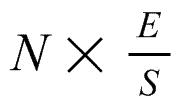
; and
(b)for the purposes of section 51(1) of this Act, deduct the sum equal to—
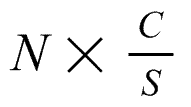
.
(4)In subsections (2) and (3) above—
N is the amount of any net earnings in so far as they exceed the sum mentioned in subsection (2)(b) of section 53 of this Act for the number of days mentioned in subsection (2)(a) of that section;
E is the sum which the employer is required to deduct under section 47(1) of this Act;
C is the sum which the employer is required to deduct under section 51(1) of this Act; and
S is the total of E and C.”.
(2)In section 63(5)(b) of that Act (sum payable under conjoined arrestment order including both ordinary debts and current maintenance), for “all the debts were current maintenance” substitute “ the only debts were the current maintenance debts ”.
(3)In Schedule 3 to that Act (disbursement under conjoined arrestment order)—
(a)in paragraph 4, for the words from “priority” to the end substitute “ disbursement shall be in accordance with paragraph 4A below. ”; and
(b)after that paragraph, insert—
Where—
(a)only one of the debts is an ordinary debt, the creditor in that debt shall be paid the sum equal to—
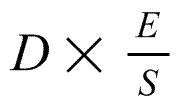
;
(b)more than one of the debts is an ordinary debt, each of the creditors in those debts, out of the sum mentioned in sub-paragraph (a) above, shall be paid the same proportion of the amount of that creditor's debt;
(c)only one of the debts is current maintenance, the creditor in that debt shall be paid the sum equal to—
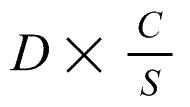
;
(d)more than one of the debts is current maintenance, each of the creditors in those debts, out of the sum mentioned in sub-paragraph (c) above, shall be paid the same proportion of the amount of that creditor's debt,
where—
D is the sum deducted under subsection (5) of section 63 of this Act;
E is the sum deducted under paragraph (a) of that subsection;
C is the sum which would, if the only debts were the current maintenance debts, be deducted under subsection (3) of that section; and
S is the total of E and C.”.
200Arrestment of earnings: deductions from holiday payS
(1)In section 47(1) of the 1987 Act (general effect of earnings arrestment), after “section 49” insert “ or 49A ”.
(2)In section 49(1) of that Act (method of calculating deduction from earnings), at the beginning insert “ Subject to section 49A of this Act, ”.
(3)After section 49 of that Act, insert—
“49ADeductions where net earnings include holiday pay
(1)This section applies where—
(a)the debtor's earnings are paid at regular intervals; and
(b)on one pay-day (in this section, the “normal pay-day”) there are paid to the debtor both—
(i)earnings normally payable on that pay-day (in this section, “normal earnings”); and
(ii)earnings such as are mentioned in subsection (2) below (in this section, “holiday pay”).
(2)Holiday pay is earnings which—
(a)are paid in respect of a period of annual leave or public holiday; and
(b)would, were they not paid in respect of such leave or holiday, have been paid on a pay-day other than the normal pay-day.
(3)In arriving at the sum to be deducted under section 47 of this Act on the normal pay-day, subsections (4) to (8) below shall apply.
(4)Calculate in accordance with section 49 of this Act the sum, if any, which would be deducted from the normal earnings if the holiday pay had not been paid on the normal pay-day.
(5)Where—
(a)the debtor's normal earnings are payable weekly, monthly or at regular intervals of a whole number of weeks or months; and
(b)all of the holiday pay relates to a whole number of weeks or months,
the sum, if any, to be deducted from the holiday pay shall be the sum arrived at by applying sub-paragraphs (i) to (iii) of section 49(1)(c) of this Act to the holiday pay as if it were the net earnings mentioned in that sub-paragraph (i).
(6)Where the debtor's normal earnings are payable weekly, monthly or at regular intervals of a whole number of weeks or months but part of the holiday pay relates to a whole number of weeks or months and part does not, the sum, if any, to be deducted from the holiday pay shall be the sum arrived at by—
(a)in relation to the part of the holiday pay which relates to a whole number of weeks or months, applying subsection (5) above to that part;
(b)in relation to the part of the holiday pay which does not relate to a whole number of weeks or months, applying paragraphs (a) to (c) of section 49(2) of this Act to that part of the holiday pay as if it were the net earnings mentioned in that paragraph (a); and
(c)aggregating the sums arrived at as mentioned in paragraphs (a) and (b) above.
(7)Where—
(a)the debtor's normal earnings are payable weekly, monthly or at regular intervals of a whole number of weeks or months but none of the holiday relates to such a whole number of weeks or months; or
(b)the debtor's normal earnings are payable at regular intervals other than at intervals to which paragraph (a) above applies,
the sum, if any, to be deducted from the holiday pay shall be arrived at by applying paragraph (b) of subsection (6) above to the holiday pay.
(8)Aggregate—
(a)the deduction, if any, calculated under subsection (4) above; and
(b)the deduction, if any, calculated under subsection (5), (6) or, as the case may be, (7) above.”.
201Provision of debt advice and information packageS
(1)In section 47 of the 1987 Act (general effect of earnings arrestment)—
(a)in subsection (2)(a), after “shall” insert “ , subject to subsection (3) below, ”; and
(b)after subsection (2) insert—
“(3)An earnings arrestment shall not come into effect unless, no earlier than 12 weeks before the date on which the earnings arrestment schedule is served, the creditor has provided the debtor with a debt advice and information package.
(4)In this section and in sections 51(2A) and 60(3A) of this Act, “debt advice and information package” means the debt advice and information package referred to in section 10(5) of the Debt Arrangement and Attachment (Scotland) Act 2002 (asp 17).”.
(2)In section 51 of that Act (general effect of current maintenance arrestment)—
(a)in subsection (2)(a), after “shall” insert “ , subject to subsection (2A) below, ”; and
(b)after subsection (2) insert—
“(2A)A current maintenance arrestment shall not come into effect unless, no earlier than 12 weeks before the date on which the current maintenance arrestment schedule is served, the creditor has provided the debtor with a debt advice and information package.”.
(3)In section 60 of that Act (conjoined arrestment orders), after subsection (3) insert—
“(3A)It shall not be competent to make a conjoined arrestment order unless, no earlier than 12 weeks before the date of the application under subsection (2) above, the creditor has provided the debtor with a debt advice and information package.”.
(4)In section 73(1) of that Act (interpretation), after the definition of “current maintenance” insert—
““debt advice and information package” has the meaning given by section 47(4) of this Act;”.
202Intimation of arrestment scheduleS
(1)Section 70 of the 1987 Act is amended as follows.
(2)In subsection (1), for the words “, if reasonably practicable,” substitute “ take all reasonably practicable steps to ”.
(3)After subsection (4), insert—
“(4A)An employer on whom an earnings arrestment schedule or a current maintenance arrestment schedule is served shall, as soon as is reasonably practicable—
(a)intimate a copy of it to the debtor; and
(b)notify the debtor of—
(i)the date on which the first deduction is made; and
(ii)the sum so deducted.
(4B)An employer on whom a copy of a conjoined arrestment order is served shall, as soon as is reasonably practicable, notify the debtor of the matters mentioned in sub-paragraphs (i) and (ii) of subsection (4A)(b) above.”.
203Provision of informationS
After section 70 of the 1987 Act, insert—
“70AEmployer's duty to provide information
(1)Where an employer receives, in relation to a debtor—
(a)an earnings arrestment schedule;
(b)a current maintenance arrestment schedule; or
(c)a copy of a conjoined arrestment order,
the employer shall, as soon as is reasonably practicable, send to the creditor or, in the case of a conjoined arrestment order, the sheriff clerk, the information mentioned in subsection (3) below.
(2)The employer shall, provided the debt has not been extinguished, send, on or as soon as is reasonably practicable after the dates mentioned in subsection (4) below, to the creditor or, as the case may be, the sheriff clerk the information mentioned in subsection (3) below.
(3)The information referred to in subsection (1) above is—
(a)how the debtor is paid (whether weekly, monthly or otherwise);
(b)the date of the debtor's pay-day next following—
(i)where subsection (1) above applies, receipt of the schedule or order; or
(ii)where subsection (2) above applies, the date mentioned in subsection (4) below;
(c)the sum deducted on that pay-day and the net earnings from which it is so deducted; and
(d)any other information which the Scottish Ministers may, by regulations, prescribe.
(4)The dates referred to in subsection (2) above are—
(a)the later of—
(i)6 April next following receipt of the schedule or order; or
(ii)the day falling 6 months after receiving the schedule or order; and
(b)each 6 April thereafter.
(5)Notwithstanding subsections (1) and (2) above, the employer shall, if the debtor ceases for whatever reason to be employed by the employer, give notice, as soon as is reasonably practicable, to the creditor or, as the case may be, the sheriff clerk—
(a)of that fact; and
(b)in so far as is known to the employer, the name and address of any new employer of the debtor.
(6)Where an employer sends information under subsection (1) or (2) above or gives notice under subsection (5) above, the employer shall, as soon as is reasonably practicable, send a copy of that information or notice to the debtor.
70BFailure to give notice under section 70A(5)
(1)Where an employer fails without reasonable excuse to give notice under section 70A(5) of this Act, the sheriff may, on the application of any creditor, make an order requiring the employer—
(a)to provide such information as is known to the employer as to the debtor's employment after ceasing to be employed by that employer;
(b)to pay to the creditor an amount not exceeding twice the sum which the employer would have been required to deduct on the debtor's next pay-day had the debtor still been employed by that employer.
(2)Where a sum is paid by virtue of an order under subsection (1)(b) above—
(a)the debt owed by the debtor to the creditor shall be reduced by that sum; and
(b)the employer shall not be entitled to recover that sum from the debtor.
(3)An employer aggrieved by an order under subsection (1) above may, before the expiry of the period of 14 days beginning with the day on which the order is made, appeal, on point of law only, to the sheriff principal, whose decision shall be final.
70CCreditor's duty to provide information
(1)A creditor who is receiving payment from a debtor by virtue of—
(a)an earnings arrestment;
(b)a current maintenance arrestment; or
(c)a conjoined arrestment order,
shall, provided the debt has not been extinguished, send, on or as soon as is reasonably practicable after the dates mentioned in subsection (2) below, to the employer or, in the case of a conjoined arrestment order, the sheriff clerk the information mentioned in subsection (3) below.
(2)The dates referred to in subsection (1) above are—
(a)the later of—
(i)6 April next following service of the schedule of arrestment or, as the case may be, order; or
(ii)the day falling 6 months after the service of the schedule or order; and
(b)each 6 April thereafter.
(3)The information referred to in subsection (1) above is—
(a)the sum owed by the debtor to the creditor;
(b)the amounts received by the creditor by virtue of the arrestment or order; and
(c)the dates of payment of those amounts.
70DDebtor's duty to provide information
Where a debtor ceases to be employed by an employer who is deducting sums under this Part of this Act, the debtor shall give notice to the creditor or, where those sums are being deducted by virtue of a conjoined arrestment order, the sheriff clerk—
(a)of that fact; and
(b)of the name and address of any new employer.”.
204Conjoined arrestment orders: jurisdictionS
In section 73(1) of the 1987 Act (interpretation of Part 3 of that Act), in paragraph (c) of the definition of “sheriff”, for the words from “the” where it second occurs to the end substitute—
“(i)the place where the debtor is principally employed;
(ii)where that place is outside Scotland, any other place where the debtor is employed; or
(iii)where neither sub-paragraph (i) nor sub-paragraph (ii) above applies, the place where the debtor is domiciled.”.
205Arrestment of seamen's wagesS
In section 73 of the 1987 Act (interpretation of Part 3 of that Act), subsections (3)(c) and (4) are repealed.
Part 10 SArrestment in execution and action of furthcoming
206Arrestment in executionS
After section 73 of the 1987 Act, insert—
“Part 3A SArrestment and action of furthcoming
73AArrestment and action of furthcoming to proceed only on decree or document of debt
(1)Arrestment and action of furthcoming or sale shall be competent only in execution of—
(a)subject to subsection (2) below, a decree; or
(b)a document of debt.
(2)Arrestment and action of furthcoming or sale in execution of a summary warrant shall be competent only if—
(a)the debtor has been charged to pay the debt due by virtue of the summary warrant; and
(b)the period for payment specified in the charge has expired without payment being made.
(3)Any rule of law, having effect immediately before the coming into force of this section, as to the decrees or documents on which arrestment and action of furthcoming or sale can proceed shall, in so far as inconsistent with this section, cease to have effect.
(4)In this Part of this Act—
“decree” means—
(a)a decree of the Court of Session, of the High Court of Justiciary or of the sheriff;
(b)a decree of the Court of Teinds;
(c)a summary warrant;
(d)a civil judgment granted outside Scotland by a court, tribunal or arbiter which by virtue of any enactment or rule of law is enforceable in Scotland;
(e)an order or determination which by virtue of any enactment is enforceable as if it were an extract registered decree arbitral bearing a warrant for execution issued by the sheriff;
(f)a warrant granted, in criminal proceedings, for enforcement by civil diligence; or
(g)a liability order within the meaning of section 33(2) of the Child Support Act 1991 (c. 48),
being a decree, warrant, judgment, order or determination which, or an extract of which, authorises arrestment and action of furthcoming or sale; and
“document of debt” means—
(a)a document registered for execution in the Books of Council and Session or the sheriff court books; or
(b)a document or settlement which by virtue of an Order in Council under section 13 of the Civil Jurisdiction and Judgments Act 1982 (c. 27) is enforceable in Scotland,
being a document or settlement which, or an extract of which, authorises arrestment and action of furthcoming or sale.
(5)The Scottish Ministers may, by order, modify the definitions of “decree” and “document of debt” in subsection (4) above so as to—
(a)add or remove types of decree or document to or, as the case may be, from those referred to in that provision; or
(b)vary any of the descriptions of the types of decree or document there referred to.
73BSchedule of arrestment to be in prescribed form
(1)This section applies where a creditor arrests in execution of —
(a)a decree and the creditor has not executed an arrestment on the dependence of the action; or
(b)a document of debt.
(2)The schedule of arrestment used in executing the arrestment shall be in (or as nearly as may be in) the form prescribed by the Scottish Ministers by regulations.
73CArrestment on the dependence followed by decree
(1)This section applies where a creditor obtains a decree (in this Part of this Act referred to as a “final decree”) in an action on the dependence of which the creditor has executed an arrestment.
(2)The creditor shall, as soon as reasonably practicable, serve a copy of that final decree, in (or as nearly as may be in) the form prescribed by Act of Sederunt, on the arrestee.
73DDebt advice and information
(1)This section applies where—
(a)a creditor—
(i)obtains a final decree in an action on the dependence of which the creditor has executed an arrestment; or
(ii)arrests in execution of a decree or document of debt; and
(b)the debtor is an individual.
(2)The creditor shall, during the period of 48 hours beginning with the time at which the copy of the final decree is served under section 73C(2) of this Act or, as the case may be, the time at which the schedule of arrestment is served, provide the debtor with a debt advice and information package.
(3)Where the creditor fails to comply with subsection (2) above, the arrestment shall cease to have effect or, as the case may be, shall be incompetent.
(4)In this section, “debt advice and information package” has the meaning given by section 47(4) of this Act.
73EFunds attached
(1)Subsections (2) to (5) below apply—
(a)where a creditor arrests in execution of —
(i)a decree and the creditor has not executed an arrestment on the dependence of the action; or
(ii)a document of debt; and
(b)only to the extent that the arrestee holds funds due to the debtor the value of which, at the time the arrestment is executed, is or can be ascertained (whether or not that arrestee also holds other moveable property of the debtor).
(2)Subject to subsection (4) below and to section 73F of this Act, the funds mentioned in subsection (1)(b) above attached by the arrestment shall be the lesser of—
(a)the sum due by the arrestee to the debtor; or
(b)the aggregate of—
(i)the principal sum, in relation to which the decree or document is executed, owed by the debtor to the creditor;
(ii)any judicial expenses chargeable against the debtor by virtue of the decree;
(iii)the expenses of executing the arrestment;
(iv)interest on the principal sum up to and including the date of service of the schedule of arrestment;
(v)the interest on the principal sum which would be accrued in the period of 1 year beginning with the day after the date mentioned in sub-paragraph (iv) above;
(vi)any interest on the expenses of executing the arrestment which is chargeable against the debtor; and
(vii)any sum prescribed under subsection (3) below.
(3)The Scottish Ministers may, by regulations, prescribe a sum which appears to them to be reasonable having regard to the average expenses likely to be incurred and chargeable against a debtor in a typical action of furthcoming.
(4)Where—
(a)the arrestee holds both funds due to and other moveable property of the debtor; and
(b)the sum mentioned in paragraph (b) of subsection (2) above exceeds the sum mentioned in paragraph (a) of that subsection,
the arrestment shall, in addition to the funds equal to the sum mentioned in that paragraph (a), attach the whole moveable property so held.
(5)Except as provided for in subsection (4) above, an arrestment to which this section applies shall not attach any moveable property of the debtor other than the sum attached under subsection (2) above.
(6)Where, in a case to which subsections (2) to (5) above apply—
(a)in addition to the funds mentioned in subsection (1)(b) above, the arrestee holds funds due to the debtor the value of which is not or cannot be ascertained; and
(b)the sum mentioned in paragraph (a) of subsection (2) above exceeds the sum mentioned in paragraph (b) of that subsection,
the arrestment shall not attach any of the funds mentioned in paragraph (a) above.
73FProtection of minimum balance in certain bank accounts
(1)Subject to subsection (2) below, this section applies where—
(a)a creditor arrests—
(i)in pursuance of a warrant granted for diligence on the dependence of an action; or
(ii)in execution of a decree or document of debt;
(b)the arrestment attaches funds standing to the credit of a debtor in an account held by a bank or other financial institution; and
(c)the debtor is an individual.
(2)This section does not apply where the account is—
(a)held in the name of a company, a limited liability partnership, a partnership or an unincorporated association; or
(b)operated by the debtor as a trading account.
(3)The arrestment shall—
(a)in a case where the sum standing to the credit of the debtor exceeds the sum mentioned in subsection (4) below, attach only the balance above that sum; and
(b)in any other case, attach no funds.
(4)The sum referred to in subsection (3)(a) above is the sum first mentioned in column 1 of Table B in Schedule 2 to this Act (being the sum representing the net monthly earnings from which no deduction would be made under an earnings arrestment were such an arrestment in effect).
(5)In subsection (1) above, “bank or other financial institution” means—
(a)the Bank of England;
(b)a person who has permission under Part 4 of the Financial Services and Markets Act 2000 (c. 8) to accept deposits;
(c)an EEA firm of the kind mentioned in paragraph 5(b) of Schedule 3 to that Act which has permission under paragraph 15 of that schedule (as a result of qualifying for authorisation under paragraph 12 of that schedule) to accept deposits; or
(d)a person who is exempt from the general prohibition in respect of accepting deposits as a result of an exemption order made under section 38(1) of that Act,
and the expressions in this definition shall be read with section 22 of that Act, any relevant order made under that section and Schedule 2 to that Act.
(6)The Scottish Ministers may, by regulations—
(a)modify subsection (2) above so as to—
(i)add or remove types of account to or, as the case may be, from those referred to in that paragraph; or
(ii)vary any of the descriptions of the types of account there referred to; and
(b)modify the definition of “bank or other financial institution” in subsection (5) above so as to—
(i)add or remove types of financial institution to or, as the case may be, from those referred to in that provision; or
(ii)vary any of the descriptions of the types of institution there referred to.
73GArrestee's duty of disclosure
(1)This section applies where a creditor arrests—
(a)in pursuance of a warrant granted for diligence on the dependence of an action; or
(b)in execution of a decree or document of debt.
(2)The arrestee shall, before the expiry of the period mentioned in subsection (3) below, send to the creditor in (or as nearly as may be in) the form prescribed by the Scottish Ministers by regulations, the information mentioned in subsection (4) below.
(3)The period referred to in subsection (2) above is the period of 3 weeks beginning with the day on which the arrestment is executed.
(4)The information referred to in subsection (2) above is—
(a)where any property, other than funds due to the debtor, is attached—
(i)the nature of that property; and
(ii)the value of it in so far as known to the arrestee; and
(b)where any such funds are attached, the nature and value of those funds.
(5)The arrestee shall, at the same time as sending, under subsection (2) above, the information to the creditor, send a copy of it to—
(a)the debtor; and
(b)in so far as known to the arrestee, any person—
(i)who owns or claims to own attached property; or
(ii)to whom attached funds are or are claimed to be due,
solely or in common with the debtor.
73HFailure to disclose information
(1)Where an arrestee fails without reasonable excuse to send the prescribed form under section 73G(2) of this Act, the sheriff may, on the application of the creditor, make an order requiring the arrestee to pay to the creditor—
(a)the sum due to the creditor by the debtor; or
(b)the sum mentioned in section 73F(4) of this Act,
whichever is the lesser.
(2)Where the arrestee fails to send the prescribed form in relation to an arrestment on the dependence of an action, the sheriff—
(a)may not make an order under subsection (1) above until the creditor has served a copy of the final decree under section 73C(2) above; and
(b)may deal with the failure as a contempt of court.
(3)Where a sum is paid by virtue of an order under subsection (1) above—
(a)the debt owed by the debtor to the creditor shall be reduced by that sum; and
(b)the arrestee shall not be entitled to recover that sum from the debtor.
(4)An arrestee aggrieved by an order under subsection (1) above may, before the expiry of the period of 2 weeks beginning with the day on which the order is made, appeal, on point of law only, to the sheriff principal, whose decision shall be final.
73JAutomatic release of arrested funds
(1)This section applies where—
(a)a creditor—
(i)obtains a final decree in an action on the dependence of which the creditor has executed an arrestment; or
(ii)arrests in execution of a decree or document of debt; and
(b)the arrestment attaches funds which are due to the debtor (whether or not it also attaches other moveable property of the debtor).
(2)Subject to section 73L of this Act, the arrestee—
(a)shall, on the expiry of the period mentioned in subsection (3) below, release to the creditor, from the attached funds, a sum calculated in accordance with section 73K of this Act; and
(b)may, where a mandate authorises the arrestee to do so, release that sum before the expiry of that period.
(3)The period referred to in subsection (2) above is the period of 14 weeks beginning with the date of service of a copy of the final decree under section 73C(2) of this Act or, as the case may be, the date of service of the schedule of arrestment.
(4)In this section and in sections 73K to 73P of this Act, references to funds or sums due to or by any person do not include references to funds or sums due in respect of future or contingent debts.
73KSum released under section 73J(2)
The sum released under section 73J(2) of this Act is the lowest of—
(a)the sum attached by the arrestment;
(b)the sum due by the arrestee to the debtor; or
(c)the aggregate of—
(i)the principal sum, in relation to which the decree or document is executed or, as the case may be, which is decerned for in the final decree, owed by the debtor to the creditor;
(ii)any judicial expenses chargeable against the debtor by virtue of the decree or final decree;
(iii)the expenses of executing the arrestment;
(iv)interest on the principal sum up to and including the date of service of the schedule of arrestment or, as the case may be, the date of the final decree;
(v)the interest on the principal sum which would be accrued in the period beginning with the day after the date mentioned in sub-paragraph (iv) above and ending on the day on which the funds are released under section 73J(2) of this Act; and
(vi)any interest on the expenses of executing the arrestment which is chargeable against the debtor.
73LCircumstances preventing automatic release
(1)No funds may be released under section 73J(2) of this Act where—
(a)a person mentioned in subsection (2) below applies, by notice of objection, to the sheriff under section 73M(1) of this Act;
(b)the debtor applies to the sheriff under section 73Q(2) of this Act;
(c)an action of multiplepoinding is raised in relation to the funds attached by the arrestment; or
(d)the arrestment is—
(i)recalled;
(ii)restricted; or
(iii)otherwise ceases to have effect.
(2)The persons referred to in subsection (1)(a) above are—
(a)the debtor;
(b)the arrestee; and
(c)any other person to whom the funds are due solely or in common with the debtor (in this section and in sections 73M and 73N of this Act, the “third party”).
73MNotice of objection
(1)Where section 73J of this Act applies—
(a)the debtor;
(b)the arrestee; or
(c)a third party,
may, by notice of objection, apply to the sheriff for an order recalling or restricting the arrestment.
(2)The notice of objection referred to in subsection (1) above shall—
(a)be in (or as nearly as may be in) the form prescribed by Act of Sederunt;
(b)be given to the persons mentioned in subsection (3) below before the expiry of the period of 4 weeks beginning with the date of service of a copy of the final decree under section 73C(2) of this Act or, as the case may be, the date of service of the schedule of arrestment; and
(c)specify one or more of the grounds of objection mentioned in subsection (4) below.
(3)The persons referred to in subsection (2)(b) above are—
(a)the creditor;
(b)the sheriff clerk;
(c)the debtor or, as the case may be, the arrestee; and
(d)in so far as known to the person objecting, any third party.
(4)The grounds of objection referred to in subsection (2)(c) above are—
(a)the warrant in execution of which the arrestment was executed is invalid;
(b)the arrestment has been executed incompetently or irregularly;
(c)the funds attached are due to the third party solely or in common with the debtor.
(5)Where a person applies by notice of objection under subsection (1) above, that person may not, subject to subsection (6) below, raise—
(a)an action of multiplepoinding; or
(b)subject to subsection (7) below, any other proceedings,
in relation to the funds attached.
(6)Subsection (5) above is without prejudice to the right of the person—
(a)to enter any such action or proceedings raised by any other person; and
(b)to raise such an action or proceedings where the sheriff makes, under section 73N(5) of this Act, an order sisting the proceedings on the objection.
(7)A debtor who applies by notice of objection under subsection (1) above may apply to the sheriff under section 73Q(2) of this Act and, in such a case, the sheriff may deal with both applications at one hearing.
73NHearings following notice of objection
(1)Subject to subsection (5) below, before the expiry of the period of 8 weeks beginning with the day on which an application by notice of objection is made under section 73M(1) of this Act, the sheriff shall hold a hearing to determine the objection.
(2)At the hearing under subsection (1) above, the sheriff shall not make any order without first giving—
(a)the creditor;
(b)the arrestee;
(c)the debtor; and
(d)any third party,
an opportunity to be heard.
(3)Where the sheriff upholds the objection, the sheriff may make an order recalling or restricting the arrestment.
(4)Where the sheriff rejects the objection, the sheriff may make an order requiring a sum determined in the order to be released to the creditor—
(a)in a case where the period mentioned in section 73J(3) of this Act has not expired, on the expiry of that period; or
(b)in any other case, as soon as reasonably practicable after the date on which the order is made.
(5)Where—
(a)the sheriff is satisfied that it is more appropriate for the matters raised at the hearing to be dealt with by—
(i)an action of multiplepoinding; or
(ii)other proceedings,
raised in relation to the funds attached; or
(b)at any time before a decision is made under subsections (3) or (4) above, such an action is or other proceedings are raised,
the sheriff shall make an order sisting the proceedings on the objection.
(6)The sheriff may make such other order as the sheriff thinks fit.
(7)Where the sheriff makes an order under this section, the sheriff shall order the person who objected to intimate that order to such of the persons mentioned in subsection (2) above as the sheriff thinks fit.
(8)A person aggrieved by a decision of the sheriff under this section may, before the expiry of the period of 14 days beginning with the day on which the decision is made, appeal, on point of law only, to the sheriff principal, whose decision shall be final.
73PArrestee not liable for funds released in good faith
Where an arrestee releases funds under section 73J(2) of this Act in good faith but—
(a)the warrant in execution of which the arrestment was executed is invalid; or
(b)the arrestment was incompetently or irregularly executed,
the arrestee is not liable to the debtor or to any other person having an interest in the funds for damages for patrimonial loss caused by the release of funds.
73QApplication for release of property where arrestment unduly harsh
(1)This section applies where—
(a)a creditor—
(i)obtains final decree in an action on the dependence of which the creditor executed an arrestment; or
(ii)arrests in execution of a decree or document of debt; and
(b)the arrestment attaches funds due to or other moveable property of the debtor.
(2)The debtor may apply to the sheriff for an order—
(a)providing that the arrestment ceases to have effect in relation to—
(i)the funds or other property attached; or
(ii)so much of those funds or that property as the sheriff specifies; and
(b)requiring the arrestee to release the funds or property to the debtor.
(3)An application under subsection (2) above shall be—
(a)in (or as nearly as may be in) the form prescribed by Act of Sederunt;
(b)made at any time during which the arrestment has effect; and
(c)intimated to—
(i)the creditor;
(ii)the arrestee; and
(iii)any other person appearing to have an interest.
73RHearing on application under section 73Q for release of property
(1)At the hearing on an application under section 73Q(2) of this Act, the sheriff shall not make any order without first giving—
(a)the creditor;
(b)the arrestee; and
(c)any other person appearing to the court to have an interest,
an opportunity to be heard.
(2)Subject to subsection (3) below, if the sheriff is satisfied that the arrestment is unduly harsh—
(a)to the debtor; or
(b)where the debtor is an individual, to any person such as is mentioned in subsection (4) below,
the sheriff shall make an order such as is mentioned in section 73Q(2) of this Act.
(3)Before making an order under subsection (2) above the sheriff shall have regard to all the circumstances including, in a case where the debtor is an individual and funds are attached—
(a)the source of those funds; and
(b)where the source of those funds is or includes earnings, whether an earnings arrestment, current maintenance arrestment or conjoined arrestment order is in effect in relation to those earnings.
(4)The persons referred to in subsection (2)(b) above are—
(a)a spouse of the debtor;
(b)a person living together with the debtor as husband and wife;
(c)a civil partner of the debtor;
(d)a person living with the debtor in a relationship which has the characteristics of the relationship between a husband and wife except that the person and the debtor are of the same sex;
(e)a child of the debtor under the age of 16 years, including—
(i)a stepchild; and
(ii)any child brought up or treated by the debtor or any person mentioned in paragraph (b), (c) or (d) above as a child of the debtor or, as the case may be, that person.
(5)Where the sheriff refuses to make an order under subsection (2) above, the sheriff may, in a case where funds are attached, make an order requiring a sum determined in the order to be released to the creditor—
(a)in a case where the period mentioned in section 73J(3) of this Act has not expired, on the expiry of that period; or
(b)in any other case, as soon as reasonably practicable after the date on which the order is made.
(6)Where the sheriff makes an order under this section, the sheriff shall order the debtor to intimate that order to the persons mentioned in subsection (1) above.
(7)A person aggrieved by a decision of the sheriff under this section may, before the expiry of the period of 14 days beginning with the day on which the decision is made, appeal, on point of law only, to the sheriff principal, whose decision shall be final.
73SMandate to be in prescribed form
(1)A mandate authorising an arrestee to pay over any funds or hand over other property attached by an arrestment shall be in (or as nearly as may be in) the form prescribed by the Scottish Ministers by regulations.
(2)A mandate which is not in (or as nearly as may be in) the prescribed form is invalid.
(3)Where—
(a)a mandate is invalid by virtue of subsection (2) above; but
(b)the arrestee pays over funds or hands over other property in accordance with that mandate,
the arrestee is not liable to the debtor or to any other person having an interest in the funds or property for damages for patrimonial loss caused by paying over the funds or handing over the property provided the arrestee acted in good faith.
73TArrestment of ships etc.
For the avoidance of doubt, this Part of this Act does not apply to the arrestment of a ship, cargo or other maritime property.”.
Commencement Information
I59S. 206 partly in force; s. 206 not in force at Royal Assent see s. 227; s. 206 in force for certain purposes at 1.4.2008 by S.S.I. 2008/115, art. 3(1)(e){(4)}, Sch. 3 (with arts. 4-6, 10); s. 206 in force for certain further purposes at 22.4.2009 by S.S.I. 2009/67, art. 3 (with transitional modifications and savings in arts. 4-6)
Part 11 SMaills and duties, sequestration for rent and landlord's hypothec
Prospective
Abolition of maills and dutiesS
207Abolition of maills and dutiesS
(1)The diligence of maills and duties is abolished and any enactment or rule of law enabling an action of maills and duties to be raised ceases to have effect.
(2)Subsection (1) above does not affect an action of maills and duties brought before this section comes into force.
Landlord's hypothec and sequestration for rentS
208Abolition of sequestration for rent and restriction of landlord's hypothecS
(1)The diligence of sequestration for rent is abolished and any enactment or rule of law enabling an action of sequestration for rent to be raised ceases to have effect.
(2)Notwithstanding that abolition, the landlord's hypothec—
(a)continues, subject to subsections (3) to (9) below, as a right in security over corporeal moveable property kept in or on the subjects let; and—
(b)ranks accordingly in any—
(i)sequestration;
(ii)insolvency proceedings; or
(iii)other process in which there is ranking,
in respect of that property.
(3)The landlord's hypothec no longer arises in relation to property which is kept—
(a)in a dwellinghouse;
(b)on agricultural land; or
(c)on a croft.
(4)It no longer arises in relation to property which is owned by a person other than the tenant.
(5)Property which is acquired by a person from the tenant—
(a)in good faith; or
(b)where the property is acquired after an interdict prohibiting the tenant from disposing of or removing items secured by the hypothec has been granted in favour the landlord, in good faith and for value,
ceases to be subject to the hypothec upon acquisition by the person.
(6)Subsection (5)(b) above does not affect the tenant's liability for breach of the interdict.
(7)Where property is owned in common by the tenant and a third party, any right of hypothec arises only to the extent of the tenant's interest in that property.
(8)The landlord's hypothec—
(a)is security for rent due and unpaid only; and
(b)subsists for so long as that rent remains unpaid.
(9)Any enactment or rule of law relating to the landlord's hypothec ceases to have effect in so far as it is inconsistent with subsections (2) to (8) above.
(10)Subsections (1) to (3), (8) and (9) above do not affect an action of sequestration for rent brought before this section comes into force.
(11)Subsection (3) above does not affect a landlord's right of hypothec which arose before and subsists on the coming into force of this section.
(12)In subsection (2) above, “insolvency proceedings” means—
(a)winding up;
(b)receivership;
(c)administration; and
(d)proceedings in relation to a company voluntary arrangement,
within the meaning of the Insolvency Act 1986 (c. 45).
(13)In subsection (3) above—
“agricultural land” has the same meaning as in section 1(2) of the Agricultural Holdings (Scotland) Act 1991 (c. 55);
“croft” has the same meaning as in section 3(1) of the Crofters (Scotland) Act 1993 (c. 44); and
“dwellinghouse” includes—
(a)a mobile home or other place used as a dwelling; and
(b)any other structure or building used in connection with the dwellinghouse.
Part 12 SSummary warrants, time to pay and charges to pay
209Summary warrants, time to pay and charges to payS
(1)Section 10(4) of the 2002 Act (no charge required for attachment in pursuance of summary warrant) is repealed.
(2)In section 1 of the 1987 Act (time to pay direction)—
(a)subsection (5)(e) (certain debts in relation to which a time to pay direction cannot be granted); and
(b)subsection (9) (interpretation),
are repealed.
(3)In section 5 of the 1987 Act (time to pay order)—
(a)subsection (4)(c) and (e) (certain debts in relation to which a time to pay order cannot be granted); and
(b)subsection (9) (interpretation),
are repealed.
(4)In section 15(3) of the 1987 Act (interpretation)—
(a)in the definition of “decree or document of debt”, after paragraph (a) insert—
“(aa)a summary warrant;”; and
(b)the words “or a summary warrant” are repealed.
(5)In section 90 of the 1987 Act (provisions relating to charges)—
(a)in subsection (1), the words “Subject to subsection (2) below,” and “an attachment or” are repealed;
(b)after subsection (1) insert—
“(1A)The following subsections of this section apply to any case where it is competent to execute diligence only if a charge for payment has been served on the debtor.”;
(c)subsection (2) (no charge required for attachment or earnings arrestment in pursuance of summary warrant) is repealed;
(d)in subsection (5), for “an attachment or an earnings arrestment” substitute “ diligence ”; and
(e)in subsection (6), for “an attachment or an earnings arrestment” substitute “ diligence ”.
210Time to pay directions and time to pay ordersS
(1)The 1987 Act is further amended as follows.
(2)In section 1 (time to pay directions)—
(a)in subsection (1)—
(i)after “Act,” insert “ on an application by the debtor, ”; and
(ii)for the words “may, on an application by the debtor,” substitute “ , shall, if satisfied that it is reasonable in all the circumstances to do so, and having regard in particular to the matters mentioned in subsection (1A) below, ”; and
(b)after subsection (1) insert—
“(1A)The matters referred to in subsection (1) above are—
(a)the nature of and reasons for the debt in relation to which decree is granted;
(b)any action taken by the creditor to assist the debtor in paying that debt;
(c)the debtor's financial position;
(d)the reasonableness of any proposal by the debtor to pay that debt; and
(e)the reasonableness of any refusal by the creditor of, or any objection by the creditor to, any proposal by the debtor to pay that debt.”.
(3)In section 5 (time to pay orders)—
(a)in subsection (2), for the words “may, on an application by the debtor,” substitute “ , on an application by the debtor, shall, if satisfied that it is reasonable in all the circumstances to do so, and having regard in particular to the matters mentioned in subsection (2A) below, ”; and
(b)after subsection (2), insert—
“(2A)The matters referred to in subsection (2) above are—
(a)the nature of and reasons for the debt in relation to which the order is sought;
(b)any action taken by the creditor to assist the debtor in paying that debt;
(c)the debtor's financial position;
(d)the reasonableness of any proposal by the debtor to pay that debt; and
(e)the reasonableness of the objection by the creditor to the offer by the debtor to pay that debt.”.
Part 13 SAmendments of the Debt Arrangement and Attachment (Scotland) Act 2002
211Debt payment programmes with debt reliefS
(1)The 2002 Act is amended as follows.
(2)In section 2 (debt payment programmes)—
(a)after subsection (1) insert—
“(1A)Subsection (1) above is subject to any provision in regulations made under section 7A(1) below.”; and
(b)in subsection (4), after “section 7(1)” insert “ or 7A(1) ”.
(3)After section 7 insert—
“7ADebt payment programmes: power to make provision about debt relief
(1)The Scottish Ministers may, by regulations, make such further provision as they think fit in connection with debt payment programmes for the purposes of—
(a)enabling such programmes to provide for the payment of part only of money owed by debtors; and
(b)on the completion of such programmes or otherwise, enabling any liability of debtors to pay any part of such money owed as is outstanding to be discharged.
(2)The regulations may, in particular, make provision about—
(a)the minimum proportion or percentage of debts which shall be paid under such debt payment programmes;
(b)without prejudice to section 7(2)(h) to (j) above, the consent of creditors for the purposes of section 2(4) above (including the circumstances in which consent by a majority by number or in value shall be sufficient);
(c)the effect of such programmes on debtors' liabilities for interest, fees, penalties and other charges in relation to debts being paid under such programmes;
(d)the effect of such programmes on the rights of creditors to charge interest, fees, penalties or other charges in relation to debts being paid under such programmes;
(e)circumstances in which, on completion of such programmes or otherwise, any liability of debtors to pay—
(i)part of any debts as are outstanding; or
(ii)any interest, fees, penalties or other charges in relation to such debts,
is to be discharged.
(3)Subsections (3) and (4) of section 7 above apply for the purposes of regulations under this section as they apply for the purposes of regulations under subsection (1) of that section.”.
(4)In section 62 (regulations and orders)—
(a)in subsection (3), for “of this Act”, where those words second occur, substitute “ above or regulations made under section 7A above ”; and
(b)in subsection (4), after “section 7 above” insert “ , any regulations made under section 7A above ”.
212Further amendments of the Debt Arrangement and Attachment (Scotland) Act 2002S
(1)The 2002 Act is further amended as follows.
(2)In section 2(3) (form and content of applications for debt payment programmes), the words “shall be signed by the debtor and” are repealed.
(3)In section 3 (application by debtor for approval of debt payment programme), after subsection (2) insert—
“(3)Subsections (1) and (2) above are subject to any contrary provision in regulations made under section 7(1) below.”.
(4)In section 5(4) (form and content of applications for variation of debt payment programmes), paragraph (b) and the word “and” immediately preceding it are repealed.
(5)In section 7(2) (examples of provision that may be made by regulations under section 7(1))—
(a)after paragraph (b) insert—
“(ba)circumstances in which some or all of the functions of a money adviser under section 3 above may instead be carried out by an approved intermediary;
(bb)circumstances in which a debtor is entitled to make an application for the approval, or the variation, of a debt payment programme where the debtor has not obtained advice under section 3(1) above;
(bc)the manner in which—
(i)the seeking of the consent of creditors to applications for approval of debt payment programmes; or
(ii)the making of such applications,
affects the rights and remedies of creditors or other third parties;”;
(b)after paragraph (s) insert—
“(sa)the class of person who may act as an approved intermediary;”; and
(c)after paragraph (u) insert—
“(ua)the functions of an approved intermediary;”.
(6)In section 9(1) (interpretation), before the definition of “money adviser” insert—
““approved intermediary” means any person, not being a money adviser, who has been approved by the Scottish Ministers as a person who may give advice to a debtor for the purposes of section 3(1) above;”.
F156(7). . . . . . . . . . . . . . . . . . . . . . . . . . . . . . . .
(8)In section 19(1) (removal and auction of attached articles), for “The officer who attached articles” substitute “ An officer ”.
(9)After section 19 insert—
“19AUrgent removal of attached articles
(1)The officer may at any time remove an attached article without notice if—
(a)the officer considers it necessary for—
(i)the security; or
(ii)the preservation of the value,
of the article; and
(b)there is insufficient time to obtain an order under section 20(1)(a) below.
(2)The officer shall remove an article under subsection (1) above—
(a)to the nearest convenient premises of the debtor or the person in possession of the articles; or
(b)if—
(i)no such premises are available; or
(ii)the officer considers such premises to be unsuitable,
to the nearest suitable secure premises.
(3)Subsections (2) and (6) of section 19 above shall apply to this section as they apply to that section.”.
(10)In section 20(2)(b) (applications for orders for security etc. of articles), after “officer” insert “—
(i)who attached articles; or
(ii)who is authorised to arrange the auction”.
(11)In section 21(7) (notice of theft of attached articles), after “officer” insert “—
(i)who attached articles; or
(ii)who is authorised to arrange the auction,”.
(12)In section 26(5)(b) (return of removed articles), for “the officer” substitute “ an officer ”.
(13)In section 27(4) (notice of auction), the words “authorised to arrange the auction” are repealed.
(14)In section 31 (disposal of proceeds of auction)—
(a)after subsection (1), insert—
“(1A)Where an article is sold at the auction at a price below the value of the article, the difference between that price and that value shall, prior to the proceeds of the auction being disposed of under subsection (1) above, be credited against the sum recoverable.
(1B)Where—
(a)an article to which subsection (1A) above applies has been damaged and revalued under section 21(10)(b) above;
(b)the damage was not caused by the fault of the debtor; and
(c)no sum has been consigned into court by a third party under section 21(11) above,
the revaluation shall be disregarded for the purposes of subsection (1A) above.”; and
(b)in subsection (4), after “subsections” insert “ (1A), ”.
(15)After section 60 insert—
“60AElectronic signatures
(1)This section applies where—
(a)a report or declaration under this Act requires to be signed; and
(b)provision is made by virtue of this Act or any other enactment permitting the report or declaration to be an electronic communication.
(2)Where the report or declaration is an electronic communication, the requirement is satisfied by a certified electronic signature.
(3)Subsection (2) above is to be read in accordance with section 7(2) and (3) of the Electronic Communications Act 2000 (c. 7) (electronic signatures and certification).”.
(16)In schedule 1 (expenses)—
(a)in paragraph 1, after sub-paragraph (o), insert—
“(oa)in serving notice on the debtor under section 49(1)(b) above;”; and
(b)after that paragraph, insert—
The expenses referred to in sub-paragraphs (i), (j) and (k) of paragraph 1 above shall not be chargeable against the debtor if the articles are removed under section 19A(1) above.”.
Textual Amendments
F156S. 212(7) repealed (31.1.2011) by Public Services Reform (Scotland) Act 2010 (asp 8), s. 134(7), Sch. 4 Pt. 2; S.S.I. 2011/30, art. 3(1)(3), Sch. 1
Commencement Information
I60S. 212 partly in force: s. 212 not in force at Royal Assent see s. 227; s. 212(1) in force for certain purposes and s. 212(2)-(6) in force at 8.3.2007 and s. 212(1) in force for certain purposes and s. 212(8)-(16) in force at 31.3.2007 by S.S.I. 2007/82, arts. 3(b), 4(b)
Part 14 SAdmiralty actions and arrestment of ships
213Admiralty actions and the arrestment of ships: modification of enactmentsS
Schedule 4 makes modifications of enactments relating to admiralty actions and the arrestment of ships.
Commencement Information
I61S. 213 in force at 1.7.2010 by S.S.I. 2010/249, art. 2 (with art. 3)
Part 15 SActions for removing from heritable property
214Expressions used in this PartS
(1)In this Part—
“a decree for removing from heritable property” means—
“an action for removing from heritable property” means, in the case of a decree [F159, order] or warrant, the proceedings in which such a decree [F159, order] or warrant is obtained.
[F160“defender”, in relation to a decree for removing from heritable property of the type mentioned in subsection (2)(l), means any person against whom the decree is enforceable.]
[F161“the First-tier Tribunal” means the First-tier Tribunal for Scotland,]
(2)The decrees [F162, orders] and warrants referred to in subsection (1) above are—
(a)a decree of removing and warrant of ejection obtained in an action of removing;
(b)a decree and warrant of ejection obtained in an action of ejection;
(c)a summary warrant of ejection obtained by virtue of section 36 of the Sheriff Courts (Scotland) Act 1907 (c. 51) (in this section, the “1907 Act”);
(d)a warrant for summary ejection obtained by virtue of section 37 of the 1907 Act;
(e)a decree obtained by virtue of a summary application for removing under section 38 of the 1907 Act;
(f)a decree for recovery of possession of heritable property obtained by virtue of a summary cause under section 35(1)(c) of the Sheriff Courts (Scotland) Act 1971 (c. 58);
(g)an order for possession (within the meaning of section 115(1) of the Rent (Scotland) Act 1984 (c. 58)) obtained by virtue of the Housing (Scotland) Act 1987 (c. 26) or the Housing (Scotland) Act 1988 (c. 43);
(h)a warrant for ejection of a crofter granted under section 22(3) of the Crofters (Scotland) Act 1993 (c. 44);
(i)an order of removal or ejection made under section 84(1)(e) of the Agricultural Holdings (Scotland) Act 2003 (asp 11); F163...
(j)a warrant of ejection obtained by virtue of a summary application under section 38(1) of, or paragraph 3(1) of schedule 5 to, the Housing (Scotland) Act 2006 (asp 1), [F164; F165...
(k)an eviction order issued under section 51 of the Private Housing (Tenancies) (Scotland) Act 2016,][F166; and
(l)a decree of removing and warrant for ejection granted under section 266(8ZA) of the Proceeds of Crime Act 2002.]
being decrees [F162, orders] or warrants which, or extracts of which, authorise the removing or ejection of persons from subjects or premises.
(3)The documents referred to in subsection (1) above are—
(a)a lease, or an extract of a lease, having, by virtue of section 34 of the 1907 Act, the same force and effect as an extract decree of removing; and
(b)a letter of removal having, by virtue of section 35 of the 1907 Act, the same force and effect as an extract decree of removing.
(4)The Scottish Ministers may by order modify subsections (2) and (3) above by—
(a)adding types of decree, warrant or document to;
(b)removing types of decree, warrant or document from; or
(c)varying the description of,
the types of decree, warrant or document referred to in those subsections.
Textual Amendments
F157Word in s. 214(1) inserted (6.3.2019) by The First-tier Tribunal for Scotland Housing and Property Chamber (Incidental Provisions) Regulations 2019 (S.S.I. 2019/51), regs. 1, 6(2)(a)(i)
F158Word in s. 214(1) omitted (27.4.2017 for specified purposes, 31.10.2017 for specified purposes, 31.1.2018 in so far as not already in force) by virtue of Criminal Finances Act 2017 (c. 22), s. 58(5)(6), Sch. 5 para. 91(2)(a); S.I. 2017/991, reg. 2(y); S.I. 2018/78, reg. 5(1)(f)
F159Word in s. 214(1) inserted (6.3.2019) by The First-tier Tribunal for Scotland Housing and Property Chamber (Incidental Provisions) Regulations 2019 (S.S.I. 2019/51), regs. 1, 6(2)(a)(ii)
F160Words in s. 214(1) inserted (27.4.2017 for specified purposes, 31.10.2017 for specified purposes, 31.1.2018 in so far as not already in force) by Criminal Finances Act 2017 (c. 22), s. 58(5)(6), Sch. 5 para. 91(2)(b); S.I. 2017/991, reg. 2(y); S.I. 2018/78, reg. 5(1)(f)
F161Words in s. 214(1) inserted (6.3.2019) by The First-tier Tribunal for Scotland Housing and Property Chamber (Incidental Provisions) Regulations 2019 (S.S.I. 2019/51), regs. 1, 6(2)(a)(iii)
F162Word in s. 214(2) inserted (6.3.2019) by The First-tier Tribunal for Scotland Housing and Property Chamber (Incidental Provisions) Regulations 2019 (S.S.I. 2019/51), regs. 1, 6(2)(b)
F163Word in s. 214(2)(i) repealed (1.12.2017) by Private Housing (Tenancies) (Scotland) Act 2016 (asp 19), s. 79(2), sch. 4 para. 10(2)(a); S.S.I. 2017/346, reg. 2, sch.
F164S. 214(2)(k) and word inserted (1.12.2017) by Private Housing (Tenancies) (Scotland) Act 2016 (asp 19), s. 79(2), sch. 4 para. 10(2)(b); S.S.I. 2017/346, reg. 2, sch.
F165Word in s. 214(2)(j) omitted (31.1.2018) by virtue of Criminal Finances Act 2017 (c. 22), s. 58(5)(6), Sch. 5 para. 91(3)(a); S.I. 2018/78, reg. 5(1)(f)
F166S. 214(2)(l) and word inserted (27.4.2017 for specified purposes, 31.10.2017 for specified purposes, 31.1.2018 in so far as not already in force) by Criminal Finances Act 2017 (c. 22), s. 58(5)(6), Sch. 5 para. 91(3)(b); S.I. 2017/991, reg. 2(y); S.I. 2018/78, reg. 5(1)(f)
Commencement Information
I62S. 214 partly in force; s. 214 not in force at Royal Assent see s. 227; s. 214(4) in force for certain purposes at 1.4.2008 by S.S.I. 2008/115, art. 3(4), Sch. 3 (with arts. 4-6, 10)
I63S. 214(1)-(3) in force at 4.4.2011 by S.S.I. 2011/179, art. 3(a) (with art. 4)
I64S. 214(4) in force at 4.4.2011 in so far as not already in force by S.S.I. 2011/179, art. 3(a) (with art. 4)
215Procedure for execution of removingS
The procedure and practice to be followed in the execution of any decree for removing from heritable property may be regulated and prescribed by Act of Sederunt [F167or by rules made under section 68 or paragraph 4 of schedule 9 of the Tribunals (Scotland) Act 2014] and, without prejudice to that generality, such Act [F168or rules] may, in particular—
(a)prescribe the form of any notices or certificates to be used in or for the purposes of any such execution; and
(b)prescribe the procedure for removal from subjects or premises of any property in or on those subjects or premises.
Textual Amendments
F167Words in s. 215 inserted (6.3.2019) by The First-tier Tribunal for Scotland Housing and Property Chamber (Incidental Provisions) Regulations 2019 (S.S.I. 2019/51), regs. 1, 6(3)(a)
F168Words in s. 215 inserted (6.3.2019) by The First-tier Tribunal for Scotland Housing and Property Chamber (Incidental Provisions) Regulations 2019 (S.S.I. 2019/51), regs. 1, 6(3)(b)
Commencement Information
I65S. 215 partly in force; s. 215 not in force at Royal Assent see s. 227; s. 215 in force for certain purposes at 1.4.2008 by S.S.I. 2008/115, art. 3(4), Sch. 3 (with arts. 4-6, 10)
I66S. 215 in force at 4.4.2011 in so far as not already in force by S.S.I. 2011/179, art. 3(a) (with art. 4)
216Service of charge before removingS
(1)A defender and any effects of the defender may, by virtue of a decree for removing from heritable property, be removed from subjects or premises but only if—
(a)the defender has been charged to remove from those subjects or premises within [F169the appropriate period] after the giving of the charge; and
(b)the period of charge has expired without the defender so removing.
[F170(1A)In subsection (1)(a), “the appropriate period” means—
(a)in the case of a decree for removing from heritable property of the type mentioned in paragraph (l) of section 214(2), 28 days,
(b)in the case of a decree for removing from heritable property of the type mentioned in any other paragraph of that section, 14 days.]
(2)Where—
(a)the subjects or premises are occupied by an occupant deriving right or having permission from the defender;
(b)the defender has been charged, under subsection (1) above, to remove from those subjects or premises; and
(c)the period of charge has expired without the occupant so removing,
that occupant and any effects of that occupant may be removed from the subjects or premises.
[F171(2A)Subsection (2) does not apply to an occupant with an assured tenancy [F172or private residential tenancy] F173... or any effects of that occupant where the decree for removing from heritable property was granted on an application—
(a)to which section 5A of the Heritable Securities (Scotland) Act 1894 (c.44) applies; or
(b)under section 24(1B) of the Conveyancing and Feudal Reform (Scotland) Act 1970 (c.35).]
[F174(2B)In subsection (2A)—
“assured tenancy” has the same meaning as in Part 2 of the Housing (Scotland) Act 1988,
“private residential tenancy” has the same meaning as in the Private Housing (Tenancies) (Scotland) Act 2016.]
(3)The [F175officer of court] removing the defender, any other occupant and any effects of such a defender or occupant from the subjects or premises—
(a)may, if necessary for the purposes of such removing, open shut and lockfast places; and
(b)must make an inventory of any effects removed.
(4)Where the decree [F176or order] for removing from heritable property is granted by a court [F177or the First-tier Tribunal], the court [F177or the First-tier Tribunal] may, on cause shown, dispense with or vary the period of charge.
(5)It is no longer necessary to obtain from the Court of Session letters of ejection before removing a person by virtue of subsection (1) or (2) above.
(6)The Scottish Ministers may, by regulations, prescribe the form of charge under subsection (1) above.
Textual Amendments
F169Words in s. 216(1)(a) substituted (27.4.2017 for specified purposes, 31.1.2018 in so far as not already in force) by Criminal Finances Act 2017 (c. 22), s. 58(5)(6), Sch. 5 para. 92(a); S.I. 2018/78, reg. 5(1)(g)
F170S. 216(1A) inserted (27.4.2017 for specified purposes, 31.1.2018 in so far as not already in force) by Criminal Finances Act 2017 (c. 22), s. 58(5)(6), Sch. 5 para. 92(b); S.I. 2018/78, reg. 5(1)(g)
F171S. 216(2A) inserted (4.4.2011) by Housing (Scotland) Act 2010 (asp 17), ss. 152(3), 166(2); S.S.I. 2011/96, art. 2, Sch.
F172Words in s. 216(2A) inserted (1.12.2017) by Private Housing (Tenancies) (Scotland) Act 2016 (asp 19), s. 79(2), sch. 4 para. 10(3)(a)(i); S.S.I. 2017/346, reg. 2, sch.
F173Words in s. 216(2A) repealed (1.12.2017) by Private Housing (Tenancies) (Scotland) Act 2016 (asp 19), s. 79(2), sch. 4 para. 10(3)(a)(ii); S.S.I. 2017/346, reg. 2, sch.
F174S. 216(2B) inserted (1.12.2017) by Private Housing (Tenancies) (Scotland) Act 2016 (asp 19), s. 79(2), sch. 4 para. 10(3)(b); S.S.I. 2017/346, reg. 2, sch.
F175Words in s. 216(3) substituted (31.1.2011) by Public Services Reform (Scotland) Act 2010 (asp 8), s. 134(7), Sch. 4 para. 24(2); S.S.I. 2011/30, art. 3(1)(3), Sch. 1
F176Words in s. 216(4) inserted (6.3.2019) by The First-tier Tribunal for Scotland Housing and Property Chamber (Incidental Provisions) Regulations 2019 (S.S.I. 2019/51), regs. 1, 6(4)(a)
F177Words in s. 216(4) inserted (6.3.2019) by The First-tier Tribunal for Scotland Housing and Property Chamber (Incidental Provisions) Regulations 2019 (S.S.I. 2019/51), regs. 1, 6(4)(b)
Commencement Information
I67S. 216 partly in force; s. 216 not in force at Royal Assent see s. 227; s. 216(6) in force for certain purposes at 1.4.2008 by S.S.I. 2008/115, art. 3(4), Sch. 3 (with arts. 4-6, 10)
I68S. 216(1)-(5) in force at 4.4.2011 by S.S.I. 2011/179, art. 3(a) (with art. 4)
I69S. 216(6) in force at 4.4.2011 in so far as not already in force by S.S.I. 2011/179, art. 3(a) (with art. 4)
217When removing not competentS
(1)It is not competent to execute a decree for removing from heritable property on—
(a)a Sunday;
(b)a day which is a public holiday in the area in which the decree is to be executed; or
(c)such other day as may be prescribed by Act of Sederunt [F178or by rules made under section 68 or paragraph 4 of schedule 9 of the Tribunals (Scotland) Act 2014].
(2)The execution of such a decree must not—
(a)begin before 8 a.m. or after 8 p.m.; or
(b)be continued after 8 p.m.,
unless the [F179officer of court] has obtained prior authority from the sheriff for the district in which the subjects or premises are situated [F180, or from the First-tier Tribunal,] for such commencement or continuation.
Textual Amendments
F178Words in s. 217(1) inserted (6.3.2019) by The First-tier Tribunal for Scotland Housing and Property Chamber (Incidental Provisions) Regulations 2019 (S.S.I. 2019/51), regs. 1, 6(5)(a)
F179Words in s. 217(2) substituted (31.1.2011) by Public Services Reform (Scotland) Act 2010 (asp 8), s. 134(7), Sch. 4 para. 24(2); S.S.I. 2011/30, art. 3(1)(3), Sch. 1
F180Words in s. 217(2) inserted (6.3.2019) by The First-tier Tribunal for Scotland Housing and Property Chamber (Incidental Provisions) Regulations 2019 (S.S.I. 2019/51), regs. 1, 6(5)(b)
Commencement Information
I70S. 217 partly in force; s. 217 not in force at Royal Assent see s. 227; s. 217(1)(c) in force for certain purposes at 1.4.2008 by S.S.I. 2008/115, art. 3(4), Sch. 3 (with arts. 4-6, 10)
I71S. 217(1)(a)(b)(2) in force at 4.4.2011 by S.S.I. 2011/179, art. 3(a) (with art. 4)
I72S. 217(1)(c) in force at 4.4.2011 in so far as not already in force by S.S.I. 2011/179, art. 3(a) (with art. 4)
218Preservation of property left in premisesS
(1)A court [F181or the First-tier Tribunal], when granting decree for removing from heritable property, may direct that the pursuer takes such steps as the court [F181or the First-tier Tribunal] considers appropriate for the preservation of any effects removed from the subjects or premises.
(2)The court [F181or the First-tier Tribunal] may, when making a direction under subsection (1) above, order that the defender is to be liable for any costs incurred in taking such steps as are specified by virtue of that subsection.
[F182(3)In the application of this section to the granting of a decree for removing from heritable property of the type mentioned in section 214(2)(l), “pursuer” means the trustee for civil recovery who is responsible by virtue of section 267(3)(ba) of the Proceeds of Crime Act 2002 for enforcing the decree.]
Textual Amendments
F181Words in s. 218 inserted (6.3.2019) by The First-tier Tribunal for Scotland Housing and Property Chamber (Incidental Provisions) Regulations 2019 (S.S.I. 2019/51), regs. 1, 6(6)
F182S. 218(3) inserted (27.4.2017 for specified purposes, 31.1.2018 in so far as not already in force) by Criminal Finances Act 2017 (c. 22), s. 58(5)(6), Sch. 5 para. 93; S.I. 2018/78, reg. 5(1)(g)
Commencement Information
I73S. 218 in force at 4.4.2011 by S.S.I. 2011/179, art. 3(a) (with art. 4)
219Caution for pecuniary claimsS
(1)In an action for removing from heritable property, the court may, on cause shown, order the defender to find caution for any payment claimed (other than by way of expenses) by the pursuer for loss arising from the occupation of the subjects or premises by the defender or any other occupant deriving right or having permission from the defender.
(2)Notwithstanding subsection (1) above, it is no longer competent to order a defender to find caution for violent profits.
(3)Where an order is made under subsection (1) above, the defender may provide caution—
(a)by means of a bond of caution or other guarantee; or
(b)by consigning an appropriate sum in court.
(4)For the avoidance of doubt, the loss referred to in subsection (1) above includes loss arising from the lawful occupation of the subjects or premises by the defender or such other occupant.
Commencement Information
I74S. 219 in force at 4.4.2011 by S.S.I. 2011/179, art. 3(a) (with art. 4)
Part 16 SDisclosure of information
220Information disclosureS
(1)The Scottish Ministers may, by regulations, make provision for—
(a)the obtaining, on the application to the sheriff by creditors, by the sheriff of information about debtors; and
(b)the disclosure of that information to creditors to facilitate diligence to enforce payment of debts due by virtue of decrees and documents of debt.
(2)Regulations under subsection (1) above may, in particular—
(a)provide about applications by the creditor;
(b)prescribe persons who may make an application on the creditor's behalf;
(c)provide about the functions of the sheriff on such applications;
(d)prescribe the information about the debtor which may be obtained;
(e)prescribe the persons from whom such information may be required;
(f)provide about the consequences (if any) of such a prescribed person failing to disclose information when required to do so;
(g)provide about the disclosure of information obtained by the sheriff to—
(i)the creditor; and
(ii)such other persons as the regulations may prescribe;
(h)provide for unauthorised use or disclosure of such information to be an offence; and
(i)make such other provision as the Scottish Ministers think fit.
(3)Regulations under subsection (1) above may not prescribe the debtor as a person from whom information may be required.
(4)A person who commits an offence under regulations made under subsection (1) above is liable to such penalties, not exceeding the penalties mentioned in subsection (5) below, as are provided for in the regulations.
(5)Those penalties are—
(a)on summary conviction, imprisonment for a term not exceeding 12 months or a fine not exceeding the statutory maximum or both;
(b)on conviction on indictment, imprisonment for a term not exceeding 2 years or a fine or both.
(6)Any provision made under regulations under subsection (1) above does not prejudice any power to disclose or use information (or to order such disclosure or use) that exists under any other enactment or rule of law.
(7)The disclosure or use of information by virtue of regulations under subsection (1) above is not to be taken to breach any restriction on the disclosure or use of such information (however imposed).
(8)The Scottish Ministers may by order modify, for the purposes of this section, the definitions of “decree” and “document of debt” in section 221 of this Act by—
(a)adding types of decree or document to;
(b)removing types of decree or document from; or
(c)varying the description of,
the types of decree or document to which those definitions apply.
Commencement Information
Part 17 SGeneral and miscellaneous
221InterpretationS
In this Act—
the “1985 Act” means the Bankruptcy (Scotland) Act 1985 (c. 66);
the “1987 Act” means the Debtors (Scotland) Act 1987 (c. 18);
the “2002 Act” means the Debt Arrangement and Attachment (Scotland) Act 2002 (asp 17);
F183...
“certified electronic signature” is to be read in accordance with section 7(2) and (3) of the Electronic Communications Act 2000 (c. 7);
F184...
“debt advice and information package” has the meaning given by section 81(8) of this Act;
“decree” means—
(a)a decree of the Court of Session, of the High Court of Justiciary or of the sheriff;
(b)a decree of the Court of Teinds;
(c)a summary warrant;
(d)a civil judgement granted outside Scotland by a court, tribunal or arbiter which, by virtue of any enactment or rule of law, is enforceable in Scotland;
(e)an order or determination which, by virtue of any enactment, is enforceable as if it were an extract registered decree arbitral bearing a warrant for execution granted by the sheriff;
(f)a warrant granted in criminal proceedings for enforcement by civil diligence;
(g)an order under section 114 of the Companies Clauses Consolidation (Scotland) Act 1845 (c. 17);
(h)a determination under section 46 of the Harbours, Docks and Piers Clauses Act 1847 (c. 27); or
(i)a liability order within the meaning of section 33(2) of the Child Support Act 1991 (c. 48);
“document of debt” means—
(a)a document registered for execution in the Books of Council and Session or in the sheriff court books;
(b)a bill protested for non-payment by a notary public; F185...
(c)a document or settlement which, by virtue of an Order in Council made under section 13 of the Civil Jurisdiction and Judgments Act 1982 (c. 27), is enforceable in Scotland;
(d)F186...
(e)[F187a maintenance arrangement (within the meaning of Article 3(e) of the Hague Convention) which is registered in the sheriff court under the Hague Convention;]
“electronic communication” has the meaning given by section 15(1) of the Electronic Communications Act 2000 (c. 7);
[F188“the Hague Convention” means the Convention on the International Recovery of Child Support and other forms of Family Maintenance done at The Hague on 23rd November 2007;
F189...]
F184...
[F190 “ officer of court ” means a messenger-at-arms or a sheriff officer; ]
“professional association” shall be construed in accordance with section 63(1)(a) of this Act.
Textual Amendments
F183Words in s. 221 omitted (31.12.2020) by virtue of The Jurisdiction and Judgments (Family) (Amendment etc.) (EU Exit) Regulations 2019 (S.I. 2019/519), reg. 1(1), Sch. para. 27(a) (with reg. 8) (as amended by S.I. 2020/1574, regs. 1, 5(2)); 2020 c. 1, Sch. 5 para. 1(1)
F184Words in s. 221 repealed (31.1.2011) by Public Services Reform (Scotland) Act 2010 (asp 8), s. 134(7), Sch. 4 Pt. 2; S.S.I. 2011/30, art. 3(1)(3), Sch. 1
F185Word in s. 221 omitted (coming into force in accordance with reg. 1(b) of the amending S.S.I.) by virtue of The International Recovery of Maintenance (Hague Convention 2007) (Scotland) Regulations 2012 (S.S.I. 2012/301), reg. 1(b), Sch. para. 3(2)(b)(i)
F186Words in s. 221 omitted (31.12.2020) by virtue of The Jurisdiction and Judgments (Family) (Amendment etc.) (EU Exit) Regulations 2019 (S.I. 2019/519), reg. 1(1), Sch. para. 27(b) (with reg. 8) (as amended by S.I. 2020/1574, regs. 1, 5(2)); 2020 c. 1, Sch. 5 para. 1(1)
F187Words in s. 221 inserted (coming into force in accordance with reg. 1(b) of the amending S.S.I.) by The International Recovery of Maintenance (Hague Convention 2007) (Scotland) Regulations 2012 (S.S.I. 2012/301), reg. 1(b), Sch. para. 3(2)(b)(ii)
F188Words in s. 221 inserted (coming into force in accordance with reg. 1(b) of the amending S.S.I.) by The International Recovery of Maintenance (Hague Convention 2007) (Scotland) Regulations 2012 (S.S.I. 2012/301), reg. 1(b), Sch. para. 3(2)(c)
F189Words in s. 221 omitted (31.12.2020) by virtue of The Jurisdiction and Judgments (Family) (Amendment etc.) (EU Exit) Regulations 2019 (S.I. 2019/519), reg. 1(1), Sch. para. 27(c) (with reg. 8) (as amended by S.I. 2020/1574, regs. 1, 5(2)); 2020 c. 1, Sch. 5 para. 1(1)
F190Words in s. 221 inserted (31.1.2011) by Public Services Reform (Scotland) Act 2010 (asp 8), s. 134(7), Sch. 4 para. 30; S.S.I. 2011/30, art. 3(1)(3), Sch. 1
Execution of diligence: electronic standard securitiesS
222Registration and execution of electronic standard securitiesS
(1)The Requirements of Writing (Scotland) Act 1995 (c. 7) is amended as follows.
(2)In section 6(1) of that Act (recording and registration of documents), after “subsection (3) below” insert “ and section 6A of this Act ”.
(3)After section 6 of that Act insert—
“6ARegistration for preservation and execution of electronic standard securities
(1)This section applies where an electronic document, which creates a standard security over a real right in land, is presumed under section 3A of this Act to have been authenticated by the granter.
(2)An office copy of the electronic document may be registered for preservation and execution in the Books of Council and Session or in the sheriff court books.
(3)An office copy so registered is to be treated for the purposes of executing any diligence (including, for the avoidance of doubt, for the purposes of sections 1 and 2 of the Writs Execution (Scotland) Act 1877 (c. 40)) as if—
(a)the standard security were created by a document to which section 6(2) of this Act applies; and
(b)the office copy were that document.”.
GeneralS
223Crown applicationS
(1)Subject to subsection (2) below, this Act binds the Crown acting in its capacity as a creditor.
(2)An amendment or other modification by this Act of an enactment binds the Crown to the same extent as the enactment being amended or modified.
224Orders and regulationsS
(1)Any power conferred by this Act on the Scottish Ministers to make orders or regulations is exercisable by statutory instrument.
(2)Any power conferred by this Act on the Scottish Ministers to make orders or regulations—
(a)may be exercised so as to make different provision for different cases or descriptions of case or for different purposes; and
(b)includes power to make such incidental, supplementary, consequential, transitory, transitional or saving provision as the Scottish Ministers think fit.
(3)A statutory instrument containing an order or regulations made under this Act (other than an order under section 227(3) of this Act) is, subject to subsections (4) and (5) below, subject to annulment in pursuance of a resolution of the Scottish Parliament.
(4)No statutory instrument—
(a)containing an order which makes provision such as is mentioned in section 225(2) of this Act; or
(b)containing—
(i)regulations made under section 50(4), 83(3), 92(2) or (3), 97(7)(b) or 98(6) of this Act; or
(ii)the first regulations made under section 220(1) of this Act,
may be made unless a draft of it has been laid before, and approved by a resolution of, the Scottish Parliament.
(5)Subsection (3) above does not apply to a statutory instrument containing further regulations made under section 220(1) of this Act where a draft of it has been laid before, and approved by a resolution of, the Scottish Parliament.
225Ancillary provisionS
(1)The Scottish Ministers may, by order made by statutory instrument, make such incidental, supplemental, consequential, transitory, transitional or saving provision which they consider necessary or expedient for the purposes of this Act or in consequence of any provision made by or under this Act.
(2)An order under subsection (1) above may modify any enactment (including this Act) or instrument.
226Minor and consequential amendments and repealsS
(1)Schedule 5 to this Act, which contains minor amendments and amendments consequential on the provisions of this Act, has effect.
(2)The enactments mentioned in the first column of Part 1 of schedule 6 to this Act are repealed to the extent specified in the second column of that schedule.
(3)The enactment mentioned in the first column of Part 2 of schedule 6 to this Act is revoked to the extent specified in the second column of that schedule.
Commencement Information
I76S. 226 partly in force; s. 226 not in force at Royal Assent see s. 227; s. 226(1) in force for certain purposes at 31.3.2007 by S.S.I. 2007/82, art. 4(c); s. 226(1)(2) in force for certain purposes and s. 226(3) in force at 1.4.2008 by S.S.I. 2008/115, art. 3(1)(h) (with arts. 4-6, 10); s. 226(1)(2) in force for certain further purposes at 22.4.2009 by S.S.I. 2009/67, art. 3 (with transitional modifications and savings in arts. 4-6); s. 226(1) in force for certain further purposes at 23.11.2009 by S.S.I. 2009/369, art. 3 (with transitional modifications in art. 4)
I77S. 226(1) in force at 31.1.2011 for specified purposes by S.S.I. 2011/31, art. 3(h)
I78S. 226(1)(2) in force at 4.4.2011 for specified purposes by S.S.I. 2011/179, art. 3(d) (with art. 4)
227Short title and commencementS
(1)This Act may be cited as the Bankruptcy and Diligence etc. (Scotland) Act 2007.
(2)Section 222 of this Act comes into force on the day after Royal Assent.
(3)The remaining provisions of this Act, except this section and sections 224 and 225, come into force on such day as the Scottish Ministers may, by order, appoint.
(4)Different days may, under subsection (3) above, be appointed for different purposes.
Subordinate Legislation Made
P1S. 227(3) power partly exercised; 8.3.2007 appointed for specified provisions and purposes by {S.S.I. 2007/82}, arts. 3, 4; 19.2.2008 appointed for specified provisions by {S.S.I. 2008/45}, art. 2 (with art. 3); 1.4.2008 appointed for specified provisions and purposes by {S.S.I. 2008/115}, art. 3 (with arts. 4-6, 10) (as amended (23.2.2009) by S.S.I. 2009/67, art. 7); 22.4.2009 appointed for specified provisions and purposes by {S.S.I. 2009/67}, art. 3, Sch. 1, Sch. 2 (with transitional modifications and savings in arts. 4-6); 23.11.2009 appointed for specified provisions and purposes by {S.S.I. 2009/369}, art. 3, Sch. 1 (with transitional modifications in art. 4)
Options/Help
Print Options
PrintThe Whole Act
PrintThe Act without Schedules
You have chosen to open The Whole Act
The Whole Act you have selected contains over 200 provisions and might take some time to download. You may also experience some issues with your browser, such as an alert box that a script is taking a long time to run.
Would you like to continue?
You have chosen to open The Whole Act as a PDF
The Whole Act you have selected contains over 200 provisions and might take some time to download.
Would you like to continue?
You have chosen to open This Act without Schedules only
This Act without Schedules only you have selected contains over 200 provisions and might take some time to download. You may also experience some issues with your browser, such as an alert box that a script is taking a long time to run.
Would you like to continue?
You have chosen to open This Act without Schedules only as a PDF
This Act without Schedules only you have selected contains over 200 provisions and might take some time to download.
Would you like to continue?
You have chosen to open the Whole Act
The Whole Act you have selected contains over 200 provisions and might take some time to download. You may also experience some issues with your browser, such as an alert box that a script is taking a long time to run.
Would you like to continue?
You have chosen to open the Whole Act without Schedules
The Whole Act without Schedules you have selected contains over 200 provisions and might take some time to download. You may also experience some issues with your browser, such as an alert box that a script is taking a long time to run.
Would you like to continue?
You have chosen to open Schedules only
The Schedules you have selected contains over 200 provisions and might take some time to download. You may also experience some issues with your browser, such as an alert box that a script is taking a long time to run.
Would you like to continue?
Legislation is available in different versions:
Latest Available (revised):The latest available updated version of the legislation incorporating changes made by subsequent legislation and applied by our editorial team. Changes we have not yet applied to the text, can be found in the ‘Changes to Legislation’ area.
Original (As Enacted or Made): The original version of the legislation as it stood when it was enacted or made. No changes have been applied to the text.
See additional information alongside the content
Geographical Extent: Indicates the geographical area that this provision applies to. For further information see ‘Frequently Asked Questions’.
Show Timeline of Changes: See how this legislation has or could change over time. Turning this feature on will show extra navigation options to go to these specific points in time. Return to the latest available version by using the controls above in the What Version box.
Opening Options
Different options to open legislation in order to view more content on screen at once
Explanatory Notes
Text created by the Scottish Government to explain what the Act sets out to achieve and to make the Act accessible to readers who are not legally qualified. Explanatory Notes were introduced in 1999 and accompany all Acts of the Scottish Parliament except those which result from Budget Bills.
More Resources
Access essential accompanying documents and information for this legislation item from this tab. Dependent on the legislation item being viewed this may include:
- the original print PDF of the as enacted version that was used for the print copy
- lists of changes made by and/or affecting this legislation item
- confers power and blanket amendment details
- all formats of all associated documents
- correction slips
- links to related legislation and further information resources
Timeline of Changes
This timeline shows the different points in time where a change occurred. The dates will coincide with the earliest date on which the change (e.g an insertion, a repeal or a substitution) that was applied came into force. The first date in the timeline will usually be the earliest date when the provision came into force. In some cases the first date is 01/02/1991 (or for Northern Ireland legislation 01/01/2006). This date is our basedate. No versions before this date are available. For further information see the Editorial Practice Guide and Glossary under Help.
More Resources
Use this menu to access essential accompanying documents and information for this legislation item. Dependent on the legislation item being viewed this may include:
- the original print PDF of the as enacted version that was used for the print copy
- correction slips
Click 'View More' or select 'More Resources' tab for additional information including:
- lists of changes made by and/or affecting this legislation item
- confers power and blanket amendment details
- all formats of all associated documents
- links to related legislation and further information resources
 All content is available under the Open Government Licence v3.0 except where otherwise stated. This site additionally contains content derived from EUR-Lex, reused under the terms of the Commission Decision 2011/833/EU on the reuse of documents from the EU institutions. For more information see the EUR-Lex public statement on re-use.