- Latest available (Revised)
- Original (As enacted)
Domestic Proceedings and Magistrates’ Courts Act 1978
You are here:
- UK Public General Acts
- 1978 c. 22
- Schedules only

What Version
Advanced Features
- Show Geographical Extent(e.g. England, Wales, Scotland and Northern Ireland)
- Show Timeline of Changes
Opening Options
More Resources
Changes over time for: Domestic Proceedings and Magistrates’ Courts Act 1978 (Schedules only)
Changes to legislation:
Domestic Proceedings and Magistrates’ Courts Act 1978 is up to date with all changes known to be in force on or before 28 April 2024. There are changes that may be brought into force at a future date. Changes that have been made appear in the content and are referenced with annotations.

Changes to Legislation
Revised legislation carried on this site may not be fully up to date. Changes and effects are recorded by our editorial team in lists which can be found in the ‘Changes to Legislation’ area. Where those effects have yet to be applied to the text of the legislation by the editorial team they are also listed alongside the legislation in the affected provisions. Use the ‘more’ link to open the changes and effects relevant to the provision you are viewing.
Changes and effects yet to be applied to :
- s. 5(2)(a) amended (temp.) (prosp.) by 1996 c. 56 s. 582(1)(4) Sch. 37 Pt. 2 para. 138 Sch. 40 para. 1
- s. 7(1) repealed in part (prosp.) by 1996 c. 27 s. 18(2) 66(3) Sch. 10
- s. 16-18 repealed (prosp.) by 1996 c. 27 s. 66(3) Sch. 10
- s. 26(2) by 2000 c. 43 Sch. 7 para. 57(a)(b)
- s. 28(1) amended (prosp.) by 1996 c. 27 s. 66(1) Sch. 8 Pt. 1 para. 28
- s. 28(2) 63(3) Sch. 2 para. 38 53 repealed (prosp.) by 1996 c. 27 s. 66(3) Sch. 10
- s. 88 repealed in part by 1999 c. 22 Sch. 15 Pt. 5(1)
Changes and effects yet to be applied to the whole Act associated Parts and Chapters:
Whole provisions yet to be inserted into this Act (including any effects on those provisions):
- s. 1(c)(d) repealed (prosp.) by 1996 c. 27 s. 18(1) 66(3) Sch. 10
SCHEDULES
Section 89.
SCHEDULE 1E+W Transitional Provisions
1E+WThis Act (including the repeals and amendments made by it) shall not have effect in relation to any application made under any enactment repealed or amended by this Act if that application is pending at the time when the provision of this Act which repeals or amends that enactment comes into force.
2E+WAny order made or other thing done under the M1Matrimonial Proceedings (Magistrates’ Courts) Act 1960 which is in force immediately before the coming into force of Part I of this Act shall not be affected by the repeal by this Act of that Act, and the provisions of that Act shall after the coming into force of the said Part I apply in relation to such an order, and to an order made under that Act by virtue of paragraph 1 above, subject to the following modifications—
(a)on a complaint for the revocation of the order the court shall not be bound under section 8 of that Act to revoke the order by reason of an act of adultery committed by the person on whose complaint the order was made;
(b)on a complaint for the variation, revival or revocation of the order, the court, in exercising its powers under the said section 8 in relation to a provision of the order requiring the payment of money, shall have regard to any change in any of the matters to which the court would have been required to have regard when making that order if the order had been made on an application under section 2 of this Act;
[F1(bb)on a complaint after the coming into force of paragraph 27 of Schedule 1 to the Matrimonial and Family Proceedings Act 1984 for the variation, revival or revocation of the order, the court, in exercising its powers under the said section 8 in relation to any provision of the order requiring the payment of money, shall have power to order that payments required to be made for the maintenance of a child of the family shall be made to the child himself.]
(c)where the order contains a provision for the legal custody of a child, the court shall have power, on a complaint made by a grandparent of the child, to vary that order under the said section 8 by the addition to the order of a provision requiring access to the child to be given to that grandparent;
(d)where the court, by virtue of paragraph (c) above, varies the order by the addition of a provision requiring access to a child to be given to a grandparent, the court shall have power to vary or revoke that provision on a complaint made—
(i)by that grandparent, or
(ii)by either party to the marriage in question, or
(iii)where the child is not a child of both the parties to the marriage, by any person who though not a party to the marriage is a parent of the child, or
(iv)where under the order a child is for the time being committed to the legal custody of some person other than one of the parents or a party to the marriage, by the person to whose legal custody the child is committed by the order.
Textual Amendments
F1Sch. 1 para. 2(bb) inserted by Matrimonial and Family Proceedings Act 1984 (c. 42, SIF 49:3), ss. 46(1), 48(3), Sch. 1, para. 27(a)
Marginal Citations
3E+WThe amendment by this Act of any enactment shall not affect the operation of that enactment in relation to any order made or having effect as if made under the M2Matrimonial Proceedings (Magistrates’ Courts) Act 1960 (including an order made under that Act by virtue of paragraph 1 above) or in relation to any decision of a magistrates’ court made on an application for such an order or for the variation, revival or revocation of such an order [F2but as respects enactments amended by this Act in their application in relation to orders made or decisions on applications for orders or for the variation, revival or revocation of orders made or having effect as if made under other Acts those enactments shall apply as amended by this Act].
Textual Amendments
F2Words added by Matrimonial and Family Proceedings Act 1984 (c. 42, SIF 49:3), ss. 46(1), 48(3), Sch. 1 para. 27(b)
Marginal Citations
[F33AE+WAny order for the payment of money in force under the M3Matrimonial Proceedings (Magistrates’ Courts) Act 1960 (including any such order made under that Act by virtue of paragraph 1 above) shall be enforceable as a magistrates’ court maintenance order.]
Textual Amendments
F3Sch. 1 para. 3A inserted by Family Law Reform Act 1987 (c. 42, SIF 49:7), s. 33(1), Sch. 2 para. 72(a)
Marginal Citations
4E+WAny reference in paragraph 1 above to an application made under an enactment repealed by this Act shall be construed as including a reference to an application which is treated as a complaint under section 1 of the M4Matrimonial Proceedings (Magistrates’ Courts) Act 1960 by virtue of section 27 of the M5Maintenance Orders (Reciprocal Enforcement) Act 1972 and any reference in [F4paragraph 2, 3 or 3A] above to an order made under the M6Matrimonial Proceedings (Magistrates’ Courts) Act 1960 shall be construed as including a reference to an order which is made under that Act by virtue of section 28 of the M7Maintenance Orders (Reciprocal Enforcement) Act 1972
Textual Amendments
F4Words substituted by Family Law Reform Act 1987 (c. 42, SIF 49:7), s. 33(1), Sch. 2 para. 72(b)
Marginal Citations
5E+WA provision contained in section 72 . . . F5 of this Act shall not apply in relation to proceedings commenced before the coming into force of that provision.
Textual Amendments
F5Words repealed by Magistrates' Courts Act 1980 (c. 43, SIF 82), s. 154(3), Sch. 9
6, 7.E+W. . . . . . . . . . . . . . . . . . . . . . . . . . . . . . . . F6
Textual Amendments
8E+WA provision of Schedule 2 to this Act which relates to the punishment by way of fine which may be imposed for any offence shall not affect the punishment which may be imposed for an offence which is committed before the date on which that provision comes into force.
Section 89.
X1SCHEDULE 2U.K. Minor and Consequential Amendments
Editorial Information
X1The text of Sch. 2 is in the form in which it was originally enacted: it was not reproduced in Statutes in Force and, except as specified, does not reflect any amendments or repeals which may have been made prior to 1.2.1991.
The Sheriff Courts (Scotland) Act 1907 (c. 51)E+W+S
1E+W+SIn section 5 of the Sheriff Courts (Scotland) Act 1907—
[F7(a)in subsection (2), after the words “Actions of aliment ”, there shall be inserted the words “(other than any action mentioned in sub-section (2A) below) ” ;]
(b)the following subsection shall be inserted after subsection (2)—
“(2A)Actions, arising out of an application under section 31(1) of the Maintenance Orders (Reciprocal Enforcement) Act 1972, for the recovery of maintenance:” ; and
(c)in the final proviso, for the words “the second sub-section ” there shall be substituted the words “sub-section (2) or (2A) ”.
Textual Amendments
F7Sch. 2 para. 1(a) repealed (S.) by Family Law (Scotland) Act 1985 (c. 37, SIF 49:3), ss. 28(2), 29(4), Sch. 2
The Maintenance Orders (Facilities for Enforcement) Act 1920 (c. 33)E+W
F82E+W. . . . . . . . . . . . . . . . . . . . . . . . . . . . . . . .
Textual Amendments
F8Sch. 2 para. 2 repealed (1.4.2005) by Courts Act 2003 (c. 39), s. 110(1), Sch. 10; S.I. 2005/910, art. 3(aa)
3—5.E+W. . . . . . . . . . . . . . . . . . . . . . . . . . . . . . . . F9
Textual Amendments
F9Sch. 2 paras. 3–5, 8 repealed by Child Care Act 1980 (c. 5), s. 89(3), Sch. 6
The National Assistance Act 1948 (c. 29)E+W
F106E+W. . . . . . . . . . . . . . . . . . . . . . . . . . . . . . . .
Textual Amendments
F10Sch. 2 para. 6 repealed (1.4.2005) by Courts Act 2003 (c. 39), s. 110(1), Sch. 10; S.I. 2005/910, art. 3(aa)
7E+WIn section 44(2) of that Act for the words “having jurisdiction in the place ” there shall be substituted the words “appointed for the commission area (within the meaning of section 1 of the Administration of Justice Act 1973). ”
8E+W. . . . . . . . . . . . . . . . . . . . . . . . . . . . . . . . F11
Textual Amendments
F11Sch. 2 paras. 3–5, 8 repealed by Child Care Act 1980 (c. 5), s. 89(3), Sch. 6
The Marriage Act 1949 (c. 76)E+W
F12F139E+W. . . . . . . . . . . . . . . . . . . . . . . . . . . . . . . .
Textual Amendments
F12Sch. 2 para. 9 repealed (1.4.2005) by Courts Act 2003 (c. 39), s. 110(1), Sch. 10; S.I. 2005/910, art. 3(aa)
F13Sch. 2 para. 9 repealed (22.4.2014) by Crime and Courts Act 2013 (c. 22), s. 61(3), Sch. 11 para. 210 Table; S.I. 2014/954, art. 2(e) (with art. 3) (with transitional provisions and savings in S.I. 2014/956, arts. 3-11)
The Justices of the Peace Act 1949 (c. 101)E+W
10E+WIn section 13(4) of the Justices of the Peace Act 1949 after the words “juvenile ” there shall be inserted the words “or domestic ”.
The Maintenance Orders Act 1950 (c. 37.)U.K.
11E+WIn section 3(2) of the Maintenance Orders Act 1950 for the words “having jurisdiction in the place ” there shall be substituted the words “appointed for the commission area (within the meaning of the Administration of Justice Act 1973) ”.
12U.K.In section 15(1)(a) of that Act for sub-paragraph (ii) there shall be substituted the following sub-paragraph—
“(ii)section 24(1) and 30(3) of the Domestic Proceedings and Magistrates’ Courts Act 1978”.
13U.K.In section 16(2)(a) of that Act, for sub-paragraph (ii) there shall be substituted the following sub-paragraph—
“(ii)Part 1 of the Domestic Proceedings and Magistrates’ Courts Act 1978.”
14U.K.In section 22(1) of that Act after the words “person liable to make ”, in the first place where they occur, there shall be inserted the word “periodical ”.
15E+W. . . . . . . . . . . . . . . . . . . . . . . . . . . . . . . . F14
Textual Amendments
The Affiliation Proceedings Act 1957 (c. 55)E+W
16E+WIn section 9(2) of the Affiliation Proceedings Act 1957 for the words “£10 ” there shall be substituted the words “£50 ”.
The Adoption Act 1958 (7 & 8 Eliz. 2 c. 5)E+W+S
[F1517E+W+SIn section 32(2) of the Adoption Act 1958 for the words “subsection (2) ” there shall be substituted the words “subsection (1A) ”.]
Textual Amendments
F15Sch. 2 paras. 17, 18 repealed (S.) by Adoption (Scotland) Act 1978 (c. 28, SIF 49:11), s. 66(3), Sch. 4
[F1618E+W+SIn section 34A(3) of that Act—
(a)for the words “the authority ”, in the first place where those words occur, there shall be substituted the words “a local authority ” ;
(b)after the words “the authority ”, in the second place where those words occur, there shall be inserted the words “in whose care the child is ” ;
(c)for the words “the court ” there shall be substituted the words “a court ”.]
Textual Amendments
F16Sch. 2 paras. 17, 18 repealed (S.) by Adoption (Scotland) Act 1978 (c. 28, SIF 49:11), s. 66(3), Sch. 4
The County Courts Act 1959 (c. 22)E+W
19E+WIn section 109(2) of the County Courts Act 1959—
(a)in paragraph (g) for the words “section 13A of the Matrimonial Proceedings (Magistrates’ Courts) Act 1960 ” there shall be substituted the words “section 35 of the Domestic Proceedings and Magistrates’ Courts Act 1978 ” ;
(b)in paragraph (h) after the words “proceedings under ” there shall be inserted the words “section 34 or 34A of the Adoption Act 1958 ; ”
(c)in paragraph (i) for the words “section 29 ” there shall be substituted the words “section 27, 28, 29 ”.
20E+W. . . . . . . . . . . . . . . . . . . . . . . . . . . . . . . . F17
Textual Amendments
F17Sch. 2 paras. 20, 24 repealed by Child Care Act 1980 (c. 5), s. 89(3), Sch. 6
21E+W. . . . . . . . . . . . . . . . . . . . . . . . . . . . . . . . F18
Textual Amendments
The Health Services and Public Health Act 1968 (c. 46)E+W
F1922E+W. . . . . . . . . . . . . . . . . . . . . . . . . . . . . . . .
Textual Amendments
F19Sch. 2 paras. 22, 23, 27, 29 repealed (14.10.1991) by Children Act 1989 (c. 41, SIF 20), s. 108, Sch.15 (with Sch. 14 paras. 1(1), 27(4)); S.I. 1991/828, art. 3(2)
F2023E+W. . . . . . . . . . . . . . . . . . . . . . . . . . . . . . . .
Textual Amendments
F20Sch. 2 paras. 22, 23, 27, 29 repealed (14.10.1991) by Children Act 1989 (c. 41, SIF 20), s. 108, Sch.15 (with Sch. 14 paras. 1(1), 27(4)); S.I. 1991/828, art. 3(2)
24E+W. . . . . . . . . . . . . . . . . . . . . . . . . . . . . . . . F21
Textual Amendments
F21Sch. 2 paras. 20, 24 repealed by Child Care Act 1980 (c. 5), s. 89(3), Sch. 6
25E+W. . . . . . . . . . . . . . . . . . . . . . . . . . . . . . . . F22
Textual Amendments
The Administration of Justice Act 1970 (c. 31)E+W
26E+WIn Schedule 8 of that Act in paragraph 3 for the words “or having effect as if made under the Matrimonial Proceedings (Magistrates’ Courts) Act 1960 ” there shall be substituted the words “under Part I of the Domestic Proceedings and Magistrates’ Courts Act 1978 ”.
The Local Authority Social Services Act 1970 (c. 42)E+W
F2327E+W. . . . . . . . . . . . . . . . . . . . . . . . . . . . . . . .
Textual Amendments
F23Sch. 2 paras. 22, 23, 27, 29 repealed (14.10.1991) by Children Act 1989 (c. 41, SIF 20), s. 108, Sch. 15 (with Sch. 14 paras. 1(1), 27(4)); S.I. 1991/828, art. 3(2)
The Matrimonial Proceedings and Property Act 1970 (c. 45)E+W
28E+WIn section 30(2) of the Matrimonial Proceedings and Property Act 1970 for the words “Subsections (4), (5) and (6) of section 7 of the Matrimonial Proceedings (Magistrates’ Courts) Act 1960 ” there shall be substituted the words “Section 4(2) of the Domestic Proceedings and Magistrates’ Courts Act 1978 ”, for the words “section 2(1)(b) or (c) ” there shall be substituted the words “section 2(1)(a) ” and for the words “as they apply in relation to such an order as is referred to in the said subsection (4) ” there shall be substituted the words “as it applies in relation to an order made under section 2(1)(a) of the Domestic Proceedings and Magistrates’ Courts Act 1978 ”.
The Guardianship of Minors Act 1971 (c. 3)E+W
F2429E+W. . . . . . . . . . . . . . . . . . . . . . . . . . . . . . . .
Textual Amendments
F24Sch. 2 paras. 22, 23, 27, 29 repealed (14.10.1991) by Children Act 1989 (c. 41, SIF 20), s. 108, Sch.15 (with Sch. 14 paras. 1(1), 27(4)); S.I. 1991/828, art. 3(2)
30E+W. . . . . . . . . . . . . . . . . . . . . . . . . . . . . . . . F25
Textual Amendments
F2631E+W. . . . . . . . . . . . . . . . . . . . . . . . . . . . . . . .
Textual Amendments
F26Sch. 2 paras. 31, 36, 41-43 repealed (14.10.1991) by Children Act 1989 (c. 41, SIF 20), s. 108, Sch. 15 (with Sch. 14 paras. 1(1), 27(4)); S.I. 1991/828, art. 3(2)
The Attachment of Earnings Act 1971 (c. 32)E+W
32E+WIn Schedule 1 to the Attachment of Earnings Act 1971 in paragraph 4 for the words “or having effect as if made under the Matrimonial Proceedings (Magistrates’ Courts) Act 1960 ” there shall be substituted the words “under Part I of the Domestic Proceedings and Magistrates’ Courts Act 1978 ”.
The Maintenance Orders (Reciprocal Enforcement) Act 1972 (c. 18)E+W+N.I.
33E+W+N.I.In section 8(3) of the Maintenance Orders (Reciprocal Enforcement) Act 1972 for the words “£10 ” there shall be substituted the words “£50 ”.
F2734E+W+N.I.. . . . . . . . . . . . . . . . . . . . . . . . . . . . . . . .
Textual Amendments
F27Sch. 2 para. 34 repealed (5.4.1993) by Maintenance Orders (Reciprocal Enforcement) Act 1992 (c. 56), s. 2(2), Sch.3; S.I. 1993/618, art. 2.
F2835E+W. . . . . . . . . . . . . . . . . . . . . . . . . . . . . . . .
Textual Amendments
F28Sch. 2 para. 35 repealed (5.4.1993) by Maintenance Orders (Reciprocal Enforcement) Act 1992 (c. 56), s. 2(2), Sch.3; S.I. 1993/618, art. 2.
F2936E+W. . . . . . . . . . . . . . . . . . . . . . . . . . . . . . . .
Textual Amendments
F29Sch. 2 paras. 31, 36, 41-43 repealed (14.10.1991) by Children Act 1989 (c. 41, SIF 20), s. 108, Sch. 15 (with Sch. 14 paras. 1(1), 27(4)); S.I. 1991/828, art. 3(2)
37E+WIn section 42(1) of that Act for the words “section 2(1)(b) or (c) of the Matrimonial Proceedings (Magistrates’ Courts) Act 1960 (payment of weekly sums by husband or wife) ” there shall be substituted the words “section 2(1)(a) of the Domestic Proceedings and Magistrates’ Courts Act 1978 (making of periodical payments by husband or wife) ”.
The Matrimonial Causes Act 1973 (c. 18)E+W
38E+WIn section 4(1) of the Matrimonial Causes Act 1973 after the words “the Matrimonial Proceedings (Magistrates’ Courts) Act 1960 ” there shall be inserted the words “or Part I of the Domestic Proceedings and Magistrates’ Courts Act 1978 ”.
39E+WIn section 47(2)(e) of that Act for the words “the Matrimonial Proceedngs (Magistrates’ Courts) Act 1960 ” there shall be substituted the words “Part I of the Domestic Proceedings and Magistrates’ Courts Act 1978 ”.
40E+WIn section 50(2)(b) of that Act for the words “the Matrimonial Proceedings (Magistrates’ Courts) Act 1960 ” there shall be substituted the words “Part I of the Domestic Proceedings and Magistrates’ Courts Act 1978 ”.
The Guardianship Act 1973 (c. 29)E+W
F3041E+W. . . . . . . . . . . . . . . . . . . . . . . . . . . . . . . .
Textual Amendments
F30Sch. 2 paras. 31, 36, 41-43 repealed (14.10.1991) by Children Act 1989 (c. 41, SIF 20), s. 108, Sch. 15 (with Sch. 14 paras. 1(1), 27(4)); S.I. 1991/828, art. 3(2)
F3142E+W. . . . . . . . . . . . . . . . . . . . . . . . . . . . . . . .
Textual Amendments
F31Sch. 2 paras. 31, 36, 41-43 repealed (14.10.1991) by Children Act 1989 (c. 41, SIF 20), s. 108, Sch. 15 (with Sch. 14 paras. 1(1), 27(4)); S.I. 1991/828, art. 3(2)
F3243E+W. . . . . . . . . . . . . . . . . . . . . . . . . . . . . . . .
Textual Amendments
F32Sch. 2 paras. 31, 36, 41-43 repealed (14.10.1991) by Children Act 1989 (c. 41, SIF 20), s. 108, Sch. 15 (with Sch. 14 paras. 1(1), 27(4)); S.I. 1991/828, art. 3(2)
44E+W. . . . . . . . . . . . . . . . . . . . . . . . . . . . . . . . F33
Textual Amendments
F33Sch. 2 para. 44 repealed by Family Law Reform Act 1987 (c. 42, SIF 49:7), s. 33(4), Sch. 4 and expressed to be repealed (prosp.) by Children Act 1989 (c. 41, SIF 20), s. 108, Sch. 15 (with Sch. 14 paras. 1(1), 27(4))
45E+W. . . . . . . . . . . . . . . . . . . . . . . . . . . . . . . . F34
Textual Amendments
F34Sch. 2 paras. 45, 52 repealed by Legal Aid Act 1988 (c. 34, SIF 77:1), s. 45, Sch. 6
The Children Act 1975 (c. 72)E+W
F3546E+W. . . . . . . . . . . . . . . . . . . . . . . . . . . . . . . .
Textual Amendments
F35Sch. 2 paras. 46-48, 50 repealed (14.10.1991) by Children Act 1989 (c. 41, SIF 20), s. 108, Sch. 15 (with Sch. 14 paras. 1(1), 27(4)); S.I. 1991/828, art. 3(2)
F3647E+W. . . . . . . . . . . . . . . . . . . . . . . . . . . . . . . .
Textual Amendments
F36Sch. 2 paras. 46-48, 50 repealed (14.10.1991) by Children Act 1989 (c. 41, SIF 20), s. 108, Sch. 15 (with Sch. 14 paras. 1(1), 27(4)); S.I. 1991/828, art. 3(2)
F3748E+W. . . . . . . . . . . . . . . . . . . . . . . . . . . . . . . .
Textual Amendments
F37Sch. 2 paras. 46-48, 50 repealed (14.10.1991) by Children Act 1989 (c. 41, SIF 20), s. 108, Sch. 15 (with Sch. 14 paras. 1(1), 27(4)); S.I. 1991/828, art. 3(2)
49E+W. . . . . . . . . . . . . . . . . . . . . . . . . . . . . . . . F38
Textual Amendments
F38Sch. 2 para. 49 repealed by Matrimonial and Family Proceedings Act 1984 (c. 42, SIF 49:3), ss. 46(3), 48(2), Sch. 3 and repealed (14.10.1991) by Children Act 1989 (c.41, SIF 20), s. 108, Sch.15 (with Sch. 14 paras. 1(1), 27(4)); S.I. 1991/828, art. 3(2)
The Adoption Act 1976 (c. 36)E+W
F3950E+W. . . . . . . . . . . . . . . . . . . . . . . . . . . . . . . .
Textual Amendments
F39Sch. 2 paras. 46-48, 50 repealed (14.10.1991) by Children Act 1989 (c. 41, SIF 20), s. 108, Sch. 15 (with Sch. 14 paras. 1(1), 27(4)); S.I. 1991/828, art. 3(2)
51E+WIn section 63(4) of that Act the words “to remove a child from a person’s custody under section 27 or 28 or ” shall be omitted.
52E+W. . . . . . . . . . . . . . . . . . . . . . . . . . . . . . . . F40
Textual Amendments
F40Sch. 2 paras. 45, 52 repealed by Legal Aid Act 1988 (c. 34, SIF 77:1), s. 45, Sch. 6
The Domestic Violence and Matrimonial Proceedings Act 1976 (c. 50)E+W
F4153E+W. . . . . . . . . . . . . . . . . . . . . . . . . . . . . . . .
Textual Amendments
F41Sch. 2 para. 53 repealed (1.10.1997) by 1996 c. 27, s. 66(3), Sch. 10 (with Sch. 9 paras. 5, 8-10); S.I. 1997/1892, art. 3(d)(ii)
The Supplementary Benefits Act 1976 (c. 71)E+W
54E+WIn section 19(2) of the Supplementary Benefits Act 1976 for the words “acting for the petty sessions area ” there shall be substituted the words “appointed for the commission area (within the meaning of section 1 of the Administration of Justice Act 1973) ”
Section 89.
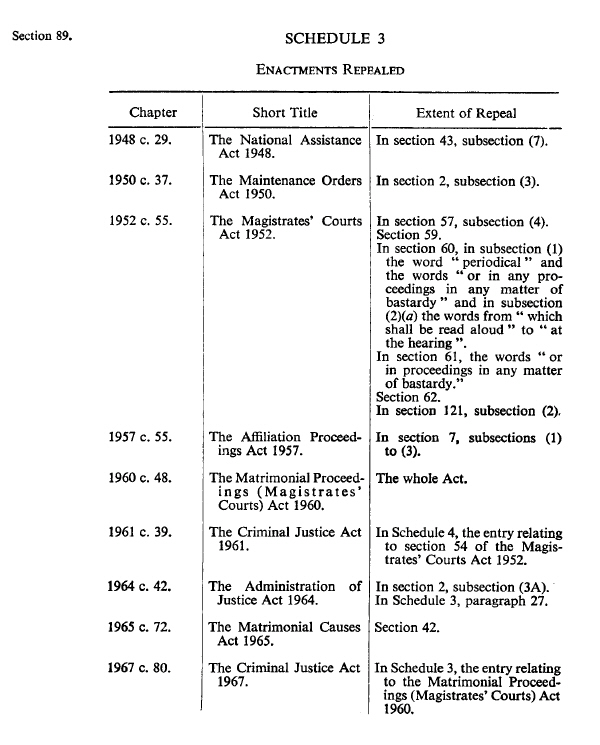
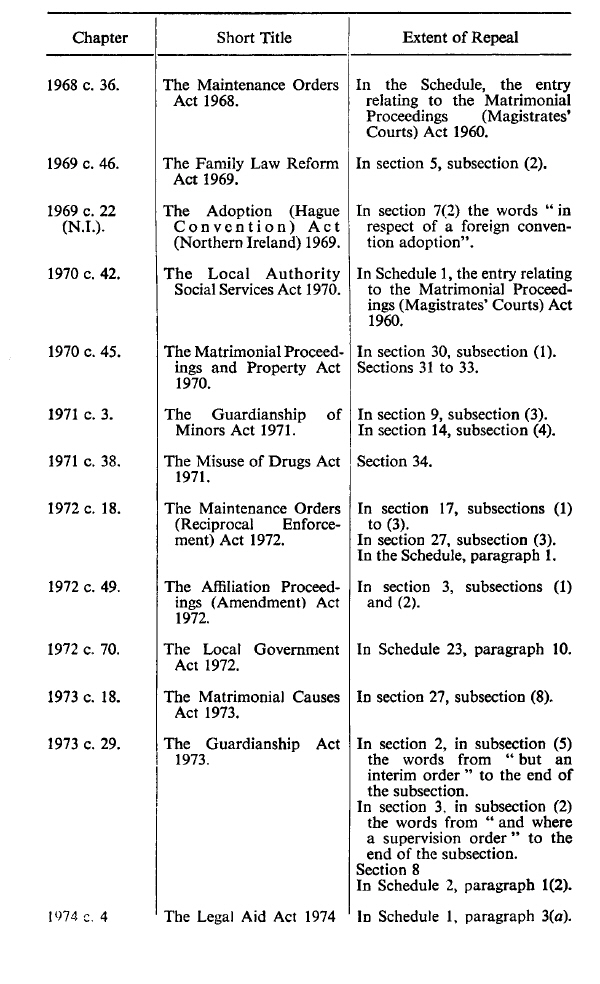
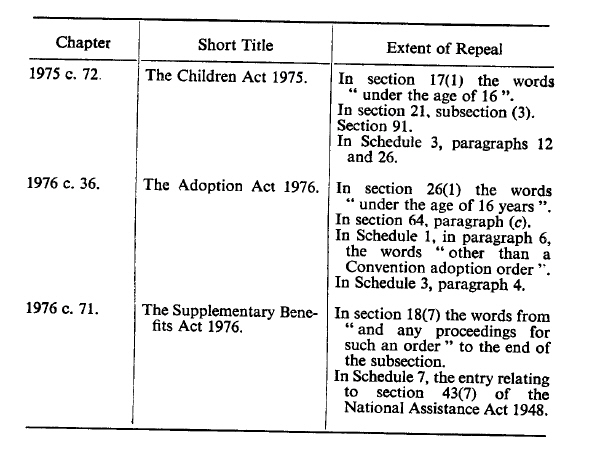
X2SCHEDULE 3E+W+N.I. Enactments Repealed
Editorial Information
X2The text of Sch. 3 is in the form in which it was originally enacted: it was not reproduced in Statutes in Force and does not reflect any amendments or repeals which may have been made prior to 1.2.1991.
Options/Help
Print Options
PrintThe Whole Act
PrintThe Schedules only
Legislation is available in different versions:
Latest Available (revised):The latest available updated version of the legislation incorporating changes made by subsequent legislation and applied by our editorial team. Changes we have not yet applied to the text, can be found in the ‘Changes to Legislation’ area.
Original (As Enacted or Made): The original version of the legislation as it stood when it was enacted or made. No changes have been applied to the text.
See additional information alongside the content
Geographical Extent: Indicates the geographical area that this provision applies to. For further information see ‘Frequently Asked Questions’.
Show Timeline of Changes: See how this legislation has or could change over time. Turning this feature on will show extra navigation options to go to these specific points in time. Return to the latest available version by using the controls above in the What Version box.
Opening Options
Different options to open legislation in order to view more content on screen at once
More Resources
Access essential accompanying documents and information for this legislation item from this tab. Dependent on the legislation item being viewed this may include:
- the original print PDF of the as enacted version that was used for the print copy
- lists of changes made by and/or affecting this legislation item
- confers power and blanket amendment details
- all formats of all associated documents
- correction slips
- links to related legislation and further information resources
Timeline of Changes
This timeline shows the different points in time where a change occurred. The dates will coincide with the earliest date on which the change (e.g an insertion, a repeal or a substitution) that was applied came into force. The first date in the timeline will usually be the earliest date when the provision came into force. In some cases the first date is 01/02/1991 (or for Northern Ireland legislation 01/01/2006). This date is our basedate. No versions before this date are available. For further information see the Editorial Practice Guide and Glossary under Help.
More Resources
Use this menu to access essential accompanying documents and information for this legislation item. Dependent on the legislation item being viewed this may include:
- the original print PDF of the as enacted version that was used for the print copy
- correction slips
Click 'View More' or select 'More Resources' tab for additional information including:
- lists of changes made by and/or affecting this legislation item
- confers power and blanket amendment details
- all formats of all associated documents
- links to related legislation and further information resources
 All content is available under the Open Government Licence v3.0 except where otherwise stated. This site additionally contains content derived from EUR-Lex, reused under the terms of the Commission Decision 2011/833/EU on the reuse of documents from the EU institutions. For more information see the EUR-Lex public statement on re-use.