- Y Diweddaraf sydd Ar Gael (Diwygiedig)
- Gwreiddiol (Fel y’i mabwysiadwyd gan yr UE)
Commission Regulation (EU) 2016/631Dangos y teitl llawn
Commission Regulation (EU) 2016/631 of 14 April 2016 establishing a network code on requirements for grid connection of generators (Text with EEA relevance)
You are here:

Pa Fersiwn
Nodweddion Uwch
- Dangos Graddfa Ddaearyddol(e.e. Lloegr, Cymru, Yr Alban aca Gogledd Iwerddon)
- Dangos Llinell Amser Newidiadau
Dewisiadau Agor
Rhagor o Adnoddau
Deddfwriaeth yn deillio o’r UE
Pan adawodd y DU yr UE, cyhoeddodd legislation.gov.uk ddeddfwriaeth yr UE a gyhoeddwyd gan yr UE hyd at ddiwrnod cwblhau’r cyfnod gweithredu (31 Rhagfyr 2020 11.00 p.m.). Ar legislation.gov.uk, mae'r eitemau hyn o ddeddfwriaeth yn cael eu diweddaru'n gyson ag unrhyw ddiwygiadau a wnaed gan y DU ers hynny.


Mae'r eitem hon o ddeddfwriaeth yn tarddu o'r UE
Mae legislation.gov.uk yn cyhoeddi fersiwn y DU. Mae EUR-Lex yn cyhoeddi fersiwn yr UE. Mae Archif Gwe Ymadael â’r UE yn rhoi cipolwg ar fersiwn EUR-Lex o ddiwrnod cwblhau’r cyfnod gweithredu (31 Rhagfyr 2020 11.00 p.m.).
Changes over time for: CHAPTER 2
Changes to legislation:
There are currently no known outstanding effects by UK legislation for Commission Regulation (EU) 2016/631,
CHAPTER 2
.
Changes to Legislation
Revised legislation carried on this site may not be fully up to date. At the current time any known changes or effects made by subsequent legislation have been applied to the text of the legislation you are viewing by the editorial team. Please see ‘Frequently Asked Questions’ for details regarding the timescales for which new effects are identified and recorded on this site.
CHAPTER 2 U.K. Requirements for synchronous power-generating modules
Article 17U.K.Requirements for type B synchronous power-generating modules
1.Type B synchronous power-generating modules shall fulfil the requirements listed in Articles 13, except for Article 13(2)(b), and 14.
2.Type B synchronous power-generating modules shall fulfil the following additional requirements relating to voltage stability:
(a)with regard to reactive power capability, the relevant system operator shall have the right to specify the capability of a synchronous power-generating module to provide reactive power;
(b)with regard to the voltage control system, a synchronous power-generating module shall be equipped with a permanent automatic excitation control system that can provide constant alternator terminal voltage at a selectable setpoint without instability over the entire operating range of the synchronous power-generating module.
3.With regard to robustness, type B synchronous power-generating modules shall be capable of providing post-fault active power recovery. The relevant TSO shall specify the magnitude and time for active power recovery.
Article 18U.K.Requirements for type C synchronous power-generating modules
1.Type C synchronous power-generating modules shall fulfil the requirements laid down in Articles 13, 14, 15 and 17, except for Article 13(2)(b) and 13(6), Article 14(2) and Article 17(2)(a).
2.Type C synchronous power-generating modules shall fulfil the following additional requirements in relation to voltage stability:
(a)with regard to reactive power capability, the relevant system operator may specify supplementary reactive power to be provided if the connection point of a synchronous power-generating module is neither located at the high-voltage terminals of the step-up transformer to the voltage level of the connection point nor at the alternator terminals, if no step-up transformer exists. This supplementary reactive power shall compensate the reactive power demand of the high-voltage line or cable between the high-voltage terminals of the step-up transformer of the synchronous power-generating module or its alternator terminals, if no step-up transformer exists, and the connection point and shall be provided by the responsible owner of that line or cable;
(b)with regard to reactive power capability at maximum capacity:
(i)
the relevant system operator in coordination with the relevant TSO shall specify the reactive power provision capability requirements in the context of varying voltage. For that purpose the relevant system operator shall specify a U-Q/Pmax-profile within the boundaries of which the synchronous power-generating module shall be capable of providing reactive power at its maximum capacity. The specified U-Q/Pmax profile may take any shape, having regard to the potential costs of delivering the capability to provide reactive power production at high voltages and reactive power consumption at low voltages;
(ii)
the U-Q/Pmax-profile shall be specified by the relevant system operator in coordination with the relevant TSO, in conformity with the following principles:
the U-Q/Pmax-profile shall not exceed the U-Q/Pmax-profile envelope, represented by the inner envelope in Figure 7,
the dimensions of the U-Q/Pmax-profile envelope (Q/Pmax range and voltage range) shall be within the range specified for each synchronous area in Table 8, and
the position of the U-Q/Pmax-profile envelope shall be within the limits of the fixed outer envelope in Figure 7;
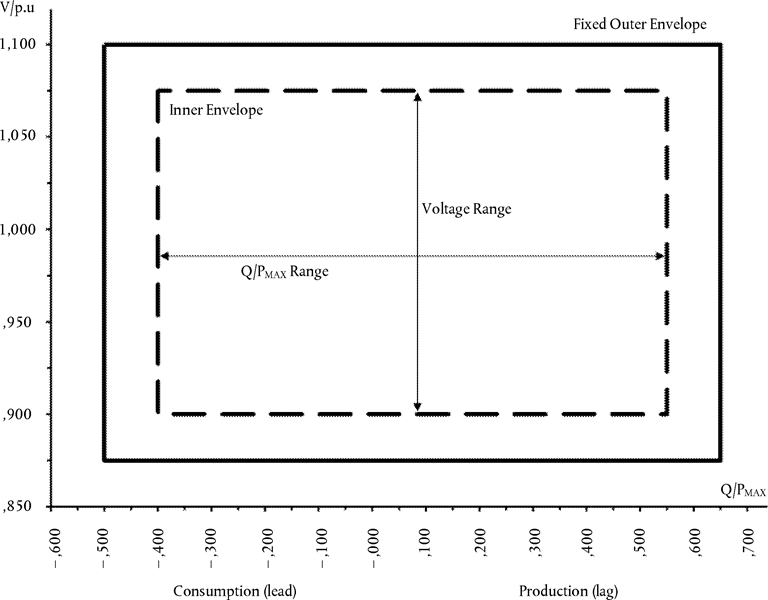
The diagram represents boundaries of a U-Q/Pmax-profile by the voltage at the connection point, expressed by the ratio of its actual value and the reference 1 pu value, against the ratio of the reactive power (Q) and the maximum capacity (Pmax). The position, size and shape of the inner envelope are indicative.
(iii)
the reactive power provision capability requirement applies at the connection point. For profile shapes other than rectangular, the voltage range represents the highest and lowest values. The full reactive power range is therefore not expected to be available across the range of steady-state voltages;
(iv)
the synchronous power-generating module shall be capable of moving to any operating point within its U-Q/Pmax profile in appropriate timescales to target values requested by the relevant system operator;
(c)with regard to reactive power capability below maximum capacity, when operating at an active power output below the maximum capacity (P < Pmax), the synchronous power-generating modules shall be capable of operating at every possible operating point in the P-Q-capability diagram of the alternator of that synchronous power-generating module, at least down to minimum stable operating level. Even at reduced active power output, reactive power supply at the connection point shall correspond fully to the P-Q-capability diagram of the alternator of that synchronous power-generating module, taking the auxiliary supply power and the active and reactive power losses of the step-up transformer, if applicable, into account.
Textual Amendments
F1Figure 7 amended (E.W.S.) (31.12.2020) by The Electricity and Gas (Internal Markets and Network Codes) (Amendment etc.) (EU Exit) Regulations 2020 (S.I. 2020/1006), reg. 1(2), Sch. 1 para. 17(a) as follows:
(i) for “1,100” substitute “1.100”;
(ii) for “1,050” substitute “1.050”;
(iii) for “1,000” substitute “1.000”;
(iv) for “,950” substitute “.950”;
(v) for “,900” substitute “.900”;
(vi) for “,850” substitute “.850”;
(vii) for “-,600” substitute “-.600”;
(viii) for “-,500” substitute “-.500”;
(ix) for “-,400” substitute “-.400”;
(x) for “-,300” substitute “-.300”;
(xi) for “-,200” substitute “-.200”;
(xii) for “-,100” substitute “-.100”;
(xiii) for “-,000” substitute “-.000”;
(xiv) for “,100” substitute “.100”;
(xv) for “,200” substitute “.200”;
(xvi) for “,300” substitute “.300”;
(xvii) for “,400” substitute “.400”;
(xviii) for “,500” substitute “.500”;
(xix) for “,600” substitute “.600”;
(xx) for “,700” substitute “.700”
F2Words in Art. 18(2) Table 8 omitted (E.W.S.) (31.12.2020) by virtue of The Electricity and Gas (Internal Markets and Network Codes) (Amendment etc.) (EU Exit) Regulations 2020 (S.I. 2020/1006), reg. 1(2), Sch. 1 para. 17(b)(i)
F3Words in Art. 18(2) Table 8 omitted (E.W.S.) (31.12.2020) by virtue of The Electricity and Gas (Internal Markets and Network Codes) (Amendment etc.) (EU Exit) Regulations 2020 (S.I. 2020/1006), reg. 1(2), Sch. 1 para. 17(b)(ii)
F4Word in Art. 18(2) Table 8 substituted (E.W.S.) (31.12.2020) by The Electricity and Gas (Internal Markets and Network Codes) (Amendment etc.) (EU Exit) Regulations 2020 (S.I. 2020/1006), reg. 1(2), Sch. 1 para. 17(b)(iii)(aa)
F5Word in Art. 18(2) Table 8 substituted (E.W.S.) (31.12.2020) by The Electricity and Gas (Internal Markets and Network Codes) (Amendment etc.) (EU Exit) Regulations 2020 (S.I. 2020/1006), reg. 1(2), Sch. 1 para. 17(b)(iii)(bb)
F6Words in Art. 18(2) Table 8 omitted (E.W.S.) (31.12.2020) by virtue of The Electricity and Gas (Internal Markets and Network Codes) (Amendment etc.) (EU Exit) Regulations 2020 (S.I. 2020/1006), reg. 1(2), Sch. 1 para. 17(b)(iv)
F7Words in Art. 18(2) Table 8 omitted (E.W.S.) (31.12.2020) by virtue of The Electricity and Gas (Internal Markets and Network Codes) (Amendment etc.) (EU Exit) Regulations 2020 (S.I. 2020/1006), reg. 1(2), Sch. 1 para. 17(b)(v)
Article 19U.K.Requirements for type D synchronous power-generating modules
1.Type D synchronous power-generating modules shall fulfil the requirements laid down in Article 13, except for Article 13(2)(b), (6) and (7), Article 14 except for Article 14(2), Article 15, except for Article 15(3), Article 16, Article 17, except for Article 17(2) and Article 18.
2.Type D synchronous power-generating modules shall fulfil the following additional requirements in relation to voltage stability:
(a)the parameters and settings of the components of the voltage control system shall be agreed between the power-generating facility owner and the relevant system operator, in coordination with the relevant TSO;
(b)the agreement referred to in subparagraph (a) shall cover the specifications and performance of an automatic voltage regulator (‘AVR’) with regard to steady-state voltage and transient voltage control and the specifications and performance of the excitation control system. The latter shall include:
(i)
bandwidth limitation of the output signal to ensure that the highest frequency of response cannot excite torsional oscillations on other power-generating modules connected to the network;
(ii)
an underexcitation limiter to prevent the AVR from reducing the alternator excitation to a level which would endanger synchronous stability;
(iii)
an overexcitation limiter to ensure that the alternator excitation is not limited to less than the maximum value that can be achieved whilst ensuring that the synchronous power-generating module is operating within its design limits;
(iv)
a stator current limiter; and
(v)
a PSS function to attenuate power oscillations, if the synchronous power-generating module size is above a value of maximum capacity specified by the relevant TSO.
3.The relevant TSO and the power-generating facility owner shall enter into an agreement regarding technical capabilities of the power-generating module to aid angular stability under fault conditions.
Options/Cymorth
Print Options
PrintThe Whole Regulation
PrintThe Whole Title
PrintThis Chapter only
Mae deddfwriaeth ar gael mewn fersiynau gwahanol:
Y Diweddaraf sydd Ar Gael (diwygiedig):Y fersiwn ddiweddaraf sydd ar gael o’r ddeddfwriaeth yn cynnwys newidiadau a wnaed gan ddeddfwriaeth ddilynol ac wedi eu gweithredu gan ein tîm golygyddol. Gellir gweld y newidiadau nad ydym wedi eu gweithredu i’r testun eto yn yr ardal ‘Newidiadau i Ddeddfwriaeth’.
Gwreiddiol (Fel y’i mabwysiadwyd gan yr UE): Mae'r wreiddiol version of the legislation as it stood when it was first adopted in the EU. No changes have been applied to the text.
Gweler y wybodaeth ychwanegol ochr yn ochr â’r cynnwys
Rhychwant ddaearyddol: Indicates the geographical area that this provision applies to. For further information see ‘Frequently Asked Questions’.
Dangos Llinell Amser Newidiadau: See how this legislation has or could change over time. Turning this feature on will show extra navigation options to go to these specific points in time. Return to the latest available version by using the controls above in the What Version box.
Dewisiadau Agor
Dewisiadau gwahanol i agor deddfwriaeth er mwyn gweld rhagor o gynnwys ar y sgrin ar yr un pryd
Rhagor o Adnoddau
Gallwch wneud defnydd o ddogfennau atodol hanfodol a gwybodaeth ar gyfer yr eitem ddeddfwriaeth o’r tab hwn. Yn ddibynnol ar yr eitem ddeddfwriaeth sydd i’w gweld, gallai hyn gynnwys:
- y PDF print gwreiddiol y fel adopted version that was used for the EU Official Journal
- rhestr o newidiadau a wnaed gan a/neu yn effeithio ar yr eitem hon o ddeddfwriaeth
- pob fformat o’r holl ddogfennau cysylltiedig
- slipiau cywiro
- dolenni i ddeddfwriaeth gysylltiedig ac adnoddau gwybodaeth eraill
Llinell Amser Newidiadau
Mae’r llinell amser yma yn dangos y fersiynau gwahanol a gymerwyd o EUR-Lex yn ogystal ag unrhyw fersiynau dilynol a grëwyd ar ôl y diwrnod ymadael o ganlyniad i newidiadau a wnaed gan ddeddfwriaeth y Deyrnas Unedig.
Cymerir dyddiadau fersiynau’r UE o ddyddiadau’r dogfennau ar EUR-Lex ac efallai na fyddant yn cyfateb â’r adeg pan ddaeth y newidiadau i rym ar gyfer y ddogfen.
Ar gyfer unrhyw fersiynau a grëwyd ar ôl y diwrnod ymadael o ganlyniad i newidiadau a wnaed gan ddeddfwriaeth y Deyrnas Unedig, bydd y dyddiad yn cyd-fynd â’r dyddiad cynharaf y daeth y newid (e.e. ychwanegiad, diddymiad neu gyfnewidiad) a weithredwyd i rym. Am ragor o wybodaeth gweler ein canllaw i ddeddfwriaeth ddiwygiedig ar Ddeall Deddfwriaeth.
Rhagor o Adnoddau
Defnyddiwch y ddewislen hon i agor dogfennau hanfodol sy’n cyd-fynd â’r ddeddfwriaeth a gwybodaeth am yr eitem hon o ddeddfwriaeth. Gan ddibynnu ar yr eitem o ddeddfwriaeth sy’n cael ei gweld gall hyn gynnwys:
- y PDF print gwreiddiol y fel adopted fersiwn a ddefnyddiwyd am y copi print
- slipiau cywiro
liciwch ‘Gweld Mwy’ neu ddewis ‘Rhagor o Adnoddau’ am wybodaeth ychwanegol gan gynnwys
- rhestr o newidiadau a wnaed gan a/neu yn effeithio ar yr eitem hon o ddeddfwriaeth
- manylion rhoi grym a newid cyffredinol
- pob fformat o’r holl ddogfennau cysylltiedig
- dolenni i ddeddfwriaeth gysylltiedig ac adnoddau gwybodaeth eraill
 Mae’r holl gynnwys ar gael dan Drwydded Llywodraeth Agored v3.0 ac eithrio ble nodir yn wahanol. Yn ychwanegol mae’r safle hwn â chynnwys sy’n deillio o EUR-Lex, a ailddefnyddiwyd dan delerau Penderfyniad y Comisiwn 2011/833/EU ar ailddefnyddio dogfennau o sefydliadau’r UE. Am ragor o wybodaeth gweler ddatganiad cyhoeddus Swyddfa Gyhoeddiadau’r UE ar ailddefnyddio.