- Latest available (Revised)
- Original (As enacted)
Coal Mining Subsidence Act 1991
You are here:
- UK Public General Acts
- 1991 c. 45
- SCHEDULE 3

What Version
Advanced Features
- Show Geographical Extent(e.g. England, Wales, Scotland and Northern Ireland)
- Show Timeline of Changes
Opening Options
More Resources
Changes to legislation:
Coal Mining Subsidence Act 1991,
SCHEDULE 3 is up to date with all changes known to be in force on or before 24 September 2024. There are changes that may be brought into force at a future date. Changes that have been made appear in the content and are referenced with annotations.

Changes to Legislation
Revised legislation carried on this site may not be fully up to date. Changes and effects are recorded by our editorial team in lists which can be found in the ‘Changes to Legislation’ area. Where those effects have yet to be applied to the text of the legislation by the editorial team they are also listed alongside the legislation in the affected provisions. Use the ‘more’ link to open the changes and effects relevant to the provision you are viewing.
Changes and effects yet to be applied to the whole Act associated Parts and Chapters:
Whole provisions yet to be inserted into this Act (including any effects on those provisions):
- s. 19(1A) inserted by 2023 asc 3 Sch. 13 para. 162
Section 21(1).
SCHEDULE 3E+W+S Property Belonging to Protected Tenants
Commencement Information
I1 Sch. 3 wholly in force at 30. 11. 1991 see s. 54(2) and S.I. 1991/2508, art.2
Protected tenant treated as liable to make good the damageE+W+S
1(1)Subject to paragraph 2 below, the protected tenant shall be treated for the purposes of this Part of this Act—E+W+S
(a)as a person liable to make good the whole of the damage to the property; or
(b)in the circumstances mentioned in sub-paragraph (2) below, as a person liable to meet such part of the cost of making good the whole of that damage as is given by the formula mentioned in sub-paragraph (3) below.
(2)The circumstances referred to in sub-paragraph (1)(b) above are that, by reason of any other enactment contained in the relevant Act or Acts, compensation in respect of the damaged property would have been payable to the protected tenant of less than the amount provided for by whichever of the following enactments would otherwise have been applicable, namely—
(a)section 1(1) of the M1Landlord and Tenant Act 1927;
(b)section 66(1) of and paragraph 2(1) of Part I of Schedule 9 to the M2Agricultural Holdings Act 1986;
[F1(bb)section 20 of the Agricultural Tenancies Act 1995;]
(c)sections 38 and 49(1) of the M3Agricultural Holdings (Scotland) Act 1949;
(d)so much of section 10 of the M4Crofters Holdings (Scotland) Act 1886 as precedes the proviso; and
(e)section 6(2) of the M5Crofters (Scotland) Act 1961.
(3)The formula referred to in sub-paragraph (1)(b) above is—
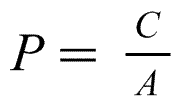
where—
P is such part of the cost of making good the whole of the damage to the property as the protected tenant is to be treated as a person liable to meet;
C is the compensation which would have been payable to the protected tenant by reason of the other enactment contained in the relevant Act or Acts;
A is the amount provided for by whichever of the enactments mentioned in sub-paragraph (2) above would otherwise have been applicable.
(4)Any question arising under this paragraph in relation to any property—
(a)as to whether or not any person is a protected tenant; or
(b)as to the amount of any compensation which would have been payable to him under the relevant Act or Acts,
shall be determined in like manner as if it had arisen under the relevant Act or Acts.
Textual Amendments
F1Sch. 3 para. 1(2)(bb) inserted (1.9.1995) by 1995 c. 8, ss. 40, 41(2), Sch. para. 37 (with s. 37)
Commencement Information
I2 Sch. 3 para. 1 wholly in force at 30. 11. 1991 see s. 54(2) and S.I. 1991/2508, art. 2
Marginal Citations
Circumstances in which Schedule appliesE+W+S
2(1)Where in the case of any damaged property—E+W+S
(a)it is claimed that a person who, apart from the provisions of this Schedule, is neither the owner of, nor liable to make good in whole or in part the damage to, the property falls to be treated as so liable by virtue of paragraph 1 above; and
(b)a damage notice is given in respect of the property, whether by that or any other person,
that person shall not be treated as so liable except in the circumstances mentioned in sub-paragraph (2) below.
(2)The circumstances referred to in sub-paragraph (1) above are—
(a)that it is agreed between the person in question and his landlord before the end of the period of one month beginning with the first giving of a damage notice in respect of the property, or it is determined in proceedings by virtue of paragraph 1(4) above begun before the end of that period, that he is a protected tenant and the property belongs to him; and
(b)that notice of that agreement or of the beginning of those proceedings has been given to the Corporation before the end of that period.
(3)Where the liability of the Corporation to comply with any requirement of this Part of this Act in consequence of the giving of a damage notice depends on the determination of the question whether or not a person falls to be treated as liable as mentioned in sub-paragraph (1) above, the Corporation shall not be required to comply with that requirement until it is established in accordance with the provisions of that sub-paragraph whether or not that person falls to be so treated.
(4)For the purposes of sub-paragraph (2) above, proceedings to determine by arbitration whether or not a person is a protected tenant by virtue of the M6Agricultural Holdings Act 1986 or the M7Agricultural Holdings (Scotland) Act 1949 shall be deemed to be begun when either—
(a)an arbitrator or, as the case may be, an arbiter has been appointed by agreement between that person and his landlord; or
(b)an application for the appointment of an arbitrator or, as the case may be, an arbiter has been made by that person or his landlord to the President of the Royal Institution of Chartered Surveyors or, as the case may be, the Secretary of State.
Commencement Information
I3 Sch. 3 para. 2 wholly in force at 30. 11. 1991 see s. 54(2) and S.I. 1991/2508, art. 2
Marginal Citations
SupplementalE+W+S
3E+W+SThe following enactments, namely—
(a)section 8(1) of the M8Small Landholders (Scotland) Act 1911 other than the provisos (which provides that an agreement for a loan by the Secretary of State to a landholder shall effect a transfer to the Secretary of State of all rights of the landholder to compensation for permanent improvements); and
(b)section 23(3) of the M9Crofters (Scotland) Act 1955 (which makes corresponding provision in relation to an agreement for a loan by the Secretary of State to a crofter),
shall have effect as if the references to such compensation included references to any amount payable to a landholder or crofter by virtue of this Schedule.
Commencement Information
I4Sch. 3 para. 3 wholly in force at 30.11.1991 see s. 54(2) and S.I. 1991/2508, art. 2
Marginal Citations
Options/Help
Print Options
PrintThe Whole Act
PrintThis Schedule only
Legislation is available in different versions:
Latest Available (revised):The latest available updated version of the legislation incorporating changes made by subsequent legislation and applied by our editorial team. Changes we have not yet applied to the text, can be found in the ‘Changes to Legislation’ area.
Original (As Enacted or Made): The original version of the legislation as it stood when it was enacted or made. No changes have been applied to the text.
See additional information alongside the content
Geographical Extent: Indicates the geographical area that this provision applies to. For further information see ‘Frequently Asked Questions’.
Show Timeline of Changes: See how this legislation has or could change over time. Turning this feature on will show extra navigation options to go to these specific points in time. Return to the latest available version by using the controls above in the What Version box.
Opening Options
Different options to open legislation in order to view more content on screen at once
More Resources
Access essential accompanying documents and information for this legislation item from this tab. Dependent on the legislation item being viewed this may include:
- the original print PDF of the as enacted version that was used for the print copy
- lists of changes made by and/or affecting this legislation item
- confers power and blanket amendment details
- all formats of all associated documents
- correction slips
- links to related legislation and further information resources
Timeline of Changes
This timeline shows the different points in time where a change occurred. The dates will coincide with the earliest date on which the change (e.g an insertion, a repeal or a substitution) that was applied came into force. The first date in the timeline will usually be the earliest date when the provision came into force. In some cases the first date is 01/02/1991 (or for Northern Ireland legislation 01/01/2006). This date is our basedate. No versions before this date are available. For further information see the Editorial Practice Guide and Glossary under Help.
More Resources
Use this menu to access essential accompanying documents and information for this legislation item. Dependent on the legislation item being viewed this may include:
- the original print PDF of the as enacted version that was used for the print copy
- correction slips
Click 'View More' or select 'More Resources' tab for additional information including:
- lists of changes made by and/or affecting this legislation item
- confers power and blanket amendment details
- all formats of all associated documents
- links to related legislation and further information resources
 All content is available under the Open Government Licence v3.0 except where otherwise stated. This site additionally contains content derived from EUR-Lex, reused under the terms of the Commission Decision 2011/833/EU on the reuse of documents from the EU institutions. For more information see the EUR-Lex public statement on re-use.