The Developments of National Significance (Procedure) (Wales) (Amendment) Order 2019
Made
Laid before the National Assembly for Wales
Coming into force
The Welsh Ministers, in exercise of the powers conferred on them by sections 61Z, 62R and 333 of the Town and Country Planning Act 19901, and in exercise of the powers conferred on the Secretary of State by sections 59 and 62 of that Act2 now exercisable by them3 (as applied in the case of section 62 with modifications by the Developments of National Significance (Application of Enactments) (Wales) Order 2016)4, make the following Order:
Title, commencement, application and interpretation1.
(1)
The title of this Order is the Developments of National Significance (Procedure) (Wales) (Amendment) Order 2019 and it comes into force on 1 April 2019.
(2)
This Order does not apply to an application made or proposed to be made to the Welsh Ministers under section 62D of the Town and Country Planning Act 1990 before the date this Order comes into force.
(3)
In this Order “the Procedure Order” means the Developments of National Significance (Procedure) (Wales) Order 20165.
Amendments to the Procedure Order2.
(1)
The Procedure Order is amended as follows.
(2)
In article 2 at the appropriate place insert—
““the Criteria Regulations” (“y Rheoliadau Meini Prawf”) means the Developments of National Significance (Specified Criteria and Prescribed Secondary Consents) (Wales) Regulations 20166;”.
(3)
In article 8—
(a)
at the end of paragraph (1)(b)(vii) omit “and”;
(b)
at the end of paragraph (1)(b)(viii) insert “; and”; and
(c)
after paragraph (1)(b)(viii) insert—
“(ix)
in the case of development within regulation 3(1)(ab) of the Criteria Regulations, a written statement about the length of the proposed line and its nominal voltage.”
(4)
In article 12—
(a)
at the end of paragraph (1)(b)(ix) omit “and”;
(b)
at the end of paragraph (1)(b)(x) insert “; and”; and
(c)
after paragraph (1)(b)(x) insert—
“(xi)
in the case of development within regulation 3(1)(ab) of the Criteria Regulations, a written statement about the length of the proposed line and its nominal voltage, and whether all necessary wayleaves have been agreed with owners and occupiers of land proposed to be crossed by the line.”
(5)
For Schedule 1, substitute the Schedule at Schedule 1 to this Order.
(6)
For Schedule 2, substitute the Schedule at Schedule 2 to this Order.
(7)
The amendments in Schedule 3 to this Order have effect.
Julie James
Minister for Housing and Local Government, one of the Welsh Ministers
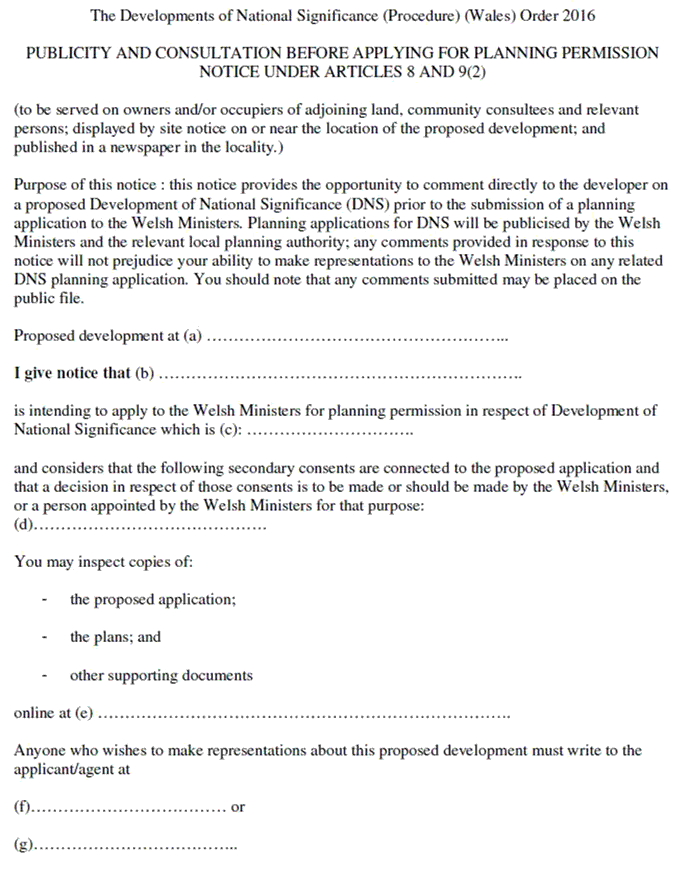
SCHEDULE 1Substitution of Schedule 1 to the Procedure Order
Article 2(5)
“"SCHEDULE 1Publicity and consultation before applying for planning permission”
Articles 8 and 9(5)
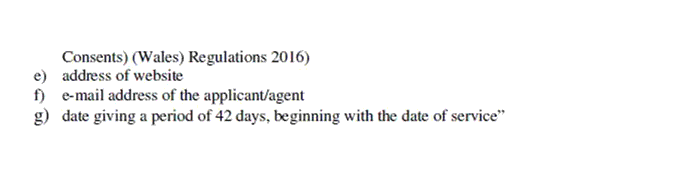
SCHEDULE 2Substitution of Schedule 2 to the Procedure Order
Article 2(6)
"SCHEDULE 2
Article 9(5)
SCHEDULE 3Duty to consult before the grant of planning permission
Article 2(7)
1.
Schedule 5 to the Procedure Order is amended as follows
2.
In the Table—
(a)
for paragraph (h) substitute—
“(h)
(i)
Development which has a direct physical impact on a scheduled monument.
(ii)
Development likely to be visible from a scheduled monument and which meets one of the following criteria—
a)
it is within a distance of 0.5 kilometres from any point of the perimeter of a scheduled monument;
b)
it is within a distance of 1 kilometre from the perimeter of a scheduled monument and is 15 metres or more in height, or has an area of 0.2 hectares or more;
c)
it is within a distance of 2 kilometres from the perimeter of a scheduled monument and is 50 metres or more in height, or has an area of 0.5 hectares or more;
d)
it is within a distance of 3 kilometres from the perimeter of a scheduled monument and is 75 metres or more in height, or has an area of 1 hectare or more; or
e)
it is within a distance of 5 kilometres from the perimeter of a scheduled monument and is 100 metres or more in height, or has an area of 1 hectare or more.
(iii)
Development likely to affect the site of a registered historic park or garden or its setting;
(iv)
Development within a registered historic landscape that requires an Environmental Impact Assessment; or
(v)
Development likely to have an impact on the outstanding universal value of a World Heritage Site
The Welsh Ministers”
(b)
omit paragraph (k); and
(c)
after paragraph (t) insert—
“(u)
Development—
(i)
on land designated as Flood Zone C2;
(ii)
involving or including emergency services development or highly vulnerable development on land designated as Flood Zone C1 or on land that has been notified to the local planning authority by the Natural Resources Body for Wales for the purpose of this provision
The Natural Resources Body for Wales
(v)
Any development
The water and sewerage undertaker concerned”
3.
In the definitions given under the heading “Interpretation of Table”—
(a)
for paragraph (d) substitute—
“(d)
in paragraph (h)—
(i)
“scheduled monument” (“heneb gofrestredig”) has the same meaning as in section 1(11) of the Ancient Monuments and Archaeological Area Act 1979 (scheduled monuments)7;
(ii)
reference to the height of development is to be construed as a reference to its height when measured from ground level; and for the purposes of this paragraph “ground level” (“lefel y ddaear”) means the level of the surface of the ground immediately adjacent to the development in question or, where the level of the surface of the ground on which it is situated is not uniform, the level of the highest part of the surface adjacent to it;
(iii)
“registered historic park or garden” (“parc hanesyddol cofrestredig neu ardd hanesyddol gofrestredig”) and “registered historic landscape” (“tirwedd hanesyddol gofrestredig”) means the park, garden or landscape included in the Register of Landscapes, Parks and Gardens of Special Historic Interest in Wales maintained by the Welsh Ministers8;
(iv)
“World Heritage Site” (“Safle Treftadaeth y Byd”) means land appearing on the World Heritage List kept under article 11(2) of the UNESCO Convention for the Protection of the World Cultural and Natural Heritage adopted at Paris on 16th November 19729;”; and
(b)
after paragraph (i) insert—
“(j)
in paragraph (u)—
(i)
“Flood Zone C1” (“Parth Llifogydd C1”) means an area of a floodplain which is developed and served by significant infrastructure, including flood defences10;
(ii)
“Flood Zone C2” (“Parth Llifogydd C2”) means an area of a floodplain without significant flood defence infrastructure;
(iii)
“emergency services development” (“datblygiad gwasanaethau brys”) and “highly vulnerable development” (“datblygiad a all fod mewn perygl mawr”) have the same meaning as set out in the Town and Country Planning (Notification) (Wales) Direction 201211.”
EXPLANATORY NOTE
(This note is not part of the Order)
This Order amends the Developments of National Significance (Procedure) (Wales) Order 2016 (“the Procedure Order”).
Article 2 amends articles 8 and 12 of the Procedure Order. The amendments add requirements where development consists of the installation of certain kinds of overhead electric lines. The requirements relate to the information that a person proposing to make an application for planning permission must publish, and the content of that application.
Schedules 1 and 2 substitute the forms of notice at Schedules 1 and 2 to the Procedure Order to take account of the fact that decisions on consents connected with the development of certain overhead electric lines may be taken by a person appointed by the Welsh Ministers for that purpose.
Schedule 3 amends Schedule 5 to the Procedure Order. The effect of those amendments is to amend the requirements in respect of the specialist consultees who must, under article 22 of that Order, be consulted by the Welsh Ministers before the grant of planning permission.
The Welsh Ministers’ Code of Practice on the carrying out of Regulatory Impact Assessments was considered in relation to this Order. As a result, it was not considered necessary to carry out a Regulatory Impact Assessment as to the likely costs and benefits of complying with this Order.