The Air Navigation (Overseas Territories) (Amendment) (No. 2) Order 2021
At the Court at Buckingham Palace, the 23rd day of June 2021
Present,
The Queen’s Most Excellent Majesty in Council
Her Majesty, by and with the advice of Her Privy Council, orders as follows:
Citation and commencement1.
(1)
This Order may be cited as the Air Navigation (Overseas Territories) (Amendment) (No. 2) Order 2021 and, subject to paragraph (2), it comes into force on 22nd July 2021.
(2)
Article 23(13) comes into force on 30th September 2021.
Amendment of the Air Navigation (Overseas Territories) Order 20132.
Interpretation3.
In article 3(1)—
(a)
““known consignor” means a person who consigns cargo for that person’s own account;”;
(b)
““psychoactive substance” means any alcohol, opioid, cannabinoid, sedative, hypnotic, cocaine, other psychostimulant, hallucinogen or volatile solvent, but does not include coffee or tobacco;”;
(c)
““regulated agent” means a person who acts as an agent for another person, to apply security controls to cargo or mail intended to be consigned by air;”;
(d)
in the definition of “small unmanned aircraft”, for “20kg” substitute “25kg”;
(e)
in the definition of “State of the operator”, omit “for the purposes of articles 24(1), 36(1), 45 and 82(1)”.
Part 1 – Powers and Duties4.
(1)
In article 7(2)—
(a)
at the end of paragraph (c), omit “and”;
(b)
“; and
(e)
review the classification of airspace in the Territory where appropriate in light of any relevant regional air navigation plan published by the International Civil Aviation Organization, and make such alterations to that classification as the Governor, after consulting with such persons as the Governor thinks fit, considers appropriate to ensure compliance with any such plan.”;
(c)
“(4)
Nothing in paragraph (2) requires the Governor to provide any services in relation to a military aerodrome if those services are provided by, or under the direction of, any military authority at that aerodrome.”.
(2)
In article 8(1)(a), after “111” insert “, 167”.
(3)
In article 9(1)—
(a)
at the end of paragraph (e), omit “and”;
(b)
“(g)
to any place where a known consignor or regulated agent approved by the Governor carries on business, for the purpose of determining whether that person is applying aviation security procedures in accordance with the specified requirements;
(h)
to any premises used by an operator, for the purpose of determining whether the operator is complying with the specified requirements; and
(i)
to any premises used for training by a person approved in accordance with this Order, for the purpose of determining whether that person is conducting training in accordance with the approval for that training.”.
Part 2 – Registration and marking of aircraft5.
(1)
In article 16(1)—
(a)
in paragraph (d), after “State” insert “or of the Swiss Confederation”;
(b)
in paragraph (f)—
(i)
after “State” insert “or of the Swiss Confederation”;
(ii)
after “Area”, in the second place it occurs, insert “or within the Swiss Confederation”.
(2)
“(2)
The nationality mark to be borne by aircraft registered in the Territory shall consist of a group of two capital letters in Roman character complying with the requirements of paragraph 3.3 of the sixth edition of Annex 7 to the Chicago Convention entitled “Aircraft Nationality Registration Marks” and published in July 20126 (“Annex 7”) and with any other requirements published by the Governor under article 5.(2A)
The registration mark to be borne by aircraft registered in the Territory shall consist of a group of three capital letters in Roman character complying with the requirements of paragraph 3.6 of Annex 7 and with any other requirements published by the Governor under article 5.”.
Part 3 – Airworthiness and equipment of aircraft6.
(1)
In article 24(2)(d), after “permit to fly” insert “or a special flight permit”.
(2)
In article 27—
(a)
in paragraph (1), after “certificate of airworthiness” insert “for an aircraft registered in the Territory”;
(b)
in paragraph (2), for “becomes valid again” substitute “comes back into force”.
(3)
In article 28—
(a)
in the heading, at the end insert “and special flight permit”;
(b)
in paragraph (1), for “issue for any aircraft a permit to fly” substitute “issue a permit to fly, for any aircraft registered in the Territory which does not qualify for a Type Acceptance Certificate under article 23,”;
(c)
“(1A)
The Governor may issue a special permit, for any aircraft registered in the Territory whose certificate of airworthiness has ceased to be in force, if the Governor is satisfied that the aircraft is fit to fly having regard to its airworthiness and any conditions to be attached to the permit.
(1B)
The Governor may issue a special permit, for any aircraft registered other than in the Territory whose certificate of airworthiness has ceased to be in force, if the Governor is satisfied that the aircraft is fit to fly, having regard to—
(a)
its airworthiness;
(b)
any conditions to be attached to the permit; and
(c)
any conditions of the competent authority of the State of registry or of the State of the operator of the aircraft, as the case may be.”;
(d)
in paragraphs (2) to (8), after “permit to fly”, in each place it occurs, insert “or special flight permit”.
(4)
In article 29—
(a)
after “permit to fly”, in each place it occurs (including in the heading), insert “or special flight permit”;
(b)
in paragraph (b)(i), after “Governor”, insert “or, in the case of any aircraft registered other than in the Territory, by the competent authority of the State of registry or of the State of the operator of the aircraft, as the case may be”;
(c)
in paragraph (c), after “purpose”, insert “or, in the case of any aircraft registered other than in the Territory, by the competent authority of the State of registry or of the State of the operator of the aircraft, as the case may be”.
(5)
“(8)
When exercising the privileges of an aircraft maintenance engineer’s licence, the holder must not be under the influence of any psychoactive substance or any medication which renders the holder unable to safely exercise the privileges of that licence or makes the holder a risk to the safety of any other person.”.
Pilots required on commercial air transport flights7.
In article 41—
(a)
in paragraph (1)—
(i)
omit sub-paragraph (d) and the word “and” immediately preceding it;
(ii)
for the words after sub-paragraph (d) substitute “and which is flying for the purpose of commercial air transport, must carry at least two pilots as members of the flight crew.”;
(b)
“(3)
An aircraft registered in the Territory must not be flown for the purpose of commercial air transport operations by a pilot-in-command of that aircraft who is 60 years of age or above unless the aircraft is fitted with dual controls and carries two pilots as members of the flight crew, both of whom are below 65 years of age.”.
Application and interpretation of Part 58.
In article 61(3)(a)(i), in the definition of “flight time”, for “weight” substitute “mass”.
Regulation of small unmanned aircraft9.
In article 73—
(a)
in paragraph (3), for “The person” substitute “Unless the Governor has granted written permission, the person”;
(b)
“(4)
The person in charge of a small unmanned aircraft must not fly the aircraft—
(a)
at a height of more than 400 feet above the surface;
(b)
for aerial work;
(c)
within 400 feet of an open-air assembly of more than 400 persons;
(d)
within 150 feet of any person, other than the operator or any person accompanying the operator;
(e)
within 150 feet of any vehicle, vessel or structure which is not under the control of the person in charge of the small unmanned aircraft; or
(f)
within the boundary of an aerodrome,
except with the permission of the Governor.
(5)
A small unmanned aircraft shall be operated in such a manner as to minimize hazards to persons, property or other aircraft.
(6)
The Governor may require that a person who intends to operate in the Territory a small unmanned aircraft with a mass of more than 400 grammes, excluding its fuel but including any articles or equipment installed in or attached to the aircraft at the commencement of its flight, must provide the Governor with such information regarding the purpose, scope, location and manner of operation as the Governor may prescribe.”.
Minimum navigation performance10.
In article 91(2), at the end insert “and includes the North Atlantic High-Level Airspace (NAT HLA)”.
Commercial air transport operations at night etc.11.
In article 103, at the end insert “or it is a single-engine turbine aeroplane operating under, and in accordance with, an approval issued by the Governor”.
Part 11 – Carriage of weapons and munitions of war12.
(1)
In article 107–
(a)
in paragraph (2), at the end insert “, except with the permission of the Governor”;
(b)
in paragraph (3)(a)(ii), after “passengers”, insert “, except in a case where the Governor has given permission under paragraph (2) for them to be carried in any compartment or apparatus to which passengers have access”.
(2)
“(4)
Nothing in article 107 applies to a police officer, or person authorised by the Governor to act as flight security officer, carrying munitions of war whilst acting in the course of their duties as such.”.
Part 12 – Carriage of dangerous goods13.
(1)
In article 110—
(a)
in paragraph (1)(a), after “Part” insert “or by the competent authority of the State of the operator of the aircraft,”;
(b)
in paragraph (1)(c) for “specified requirements” substitute “Technical Instructions,”.
(2)
“Designated postal operators118A.
(1)
Designated postal operators must establish and maintain initial and recurrent dangerous goods training programmes in accordance with the Technical Instructions.
(2)
The training programmes referred to in paragraph (1) must be approved by the Governor.
(3)
Staff of designated postal operators must be trained in requirements commensurate with their experience and responsibilities.
(4)
The procedures of designated postal operators for controlling the introduction of dangerous goods in mail into air transport must be approved by the Governor.
(5)
In this article, “designated postal operator” means any governmental or non-governmental entity officially designated to operate postal services and to fulfil the related obligations arising from the Acts of the Universal Postal Union Convention on the Territory.”.
(3)
““Technical Instructions” means the English language edition of the 2021-2022 Edition of the Technical Instructions for the Safe Transport of Dangerous Goods by Air7 as approved and published by decision of the Council of the International Civil Aviation Organization and as amended from time to time.”.
Part 14 – General Aviation14.
In article 132, in paragraph 2(e), for “5” substitute “9”.
Part 16 – Air traffic services15.
(1)
In article 138—
(a)
in the heading, omit “air traffic control”;
(b)
“(4)
A person in charge of the provision of a flight information service, other than at a military aerodrome, may only provide that service in accordance with the terms of a flight information service approval granted by the Governor.
(5)
The Governor must grant a flight information service approval if satisfied that the applicant for such approval meets the specified requirements and is competent to provide a flight information service which is safe for use by aircraft.”.
(2)
“Fatigue of air traffic controllers – air traffic control service provider’s responsibilities139A.
(1)
The holder of an approval under article 138 (“the approved provider”) must establish a fatigue management scheme.
(2)
A fatigue management scheme must—
(a)
be approved by the Governor;
(b)
be incorporated into the Manual of Air Traffic Services required under article 140;
(c)
be in writing and made available to every person engaged to act as an air traffic controller or student air traffic controller in the provision of the air traffic control service.
(3)
The approved provider must take all reasonable steps to ensure that the provisions of the fatigue management scheme are complied with in relation to every person engaged to act as an air traffic controller or student air traffic controller in the provision of the air traffic control service.
(4)
The approved provider must not cause or allow any person to act as an air traffic controller or student air traffic controller where the approved provider knows, or has reasonable grounds to suspect, that the person concerned is suffering from, or is likely to suffer from, such fatigue as may endanger the safety of aircraft under their control.
(5)
In this article “fatigue management scheme” means a scheme for the regulation of duty periods, intervals between duty periods and required rest periods for every person engaged in the provision of an air traffic control service.”.
(3)
In article 141(1), for “radio or radar”, substitute “radar, radio or global navigation satellite system”.
Part 17 – Licensing of air traffic controllers16.
(1)
In article 143(3), at the end insert “or when providing an air traffic control service at a military aerodrome”.
(2)
In article 144(2)—
(a)
for “18”, substitute “20”;
(b)
for “20”, substitute “21”.
(3)
“Prohibition of use of psychoactive substances148.
A person must not act as an air traffic controller or student air traffic controller whilst under the influence of any psychoactive substance, or any medication, which renders that person unable to safely perform their duties or makes that person a risk to the safety of another person.”.
Part 19 – Aerodromes, aeronautical lights and dangerous lights17.
(1)
In article 156(2), for “paragraph (3)” substitute “this paragraph”.
(2)
In article 156(3)—
(a)
in paragraphs (a) to (c), after “aircraft”, in each place it occurs, insert “(other than rotorcraft)”;
(b)
at the end of paragraph (b), omit “and”;
(c)
“(d)
rotorcraft flying for the purpose of scheduled commercial air transport operations;
(e)
rotorcraft having a certificated take-off mass exceeding 3,175 kg operating a flight for the purpose of instruction, or a flying test, for the purpose of gaining a licence or rating.”.
(3)
In article 162—
(a)
in paragraph (1)(a)(iii), omit “from a vehicle or vessel”;
(b)
“(4A)
A person must not transfer aviation fuel from one aircraft to another unless that person is satisfied, as a result of sampling or otherwise testing the fuel, that it is not contaminated.”;
(c)
in paragraph (5), after “article” insert “other than paragraph (4A)”.
(4)
In article 164(4), after “must”, insert “report the failure, as soon as is practicable, to the operator of the nearest aerodrome to the obstacle and”.
Aviation Security18.
“PART 19AAviation Security
Aviation security requirements165A.
(1)
A person who has an aviation security function, or who has unescorted access to a restricted zone, must have undertaken such aviation security training and passed such examinations or tests as may be set out in specified requirements.
(2)
The Governor may, for the purposes of this article—
(a)
approve any course of training or instruction;
(b)
authorise a person to conduct specified examinations or tests; and
(c)
approve a person to provide or conduct any course of training or instruction.
(3)
The Governor may approve a person to act as a known consignor or as a regulated agent.
(4)
In this Part—
“aviation security function” means—
(a)
any function of screening or searching cargo for security purposes before it is consigned for carriage by air or loaded on board an aircraft;
(b)
any function of screening or searching a person for security purposes before they board an aircraft;
(c)
any function of screening or searching an aircraft, baggage, cargo, goods, a person or vehicle before they enter the restricted zone of a certificated aerodrome; and
(d)
the management or supervision of any person performing a function mentioned in paragraph (a), (b) or (c) of this definition;
“restricted zone” means an area designated as such by the Governor under paragraph 11A of Schedule 2 to the Aviation Security and Piracy (Overseas Territories) Order 20008;“screening” means the application of technical or other means which are intended to identify or detect weapons, explosives or other dangerous articles, devices or substances which could be used to commit an act of unlawful interference as defined in rule 37B of Schedule 4.
Psychoactive substances165B.
A person must not carry out an aviation security function whilst under the influence of any psychoactive substance, or any medication, which renders that person unable to safely perform the aviation security function or makes that person a risk to the safety of another person.”.
Part 20 – Documents and records19.
(1)
In article 168(1)(a) omit “in force”.
(2)
In article 171(2) omit “in force or”.
Part 21 – Occurrence reporting20.
(1)
In article 174—
(a)
in paragraph (4)(g), for “authority”, substitute “licence”;
(b)
in paragraph (4)(h), omit “or licensed”;
(c)
in paragraph (5)—
(i)
at the end of paragraph (a), omit “and”;
(ii)
“; and
(c)
any incident involving a breach of the security arrangements at an aerodrome.”.
(2)
In article 175—
(a)
in the heading, for “bird” substitute “wildlife”;
(b)
in paragraph (1), for “bird” substitute “wildlife”;
(c)
in paragraph (5)—
(i)
for “bird”, in the first place it occurs, substitute “wildlife”;
(ii)
for “one or more than one bird”, substitute “wildlife”.
(3)
“Data monitoring and safety management175A.
(1)
The Governor may, by notice in writing, require any person referred to in article 174(4) to promptly provide such safety data as the Governor may require for the purposes of safety data monitoring, hazard identification and safety risk assessment.
(2)
For the purposes of this article, “safety data” means a defined set of facts or set of safety values from various aviation-related sources, which is used to maintain or improve safety.”.
(4)
“Prohibition of use of psychoactive substances178.
(1)
No person may board an aircraft whilst under the influence of any psychoactive substance which renders that person a risk to the safety of any other person on board.
(2)
No person on board an aircraft may be under the influence of any psychoactive substance which renders that person a risk to the safety of any other person on board.
(3)
Without prejudice to paragraphs (1) and (2), no person may act as crew of an aircraft whilst under the influence of any psychoactive substance, or any medication, which renders that person unable to safely perform that person’s duties or makes that person a risk to the safety of any other person on board the aircraft.”.
Part 23 – Application and general provisions21.
“Application of the Order to an aircraft the subject of an article 83 bis agreement189A.
The provisions of this Order do not apply to an aircraft registered in the Territory where that aircraft is the subject of an agreement which is—
(a)
made in accordance with article 83 bis of the Chicago Convention;
(b)
registered with the Council of the International Civil Aviation Organization; and
(c)
under which any of the Governor’s functions under this Order in respect of the aircraft have been transferred to the State of the operator.”.
Licences22.
In Schedule 3—
(a)
in the Part “Commercial Pilot’s Licence (Aeroplanes)”, in paragraph (3)(g)—
(i)
omit “who has not attained the age of 60 years and”;
(ii)
at the end add “and neither of the two pilots has attained the age of 65 years”;
(b)
in the Part “Commercial Pilot’s Licence (Helicopters and Gyroplanes)”, in paragraphs (2)(b) and (h)—
(i)
omit “who has not attained the age of 60 years and”;
(ii)
at the end add “and neither of the two pilots has attained the age of 65 years”.
Schedule 4 – Rules of the air23.
(1)
Schedule 4 is amended as follows.
(2)
“Protection of persons and property2A.
An aircraft must not be operated in a negligent or reckless manner so as to endanger life or property of others.”.
(3)
“(3A)
In controlled airspace, aircraft must not fly in formation except where—
(a)
the pilots-in-command of the aircraft flying in formation designate a flight leader for the formation (“the flight leader”) before the formation flight;
(b)
in relation to navigation and position reporting, all aircraft flying in formation fly as if each were a single aircraft;
(c)
the pilots-in-command of each aircraft maintain adequate separation between the aircraft flying in formation, including during periods of transition into, or out of, the formation;
(d)
the aircraft maintain a distance between the aircraft in the formation of not more than 1 km laterally and 30 metres vertically from the flight leader; and
(e)
the aircraft comply with any other conditions for the formation flight which are imposed by the air traffic control unit for the relevant airspace.”.
(4)
In rule 8(4), at the end insert “, taking into account the effects of aircraft wake turbulence”.
(5)
In rule 8(7), for “Paragraphs (3) and (5)” substitute “Paragraphs (3), (3A) and (5)”.
(6)
“Water operations11A.
(1)
This rule applies to aircraft when on the water.
(2)
When two aircraft are approaching each other, or an aircraft is approaching a vessel, the aircraft must proceed with caution.
(3)
An aircraft which has another aircraft or a vessel on its right must give way and keep well clear of it.
(4)
An aircraft approaching another aircraft or vessel head-on either directly or approximately, must alter its course to the right, so as to keep clear of it.
(5)
An aircraft or vessel being overtaken by another aircraft has right of way and the overtaking aircraft must alter its course, so as to keep clear of it.
(6)
When landing or taking off an aircraft must keep clear of all vessels (including other aircraft on the water) and not impede their navigation.
(7)
Between sunset and sunrise, or during such other hours as the Governor may prescribe, an aircraft must display lights in accordance with the International Regulations for Preventing Collisions at Sea 1972 published by the International Maritime Organization9 or, if it is not practical to do so, it must display similar lights and in a similar position.”.
(7)
“20.
Subject to rule 28A, an aircraft must always be flown in accordance with either the Visual Flight Rules or the Instrument Flight Rules.”.
(8)
“(3)
Rules 28A, 29 and 30 are the Visual Flight Rules which apply at night.”.
(9)
“Visual Flight Rules at night28A.
An aircraft flying at night in the Territory may be flown—
(a)
on a Special VFR flight within a control zone; or
(b)
in accordance with any relevant supplementary Rules of the Air made by the Governor under article 67(1) which are in force in the Territory.”.
(10)
In rule 29—
(a)
in paragraph (1), after “airspace”, insert “, or at night,”;
(b)
in paragraph (3), for “articles 89, 90 or 91”, substitute “article 92 or 93”.
(11)
In rule 31(1), for “Rule” substitute “Except at night, rule”.
(12)
In rule 33(1), after the second “aircraft”, insert “or, when over high terrain or in mountainous areas, at a height of less than 2000 feet,”.
(13)
In rule 34—
(a)
in the heading, omit “Quadrantal rule and”;
(b)
in paragraph (1), omit “or Table 2, as appropriate”;
(c)
“Table 1Semi-circular rule
From 000 degrees to 179 degrees
From 180 degrees to 359 degrees
IFR flights
VFR flights
IFR flights
VFR flights
Level
Level
Level
Level
Feet
Metres
FL
Feet
Metres
FL
Feet
Metres
FL
Feet
Metres
010
1,000
300
-
-
-
020
2,000
600
-
-
-
030
3,000
900
035
3,500
1,050
040
4,000
1.200
045
4,500
1,350
050
5,000
1,500
055
5,500
1,700
060
6,000
1,850
065
6,500
2,000
070
7,000
2,150
075
7,500
2,300
080
8,000
2,450
085
8,500
2,600
090
9,000
2,750
095
9,500
2,900
100
10,000
3,050
105
10,500
3,200
110
11,000
3,350
115
11,500
3,350
120
12,000
3,650
125
12,500
3,800
130
13,000
3,950
135
13,500
4,100
140
14,000
4,250
145
14,500
4,400
150
15,000
4,550
155
15,500
4,700
160
16,000
4,900
165
16,500
5,050
170
17,000
5,200
175
17,500
5,350
180
18,000
5,500
185
18,500
5,650
190
19,000
5,800
195
19,500
5,950
200
20,000
6,100
205
20,500
6,250
210
21,000
6,400
215
21,500
6,550
220
22,000
6,700
225
22,500
6,850
230
23,000
7,000
235
23,500
7,150
240
24,000
7,300
245
24,500
7,450
250
25,000
7,600
255
25,500
7,750
260
26,000
7,900
265
26,500
8,100
270
27,000
8,250
275
27,500
8,400
280
28,000
8,550
285
28,500
8,700
290
29,000
8,850
300
30,000
9,150
310
31,000
9,450
320
32,000
9,750
330
33,000
10,050
340
34,000
10,350
350
35,000
10,650
360
36,000
10,950
370
37,000
11,300
380
38,000
11,600
390
39,000
11,900
400
40,000
12,200
410
41,000
12,500
430
43,000
13,100
450
45,000
13,700
470
47,000
14,350
490
49,000
14,950
510
51,000
15,500
etc.
etc.
etc.
etc.
etc.
etc.”
(14)
In rule 35(2)(b), for “articles” substitute “article”.
(15)
“Co-ordinated Universal Time, time checks and time accuracy37A.
(1)
When communicating the time with an air traffic control unit a pilot must use Co-ordinated Universal Time (“UTC”), expressed in hours, minutes and seconds, as used in the 24 hour clock.
(2)
Before entering controlled airspace, and at such other times during the flight as may be necessary, the pilot of an aircraft must check the time.
(3)
Whenever time is utilised by an aircraft operator in the use of data-link communications, the time must be accurate to 1 second UTC.
(4)
In paragraph (3), “data-link communications” means a form of communication intended for the exchange of messages via a data link.
SECTION 6AACTS OF UNLAWFUL INTERFERENCE AND INTERCEPTION
Duties of pilot-in-command37B.
(1)
This rule applies if an aircraft is subjected to an act of unlawful interference.
(2)
The pilot-in-command must attempt to notify the appropriate air traffic control unit immediately of the interference and of any actual or required deviation from the filed flight plan.
(3)
The pilot-in-command must attempt to land as soon as reasonably practicable at the nearest suitable aerodrome, or at another aerodrome as instructed by the appropriate air traffic control unit, unless circumstances on board the aircraft make this impracticable.
(4)
Interception37C.
(1)
Interception of civil aircraft must be governed by these rules and any administrative instructions, directions or requirements issued by the Governor.
(2)
The pilot-in-command of a civil aircraft, when intercepted, must comply with any instructions, directions or requirements issued by the Governor under paragraph (1).”.
(16)
“(5A)
A flying machine taxiing on the manoeuvring area must stop and hold at—
(a)
runway-holding positions, until otherwise authorised by the air traffic control unit; and
(b)
lighted “stop” bars, until the stop lights are turned off.”.
(17)
In rule 61(1)—
(a)
for “described” substitute “illustrated”;
(b)
for “as illustrated in column 3” substitute “described in column 2”.
(18)
In rule 61(2)—
(a)
after “by hand” insert “, by glove,”;
(b)
after “by night” insert “or in low visibility”;
(c)
omit “torches or by”.
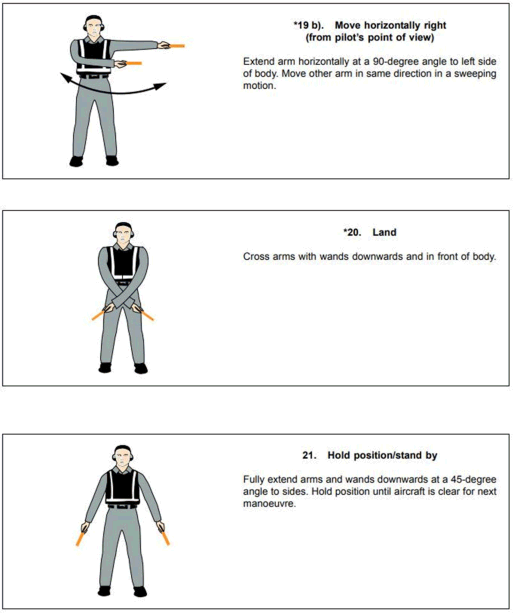
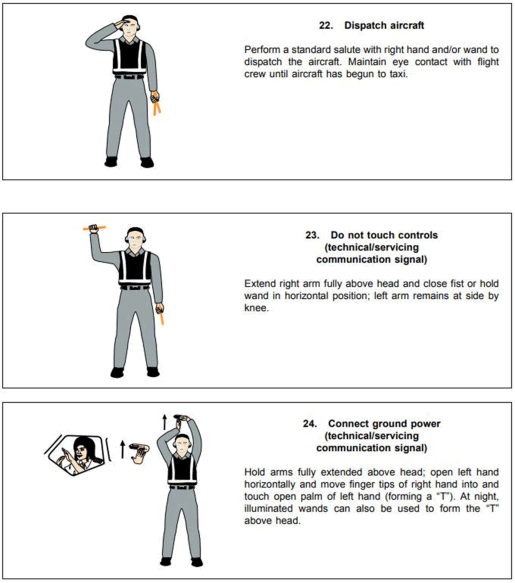
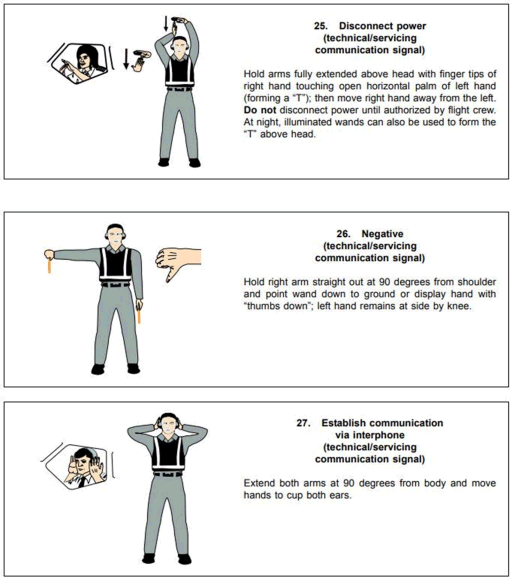
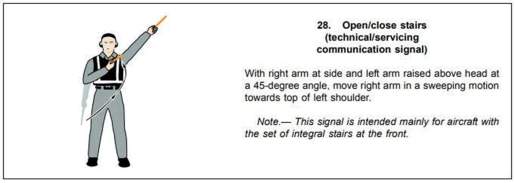
(19)
“Table 5Meaning of marshalling signals (from a marshaller to an aircraft on or off the ground)
Column 1
Column 2
Illustration of signal
Meaning and description of signal”.
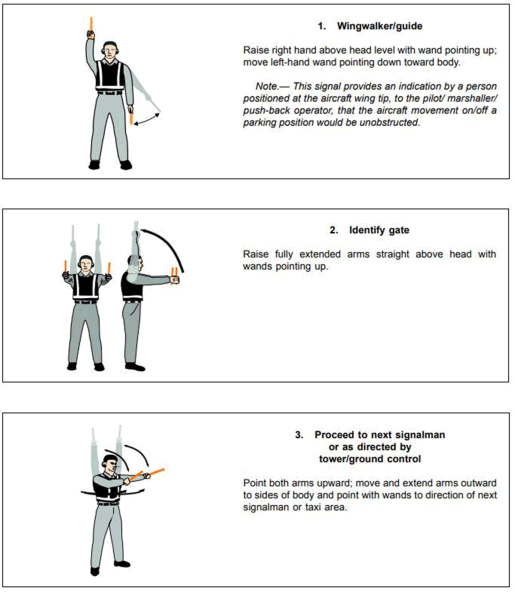
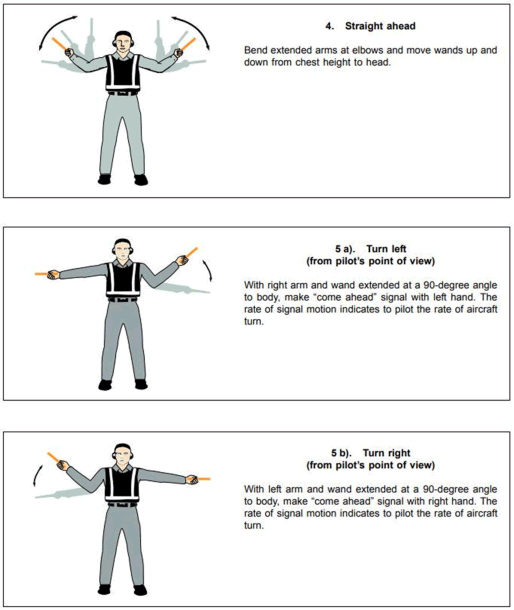
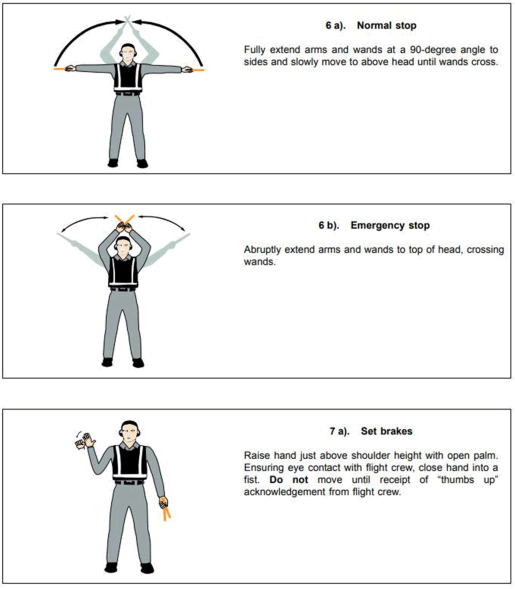
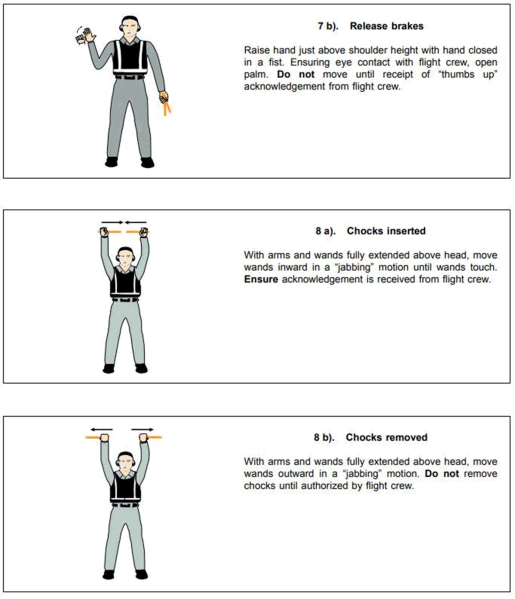
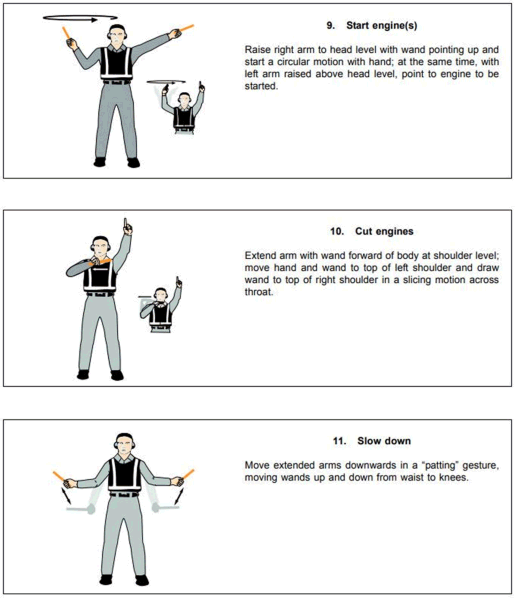
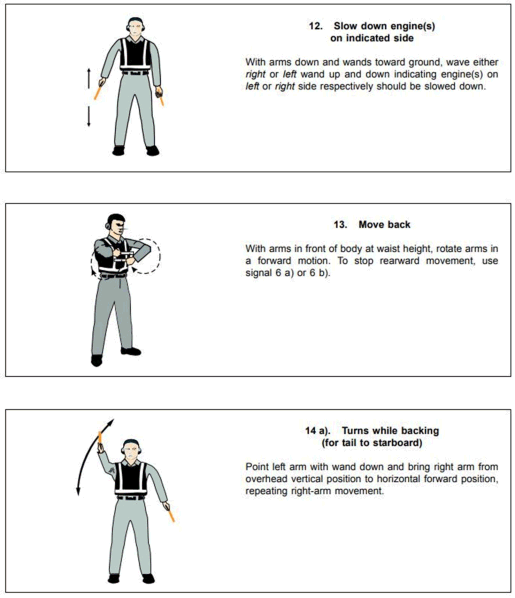
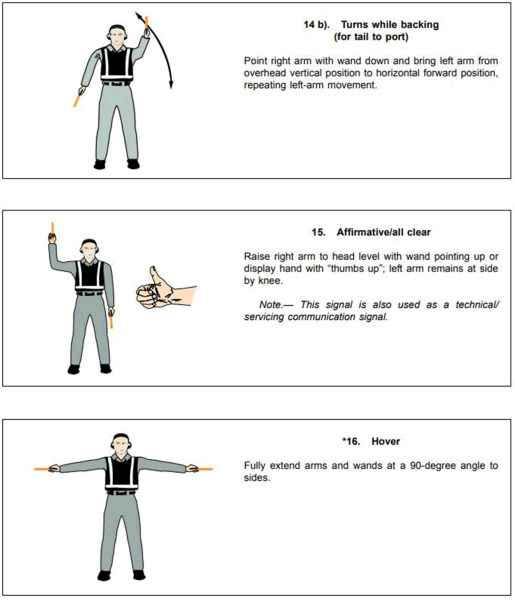
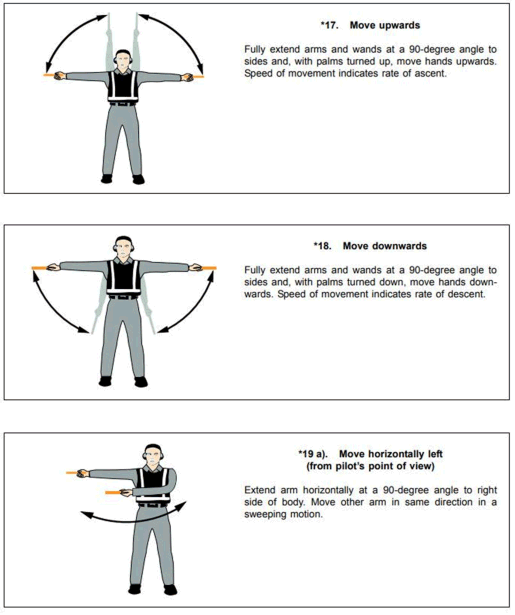
(20)
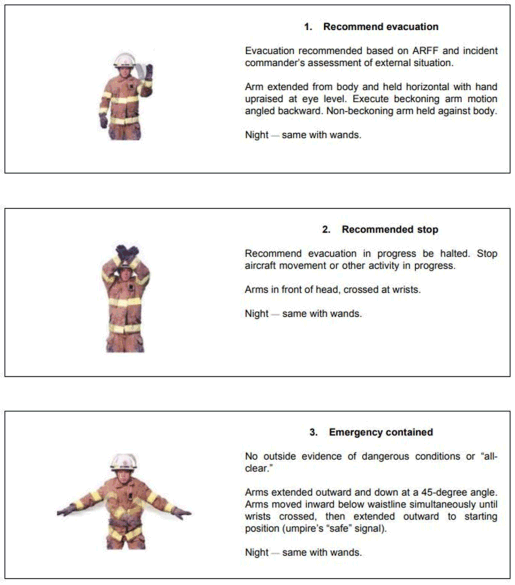
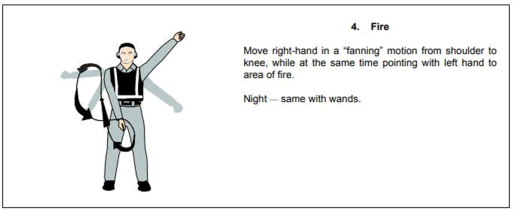
“Emergency signals by firemen and marshallers to aircraft on or off the ground61A.
(1)
Each of the signals illustrated in column 1 and described in column 2 of Table 5A, when given by a fireman or marshaller to an aircraft on or off the ground, shall have the meanings given to them in column 1 of the Table.
(2)
By day any such signals shall be given by glove, hand or by circular bats and by night or in low visibility shall be given by illuminated wands.
Table 5AMeaning of emergency signals (from a fireman or marshaller to an aircraft on or off the ground)
Column 1
Column 2
Illustration of signal
Meaning and description of signal
Requirements for marshallers61B.
(1)
This rule applies to persons acting as marshallers of aircraft at a certificated aerodrome.
(2)
A marshaller must not guide an aircraft on the ground unless trained and approved by, or on behalf of, the aerodrome certificate holder.
(3)
A marshaller must, when marshalling an aircraft, wear a distinctive, fluorescent identification vest.”.
Schedule 5 – Penalties24.
In Schedule 5, Part B—
(a)
in the table entries for articles 148 and 178, for the text in the column entitled “Subject matter” substitute “Prohibition of use of psychoactive substances”;
(b)
after the table entry for article 162(4), in the column entitled “Article of order” insert “165B” and in the column entitled “Subject matter” insert “Psychoactive substances”.
This Order amends the Air Navigation (Overseas Territories) Order 2013 (“the Order”) (S.I. 2013/2870) to update regulatory standards and ensure the aviation safety regime in the Overseas Territories complies with the United Kingdom’s obligations under the Chicago Convention of 7th December 1944.
The amendments include new provisions in relation to aviation security; use of psychoactive substances; the carriage of dangerous goods, weapons and munitions; age restrictions for pilots flying commercial air transport; wildlife aircraft strikes; and for data monitoring and safety management, as well as other minor amendments.
The amendments also incorporate the latest International Civil Aviation Organization (“ICAO”) standards on the registration and use of unmanned aircraft, adoption of the ICAO Technical Instructions on dangerous goods, and the training of designated postal operators, as well making provision for article 83 bis agreements under the Chicago Convention.
In addition, this Order makes changes to Schedule 4 to the Order (Rules of the Air), including rules for protection of persons and property, formation flights, water operations, time reporting requirements, night flights, acts of unlawful interference, and interception of civil aircraft, and updates marshalling signals.
A full impact assessment has not been produced for this instrument as no, or no significant, impact on the private, voluntary or public sector is foreseen. An Explanatory Memorandum has been published alongside this Order and is available on www.legislation.gov.uk .