The Local Authorities (Mayoral Elections) (England and Wales) Regulations 2007
The provisions of these Regulations which relate to the limitation of election expenses (and the creation of criminal offences in connection with the limitation of such expenses) are made in accordance with a recommendation of the Electoral Commission.
A draft of these Regulations has been laid before and approved by resolution of each House of Parliament:
Citation, Commencement and Revocation1.
(1)
These Regulations may be cited as the Local Authorities (Mayoral Elections) (England and Wales) Regulations 2007.
(2)
These Regulations come into force on the day after that on which they are made except for the purposes of an election if the last date for the publication of the notice of election for that election is on or before 26 March 2007.
(3)
The following instruments are revoked—
(a)
(b)
(c)
Interpretation2.
In these Regulations, —
“the 2000 Act” means the Local Government Act 2000;
“the Mayoral Elections Rules” means the rules set out in Schedule 1 to these Regulations;
“the Referendums Regulations” means the F1Local Authorities (Conduct of Referendums) (England) Regulations 2012;
“candidate” means a candidate to be an elected mayor;
F2“combined authority mayoral election” means an election of a mayor for a combined authority under Part 6 of the Local Democracy, Economic Development and Construction Act 2009;
F3“combined county authority mayoral election” means an election of a mayor for a combined county authority under Chapter 1 of Part 2 of the Levelling-up and Regeneration Act 2023;
“election” or “mayoral election” means an election for the return of an elected mayor;
“electoral area”—
(a)
in relation to a mayoral election in England, means the county, district or London borough in which the election is held;
(b)
in relation to a mayoral election in Wales, means the county or county borough in which the election is held;
F4...
F5“police and crime commissioner election” means an election of a police and crime commissioner in accordance with Chapter 6 of Part 1 of the 2011 Act;
“proper officer” has the meaning given by section 270(3) of the Local Government Act 1972;
“referendum” means a referendum conducted under the Referendums Regulations;
“relevant election or referendum” means one or more of the following—
(a)
(b)
F4...
(c)
a local government election;
(d)
another mayoral election; and
(e)
a referendum,
(f)
F6a combined authority mayoral election,
(g)
F7a combined county authority mayoral election;
(h)
F8a police and crime commissioner election,
the poll at which is taken together with the poll at the mayoral election;
“returning officer”, in relation to a mayoral election, means—
(a)
(b)
any person appointed under subsection (4) of that section by a person of a description mentioned in paragraph (a).
Conduct of mayoral elections3.
(1)
(2)
The relevant provisions in the enactments referred to in paragraph (3), shall have effect—
(a)
in relation to the conduct of a mayoral election in England, as they have effect in relation to the conduct of an election of councillors for any county electoral division or district or London borough ward,
(b)
in relation to the conduct of a mayoral election in Wales, as they have effect in relation to the conduct of an election of councillors for any county electoral division or county borough ward,
subject to the modifications set out in paragraph (4).
(3)
The enactments referred to in paragraph (2) are—
(a)
the 1983 Act;
(b)
the Representation of the People Act 1985;
(c)
(d)
the Elections Regulations, and
(e)
(4)
The modifications referred to in paragraph (2) are—
(a)
references in the relevant provisions to “local government elections” shall be taken to include mayoral elections;
(b)
references in the relevant provisions to a “candidate” shall be taken to include a candidate at a mayoral election;
(c)
F9Subject to paragraph (4A) the other modifications set out in Schedule 2.
F10(4A)
Where the poll at a mayoral election is taken alone, or is taken together with a poll at a police and crime commissioner election but not with a poll at any other relevant election or referendum, section 199B of the 1983 Act (translation of certain documents) has effect in relation to the conduct of the mayoral election subject to the modification in the Table in Schedule 2A instead of the modification to that section in Table 1 of Schedule 2.
(5)
In this regulation “relevant provisions” means the provisions which have effect in relation to the conduct of the election of councillors for any county electoral division or district or London borough ward (in England) or any county electoral division or county borough ward (in Wales).
Combination of polls4.
F11(1)
F12(2)
Where the poll at a mayoral election is taken together with a poll at a police and crime commissioner election and is not also taken together with a poll at any other relevant election or referendum, Schedule 3 has effect subject to the modifications set out in Schedule 3A.
Questioning of mayoral election5.
Free delivery of election addresses6.
(1)
Each candidate at a mayoral election shall be entitled (subject to and in accordance with the provisions of Schedule 4) to have an election address prepared on behalf of the candidate included in a booklet of election addresses—
(a)
prepared by the returning officer; and
(b)
(2)
Candidates’ election addresses shall be delivered at the expense of the local authority for whose electoral area the election is held.
(3)
Schedule 4 (which makes provisions supplementing paragraph (1) above) shall have effect.
Signed by authority of the Secretary of State
SCHEDULE 1The Mayoral Elections Rules
PART 1General provisions
Citation
1.
These Rules may be cited as the Mayoral Elections Rules.
Interpretation
2.
(1)
In these Rules, “the Appendix” means the Appendix to these Rules.
F14(1A)
In these Rules, “anonymous elector’s document” and “temporary electoral identity document” have the meanings given in regulation 3(1) of the Voter Identification Regulations 2022.
(2)
Other expressions used both in these Rules and in the 1983 Act (as it applies to local government elections), except for those defined in regulation 2 or modified by regulation 3, shall have the same meaning in these Rules as they have in that Act.
PART 2Provisions as to time
Timetable
3.
The proceedings at the election shall be conducted in accordance with the following Timetable:
Proceeding | Time |
|---|---|
Publication of notice of election | Not later than the twenty-fifth day before the day of election |
Delivery of nomination papers | F15Not later than 4 in the afternoon on the nineteenth day before the day of election |
Publication of statement as to persons nominated | F16Not later than 4 in the afternoon on the eighteenth day before the day of election |
Delivery of notices of withdrawal of candidature | F17Not later than 4 in the afternoon on the nineteenth day before the day of election |
Notice of poll | Not later than the sixth day before the day of election |
Polling | Between the hours of 7 in the morning and 10 at night on the day of election |
Computation of time
4.
(1)
In computing any period of time for the purposes of the Timetable—
(a)
a Saturday or Sunday,
(b)
Christmas Eve, Christmas Day, Good Friday or a bank holiday, or
(c)
a day appointed for public thanksgiving or mourning,
shall be disregarded, and any such day shall not be treated as a day for the purpose of any proceedings up to the completion of the poll nor shall the returning officer be obliged to proceed with the counting of the votes on such a day.
(2)
PART 3Stages common to contested and uncontested elections
Notice of Election
5.
(1)
The returning officer must publish notice of the election stating—
(a)
the place and times at which nomination papers are to be delivered, and
(b)
the date of the poll in the event of a contest,
and the notice must state that forms of nomination papers may be obtained at that place and those times.
(2)
The notice of election must also state the arrangements which apply for the payment of the deposit required by rule 10 to be made by means of the electronic transfer of funds.
(3)
The notice of election must state the date by which—
(a)
applications to vote by post or by proxy, and
(b)
other applications and notices about postal or proxy voting,
must reach the F18registration officer in order that they may be effective for the election.
Nomination of candidates
6.
(1)
Each candidate must be nominated by a separate nomination paper.
(2)
A nomination paper must be in the appropriate form in the Appendix or a form to the like effect and shall be delivered at the place fixed for the purpose by the returning officer, which shall be at the offices of the council of the county, county borough, district or London borough in which the electoral area wholly or mainly lies.
(3)
A nomination paper must state the candidate’s—
(a)
full names, F19and
F20(b)
home address, in full, and
(c)
if desired, description,
and the surname must be placed first in the list of names.
F21(4)
If a candidate—
(a)
commonly uses a surname that is different from any other surname the candidate has,
(b)
commonly uses a forename that is different from any other forename the candidate has, or
(c)
otherwise commonly uses one or more forenames or a surname in a different way from the way in which the candidate’s names are stated in accordance with paragraph (3)(a),
the nomination paper may state the commonly used name or names in addition to the names as stated in accordance with paragraph (3)(a).
(5)
The description (if any) can only be—
(a)
one authorised as mentioned in rule 7(1) or (3); or
(b)
the word “Independent”.
F22(6)
The nomination paper must be accompanied by a form (in these Rules referred to as the “home address form”) which states—
(a)
the candidate’s—
(i)
full names,
(ii)
home address in full, and
(iii)
qualifying address or, if the candidate declares they are qualified by more than one of the qualifications mentioned in paragraph (9), qualifying addresses;
(b)
the attesting person’s—
(i)
full names, and
(ii)
home address in full.
Provision in paragraph (2) about delivery of the nomination paper applies also to the home address form.
(7)
The home address form—
(a)
may contain a statement made and signed by the candidate that the candidate requires their home address not to be made public, and
(b)
if it does so, must—
(i)
if that address is in the United Kingdom, state the relevant area;
(ii)
if that address is outside the United Kingdom, state the country within which it is situated.
(8)
The home address form must also state, in relation to each qualifying address, which of the qualifications mentioned in paragraph (9) that address relates to.
(9)
In this rule, “qualifying address”, in relation to a candidate, means—
(a)
if the candidate declares in their consent to nomination that they are qualified to be elected as mayor by virtue of being registered as a local government elector at a particular address, that address;
(b)
if the candidate declares in that consent that they are qualified to be elected as mayor by virtue of owning or occupying land or other premises in a particular area, a description and the address of that land or those premises;
(c)
if the candidate declares in that consent that they are qualified to be elected as mayor by virtue of their principal or only place of work being in a particular area, the address in full of that place of work;
(d)
if the candidate declares in that consent that they are qualified to be elected as mayor by virtue of residing in a particular area, the address, or addresses, in full at which the candidate has so resided.
(10)
In this rule—
“attesting person”, in relation to a candidate, means the person who attests the candidate’s consent to nomination in accordance with rule 9(c);
“relevant area”—
(a)
in relation to a home address which is in England, means—
- (i)
if it is within a district for which there is a district council, that district;
- (ii)
if it is within a county in which there are no districts with councils, that county;
- (iii)
if it is within a London borough, that London borough;
- (iv)
if it is within the City of London (including the Inner and Middle Temples), the City of London;
- (v)
if it is in the Isles of Scilly, the Isles of Scilly;
(b)
in relation to a home address which is in Wales, means—
- (i)
if it is within a county, that county;
- (ii)
if it is within a county borough, that county borough;
(c)
in relation to a home address in Scotland, means the local government area in which it is situated;
(d)
in relation to a home address in Northern Ireland, means the local government district in which it is situated.
Nomination papers: name of registered political party
7.
(1)
A nomination paper may not include a description of a candidate which is likely to lead electors to associate the candidate with a registered political party unless the party is a qualifying party in relation to the electoral area and the description is authorised by a certificate—
(a)
issued by or on behalf of the registered nominating officer of the party, and
(b)
received by the returning officer before the last time for the delivery of nomination papers set out in the Timetable in rule 3.
(2)
In paragraph (1) an authorised description may be either—
(a)
(b)
(3)
A nomination paper may not include a description of a candidate which is likely to lead electors to associate the candidate with two or more registered political parties unless the parties are each qualifying parties in relation to the electoral area and the description is a registered description authorised by a certificate—
(a)
issued by or on behalf of the registered nominating officer of each of the parties, and
(b)
received by the returning officer before the last time for the delivery of nomination papers set out in the Timetable in rule 3.
(4)
(5)
A person shall be guilty of a corrupt practice if he fraudulently purports to be authorised to issue a certificate under paragraph (1) or (3) on behalf of a registered political party’s nominating officer.
(6)
For the purposes of the application of this rule in relation to an election—
(a)
“registered political party” means a party which was registered under Part 2 of the Political Parties, Elections and Referendums Act 2000 on the day (“the relevant day”) which is two days before the last day for the delivery of nomination papers at that election;
(b)
a registered political party is a qualifying party in relation to an electoral area if the electoral area is in England or Wales and the party was on the relevant day registered in respect of that part of Great Britain in the Great Britain register maintained under that Part of that Act.
(7)
For the purposes of paragraph (6)(a), any day falling within rule 4(1) must be disregarded.
Subscription of nomination paper
8.
(1)
The nomination paper must be subscribed by two electors as proposer and seconder, and by twenty-eight other electors as assenting to the nomination.
(2)
Where a nomination paper has the signatures of more than the required number of persons as proposing, seconding or assenting to the nomination of a candidate, the signature or signatures (up to the required number) appearing first on the paper in each category must be taken into account to the exclusion of any others in that category.
(3)
The nomination paper must give the electoral number of each person subscribing it.
(4)
The returning officer—
(a)
must supply any elector with as many forms of nomination paper and forms of consent to nomination as may be required at the place and during the time for delivery of nomination papers, and
(b)
must at any elector’s request prepare a nomination paper for signature,
but it is not necessary for a nomination or consent to nomination to be on a form supplied by the returning officer.
(5)
In this rule “elector”—
(a)
means a person who is registered in the register of local government electors for the electoral area in question on the last day for the publication of notice of the election; and
(b)
includes a person then shown in the register as below voting age if (but only if) it appears from the register that he will be of voting age on the day fixed for the poll.
(6)
But, in this rule, “elector” does not include a person who has an anonymous entry in the register.
Consent to nomination
9.
A person shall not be validly nominated unless his consent to nomination—
(a)
is given in writing, on or within one month before the last day for the delivery of nomination papers,
F23(b)
is in the appropriate form in the Appendix or a form to the like effect and includes—
(i)
(ii)
for a nomination in Wales, a copy of sections 80 and 81 of the Local Government Act 1972 and sections 78A and 79 of the Local Government Act 2000.
(c)
is attested by one witness, and
(d)
is delivered at the place and within the time for the delivery of nomination papers.
Deposits
10.
(1)
A person shall not be validly nominated unless the sum of £500 is deposited by him or on his behalf, with the returning officer at the place and within the time for delivery of nomination papers.
(2)
The deposit may be made either—
(a)
by the deposit of any legal tender, or
(b)
by means of a banker’s draft, or
(c)
with the returning officer’s consent, in any other manner (including by means of a debit or credit card or the electronic transfer of funds),
but the returning officer may refuse to accept a deposit sought to be made by means of a banker’s draft if he does not know that the drawer carries on business as a banker in the United Kingdom.
(3)
Where the deposit is made on behalf of the candidate, the person making the deposit must at the time he makes it give his name and address to the returning officer (unless they have previously been given to him under section 67 (appointment of election agent) of the 1983 Act).
Decisions as to validity of nomination papers F27and home address forms
11.
(1)
Where a nomination paper and the candidate’s consent to nomination F28and home address form are delivered in accordance with these Rules, the candidate shall be deemed to stand nominated unless and until—
(a)
the returning officer decides that the nomination paper is invalid, or
F29(aa)
the returning officer decides that the candidate’s home address form—
(i)
does not comply with the requirements of rule 6(6) or (8), or
(ii)
if the form contains a statement under rule 6(7)(a), does not comply with the signature requirement in that rule or the requirements of rule 6(7)(b), or
(b)
proof is given to the returning officer’s satisfaction of the candidate’s death, or
(c)
the candidate withdraws.
(2)
The returning officer is entitled to hold the nomination paper of a person invalid only on one of the following grounds—
(a)
that the particulars of the candidate or of the persons subscribing the paper are not as required by law; F30...
(b)
that the paper is not subscribed as so required.
F31(c)
in the case of a mayoral election held in England, that an order under section 30 of the Elections Act 2022 (disqualification orders) has effect in relation to the candidate.
(3)
(4)
If in the returning officer’s opinion a nomination paper breaks rule 7(1) or (3), he must give a decision to that effect—
(a)
as soon as practicable after the delivery of the nomination paper, and
(b)
in any event, before the end of the period of 24 hours starting with the last time for delivery of nomination papers set out in the Timetable in rule 3.
(5)
Where the returning officer decides that a nomination paper is invalid, he must endorse and sign on the paper the fact and the reasons for his decision.
(6)
(7)
The returning officer’s decision that a nomination paper is valid shall be final and shall not be questioned in any proceeding whatsoever.
(8)
Subject to paragraph (7), nothing in this rule prevents the validity of a nomination being questioned on an election petition.
Publication of statement of persons nominated
12.
(1)
The returning officer must prepare and publish a statement showing the persons who have been and stand nominated and any other persons who have been nominated, with the reason why they no longer stand nominated.
(2)
The statement must show the names, addresses and descriptions of the persons nominated as given in their nomination papers F35and home address forms.
(3)
(4)
Paragraph (3) does not apply if the returning officer thinks—
(a)
that the use of the person’s commonly used name may be likely to mislead or confuse electors, or
(b)
that the commonly used name is obscene or offensive.
(5)
If paragraph (4) applies, the returning officer must give notice in writing to the candidate of his reasons for refusing to allow the use of a commonly used name.
(6)
The statement must show the persons standing nominated arranged alphabetically in the order of their surnames, and if there are two or more of them with the same surname, of their other names.
F38(6A)
In relation to a nominated person whose home address form (or, if the person is nominated by more than one nomination paper, any of the home address forms) contains—
(a)
the statement mentioned in rule 6(7)(a), and
(b)
the information mentioned in rule 6(7)(b),
the reference in paragraph (2) to the person’s address is to be read as a reference to the information mentioned in rule 6(7)(b).
(7)
In the case of a person nominated by more than one nomination paper, the returning officer must take the particulars required by the foregoing provisions of this rule from such one of the papers as the candidate (or the returning officer in default of the candidate) may select.
F39(8)
Where—
(a)
two or more of the names shown on the statement are the same or so similar it is likely to cause confusion,
(b)
paragraph (6A) applies in relation to each of the persons in question, and
(c)
the information mentioned in rule 6(7)(b) is the same for both of them,
the returning officer may cause any of their particulars to be shown on the statement with such amendments or additions as the officer thinks appropriate to reduce the likelihood of confusion.
(9)
Where it is practicable to do so before the publication of the statement, the returning officer must consult any person whose particulars are to be amended or added to under paragraph (8).
(10)
The returning officer must give notice in writing to any person whose particulars are amended or added to under paragraph (8).
(11)
Anything done by a returning officer in pursuance of paragraph (8) must not be questioned in proceedings other than proceedings on an election petition.
(12)
A returning officer must have regard to any guidance issued by the Electoral Commission for the purposes of paragraph (8).
Inspection of nomination papers and consent to nomination
13.
During ordinary office hours on any day, other than a day specified in rule 4(1), after the latest time for delivery of nomination papers and before the date of the poll, any person may inspect and take copies of, or extracts from, nomination papers and consents to nomination.
F40Inspection of home address forms
13A.
(1)
During ordinary office hours on any day, other than a day specified in rule 4(1), after the latest time for delivery of nomination papers and before the date of the poll, a specified person may inspect the home address forms.
(2)
The specified persons are—
(a)
any person standing nominated as a candidate in the same electoral area, or
(b)
the election agent, proposer or seconder of such a person.
(3)
But where a candidate acts as their own election agent, the candidate may nominate another person who shall be entitled to inspect the forms.
(4)
Where a person stands nominated by more than one nomination paper, only the persons subscribing as proposer and seconder—
(a)
to such one of those papers as the candidate may select, or
(b)
in default of such a selection, to that one of those papers which is first delivered in accordance with rule 6(2),
are entitled to inspect the forms as the candidate’s proposer and seconder.
(5)
Nothing in this rule permits any person to take a copy of, or extracts from, any home address forms.
(6)
The returning officer must not permit a home address form to be inspected otherwise than in accordance with this rule, or for some other purpose authorised by law.
Correction of minor errors
14.
(1)
A returning officer may, if he thinks fit, at any time before the publication under rule 12 of the statement of persons nominated, correct minor errors in a nomination paper F41or home address form.
(2)
Errors which may be corrected include—
(a)
errors as to a person’s electoral number;
(b)
obvious errors of spelling in relation to the details of a candidate.
F42(c)
errors as to the information mentioned in rule 6(7)(b).
(3)
Anything done by a returning officer in pursuance of this rule shall not be questioned in any proceedings other than proceedings on an election petition.
(4)
A returning officer must have regard to any guidance issued by the Electoral Commission for the purposes of this rule.
Withdrawal of candidature
15.
(1)
A candidate may withdraw his candidature by notice of withdrawal—
(a)
signed by him and attested by one witness, and
(b)
delivered to the returning officer at the place for delivery of nomination papers.
(2)
Where a candidate is outside the United Kingdom, a notice of withdrawal signed by his proposer and accompanied by a written declaration also so signed of the candidate’s absence from the United Kingdom shall be of the same effect as a notice of withdrawal signed by the candidate; but where the candidate stands nominated by more than one nomination paper a notice of withdrawal under this paragraph shall be effective if, and only if—
(a)
it and the accompanying declaration are signed by all the proposers except any who is, and is stated in that declaration to be, outside the United Kingdom; or
(b)
it is accompanied, in addition to that declaration, by a written statement signed by the candidate that the proposer giving the notice is authorised to do so on the candidate’s behalf during his absence from the United Kingdom.
Method of election
16.
If, after any withdrawals under rule 15—
(a)
more than two candidates remain validly nominated, a poll shall be taken in accordance with F43Part 4 or, in the case of a mayoral election in Wales, Parts 4 and 5 of these Rules;
(b)
only two candidates remain validly nominated, a poll shall be taken in accordance with Part 4;
(c)
only one candidate remains validly nominated, that person shall be declared to be elected in accordance with Part 6.
PART 4Contested elections
Poll to be taken by ballot
17.
The votes at the poll shall be given by ballot.
The ballot papers
18.
(1)
The ballot of every person entitled to a vote at the election shall consist of a ballot paper.
(2)
The persons remaining validly nominated for election to the office of mayor, after any withdrawals, and no others, shall be entitled to have their names inserted in the ballot paper at that election.
(3)
Every ballot paper must be in the appropriate form, and must be printed in accordance with the appropriate directions set out in the Appendix, and—
(a)
must contain the names and other particulars of the candidates as shown in the statement of persons nominated;
(b)
must be capable of being folded up; and
(c)
must have a number and other unique identifying mark printed on the back.
(4)
If a candidate who is the subject of a party’s authorisation under rule 7(1) so requests, the ballot paper must contain, against the candidate’s particulars, the party’s registered emblem (or, as the case may be, one of the party’s registered emblems).
F44(4A)
If a candidate who is the subject of an authorisation by two or more parties under rule 7(3) so requests, the ballot paper must contain, against the candidate’s particulars, the registered emblem (or, as the case may be, one of the registered emblems) of one of those parties.
(5)
The candidate’s request under paragraph (4) F45or (4A) must—
(a)
be made in writing to the returning officer, and
(b)
be received by him before the last time for the delivery of nomination papers set out in the Timetable in rule 3.
(6)
The order of the names in the ballot paper must be the same as in the statement of persons nominated.
The corresponding number list
19.
(1)
The returning officer must prepare a list containing the numbers and other unique identifying marks of all of the ballot papers to be issued by him in pursuance of rule 24 or provided by him in pursuance of rule 28.
(2)
The list must be in the appropriate form in the Appendix or a form to like effect.
The official mark
20.
(1)
Every ballot paper must contain an appropriate security marking (the official mark).
(2)
The official mark must be kept secret, and an interval of not less than five years shall intervene between the use of the same official mark at an election (of whatever description) for the same county, county borough, district or London borough, as the case may be.
(3)
The returning officer may use a different official mark for different purposes at the same election.
Prohibition of disclosure of vote
21.
No person who has voted at the election shall, in any legal proceeding to question the election, be required to state for whom he has voted.
Use of schools and public rooms
22.
(1)
The returning officer may use, free of charge, for the purpose of taking the poll or counting the votes—
(a)
a room in a school maintained or assisted by a F46local authority (as defined in the Education Act 1996) or a school in respect of which grants are made out of moneys provided by Parliament to the person or body of persons responsible for the management of the school;
(b)
a room the expense of maintaining which is met by any local authority.
(2)
The use of a room in an unoccupied hereditament for that purpose or those purposes does not render a person liable to any payment by way of council tax or non-domestic rate in respect of that hereditament and any day on which it is so used.
(3)
The returning officer must make good any damage done to, and defray any expense incurred by the persons having control over, any such room as is mentioned in paragraph (1) by reason of its being used for the purpose of taking the poll or counting the votes.
Notice of poll
23.
(1)
The returning officer must publish notice of the poll stating—
(a)
the day and hours fixed for the poll;
(b)
the particulars of each candidate remaining validly nominated (the names and other particulars of the candidates, and the order of the candidates’ names being the same as in the statement of persons nominated); and
(c)
the names of all persons signing a candidate’s nomination paper.
(2)
Where a candidate is nominated by more than one nomination paper, the nomination paper referred to in paragraph (1)(c) must be that from which the names and other particulars of the candidate shown in the statement of persons nominated are taken.
(3)
The returning officer must, not later than the time of the publication of the notice of the poll, also give public notice of—
(a)
the situation of each polling station; and
(b)
the description of voters entitled to vote there,
and he must as soon as practicable after giving such a notice give a copy of it to each of the election agents.
Postal ballot papers
24.
(1)
(2)
The returning officer must also issue to those entitled to vote by post such information as he thinks appropriate about how to obtain—
(a)
translations into languages other than English of any directions to or guidance for voters sent with the ballot paper;
(b)
a translation into Braille of such directions or guidance;
(c)
graphical representations of such directions or guidance;
(d)
the directions or guidance in any other form (including any audible form).
(3)
The postal voting statement must include provision for the form to be signed and for stating the date of birth of the elector or proxy (as the case may be).
(4)
In the case of a ballot paper issued to a person at an address in the United Kingdom, the returning officer must ensure that the return of the ballot paper and postal voting statement is free of charge to the voter.
Provision of polling stations
25.
(1)
The returning officer must provide a sufficient number of polling stations and, subject to the following provisions of this rule, must allot the electors to the polling stations in such manner as he thinks most convenient.
(2)
One or more polling stations may be provided in the same room.
(3)
The polling station allotted to electors from any parliamentary polling district wholly or partly within the electoral area must, in the absence of special circumstances, be in the parliamentary polling place for that district, unless that place is outside the electoral area.
(4)
The returning officer must provide each polling station with such number of compartments as may be necessary in which the voters can mark their votes screened from observation.
F47(5)
In the case of a mayoral election held in England, the returning officer must ensure that each polling station contains an area in which voters can produce proof of identity in private.
Appointment of presiding officers and polling clerks
26.
(1)
The returning officer must appoint and pay a presiding officer to attend at each polling station and such clerks as may be necessary for the purposes of the election, but he must not appoint any person who has been employed by or on behalf of a candidate in or about the election.
(2)
The returning officer may, if he thinks fit, preside at a polling station and the provisions of these Rules relating to a presiding officer shall apply to a returning officer so presiding with the necessary modifications as to things to be done by the returning officer to the presiding officer or by the presiding officer to the returning officer.
(3)
A presiding officer may do, by the clerks appointed to assist him, any act (including the asking of questions) which he is required or authorised by these Rules to do at a polling station except order the arrest, exclusion or removal of any person from the polling station F48and in respect of a presiding officer for a mayoral election in England only—
(a)
refuse to deliver a ballot paper under rule 35(3A) or rule 37(1F) (including that rule as applied by rules 38, 39 or 40), or
(b)
resolve doubts over identity as mentioned in rule 37(1G) (including that rule as applied by rule 38, 39 or 40).
Issue of official poll cards
27.
(1)
The returning officer must as soon as practicable after the publication of the notice of the election send to electors and their proxies an official poll card.
(2)
An elector’s official poll card must be sent or delivered to his qualifying address, and a proxy’s to his address as shown in the list of proxies.
(3)
The official poll card must be in the appropriate form in the Appendix, or a form to the like effect, and must set out—
(a)
the name of the local authority to which the election relates;
(b)
that the election is a mayoral election;
(c)
the elector’s name, qualifying address and number on the register;
(d)
the date and hours of the poll and the situation of the elector’s polling station;
(e)
such other information as the returning officer thinks appropriate,
and different information may be provided in pursuance of sub-paragraph (e) to different electors or descriptions of elector.
(4)
In the case of an elector with an anonymous entry, instead of containing the matter mentioned in paragraph (3)(c), the poll card must contain such matter as is specified in the appropriate form in the Appendix.
(5)
Paragraph (5) of rule 8 shall apply for the interpretation of this rule.
Equipment of polling stations
28.
(1)
The returning officer must provide each presiding officer with such number of ballot boxes and ballot papers as in the returning officer’s opinion may be necessary.
(2)
Every ballot box must be so constructed that the ballot papers can be put in it, but cannot be withdrawn from it, without the box being unlocked or, where the box has no lock, the seal being broken.
(3)
The returning officer must provide each polling station with—
(a)
materials to enable voters to mark the ballot papers;
(b)
copies of the register of electors for the electoral area or such part of it as contains the names of the electors allotted to the station;
(c)
the parts of any special lists prepared for the election corresponding to the register of electors for the electoral area or the part of it provided under sub-paragraph (b);
(d)
a list consisting of that part of the list prepared under rule 19 which contains the numbers (but not the other unique identifying marks) corresponding to those on the ballot papers provided to the presiding officer of the polling station.
(4)
(5)
The returning officer must also provide each polling station with—
(a)
at least one large version of the ballot paper which must be displayed inside the polling station for the assistance of voters who are partially sighted; F49...
(b)
F50for a mayoral election in Wales, a device of such description as is set out in paragraph (8) for enabling voters who are blind or partially sighted to vote without any need for assistance from the presiding officer or any companion (within the meaning of rule 39(1)).
F51(c)
for a mayoral election in England, such equipment as it is reasonable to provide for the purposes of enabling, or making it easier for, relevant persons to vote independently in the manner directed by rule 37 (voting procedure), including in relation to voting secretly; and for this purpose “relevant persons” means persons who find it difficult or impossible to vote in that manner because of—
(i)
blindness or partial sight, or
(ii)
another disability.
F52(5A)
Paragraph (10) of rule 29 of Schedule 1 to the 1983 Act (Parliamentary elections rules: guidance to returning officers) applies for the purposes of paragraph (5)(c) of this rule as it applies for the purposes of that rule, but as if the reference in that paragraph to paragraph (3A)(b) were a reference to paragraph (5)(c) of this rule.
F53(5B)
In the case of a mayoral election held in England—
(a)
the returning officer must also provide each polling station with a ballot paper refusal list, in the appropriate form in the Appendix or a form to the like effect, on which entries are to be made as mentioned in rule 41A (refusal to deliver ballot paper: mayoral elections in England);
(b)
a large notice must be displayed inside each polling station containing—
(i)
relevant identification details, and
(ii)
a statement that further proof of identity may be required to resolve any discrepancy between the name of the holder of a form of identification and the name of the elector or proxy that the voter claims to be.
(5C)
In paragraph (5B)(b)(i), “relevant identification details” means details of the documents the voter needs to produce when applying for a ballot paper, namely—
(a)
in the case of an elector (other than an elector with an anonymous entry) or a proxy, any of the forms of identification for the time being referred to in rule 37(1H) of Schedule 1 to the 1983 Act (parliamentary elections rules);
(b)
in the case of an elector with an anonymous entry, the elector’s official poll card and an anonymous elector’s document showing the same electoral number as the electoral number shown on the official poll card.
(6)
A notice in the appropriate form in the Appendix giving directions for the guidance of voters in voting, must be printed in conspicuous characters and exhibited inside and outside every polling station.
(7)
The returning officer may also provide copies of the notice mentioned in paragraph (6) in Braille or translated into languages other than English as he considers appropriate, provided that these notices are accurate reproductions in Braille or that other language of that notice.
(8)
The device referred to in paragraph (5)(b) must—
(a)
allow a ballot paper to be inserted into and removed from, or attached to and detached from, the device easily and without damage to the paper;
(b)
hold the ballot paper firmly in place during use; and
(c)
provide suitable means for the voter to—
(i)
identify the spaces on the ballot paper on which he may mark his vote; and
(ii)
identify the candidate to which each such space refers; and
(iii)
mark his vote on the space he has chosen.
Appointment of polling and counting agents
29.
(1)
Subject to paragraphs (3), (4) and (5), before the commencement of the poll each candidate may appoint—
(a)
polling agents to attend at polling stations for the purpose of detecting personation; and
(b)
counting agents to attend at the counting of the votes.
(2)
The same person may be appointed as a polling agent or counting agent by more than one candidate.
(3)
Not more than four polling agents, or such greater number as the returning officer may by notice allow, shall be permitted to attend at any particular polling station.
(4)
If the number of such agents appointed to attend at a particular polling station exceeds the allowed number, the returning officer must determine which agents are permitted to attend by lot, and only the agents on whom the lot falls shall be deemed to have been duly appointed.
(5)
The returning officer may limit the number of counting agents, but in doing so must ensure that—
(a)
the number is the same in the case of each candidate; and
(b)
the number allowed to a candidate must not (except in special circumstances) be less than the number obtained by dividing the number of clerks employed on the counting by the number of candidates.
(6)
For the purposes of the calculations required by paragraph (5), a counting agent appointed for more than one candidate is a separate agent for each of the candidates for whom he has been appointed.
(7)
Notice in writing of the appointment, stating the names and addresses of the persons appointed, must be given by the candidate to the returning officer and must be so given not later than the fifth day (disregarding any referred to in rule 4 (1)) before the day of the poll.
(8)
If an agent dies, or becomes incapable of acting, the candidate may appoint another person in his place, and must forthwith give to the returning officer notice in writing of the name and address of that other person.
(9)
Any appointment for a candidate authorised by this rule may be made and the notice of appointment given to the returning officer by the candidate’s election agent, instead of by the candidate.
(10)
In the following provisions of these Rules references to polling agents and counting agents shall be taken as references to agents—
(a)
whose appointments have been duly made and notified; and
(b)
where the number of agents is restricted, who are within the permitted numbers.
(11)
Any notice required to be given to a counting agent by the returning officer may be delivered at, or sent by post to, the address stated in the notice of appointment.
(12)
A candidate may himself do any act or thing which any polling or counting agent of his, if appointed, would have been authorised to do, or may assist his agent in doing any such act or thing.
(13)
A candidate’s election agent may do or assist in doing anything which the candidate’s polling or counting agent is authorised to do; and anything required or authorised by these Rules to be done in the presence of the polling or counting agent may be done in the presence of a candidate’s election agent instead of his polling agent or counting agent.
(14)
Where by these Rules any act or thing is required or authorised to be done in the presence of the polling or counting agent, the non-attendance of any agent or agents at the time and place appointed for the purpose shall not, if the act or thing is otherwise duly done, invalidate the act or thing done.
Notification of requirement of secrecy
30.
F54(1)
The returning officer must make such arrangements as he thinks fit to ensure that—
(a)
(b)
every person attending at the counting of the votes (other than any constable on duty at the counting) has been given a copy in writing of the provisions of subsections (2) and (6) of that section.
F55(2)
In this rule, a reference to a constable includes a person designated as a community support officer under section 38 of the Police Reform Act 2002 (police powers for employees).
Return of postal ballot papers
31.
(1)
Where—
(a)
a postal vote has been returned in respect of a person who is entered on the postal voters list, or
(b)
a proxy postal vote has been returned in respect of a proxy who is entered on the proxy postal voters list,
(2)
Rule 47(4) does not apply for the purpose of determining whether, for the purposes of this rule, a postal vote or a proxy postal vote is returned.
Admission to polling station
32.
(1)
The presiding officer must exclude all persons from the polling station except—
(a)
voters;
(b)
persons under the age of 18 who accompany voters to the polling station;
F56(ba)
in England, persons aged 18 or over returning a postal ballot paper or postal voting statement by hand in accordance with rule 47(5)(b);
(c)
the candidates and their election agents;
(d)
the polling agents appointed to attend at the polling station;
(e)
the clerks appointed to attend at the polling station;
(f)
(g)
the constables on duty; and
(h)
the companions of voters with disabilities.
(2)
The presiding officer must regulate the total number of voters and persons under the age of 18 who accompany them to be admitted to the polling station at the same time.
(3)
Not more than one polling agent shall be admitted at the same time to a polling station on behalf of the same candidate.
(4)
A constable or person employed by a returning officer must not be admitted to vote in person elsewhere than at his own polling station allotted to him under these Rules, except on production and surrender of a certificate as to his employment which must be in the appropriate form in the Appendix, or a form to the like effect, and signed by an officer of police of or above the rank of inspector or by the returning officer, as the case may be.
(5)
Any certificate surrendered under this rule must forthwith be cancelled.
F57(6)
In this rule, a reference to a constable includes a person designated as a community support officer under section 38 of the Police Reform Act 2002 (police powers for employees).
Keeping of order in station
33.
(1)
It is the presiding officer’s duty to keep order at his polling station.
(2)
If a person misconducts himself in a polling station, or fails to obey the presiding officer’s lawful orders, he may immediately, by the presiding officer’s order, be removed from the polling station—
(a)
by a constable in or near that station, or
(b)
by any other person authorised in writing by the returning officer to remove him,
and the person so removed shall not, without the presiding officer’s permission, again enter the polling station during the day.
(3)
Any person so removed may, if charged with the commission in the polling station of an offence, be dealt with as a person taken into custody by a constable for an offence without a warrant.
(4)
The powers conferred by this rule must not be exercised so as to prevent a voter who is otherwise entitled to vote at a polling station from having an opportunity of voting at that station.
Sealing of ballot boxes
34.
Immediately before the commencement of the poll, the presiding officer must—
(a)
show the ballot box, empty, to such persons, if any, as are present in the polling station, so that they may see that the box is empty;
(b)
lock up the box (if it has a lock);
(c)
place his seal—
(i)
on the lock; or
(ii)
where the ballot box has no lock, on the box,
in such a manner as to prevent its being opened without breaking the seal;
(d)
place the box in his view for the receipt of ballot papers; and
(e)
keep the box locked and sealed or, as the case may be, sealed.
Questions to be put to voters
35.
(1)
At the time of the application for a ballot paper (but not afterwards), the questions specified in the second column of the following Table—
(a)
may be put by the presiding officer to a person applying for a ballot paper who is mentioned in the first column, F58...
(b)
F61(c)
in relation to a mayoral election held in England, must be put if—
(i)
(where applicable) the person has answered the previous question in the manner indicated, and
(ii)
the letter “R” appears after the question and the candidate or the candidate’s election or polling agent requires the question to be put:
Q. No. | Person applying for ballot paper | Question |
|---|---|---|
1 | A person applying as an elector |
|
2 | A person applying as proxy |
|
3 | A person applying as proxy for an elector with an anonymous entry (instead of the questions at entry 2) |
|
4 | F65In relation to a mayoral election held in Wales, a person applying as proxy if the question at entry 2(c) or 3(c) is not answered in the affirmative | Have you already voted at this election on behalf of two persons of whom you are not the spouse, civil partner, parent, grandparent, brother, sister, child or grandchild? [R] |
5 | A person applying as an elector in relation to whom there is an entry in the postal voters list |
|
6 | A person applying as proxy who is named in the proxy postal voters list |
|
(2)
In the case of an elector in respect of whom a notice has been issued under section 13B(3B) or (3D) of the 1983 Act, the references in the questions at entries 1(a) and 3(a), (b) and (c) to reading from the register shall be taken as references to reading from the notice issued under section 13B(3B) or (3D) of the 1983 Act.
F66(2A)
In the case of a mayoral election held in England, where a clerk—
(a)
gives a person the required information (see paragraph (5)),
(b)
puts a question specified in paragraph (1) to the person, and
(c)
decides that the person has failed to answer the question satisfactorily,
the clerk must refer the matter to the presiding officer, who must put the question to the person again.
(3)
F67In the case of a mayoral election in Wales, a ballot paper must not be delivered to any person required to answer any of the above questions unless he has answered each question satisfactorily.
F68(3A)
In the case of a mayoral election held in England, where the presiding officer—
(a)
gives a person the required information,
(b)
puts a question specified in paragraph (1) to the person (whether or not following a referral under paragraph (2A)), and
(c)
decides that the person has failed to answer the question satisfactorily,
the officer must refuse to deliver a ballot paper to the person (and see rule 41A (procedure where ballot paper is refused under this paragraph)).
(3B)
For the purposes of this rule, a person answers the question “What is your name?” or “What is your address?” satisfactorily if—
(a)
where one of those questions is put, the answer matches a name or address (as the case may be) in the register of local government electors;
(b)
where both those questions are put, the answers match a name and address in that register that relate to the same person.
(3C)
In the case of an elector in respect of whom a notice has been issued under section 13B(3B) or (3D) of the 1983 Act, the references to the register in paragraph (3B) are to be read as references to the notice issued under section 13B(3B) or (3D).
(4)
Except as authorised by this rule, no inquiry shall be permitted as to the right of any person to vote F69(and for the purposes of this paragraph, an inquiry relating to the production of identification by a voter is not to be regarded as an inquiry as to the right of the person to vote).
F70(5)
For the purposes of this rule, a person to whom any question is to be put is given “the required information” if the person is first informed that—
(a)
a ballot paper will be refused if the person fails to answer each question satisfactorily, and
(b)
giving false information may be an offence.
Challenge of voter
36.
A person must not be prevented from voting by reason only that—
(a)
a candidate or his election or polling agent declares that he has reasonable cause to believe that the person has committed an offence of personation, or
(b)
the person is arrested on the grounds that he is suspected of committing or of being about to commit such an offence.
Voting procedure
37.
(1)
F71Subject to rule 35(3A) and to paragraphs (1A) to (1N), a ballot paper must be delivered to a voter who applies for one, and immediately before delivery—
(a)
F72in the case of a mayoral election in Wales only, the number and (unless paragraph (2) applies) name of the elector as stated in the copy of the register of electors must be called out;
(b)
the number of the elector must be marked on the list mentioned in rule 28(3)(d) beside the number of the ballot paper to be issued to him;
(c)
a mark must be placed in the copy of the register of electors against the number of the elector to note that a ballot paper has been received but without showing the particular ballot paper which has been received; and
(d)
in the case of a person applying for a ballot paper as proxy, a mark must also be placed against his name in the list of proxies.
F73(1A)
Paragraphs (1B) to (1N) apply in the case of a mayoral election held in England.
(1B)
A ballot paper must not be delivered to a voter unless the voter produces a specified document to the presiding officer or a clerk.
(1C)
The presiding officer or clerk must arrange for the voter to produce any document in a private area of the polling station if the voter so requests, and, in such a case, must ensure that no other persons witness the production except as permitted by the voter.
(1D)
Paragraph (1E) applies in relation to a voter where—
(a)
the voter produces a specified document to a clerk and the clerk decides that the document raises a reasonable doubt as to whether the voter is the elector or proxy that the voter claims to be, or
(b)
the voter produces a document to a clerk that the clerk reasonably suspects to be a forged document.
(1E)
Where this paragraph applies, the clerk must refer the matter and produce the document to the presiding officer, who must proceed as if the voter had produced the document to the presiding officer in the first place.
(1F)
The presiding officer must refuse to deliver a ballot paper to a voter where—
(a)
the voter produces a specified document to the officer and the officer decides that the document raises a reasonable doubt as to whether the voter is the elector or proxy that the voter claims to be, or
(b)
the voter produces a document to the officer that the officer reasonably suspects to be a forged document.
(1G)
Paragraph (1F)(a) does not apply where—
(a)
a discrepancy between the name of the holder of a specified document and the name of the elector or proxy that the voter claims to be is resolved to the presiding officer’s satisfaction at the time of the application by the voter producing further proof of identity, and
(b)
the presiding officer has no other reason (arising from any document produced by the voter) to doubt that the voter is the elector or proxy that the voter claims to be.
(1H)
The refusal to deliver a ballot paper to a voter under paragraph (1F) does not prevent the voter making a further application under paragraph (1), and paragraphs (1B) to (1G) apply on any further application.
(1I)
In this rule, a “forged document” means a false document made to resemble a specified document.
(1J)
In this rule, a “specified document”—
(a)
except in the case of a voter who has an anonymous entry in the register of electors, means a document which for the time being falls within the list specified in rule 37(1H) of Schedule 1 to the 1983 Act (parliamentary elections rules);
(b)
in the case of a voter who has an anonymous entry in the register of electors, means an anonymous elector’s document which—
(i)
was issued by the registration officer for the local authority in whose area the election is held, and
(ii)
contains the number—
(aa)
allocated to the voter as stated in the copy of the register of electors, or
(bb)
where an entry relating to the voter is added to the register in pursuance of a notice issued under section 13B(3B) or (3D) of the 1983 Act, as stated in the copy of that notice.
(1K)
Subject to paragraph (1L), a reference in this rule to a document that is a specified document is a reference to the document regardless of any expiry date relating to it.
(1L)
Paragraph (1K) does not apply to a temporary electoral identity document where the date of the poll for the election is after the date for which the document is issued.
(1M)
No person other than the presiding officer or a clerk may inspect a document produced as proof of a voter’s identity, except as permitted by the voter.
(1N)
References in this rule to producing a document are to producing it for inspection.
(2)
In the case of an elector F74in respect of a mayoral election in Wales who has an anonymous entry, he must show the presiding officer his official poll card and only his number shall be called out in pursuance of paragraph (1)(a).
(3)
In the case of an elector who is added to the register in pursuance of a notice issued under section 13B(3B) or (3D) of the 1983 Act, paragraph (1) is modified as follows—
(a)
in sub-paragraph (a), for “copy of the register of electors” substitute “copy of the notice issued under section 13B(3B) or (3D) of the 1983 Act”;
(b)
in sub-paragraph (c), for “in the register of electors” substitute “on the copy of the notice issued under section 13B(3B) or (3D) of the 1983 Act”.
(4)
The voter, on receiving the ballot paper, must forthwith proceed into one of the compartments in the polling station and there secretly mark his paper and fold it up so as to conceal his vote, and must then show to the presiding officer the back of the paper, so as to disclose the number and other unique identifying mark, and put the ballot paper so folded up into the ballot box in the presiding officer’s presence.
(5)
The voter must vote without undue delay, and must leave the polling station as soon as he has put his ballot paper into the ballot box.
F75(6)
A voter who at the close of the poll is in the polling station, or in a queue outside the polling station, for the purposes of voting shall (despite the close of the poll) be entitled to apply for a ballot paper under paragraph (1); and these rules apply in relation to such a voter accordingly.
Votes marked by presiding officer
38.
(1)
F76Subject to paragraph (1A), the presiding officer, on the application of a voter—
(a)
who is incapacitated by blindness or other disability from voting in the manner directed by these Rules, or
(b)
who declares orally that he is unable to read,
must, in the presence of the polling agents, cause the voter’s vote to be marked on a ballot paper in the manner directed by the voter, and the ballot paper to be placed in the ballot box.
F77(1A)
Paragraphs (1B) to (1N) of rule 37 apply in the case of a voter at a mayoral election held in England who applies under paragraph (1) of this rule as those paragraphs apply in the case of a voter who applies under rule 37(1), but as if—
(a)
references to delivering a ballot paper to a voter were to causing a voter’s vote to be marked on a ballot paper, and
(b)
in rule 37(1H), the reference to paragraph (1) of rule 37 were to paragraph (1) of this rule.
(2)
The name and number on the register of electors of every voter whose vote is marked in pursuance of this rule, and the reason why it is so marked, must be entered on a list (in these Rules called “the list of votes marked by the presiding officer”).
(3)
In the case of a person voting as proxy for an elector, the number to be entered together with the voter’s name shall be the elector’s number.
(4)
Voting by persons with disabilities
39.
(1)
If a voter makes an application to the presiding officer to be allowed, on the ground of—
(a)
blindness or other disability, or
(b)
inability to read,
to vote with the assistance of another person by whom he is accompanied (in these Rules referred to as “the companion”), the presiding officer must require the voter to declare, orally or in writing, whether he is so incapacitated by his blindness or other disability, or by his inability to read, as to be unable to vote without assistance.
(2)
F78Subject to paragraph (2A), if the presiding officer—
(a)
is satisfied that the voter is so incapacitated, and
(b)
is also satisfied by a written declaration made by the companion (in these Rules referred to as “the declaration made by the companion of a voter with disabilities”) that the companion—
(i)
is a qualified person within the meaning of this rule; and
(ii)
has not previously assisted more than one voter with disabilities to vote at the election,
the presiding officer must grant the application, and then anything which is by these Rules required to be done to or by that voter in connection with the giving of his vote may be done to, or with the assistance of, the companion.
F79(2A)
Paragraphs (1B) to (1N) of rule 37 apply in the case of a voter at a mayoral election held in England who applies under paragraph (1) of this rule as those paragraphs apply in the case of a voter who applies under rule 37(1), but as if—
(a)
references to delivering a ballot paper to a voter were to granting a voter’s application, and
(b)
in rule 37(1H), the reference to paragraph (1) of rule 37 were to paragraph (1) of this rule.
(3)
For the purposes of these Rules—
(a)
a person is a voter with disabilities if he has made such a declaration as is mentioned in paragraph (1); F80...
(b)
F81for a mayoral election in Wales, a person shall be qualified to assist a voter with disabilities to vote if that person is either—
(i)
a person who is entitled to vote as an elector at the election; or
(ii)
the father, mother, brother, sister, spouse, civil partner, son or daughter of the voter and has attained the age of 18 years.
F82(c)
for a mayoral election in England, a person is qualified to assist a voter with disabilities to vote if that person is aged 18 or over.
(4)
Subject to paragraph (5), the name and number in the register of electors of every voter whose vote is given in accordance with this rule and the name and address of the companion must be entered on a list (in these Rules referred to as “the list of voters with disabilities assisted by companions”).
(5)
In the case of a person voting as proxy for an elector, the number to be entered together with the voter’s name shall be the elector’s number.
(6)
In the case of a person in respect of whom a notice has been issued under section 13B(3B) or (3D) of the 1983 Act, paragraph (4) applies as if for “in the register of electors of every voter” there were substituted “relating to every voter in respect of whom a notice has been issued under section 13B(3B) or (3D) of the 1983 Act”.
(7)
The declaration made by the companion of a voter with disabilities—
(a)
must be in the appropriate form in the Appendix or a form to the like effect,
(b)
must be made before the presiding officer at the time when the voter applies to vote with the assistance of the companion, and
(c)
must forthwith be given to the presiding officer who must attest and retain it.
(8)
No fee or other payment shall be charged in respect of the declaration.
Tendered ballot papers - circumstances where available
40.
(1)
If a person, representing himself to be—
(a)
a particular elector named on the register and not named in the absent voters list, or
(b)
a particular person named in the list of proxies as proxy for an elector and not entitled to vote by post as proxy,
applies for a ballot paper after another person has voted in person either as the elector or his proxy, the applicant shall, on satisfactorily answering the questions permitted by law to be asked at the poll, be entitled, subject to the provisions of rule 41, to mark a ballot paper (in these Rules referred to as “a tendered ballot paper”) in the same manner as any other voter.
(2)
Paragraph (4) applies if—
(a)
a person applies for a ballot paper representing himself to be a particular elector named on the register,
(b)
he is also named in the postal voters list, and
(c)
he claims that he did not make an application to vote by post at the election.
(3)
Paragraph (4) also applies if—
(a)
a person applies for a ballot paper representing himself to be a particular person named as a proxy in the list of proxies,
(b)
he is also named in the proxy postal voters list, and
(c)
he claims that he did not make an application to vote by post as proxy.
(4)
The person shall, on satisfactorily answering the questions permitted by law to be asked at the poll, be entitled, subject to the provisions of rule 41, to mark a ballot paper (in these Rules referred to as a “tendered ballot paper”) in the same manner as any other voter.
(5)
Paragraph (6) applies if, before the close of the poll but after the last time at which a person may apply for a replacement postal ballot paper, a person represents himself to be—
(a)
a particular elector named on the register who is also named in the postal voters list, or
(b)
a particular person named as a proxy in the list of proxies and who is also named in the proxy postal voters list,
and claims that he has lost or has not received his postal ballot paper.
(6)
The person shall, on satisfactorily answering the questions permitted by law to be asked at the poll, be entitled, subject to the provisions of rule 41, to mark a ballot paper (in these Rules referred to as a “tendered ballot paper”) in the same manner as any other voter.
F83(7)
Paragraphs (1B) to (1N) of rule 37 apply in the case of a person who seeks to mark a tendered ballot paper under this rule at a mayoral election held in England as they apply in the case of a voter who applies for a ballot paper under rule 37(1), but as if, in rule 37(1H) the reference to making a further application under paragraph (1) of rule 37 were to seeking a further time to mark a tendered ballot paper under the paragraph of this rule under which the first such attempt was made.
Tendered ballot papers-general provisions
41.
(1)
A tendered ballot paper must—
(a)
be of a colour differing from that of the other ballot papers;
(b)
instead of being put into the ballot box, be given to the presiding officer and endorsed by him with the name of the voter and his number in the register of electors, and set aside in a separate packet.
(2)
The name of the voter and his number in the register of electors must be entered on a list (in these Rules referred to as the “tendered votes list”).
(3)
In the case of a person voting as proxy for an elector, the number to be endorsed or entered together with the voter’s name shall be the number of that elector.
(4)
In the case of an elector who has an anonymous entry, this rule and rule 40 apply subject to the following modifications—
(a)
in paragraphs (1)(b) and (2) above, the references to the name of the voter shall be ignored;
(b)
otherwise, a reference to a person named on a register or list shall be construed as a reference to a person whose number appears in the register or list (as the case may be).
(5)
In the case of a person in respect of whom a notice has been issued under section 13B(3B) or (3D) of the 1983 Act, this rule and rule 40 shall apply as if—
(a)
in rule 40(1)(a), (2)(a) and (5)(a), for “named on the register” there were substituted “in respect of whom a notice under section 13B(3B) or (3D) of the 1983 Act has been issued”;
(b)
in paragraph (1)(b) of this rule for “his number in the register of electors” there were substituted “the number relating to him on a notice issued under section 13B(3B) or (3D) of the 1983 Act”;
(c)
in paragraph (2) of this rule, for “his number in the register of electors” there were substituted “the number relating to him on a notice issued under section 13B(3B) or (3D) of the 1983 Act”.
F84Refusal to deliver ballot paper: mayoral elections in England
41A.
(1)
This rule applies in relation to a mayoral election held in England.
(2)
Where a presiding officer refuses to deliver a ballot paper to a voter who applied for one as an elector, the officer or a clerk must enter on the ballot paper refusal list—
(a)
the voter’s electoral number, and
(b)
against that number, the reason for the refusal.
(3)
Where a presiding officer refuses to deliver a ballot paper to a voter who applied for one as a proxy, the officer or a clerk must enter on the ballot paper refusal list—
(a)
the name and address of the voter, and
(b)
against those details, the reason for the refusal.
(4)
Paragraphs (5) and (6) apply where—
(a)
a presiding officer refuses to deliver a ballot paper to a voter under rule 37(1F), and
(b)
the voter makes a further application as permitted by rule 37(1H).
(5)
If a ballot paper is delivered to the voter following that application, the presiding officer or a clerk must note that fact on the ballot paper refusal list.
(6)
If the presiding officer again refuses to deliver a ballot paper to the voter, the presiding officer or a clerk must note that fact on the ballot paper refusal list.
(7)
Entries required by this rule to be made on the ballot paper refusal list must be made as soon as practicable after delivery of a ballot paper to a voter is refused (or, in the case mentioned in paragraph (5), as soon as practicable after the delivery of a ballot paper to a voter).
(8)
For the purposes of paragraph (2)(a), a person’s “electoral number” is the number—
(a)
allocated to the person as stated in the copy of the register of electors, or
(b)
where an entry relating to the person is added to the register in pursuance of a notice issued under section 13B(3B) or (3D) of the 1983 Act, as stated in the copy of that notice.
(9)
Subject to rule 37(1H) and paragraph (10), a refusal to deliver a ballot paper to a voter is final and may not be questioned in any proceeding whatsoever.
(10)
A refusal to deliver a ballot paper to a voter is subject to review on an election petition.
(11)
In this rule—
(a)
except in paragraph (4)(a), any reference to the refusal to deliver a ballot paper (however expressed) is to the refusal to do so under rule 35(3A) or 37(1F), and
(b)
any reference to paragraph (1F) or (1H) of rule 37 includes a reference to that paragraph as applied by rule 38, 39 or 40.
Collection and disclosure of information relating to applications made under rules 37 to 40 at mayoral elections in England
41B.
(1)
This rule applies in relation to a mayoral election to which the Secretary of State’s duty under section 59A(4) of the 1983 Act (reports on voter identification requirements in respect of local government elections) applies by virtue of subsection (5A) of that section.
(2)
The presiding officer must—
(a)
collect the information described in regulation 34 of the Voter Identification Regulations 2022 (collection of information by presiding officer) relating to applications made under rules 37(1), 38(1), 39(1) or 40(1), and
(b)
provide that information to the returning officer as soon as practicable after the close of the poll.
(3)
The returning officer must forward the information to the relevant registration officer.
(4)
As soon as reasonably practicable after receiving the information the relevant registration officer must—
(a)
anonymise the information by removing from it all names and electoral numbers of the people to whom the information relates, and
(b)
collate the information in accordance with regulation 35 of the Voter Identification Regulations 2022 (collation of information by relevant registration officer).
The information as anonymised and collated in accordance with this paragraph is referred to in the rest of this rule as “the paragraph (4) information”.
(5)
The relevant registration officer must provide the paragraph (4) information—
(a)
to the Secretary of State, as soon as reasonably practicable after taking the steps required by paragraph (4), and
(b)
where they request the information, to the Electoral Commission.
(6)
The relevant registration officer must not disclose the paragraph (4) information otherwise than in accordance with paragraph (5).
(7)
The relevant registration officer must retain the information anonymised in accordance with paragraph (4)(a) for at least 10 years.
(8)
For the purpose of paragraph (4)(a), a person’s “electoral number” is the number—
(a)
allocated to the person as stated in the copy of the register of electors, or
(b)
where an entry relating to the person is added to the register in pursuance of a notice issued under section 13B(3B) or (3D) of the 1983 Act, as stated in the copy of that notice.
(9)
Except as provided by paragraph (10), a disclosure of information under this rule does not breach—
(a)
any obligation of confidence owed by the presiding officer, the returning officer or a registration officer, or
(b)
any other restriction on the disclosure of information (however imposed).
(10)
Nothing in this rule authorises the making of a disclosure that contravenes the data protection legislation (but in determining whether a disclosure would do so, the duties imposed by paragraphs (2) and (3) are to be taken into account).
(11)
In this rule—
(a)
“the data protection legislation” has the same meaning as in the Data Protection Act 2018;
(b)
references to the relevant registration officer are to the registration officer of the local authority in whose area the election is held.
Spoilt ballot papers
42.
A voter who has inadvertently dealt with his ballot paper in such manner that it cannot be conveniently used as a ballot paper may, on delivering it to the presiding officer and proving to his satisfaction the fact of the inadvertence, obtain another ballot paper in the place of the ballot paper so delivered (in these Rules referred to as “a spoilt ballot paper”), and the spoilt ballot paper must be immediately cancelled.
Correction of errors on day of poll
43.
The presiding officer must keep a list of persons to whom ballot papers are delivered in consequence of an alteration to the register made by virtue of section 13B(3B) or (3D) of the 1983 Act which takes effect on the day of the poll.
Adjournment of poll in case of riot
44.
(1)
Where the proceedings at any polling station are interrupted or obstructed by riot or open violence, the presiding officer must adjourn the proceedings till the following day and must forthwith give notice to the returning officer.
(2)
Where the poll is adjourned at any polling station—
(a)
the hours of polling on the day to which it is adjourned must be the same as for the original day; and
(b)
references in these Rules to the close of the poll shall be construed accordingly.
Procedure on close of poll
45.
(1)
As soon as practicable after the close of the poll, the presiding officer must, in the presence of the polling agents, make up into separate packets, sealed with his own seal and the seals of such polling agents as desire to affix their seals—
(a)
each ballot box in use at the station, sealed so as to prevent the introduction of additional ballot papers and unopened, but with the key, if any, attached,
(b)
the unused and spoilt ballot papers placed together,
(c)
the tendered ballot papers,
(d)
the marked copies of the register of electors (including any marked copy notices issued under section 13B(3B) or (3D) of the 1983 Act) and of the list of proxies,
F85(da)
in the case of a mayoral election held in England, the ballot paper refusal list completed in accordance with rule 41A,
(e)
the lists prepared under rule 19 including the parts which were completed in accordance with rule 37(1)(b) (together referred to in these Rules as “the completed corresponding number lists”),
(f)
the certificates as to employment on duty on the day of the poll,
(g)
the tendered votes list, the list of voters with disabilities assisted by companions, the list of votes marked by the presiding officer, a statement of the number of voters whose votes are so marked by the presiding officer under the heads “disability” and “unable to read”, the list maintained under rule 43 (correction of errors on day of poll), and the declarations made by the companions of voters with disabilities,
and must deliver the packets or cause them to be delivered to the returning officer to be taken charge of by him; but if the packets are not delivered by the presiding officer personally to the returning officer, the arrangements for their delivery shall require the returning officer’s approval.
(2)
The marked copies of the register of electors and of the list of proxies must be in one packet but must not be in the same packet as the completed corresponding number lists or the certificates as to employment on duty on the day of the poll.
(3)
The packets must be accompanied by a statement (in these Rules referred to as “the ballot paper account”) made by the presiding officer showing the number of ballot papers entrusted to him, and accounting for them under the heads—
(a)
ballot papers issued and not otherwise accounted for,
(b)
unused ballot papers,
(c)
spoilt ballot papers and
(d)
tendered ballot papers.
Attendance at the count
46.
(1)
The returning officer must make arrangements for counting the votes in the presence of the counting agents as soon as practicable after the close of the poll, and must give to the counting agents notice in writing of the time and place—
(a)
at which he will begin to count the votes; and
(b)
F86in the case of a mayoral election in Wales, at which he will begin any count of the second preference votes.
(2)
No person other than—
(a)
the returning officer and his clerks,
(b)
the candidates and one other person chosen by each of them,
(c)
the election agents,
(d)
the counting agents,
(e)
persons who are entitled to attend by virtue of any of sections 6A to 6D of the Political Parties, Elections and Referendums Act 2000,
may be present at the counting of the votes, unless permitted by the returning officer to attend.
(3)
A person not entitled to attend at the counting of the votes shall not be permitted to do so by the returning officer unless he—
(a)
is satisfied that the efficient counting of the votes will not be impeded; and
(b)
has either consulted the election agents or thought it impracticable to do so.
(4)
The returning officer must give the counting agents all such reasonable facilities for overseeing the proceedings, and all such information with respect to them, as he can give them consistently with the orderly conduct of the proceedings and the discharge of his duties in connection with them.
(5)
In particular, where the votes are counted by sorting the ballot papers according to the candidate for whom the vote is given and then counting the number of ballot papers for each candidate, the counting agents shall be entitled to satisfy themselves that the ballot papers are correctly sorted.
The first count
47.
(1)
The returning officer must—
(a)
in the presence of the counting agents open each ballot box and count and record the number of ballot papers in it;
(b)
in the presence of the election agents verify each ballot paper account; and
(c)
count such of the postal ballot papers as have been duly returned and record the number counted.
(2)
The returning officer must not count the votes given on any ballot papers until—
(a)
in the case of postal ballot papers, they have been mixed with the ballot papers from at least one ballot box, and
(b)
in the case of ballot papers from a ballot box, they have been mixed with the ballot papers from at least one other ballot box.
F87(2A)
The returning officer at a mayoral election in England shall then count the votes given on them.
(3)
The returning officer F88at a mayoral election in Wales shall then—
(a)
where the election is contested by more than two candidates, count the first preference votes given on them;
(b)
where the election is contested by only two candidates, count the votes given on them.
(4)
A postal ballot paper must not be taken to be duly returned unless—
(a)
it is returned in the manner set out in paragraph (5) and reaches the returning officer or any polling station in the electoral area in question before the close of the poll; and
(b)
the postal voting statement, duly signed, is also returned in the manner set out in paragraph (5) and reaches him or such a polling station before that time;
(c)
the postal voting statement also states the date of birth of the elector or proxy (as the case may be), F89...
(d)
(e)
in England, the postal ballot paper is not one that falls to be rejected in accordance with regulation 79B, 79D, 82B or 82D of the Representation of the People (England and Wales) Regulations 2001.
(5)
The manner in which any postal ballot paper or postal voting statement may be returned—
(a)
to the returning officer, is by hand or by post;
(b)
to a polling station, is by hand.
F91(5A)
A postal ballot paper or postal voting statement that reaches the returning officer or a polling station on or after the close of the poll is treated for the purposes of this rule as reaching that officer or polling station before the close of the poll if it is delivered by a person who, at the close of the poll, is in the polling station, or in a queue outside the polling station, for the purpose of returning it.
(6)
The returning officer must not count any tendered ballot paper.
(7)
The returning officer, while counting and recording the number of ballot papers and counting the votes, must keep the ballot papers with their faces upwards and take all proper precautions for preventing any person from seeing the numbers or other unique identifying marks printed on the back of the papers.
(8)
The returning officer must verify each ballot paper account by comparing it with the number of ballot papers recorded by him, and the unused and spoilt ballot papers in his possession and the tendered votes list (opening and resealing the packets containing the unused and spoilt ballot papers and the tendered votes list) and must draw up a statement as to the result of the verification, which any election agent may copy.
(9)
The returning officer must so far as practicable proceed continuously with counting the votes, allowing only time for refreshment, except that he may exclude the hours between 7 in the evening and 9 on the following morning.
(10)
During the time so excluded the returning officer must—
(a)
place the ballot papers and other documents relating to the election under his own seal and the seals of such of the counting agents as desire to affix their seals; and
(b)
otherwise take proper precautions for the security of the papers and documents.
Rejected ballot papers
48.
(1)
Any ballot paper—
(a)
which does not bear the official mark, or
(b)
on which more than one first preference vote is given, or
(c)
on which anything is written or marked by which the voter can be identified except the printed number and other unique identifying mark on the back, or
(d)
which is unmarked or void for uncertainty as to the first preference vote,
shall, subject to paragraph (2), be void and not counted.
(2)
A ballot paper on which the vote is marked—
(a)
elsewhere than in the proper place, or
(b)
otherwise than by means of a cross, or
(c)
by more than one mark,
shall not for such reason be deemed to be void if—
(i)
at an election at which more than two candidates remain validly nominated, an intention that a vote shall be given, by way of a first preference vote, for not more than one of the candidates clearly appears; or
(ii)
at any other election, an intention that a vote shall be for one only of the candidates clearly appears,
and (in either case) the way the paper is marked does not itself identify the voter and it is not shown that he can be identified by it.
(3)
A ballot paper which is not otherwise void and on which not more than one first preference vote is marked (whether or not a second preference vote is marked) shall be valid as respects that vote, and counted accordingly.
(4)
The returning officer must endorse the word “rejected” on any ballot paper which under this rule is not to be counted, and shall add to the endorsement the words “rejection objected to” if any objection is made to his decision by a counting agent.
(5)
The returning officer must draw up a statement showing the number of ballot papers rejected, under the several heads of—
(a)
want of official mark;
(b)
voting for more than one candidate as to the first preference vote;
(c)
writing or mark by which the voter could be identified; and
(d)
unmarked or void for uncertainty as to the first preference vote.
(6)
In the case of an election where only two candidates remain validly nominated, this rule is to apply as if—
(a)
in paragraph (1)(b), for “first preference vote” there were substituted “vote”;
(b)
in paragraphs (1)(d), (5)(b) and (d), the words “as to the first preference vote” were omitted;
(c)
paragraph (3) were omitted.
F92(7)
This rule applies to a mayoral election in England as if—
(a)
in paragraph (1)(b) “first preference” were omitted;
(b)
in paragraph (1)(d) “as to the first preference vote” were omitted;
(c)
in paragraph (2) sub-paragraph (i) were omitted;
(d)
in paragraph (2)(ii) “at any other election,” were omitted;
(e)
in paragraph (2) after sub-paragraph (ii) the words “(in either case)” were omitted;
(f)
paragraph (3) were omitted;
(g)
in paragraph (5)(b) and (d) “as to the first preference vote” in both places were omitted;
(h)
paragraph (6) were omitted.
Decisions on ballot papers
49.
The decision of the returning officer on any question arising in respect of a ballot paper shall be final, but shall be subject to review on an election petition.
Re-count
50.
(1)
A candidate or his election agent may, if present when the counting or any re-count of the votes or, as the case may be, the first preference votes F93at a mayoral election in Wales, is completed, require the returning officer to have the votes re-counted or again re-counted but the returning officer may refuse to do so if in his opinion the request is unreasonable.
(2)
No step shall be taken on the completion of the counting or any re-count of votes, or as the case may be, the first preference votes F94at a mayoral election in Wales, until the candidates and election agents present at its completion have been given a reasonable opportunity to exercise the right conferred by this rule.
Procedure at conclusion of first count
51.
(1)
As soon as practicable after the conclusion of the first count (including any re-count), the returning officer must draw up a statement showing—
(a)
the total number of ballot papers used;
(b)
the total number of rejected ballot papers;
(c)
at an election contested by more than two candidates—
(i)
the number of first preference votes given for each candidate; and
(ii)
the total number of first preference votes given; and
(d)
at an election contested by only two candidates, the number of votes given for each candidate.
(2)
As soon as practicable after completion of the statement, the returning officer must—
(a)
inform such of the candidates and their election agents as are then present of the contents of the statements prepared in accordance with rule 48(5) and paragraph (1) of this rule; and
(b)
give public notice of the contents of those statements.
(3)
Where an election is contested by more than two candidates, the returning officer must—
(a)
if paragraph 2 of Schedule 2 to the 2000 Act applies (candidate with overall majority of first preference votes), make the declaration required by rule 54(1); or
(b)
if paragraph 3 of that Schedule applies, count the second preference votes at the time and place notified in writing to the counting agents.
(4)
Where—
(a)
an election is contested by only two candidates; and
(b)
the total number of votes for each of them is unequal,
the person to be returned as the elected mayor is the candidate to whom the majority of the votes is given.
(5)
Where—
(a)
an election is contested by only two candidates; and
(b)
the total number of votes given for each of them is equal,
the returning officer shall decide by lot which of them is to be returned as the elected mayor.
(6)
In a case to which paragraph (4) or (5) applies, the declaration of the person to be returned as the elected mayor shall be made in accordance with rule 54.
F95(7)
This rule applies to a mayoral election in England as if—
(a)
in the heading “first” were omitted;
(b)
“(1)
As soon as practicable after the conclusion of the count (including any re-count), the returning officer must draw up a statement showing—
(a)
the total number of ballot papers used,
(b)
the total number of rejected ballot papers, and
(c)
the number of votes given for each candidate.”
(c)
“(3)
Where the total number of votes cast for each candidate is unequal, the person to be returned as the elected mayor is the candidate to whom the majority of the votes is given.
(4)
Where, after the counting of the votes (including any re-count) is completed, an equality of votes is found to exist between any candidates and the addition of a vote would entitle any of those candidates to be returned as the elected mayor, the returning officer must forthwith decide between those candidates by lot, and proceed as if the candidate on whom the lot falls had received an additional vote.
(5)
The declaration of the person to be returned as the elected mayor shall be made in accordance with rule 54.”
PART 5F96Mayoral elections in Wales — Further provision: more than two candidates
The count of second preference votes F97—mayoral elections in Wales
52.
(1)
The returning officer must count the number of second preference votes for each of the candidates remaining in the contest given by voters who did not give their first preference vote to any of those candidates.
(2)
A ballot paper which is not otherwise void and on which not more than one second preference vote is marked shall be valid as respects that vote and shall be counted accordingly if, but only if, a valid first preference vote has also been marked.
(3)
Rules 46(2) to (5), 47(6), (7), (9) and (10), 48 (except paragraph (3)) and 50 (except the words “the votes, or as the case may be,” in both paragraphs where they appear) shall apply in relation to the count of second preference votes as they apply in relation to the count of first preference votes as if references to first preference votes were references to second preference votes.
(4)
The returning officer shall not be required to re-examine any decision taken under rule 49.
The calculation of total votes and resolution of equality F98—mayoral elections in Wales
53.
(1)
The returning officer must comply with paragraph 3(6) of Schedule 2 to the 2000 Act.
(2)
The returning officer must then draw up a statement showing—
(a)
the total number of first preference votes given for each candidate,
(b)
the total number of second preference votes given for each of the candidates remaining in the contest after the count of the first preference votes,
(c)
the total number of votes given for each of those candidates, and
(d)
the number of ballot papers that were—
(i)
valid as respects a first preference vote given for a candidate who did not remain in the contest after the count of the first preference votes; and
(ii)
rejected for the purposes of the count of second preference votes on the ground that they were unmarked or void for uncertainty as to the second preference vote.
(3)
As soon as practicable after completion of the statement, the returning officer must provide such of the election agents for those candidates who remain in the contest as are then present with a copy of the statement, and shall give them a reasonable opportunity to satisfy themselves as to the accuracy of the calculation.
(4)
If, after the second preference votes have been counted, the total number of votes given for two or more candidates remaining in the contest is equal, the person to be returned as the elected mayor is the person whom the returning officer decides, in accordance with paragraph 3(8) of Schedule 2 to the 2000 Act, is to be returned as the elected mayor.
PART 6Final proceedings in contested and uncontested elections
Declaration of result
54.
(1)
The returning officer must declare the elected mayor to be the candidate who, in accordance with F99section 9HC(2) or (3) or section 42(2) or (3) of the 2000 Act or, as the case may be, Schedule 2 to that Act, is to be returned as the elected mayor at that election.
(2)
The returning officer must give public notice of—
(a)
the name of the successful candidate,
(b)
the total number of F100votes or, at a mayoral election in Wales, first preference votes, given for each candidate,
(c)
the number of rejected ballot papers at the election under each head shown in the statement of rejected ballot papers (rule 48(5)), and
(d)
F101at a mayoral election in Wales if second preference votes were counted—
(i)
the total number of second preference votes given for each of the candidates remaining in the contest after the count of the first preference votes, and
(ii)
the number of ballot papers rejected for the purposes of the count of second preference votes on the ground that they were unmarked or void for uncertainty as to the second preference vote.
(3)
In an uncontested election, the returning officer must as soon as practicable after the latest time for the delivery of notices of withdrawals of candidature—
(a)
declare to be elected the person remaining validly nominated;
(b)
give public notice of the name of the person declared to be elected.
(4)
The returning officer must inform the proper officer of the local authority concerned of the result of the election.
Return or forfeiture of candidate’s deposit
55.
(1)
Unless forfeited in accordance with paragraph (5), the deposit made under rule 10 of these Rules shall be returned to the person making it or his personal representative.
(2)
Subject to paragraph (4), the deposit shall be returned not later than the next day after that on which the result of the election is declared.
(3)
For the purposes of paragraph (2)—
(a)
a day shall be disregarded if it would be disregarded under rule 4 in computing any period of time for the purpose of the timetable for a mayoral election; and
(b)
the deposit shall be treated as being returned on a day if a cheque for the amount of the deposit is posted on that day.
(4)
If the candidate is not shown as standing nominated in the statement of persons nominated, or if proof of his death has been given to the returning officer before the conclusion of the first count, the deposit shall be returned as soon as practicable after the publication of the statement or after his death, as the case may be.
(5)
Where a poll is taken, if, after the conclusion of the first count, the candidate is found not to have polled more than one-twentieth of the total number of F102votes or, at a mayoral election in Wales, first preference votes votes polled by all the candidates, the deposit shall be forfeited to the local authority of the electoral areas concerned.
PART 7Disposal of documents
Sealing up of ballot papers
56.
(1)
On the completion of the counting at a contested election the returning officer must seal up in separate packets the counted and rejected ballot papers, including ballot papers rejected in part.
(2)
The returning officer must not open the sealed packets of—
(a)
tendered ballot papers,
F103(aa)
in the case of a mayoral election held in England, the completed ballot paper refusal list,
(b)
the completed corresponding number lists,
(c)
certificates as to employment on duty on the day of the poll, or
(d)
marked copies of the register of electors (including any marked copy notices issued under section 13B(3B) or (3D) of the 1983 Act) and lists of proxies.
Delivery and retention of documents
57.
The returning officer must then forward to the relevant registration officer of the local authority concerned the following documents—
(a)
the packets of ballot papers in his possession,
(b)
the ballot paper accounts and the statements of rejected ballot papers and of the result of the verification of the ballot paper accounts,
(c)
the tendered votes lists, the lists of voters with disabilities assisted by companions, the lists of votes marked by the presiding officer and the related statements, the lists maintained under rule 43 and the declarations made by the companions of voters with disabilities,
F104(ca)
in the case of a mayoral election held in England, the packet containing the completed ballot paper refusal list,
(d)
the packets of the completed corresponding number lists,
(e)
the packets of certificates as to employment on duty on the day of the poll,
(f)
the packets containing marked copies of registers (including any marked copy notices issued under section 13B(3B) or (3D) of the 1983 Act) and of the postal voters list, of the lists of proxies and of the proxy postal voters list,
endorsing on each packet a description of its contents, the date of the election to which they relate and the name of the electoral area for which the election was held.
Orders for production of documents
58.
(1)
An order—
(a)
for the inspection or production of any rejected ballot papers, including ballot papers rejected in part, in the custody of the relevant registration officer; or
(b)
for the opening of a sealed packet of the completed corresponding number lists or certificates as to employment on duty on the day of the poll or for the inspection of any counted ballot papers in his custody,
may be made by a county court, if the court is satisfied by evidence on oath that the order is required for the purpose of instituting or maintaining a prosecution for an offence in relation to ballot papers, or for the purpose of an election petition.
F105(1A)
An order—
(a)
for the opening of the sealed packet containing a completed ballot paper refusal list, or
(b)
for the inspection or production of that list,
may be made by the county court if satisfied by evidence on oath that the order is required for the purpose of an election petition relating to a mayoral election held in England.
(2)
An order for the opening of a sealed packet of completed corresponding number lists or of certificates as to employment on duty on the day of the poll or for the inspection of any counted ballot papers in the custody of the relevant registration officer may be made by an election court.
(3)
An order under this rule may be made subject to such conditions as to—
(a)
persons,
(b)
time,
(c)
place and mode of inspection,
(d)
production or opening,
as the court making the order may think expedient.
(4)
In making and carrying into effect an order for the opening of a packet of completed corresponding number lists or of certificates as to employment on duty on the day of the poll or for the inspection of counted ballot papers, care must be taken that the way in which the vote of any particular elector has been given shall not be disclosed until it has been proved—
(i)
that his vote was given; and
(ii)
that the vote has been declared by a competent court to be invalid.
(5)
An appeal lies to the High Court from any order of a county court under this rule.
(6)
Any power given under this rule to a county court may be exercised by any judge of the court otherwise than in open court.
(7)
Where an order is made for the production by the relevant registration officer of any document in his possession relating to any specified election—
(a)
the production by him or his agent of the document ordered in such manner as may be directed by that order shall be conclusive evidence that the document relates to the specified election; and
(b)
any endorsement on any packet of ballot papers so produced shall be prima facie evidence that the ballot papers are what they are stated to be by the endorsement.
(8)
The production from proper custody of—
(a)
a ballot paper purporting to have been used at any election, and
(b)
a completed corresponding number list with a number marked in writing beside the number of the ballot paper,
shall be prima facie evidence that the elector whose vote was given by that ballot paper was the person whose entry in the register of electors or on a notice issued under section 13B(3B) or (3D) of the 1983 Act at the time of the election contained the same number as the number written as mentioned in sub-paragraph (b) of this paragraph.
(9)
Save as by this rule provided, no person shall be allowed to inspect any rejected or counted ballot papers in the possession of the relevant registration officer or open any sealed packets of completed corresponding number lists or of certificates as to employment on duty on the day of the poll.
Retention of documents
59.
The relevant registration officer must retain for one year all documents relating to an election forwarded to him in pursuance of these Rules by a returning officer, and then, unless otherwise directed by an order of a county court, the Crown Court, a magistrates’ court or an election court, must cause them to be destroyed.
F106Destruction of home address forms
59A.
(1)
The returning officer must destroy each candidate’s home address form—
(a)
on the next working day following the 35th day after the officer returns the name of the mayor elected, or
(b)
if an election petition questioning the election or return is presented before that day, on the next working day following the conclusion of proceedings on the petition or on appeal from such proceedings.
(2)
In this rule, “working day” means a day other than—
(a)
a Saturday or Sunday,
(b)
Christmas Eve, Christmas Day, Good Friday or a bank holiday, or
(c)
a day appointed for public thanksgiving or mourning.
(3)
For the purposes of paragraph (2), “bank holiday” has the meaning given in rule 4(2).
PART 8Death of candidate
Countermand or abandonment of poll on death of a candidate
60.
(1)
(2)
Subject to paragraph (4), where the poll is abandoned by reason of a candidate’s death no further ballot papers shall be issued, and the presiding officer at any polling station must take the like steps (so far as not already taken) for the delivery to the returning officer of ballot boxes and ballot papers and other documents as he is required to take on the close of the poll in due course.
(3)
The returning officer must dispose of ballot papers and other documents in his possession as he is required to do on the completion in due course of the counting of the votes, subject to paragraphs (4) and (5).
(4)
It is not necessary for any ballot paper account to be prepared or verified.
(5)
The returning officer must seal up all the ballot papers, whether the votes on them have been counted or not, and it is not necessary to seal up counted and rejected ballot papers in separate packets.
(6)
The provisions of these Rules as to the inspection, production, retention and destruction of ballot papers and other documents relating to a poll at an election apply to any such documents relating to a poll abandoned by reason of a candidate’s death subject to paragraphs (7) and (8).
(7)
Ballot papers on which the votes were neither counted nor rejected must be treated as counted ballot papers.
(8)
No order is to be made for—
(a)
the inspection or production of any ballot papers, or
(b)
for the opening of a sealed packet of the completed corresponding number lists or certificates as to employment on duty on the day of the poll,
unless the order is made by a court with reference to a prosecution.
APPENDIX OF FORMSF107F108F109F110F111F112F113F114F115F116F117F118F119F120F121F122F123F124F125F126F127F128F129
Notes: In this Appendix any reference to a numbered rule is a reference to the rule of that number in the Mayoral Elections Rules.
The forms contained in this Appendix may be adapted so far as circumstances require.
Forms
Form 1: Nomination paper F107(for use at mayoral elections in Wales)
F108Form 1A: Nomination paper (for use at mayoral elections in England)
Form 2: Candidate’s consent to nomination F109(for use at mayoral elections in Wales)
F110Form 2A: Candidate’s consent to nomination (for use at mayoral elections in England)
Form 3: Ballot paper (two candidates) F111— mayoral elections in Wales
F112Form 3A: Ballot paper — mayoral elections in England
Form 4:Ballot paper (three or more candidates) F113— mayoral elections in Wales
Form 5: Corresponding Number List L1
Form 6: Corresponding Number List L2
Form 7: Postal Voting Statement F114— mayoral elections in Wales
F115Form 7A – Postal voting statement — mayoral elections in England
Form 8: Elector’s official poll card F118(for use at mayoral elections in Wales)
F119Form 8A (elector’s official poll card (for use at mayoral elections in England))
Form 9: Official postal poll card F121(for use at mayoral elections in Wales)
F122Form 9A: Official postal poll card (for use at mayoral elections in England)
Form 10: Official proxy poll card F123(for use at mayoral elections in Wales)
F124Form 10A: Official proxy poll card (for use at mayoral elections in England)
Form 11: Official proxy postal poll card F125(for use at mayoral elections in Wales)
F126Form 11ZA: Official proxy postal poll card (for use at mayoral elections in England)
F127Form 11A: Ballot paper refusal list
Form 12: Directions for guidance of voters F128(for use at mayoral elections in Wales)
F129Form 12A: Directions for guidance of voters (for use at mayoral elections in England)
Form 13: Certificate of employment
Form 14: Declaration to be made by the companion of a voter with disabilities F116(for use at mayoral elections in Wales)
F117Form 15: Declaration to be made by the companion of a voter with disabilities (for use at mayoral elections in England)
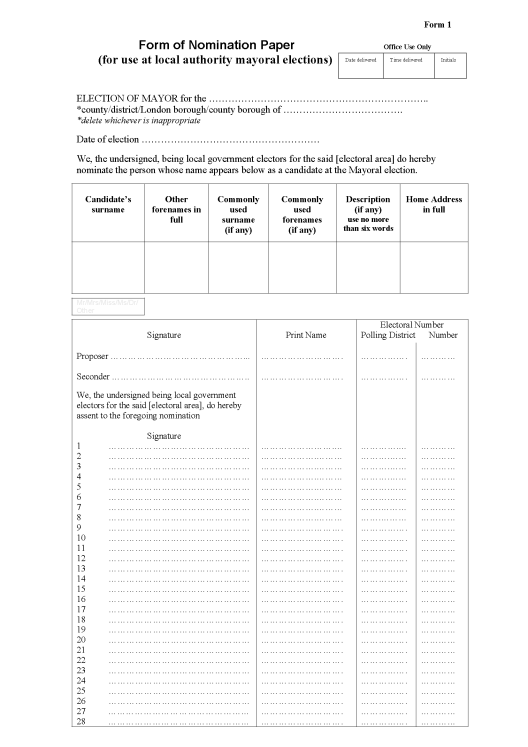
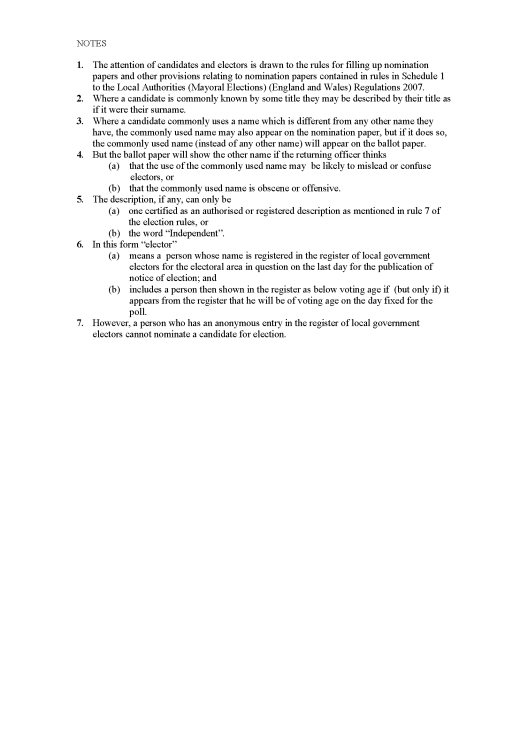


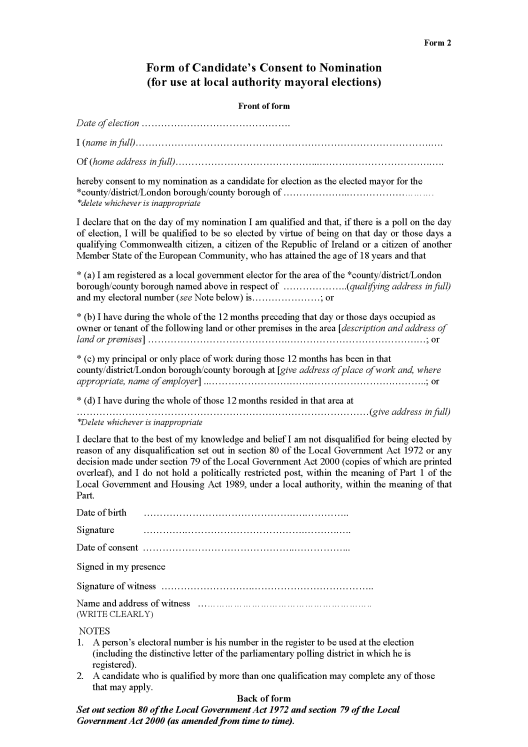


Number
Other unique identifying mark
Election of the Mayor for [insert name of authority]
on…………….20….


Number
Other unique identifying mark
Election of the Mayor for [insert name of authority]
on…………….20….


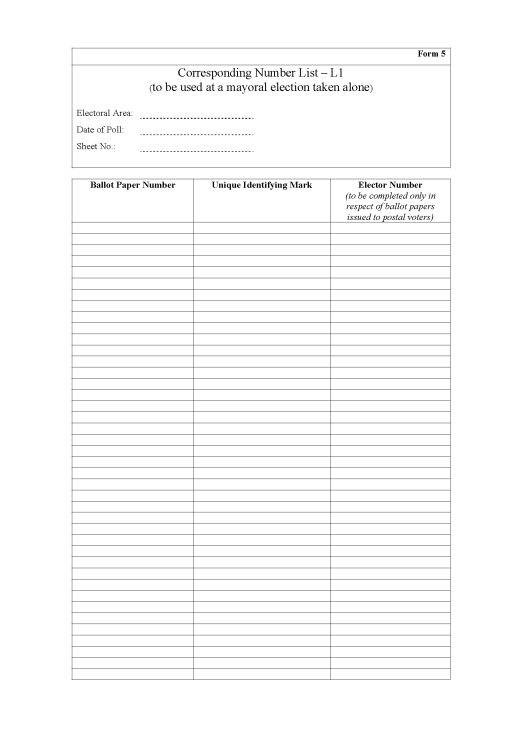
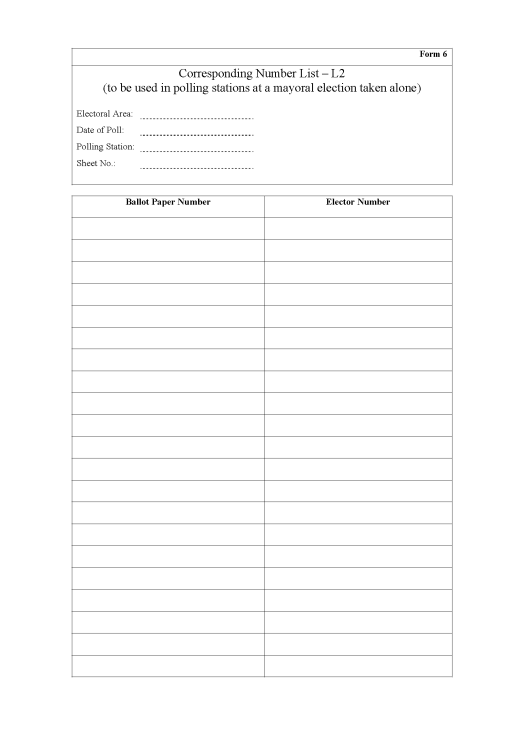


SCHEDULE 2Modifications of Acts and Statutory Instrument
Table 1 | |
The Representation of the People Act 1983 | |
(1) Provision | (2) Modification |
|---|---|
Section 31 (polling districts and stations at local government elections)31 | In subsection (1)—
In subsection (1A), after “county borough councillors”, insert “or elected mayors of county or county borough councils,”. |
Section 35 (returning officers: local elections in England and Wales)32 | In subsection (1)—
|
In subsection (1A), in paragraph (a), after “councillors of the county or county borough”, insert “and elected mayors of the county or county borough council”. | |
In subsection (3), after “London borough councillors”, insert “or the election of an elected mayor of a London borough council”. | |
F157Section 36 (local elections in England) | In subsection (3) in paragraph (a), after “such a councillor,” insert In subsection (3AC), in paragraph (a), after “such a councillor”, insert In subsection (4), after “a London borough)” insert In subsection (6), after “England”, insert |
F157Section 39 (local elections void etc in England and Wales) | In subsection (2), after “other reason”, insert In subsection (5), in paragraph (a), after “section 36 or section 36A above”, insert In subsection (6), in paragraph (a)—
|
Section 40 (timing as to local elections in England and Wales)35 | In subsection (1), after “the 1999 Act”, insert “or F158regulations under section 9HE or 44 of the 2000 Act”. |
In subsection (2), after “the 1999 Act” insert “and (in the case of a mayoral election) F158regulations under section 9HE or 44 of the 2000 Act”. | |
In subsection (3)—
| |
F159. . . | F159. . |
Section 47 (loan of equipment for local elections)37 | In subsection (2)—
|
Section 48 (validity of local elections and legal costs) | In subsection (1), after “section 42 above”, insert “or F158regulations under section 9HE or 44 of the 2000 Act”. |
Section 50 (effect of misdescription) | In paragraph (c)—
|
Section 52 (discharge of registration duties)38 | In subsections (1) and (4), after “this Act”, insert “(including any such functions in relation to mayoral elections)”. |
Section 54 (payment of expenses of registration)39 | In subsection (1) after “this Act”, at the first place where these words appear, insert “(including any such functions in relation to mayoral elections)”. |
F161Section 59A (reports on voter identification requirements in Great Britain) | After subsection (5) insert—
In subsection (6), after paragraph (b) insert—
|
Section 61 (other voting offences)40 | In subsection (2), in paragraph (a)—
In subsection (3) in paragraph (a) (ii) after “councillors”, insert “or at a mayoral election”. In subsection (6A)41, for “rule 40 (1ZC) or (1ZE) of the parliamentary elections rules”, substitute “rule 40 (4) or (6) of the Mayoral Elections Rules”. |
Section 67 (appointment of election agent)42 | In subsection (2)—
|
Section 76 (limitation of election expenses)43 | F162For subsection (2) substitute—
|
Section 85 (penalty for “sitting or voting” where no return and declarations transmitted)44 | Omit subsection (2). |
Section 85A (disqualification where no return and declarations transmitted after election of Mayor of London)45 | In subsection (1)—
|
Section 87A (duty of appropriate officer to forward returns and declarations to Electoral Commission). | In subsection (1) after paragraph (b) insert “or, (c) a mayoral election”. |
Section 94 (imitation of poll cards)46 | In subsection (2)—
|
Section 96 (schools and rooms for local election meetings)47 | In subsection (1), after “section 36”, insert “above, or regulations made under section 44 of the 2000 Act”. |
Section 97 (disturbances at election meetings)48 | In subsection (2), in paragraph (b), after “section 36”, insert “above, or regulations made under section 44 of the 2000 Act”. |
Section 99 (officials not to act for candidates) | In subsection (1), in paragraph (b), after “section 36”, insert “above, or regulations made under section 44 of the 2000 Act”. |
Section 118A (meaning of candidate)49 | In subsection (3), after “local government Act”, insert “or at an election for a mayor under the 2000 Act”. |
Section 199B (translation of certain documents)50 | F163In subsection (6), insert after paragraph (b)—
|
Section 203 (local government provisions as to England and Wales)51 | In subsection (1)—
|
In subsection (1A), at the end, insert “or a mayoral election”. | |
In subsection (2), in paragraph (b), after “Authority elections”, insert “or mayoral elections”. | |
Table 2 | |
The Representation of the People Act 198552 | |
Section 15 (combination of polls at parliamentary F166... and local elections) | F167In subsection (1), at the end of paragraph (b), insert—
|
Omit F168subsection (5). | |
Table 3 | |
The Representation of the People Act 200054 | |
F169Section 10 (pilot schemes for local elections in England and Wales) | In subsection (2), for “Representation of the People Acts” substitute “Local Government Act 2000”. |
In subsection (7), in paragraph (a) for “Representation of the People Acts” substitute “Local Government Act 2000”. | |
Section 11 (revision of procedures in the light of pilot schemes) | In subsection (6) for “Rules made under section 36 of the 1983 Act (local election in England and Wales)” substitute “Regulations made under section 9HE or 44 (power to make provision about elections) of the Local Government Act 2000”. |
Schedule 4 (absent voting in Great Britain) | In paragraph 1, in sub-paragraph (1)—
|
In paragraph 2, in sub-paragraph (6A)55 for “rule 40(1ZC) or (1ZE) of the parliamentary elections rules”, substitute “rule 40(4) or (6) of the Mayoral Elections Rules”. | |
In paragraph 7, in sub-paragraph (10)56 for “rule 40(1ZC) or (1ZE) of the parliamentary elections rules”, substitute “rule 40(4) or (6) of the Mayoral Elections Rules”. | |
Table 4 | |
The Representation of The People (England and Wales) Regulations 200157 | |
Regulation 3 (interpretation) | At the end of paragraph (2)(b) insert—
At the end of paragraph (4), insert—
|
Regulation 50 (interpretation of Part 4) | At the end of the definition of “Schedule 4” insert “as modified by Schedule 2 to the Local Authorities (Mayoral Elections) (England and Wales) Regulations 2007.” |
Regulation 64 (interpretation of Part 5) | At the appropriate place, insert— “candidates” includes a candidate at a mayoral election under F171Part 1A or Part 2 of the 2000 Act;”. |
Regulation 65 (combination of polls) | F172In paragraph (1), after sub-paragraph (b) insert—
|
F173Regulation 82A (postal voting documents handed in to the returning officer) | In paragraph (1), in sub-paragraph (b), after paragraph (i) insert— “(ia) rule 47(5)(a) of the Mayoral Elections rules.”. |
Table 5 | |
The Electoral Administration Act 2006 | |
Section 32 (photographs on ballot papers: piloting) | In subsection (10)—
|
Section 44 (access to other election documents: supplementary) | In paragraph (12), at the end insert “subject to modifications made by regulations made under section 44 of the 2000 Act.”. |
Section 69 (encouraging electoral participation) | In paragraph (9) at the end, insert—
|
F174SCHEDULE 2AModification to a provision in the Representation of the People Act 1983 where a mayoral election is taken alone or together with a police and crime commissioner election
TABLEThe Representation of the People Act 1983
(1) Provision | (2) Modification |
|---|---|
Section 199B (translation of certain documents) | In subsection (6), insert after paragraph (b)— “(ba) in the case of an election for a mayor under the 2000 Act, must have printed at the top of the list of candidates the words “Vote (x) for one candidate only” if there are only two candidates, or the words “Vote once (x) in column 1 for your first choice, and vote once (x) in column 2 for your second choice” if there are more than two candidates.” |
SCHEDULE 3Mayoral Election (Combination of Polls) Rules
PART 1General provisions
Citation
1.
These Rules may be cited as the Mayoral Elections (Combination of Polls) Rules.
Interpretation
2.
(1)
In these Rules, unless the context indicates otherwise—
F175“anonymous elector’s document” has the meaning given in regulation 3(1) of the Voter Identification Regulations 2022”;
“the Appendix” means the Appendix to these Rules;
“candidate” means a candidate to be an elected mayor;
“counting observer” shall have the same meaning as in regulation 2(1) of the Referendums Regulations;
“counting officer” shall have the same meaning as in regulation 2(1) of the Referendums Regulations;
F176...
“polling observer” shall have the same meaning as in regulation 2(1) of the Referendums Regulations;
“returning officer”, in relation to an election means—
(a)
(b)
any person appointed under subsection (4) of that section by a person of a description mentioned in paragraph (a);
F177“temporary electoral identity document” has the meaning given in regulation 3(1) of the Voter Identification Regulations 2022”;
“voting area” shall have the same meaning as in regulation 2 of the Referendums Regulations.
(2)
In the case of a referendum, a reference to—
(a)
a “candidate” shall be construed as a reference to a petition organiser;
(b)
an “election agent” or a “counting agent” shall be construed as a reference to a counting observer;
(c)
a “polling agent” shall be construed as a reference to a polling observer; and
(d)
a “returning officer” shall be construed as a reference to a counting officer.
(3)
Subject to paragraph (4), other expressions used both in these Rules and in the 1983 Act (as it applies to local government elections) have the same meaning in these Rules as they have in that Act.
(4)
Where such expressions are used in relation to a mayoral election, they have the meaning as defined in regulation 2 or modified by regulation 3.
PART 2Provisions as to time
Timetable
3.
The proceedings at the election shall be conducted in accordance with the following Timetable:
Proceedings | Time |
|---|---|
Publication of notice of election | Not later than the twenty-fifth day before the day of election. |
Delivery of nomination papers | F178Not later than 4 in the afternoon on the nineteenth day before the day of election. |
Publication of statement as to persons nominated | F179Not later than 4 in the afternoon on the eighteenth day before the day of election. |
Delivery of notices of withdrawal of candidature | F180Not later than 4 in the afternoon on the nineteenth day before the day of election. |
Notice of poll | Not later than the sixth day before the day of election. |
Polling | Between the hours of 7 in the morning and 10 at night on the day of election. |
Computation of time
4.
(1)
In computing any period of time for the purposes of the Timetable—
(a)
a Saturday or Sunday,
(b)
Christmas Eve, Christmas Day, Good Friday or a bank holiday, or
(c)
a day appointed for public thanksgiving or mourning,
shall be disregarded, and any such day shall not be treated as a day for the purpose of any proceedings up to the completion of the poll nor shall the returning officer be obliged to proceed with the counting of votes on such a day.
(2)
PART 3Stages common to contested and uncontested elections
Notice of election
5.
(1)
The returning officer shall publish notice of the election stating—
(a)
the place and times at which nomination papers are to be delivered, and
(b)
the date of the poll in the event of a contest,
and the notice must state that forms of nomination papers may be obtained at that place and those times.
(2)
The notice of election must also state the arrangements which apply for the payment of the deposit required by rule 10 to be made by means of the electronic transfer of funds.
(3)
The notice of election must state the date by which—
(a)
applications to vote by post or by proxy, and
(b)
other applications and notices about postal or proxy voting,
must reach the F181registration officer in order that they may be effective for the election.
Nomination of candidates
6.
(1)
Each candidate must be nominated by a separate nomination paper.
(2)
A nomination paper must be in the appropriate form in the Appendix or a form to the like effect and shall be delivered at the place fixed for the purpose by the returning officer, which shall be at the offices of the council of the county, county borough, district or London borough in which the electoral area wholly or mainly lies.
(3)
A nomination paper must state the candidate’s—
(a)
full names, F182and
F183(b)
home address, in full, and
(c)
if desired, description,
and the surname must be placed first in the list of names.
F184(4)
If a candidate—
(a)
commonly uses a surname that is different from any other surname the candidate has,
(b)
commonly uses a forename that is different from any other forename the candidate has, or
(c)
otherwise commonly uses one or more forenames or a surname in a different way from the way in which the candidate’s names are stated in accordance with paragraph (3)(a),
the nomination paper may state the commonly used name or names in addition to the names as stated in accordance with paragraph (3)(a).
(5)
The description, if any, which may not comprise more than six words, must consist of either—
(a)
that authorised as mentioned in paragraph rule 7(1) or (3); or
(b)
the word “Independent”.
F185(6)
The nomination paper must be accompanied by a form (in these Rules referred to as the “home address form”) which states—
(a)
the candidate’s—
(i)
full names,
(ii)
home address in full, and
(iii)
qualifying address or, if the candidate declares they are qualified by more than one of the qualifications mentioned in paragraph (9), qualifying addresses;
(b)
the attesting person’s—
(i)
full names, and
(ii)
home address in full.
Provision in paragraph (2) about delivery of the nomination paper applies also to the home address form.
(7)
The home address form—
(a)
may contain a statement made and signed by the candidate that the candidate requires their home address not to be made public, and
(b)
if it does so, must—
(i)
if that address is in the United Kingdom, state the relevant area;
(ii)
if that address is outside the United Kingdom, state the country within which it is situated.
(8)
The home address form must also state, in relation to each qualifying address, which of the qualifications mentioned in paragraph (9) that address relates to.
(9)
In this rule, “qualifying address”, in relation to a candidate, means—
(a)
if the candidate declares in their consent to nomination that they are qualified to be elected as mayor by virtue of being registered as a local government elector at a particular address, that address;
(b)
if the candidate declares in that consent that they are qualified to be elected as mayor by virtue of owning or occupying land or other premises in a particular area, a description and the address of that land or those premises;
(c)
if the candidate declares in that consent that they are qualified to be elected as mayor by virtue of their principal or only place of work being in a particular area, the address in full of that place of work;
(d)
if the candidate declares in that consent that they are qualified to be elected as mayor by virtue of residing in a particular area, the address, or addresses, in full at which the candidate has so resided.
(10)
In this rule—
“attesting person”, in relation to a candidate, means the person who attests the candidate’s consent to nomination in accordance with rule 9(c);
“relevant area”—
(a)
in relation to a home address which is in England, means—
- (i)
if it is within a district for which there is a district council, that district;
- (ii)
if it is within a county in which there are no districts with councils, that county;
- (iii)
if it is within a London borough, that London borough;
- (iv)
if it is within the City of London (including the Inner and Middle Temples), the City of London;
- (v)
if it is in the Isles of Scilly, the Isles of Scilly;
(b)
in relation to a home address which is in Wales, means—
- (i)
if it is within a county, that county;
- (ii)
if it is within a county borough, that county borough;
(c)
in relation to a home address in Scotland, means the local government area in which it is situated;
(d)
in relation to a home address in Northern Ireland, means the local government district in which it is situated.
Nomination papers: name of registered political party
7.
(1)
A nomination paper may not include a description of a candidate which is likely to lead electors to associate the candidate with a registered political party unless the party is a qualifying party in relation to the electoral area and the description is authorised by a certificate—
(a)
issued by or on behalf of the registered nominating officer of the party, and
(b)
received by the returning officer before the last time for the delivery of nomination papers set out in the Timetable in rule 3.
(2)
In paragraph (1) an authorised description may be either—
(a)
(b)
(3)
A nomination paper may not include a description of a candidate which is likely to lead electors to associate the candidate with two or more registered political parties unless the parties are each qualifying parties in relation to the electoral area and the description is a registered description authorised by a certificate—
(a)
issued by or on behalf of the registered nominating officer of each of the parties, and
(b)
received by the returning officer before the last time for the delivery of nomination papers set out in the Timetable in rule 3.
(4)
(5)
A person shall be guilty of a corrupt practice if he fraudulently purports to be authorised to issue a certificate under paragraph (1) or (3) on behalf of a registered political party’s nominating officer.
(6)
For the purposes of the application of this rule in relation to an election—
(a)
“registered political party” means a party which was registered under Part 2 of the Political Parties, Elections and Referendums Act 2000 on the day (“the relevant day”) which is two days before the last day for the delivery of nomination papers at that election;
(b)
a registered political party is a qualifying party in relation to an electoral area if the electoral area is in England or Wales and the party was on the relevant day registered in respect of that part of Great Britain in the Great Britain register maintained under that Part of that Act.
(7)
For the purposes of paragraph (6)(a), any day falling within rule 4(1) must be disregarded.
Subscription of nomination paper
8.
(1)
The nomination paper must be subscribed by two electors as proposer and seconder, and by twenty-eight other electors as assenting to the nomination.
(2)
Where a nomination paper has the signatures of more than the required number of persons as proposing, seconding or assenting to the nomination of a candidate, the signature or signatures (up to the required number) appearing first on the paper in each category must be taken into account to the exclusion of any others in that category.
(3)
The nomination paper must give the electoral number of each person subscribing it.
(4)
The returning officer—
(a)
must supply any elector with as many forms of nomination paper and forms of consent to nomination as may be required at the place and during the time for delivery of nomination papers, and
(b)
must at any elector’s request prepare a nomination paper for signature,
but it is not necessary for a nomination or consent to nomination to be on a form supplied by the returning officer.
(5)
In this rule “elector”—
(a)
means a person who is registered in the register of local government electors for the electoral area in question on the last day for the publication of notice of the election; and
(b)
includes a person then shown in the register as below voting age if (but only if) it appears from the register that he will be of voting age on the day fixed for the poll.
(6)
But, in this rule, “elector” does not include a person who has an anonymous entry in the register.
Consent to nomination
9.
A person shall not be validly nominated unless his consent to nomination—
(a)
is given in writing, on or within one month before the last day for the delivery of nomination papers,
F186(b)
is in the appropriate form in the Appendix or a form to the like effect and includes—
(i)
(ii)
for a nomination in Wales, a copy of sections 80 and 81 of the Local Government Act 1972 and sections 78A and 79 of the Local Government Act 2000.
(c)
is attested by one witness, and
(d)
is delivered at the place and within the time for the delivery of nomination papers.
Deposits
10.
(1)
A person shall not be validly nominated unless the sum of £500 is deposited by him or on his behalf, with the returning officer at the place and within the time for delivery of nomination papers.
(2)
The deposit may be made either—
(a)
by the deposit of any legal tender, or
(b)
by means of a banker’s draft, or
(c)
with the returning officer’s consent, in any other manner (including by means of a debit or credit card or the electronic transfer of funds),
but the returning officer may refuse to accept a deposit sought to be made by means of a banker’s draft if he does not know that the drawer carries on business as a banker in the United Kingdom.
(3)
Where the deposit is made on behalf of the candidate, the person making the deposit must at the time he makes it give his name and address to the returning officer (unless they have previously been given to him under section 67 (appointment of election agent) of the 1983 Act).
Decisions as to validity of nomination papers F190and home address forms
11.
(1)
Where a nomination paper and the candidate’s consent to nomination F191and home address form are delivered in accordance with these Rules, the candidate shall be deemed to stand nominated unless and until—
(a)
the returning officer decides that the nomination paper is invalid, or
F192(aa)
the returning officer decides that the candidate’s home address form—
(i)
does not comply with the requirements of rule 6(6) or (8), or
(ii)
if the form contains a statement under rule 6(7)(a), does not comply with the signature requirement in that rule or the requirements of rule 6(7)(b), or
(b)
proof is given to the returning officer’s satisfaction of the candidate’s death, or
(c)
the candidate withdraws.
(2)
The returning officer is entitled to hold the nomination paper of a person invalid only on one of the following grounds—
(a)
that the particulars of the candidate or of the persons subscribing the paper are not as required by law; F193...
(b)
that the paper is not subscribed as so required.
F194(c)
in the case of a mayoral election held in England, that an order under section 30 of the Elections Act 2022 (disqualification orders) has effect in relation to the candidate.
(3)
(4)
If in the returning officer’s opinion a nomination paper breaks rule 7(1) or (3), he must give a decision to that effect—
(a)
as soon as practicable after the delivery of the nomination paper, and
(b)
in any event, before the end of the period of 24 hours starting with the close of the period for delivery of nomination papers set out in the Timetable in rule 3.
(5)
Where the returning officer decides that a nomination paper is invalid, he must endorse and sign on the paper the fact and the reasons for his decision.
(6)
(7)
The returning officer’s decision that a nomination paper is valid shall be final and shall not be questioned in any proceeding whatsoever.
(8)
Subject to paragraph (7), nothing in this rule prevents the validity of a nomination being questioned on an election petition.
Publication of statement of persons nominated
12.
(1)
The returning officer must prepare and publish a statement showing the persons who have been and stand nominated and any other persons who have been nominated, with the reason why they no longer stand nominated.
(2)
The statement must show the names, addresses and descriptions of the persons nominated as given in their nomination papers F198and home address forms.
(3)
(4)
Paragraph (3) does not apply if the returning officer thinks—
(a)
that the use of the person’s commonly used name may be likely to mislead or confuse electors, or
(b)
that the commonly used name is obscene or offensive.
(5)
If paragraph (4) applies, the returning officer must give notice in writing to the candidate of his reasons for refusing to allow the use of a commonly used name.
(6)
The statement must show the persons standing nominated arranged alphabetically in the order of their surnames, and if there are two or more of them with the same surname, of their other names.
F201(6A)
In relation to a nominated person whose home address form (or, if the person is nominated by more than one nomination paper, any of the home address forms) contains—
(a)
the statement mentioned in rule 6(7)(a), and
(b)
the information mentioned in rule 6(7)(b),
the reference in paragraph (2) to the person’s address are to be read as a reference to the information mentioned in rule 6(7)(b).
(7)
In the case of a person nominated by more than one nomination paper, the returning officer must take the particulars required by the foregoing provisions of this rule from such one of the papers as the candidate (or the returning officer in default of the candidate) may select.
F202(8)
Where—
(a)
two or more of the names shown on the statement are the same or so similar it is likely to cause confusion,
(b)
paragraph (6A) applies in relation to each of the persons in question, and
(c)
the information mentioned in rule 6(7)(b) is the same for both of them,
the returning officer may cause any of their particulars to be shown on the statement with such amendments or additions as the officer thinks appropriate to reduce the likelihood of confusions.
(9)
Where it is practicable to do so before the publication of the statement, the returning officer must consult any person whose particulars are to be amended or added to under paragraph (8).
(10)
The returning officer must give notice in writing to any person whose particulars are amended or added to under paragraph (8).
(11)
Anything done by a returning officer in pursuance of paragraph (8) must not be questioned in proceedings other than proceedings on an election petition.
(12)
A returning officer must have regard to any guidance issued by the Electoral Commission for the purposes of paragraph (8).
Inspection of nomination papers and consent to nomination
13.
During ordinary office hours on any day, other than a day specified in rule 4(1), after the latest time for delivery of nomination papers and before the date of the poll, any person may inspect and take copies of, or extracts from, nomination papers and consents to nomination.
F203Inspection of home address forms
13A.
(1)
During ordinary office hours on any day, other than a day specified in rule 4(1), after the latest time for delivery of nomination papers and before the date of the poll, a specified person may inspect the home address forms.
(2)
The specified persons are—
(a)
any person standing nominated as a candidate in the same electoral area, or
(b)
the election agent, proposer or seconder of such a person.
(3)
But where a candidate acts as their own election agent, the candidate may nominate another person who shall be entitled to inspect the forms.
(4)
Where a person stands nominated by more than one nomination paper, only the persons subscribing as proposer and seconder—
(a)
to such one of those papers as the candidate may select, or
(b)
in default of such a selection, to that one of those papers which is first delivered in accordance with rule 6(2),
are entitled to inspect the forms as the candidate’s proposer and seconder.
(5)
Nothing in this rule permits any person to take a copy of, or extracts from, any home address form.
(6)
The returning officer must not permit a home address form to be inspected otherwise than in accordance with this rule, or for some other purpose authorised by law.
Correction of minor errors
14.
(1)
A returning officer may, if he thinks fit, at any time before the publication under rule 12 of the statement of persons nominated, correct minor errors in a nomination paper F204or home address form.
(2)
Errors which may be corrected include—
(a)
errors as to a person’s electoral number;
(b)
obvious errors of spelling in relation to the details of a candidate.
F205(c)
errors as to the information mentioned in rule 6(7)(b).
(3)
Anything done by a returning officer in pursuance of this rule shall not be questioned in any proceedings other than proceedings on an election petition.
(4)
A returning officer must have regard to any guidance issued by the Electoral Commission for the purposes of this rule.
Withdrawal of candidature
15.
(1)
A candidate may withdraw his candidature by notice of withdrawal—
(a)
signed by him and attested by one witness; and
(b)
delivered to the returning officer at the place for delivery of nomination papers.
(2)
Where a candidate is outside the United Kingdom, a notice of withdrawal signed by his election proposer and accompanied by a written declaration also so signed of the candidate’s absence from the United Kingdom shall be of the same effect as a notice of withdrawal signed by the candidate; but where the candidate stands nominated by more than one nomination paper a notice of withdrawal under this paragraph shall be effective if, and only if—
(a)
it and the accompanying declaration are signed by all the proposers except any who is, and is stated in that declaration to be, outside the United Kingdom; or
(b)
it is accompanied, in addition to that declaration, by a written statement signed by the candidate that the proposer giving the notice is authorised to do so on the candidate’s behalf during his absence from the United Kingdom
Method of election
16.
If, after any withdrawals under rule 15—
(a)
more than two candidates remain validly nominated, a poll shall be taken in accordance with F206Part 4 or, in the case of a mayoral election in Wales, Parts 4 and 5 of these Rules,
(b)
only two candidates remain validly nominated, a poll shall be taken in accordance with Part 4;
(c)
only one candidate remains validly nominated, that person shall be declared to be elected in accordance with Part 6.
PART 4Contested elections
Poll to be taken by ballot
17.
The votes at the poll shall be given by ballot.
The ballot papers
18.
(1)
The ballot of every person entitled to a vote at the election shall consist of a ballot paper.
(2)
The persons remaining validly nominated for election to the office of mayor, after any withdrawals, and no others, shall be entitled to have their names inserted in the ballot paper at that election.
(3)
Every ballot must be in the appropriate form, and must be printed in accordance with the appropriate directions, set out in the Appendix, and—
(a)
must contain the names and other particulars of the candidates as shown in the statement of persons nominated;
(b)
must be capable of being folded up;
(c)
must have a number and other unique identifying mark printed on the back;
(d)
must be of a different colour from that of any ballot papers used at any relevant election or referendum.
(4)
If a candidate who is the subject of a party’s authorisation under rule 7(1) so requests, the ballot paper must contain, against the candidate’s particulars, the party’s registered emblem (or, as the case may be, one of the party’s registered emblems).
F207(4A)
If a candidate who is the subject of an authorisation by two or more parties under rule 7(3) so requests, the ballot paper must contain, against the candidate’s particulars, the registered emblem (or, as the case may be, one of the registered emblems) of one of those parties.
(5)
The candidate’s request under paragraph (4) F208or (4A) must—
(a)
be made in writing to the returning officer, and
(b)
be received by him during the period for delivery of nomination papers set out in the Timetable in rule 3.
(6)
The order of the names in the ballot paper must be the same as in the statement of persons nominated.
The corresponding number list
19.
(1)
The returning officer must prepare a list containing the numbers and other unique identifying marks of all of the ballot papers to be issued by him in pursuance of rule 24 or provided by him in pursuance of rule 28.
(2)
The list must be in the appropriate form in the Appendix or a form to like effect.
The official mark
20.
(1)
Every ballot paper must contain an appropriate security marking (the official mark).
(2)
The official mark must be kept secret, and an interval of not less than five years shall intervene between the use of the same official mark at an election (of whatever description) for the same county, county borough, district or London borough, as the case may be.
(3)
The returning officer may use a different official mark for different purposes at the same election.
Prohibition of disclosure of vote
21.
No person who has voted at the election shall, in any legal proceeding to question the election, be required to state for whom he has voted.
Use of schools and public rooms
22.
(1)
The returning officer may use, free of charge, for the purpose of taking the poll or counting the votes—
(a)
a room in a school maintained or assisted by a F209local authority (as defined in the Education Act 1996) or a school in respect of which grants are made out of moneys provided by Parliament to the person or body of persons responsible for the management of the school;
(b)
a room the expense of maintaining which is met by any local authority.
(2)
The use of a room in an unoccupied hereditament for that purpose or those purposes does not render a person liable to any payment by way of council tax or non-domestic rate in respect of that hereditament and any day on which it is so used.
(3)
The returning officer must make good any damage done to, and defray any expense incurred by the persons having control over, any such room as is mentioned in paragraph (1) by reason of its being used for the purpose of taking the poll or counting the votes.
Notice of poll
23.
(1)
The returning officer must publish notice of the poll stating—
(a)
the day and hours fixed for the poll;
(b)
particulars of each candidate remaining validly nominated (the names and other particulars of the candidates, and the order of their names being the same as in the statement of persons nominated); and
(c)
the names of all persons signing a candidate’s nomination paper.
(2)
Where a candidate is nominated by more than one nomination paper, the nomination paper referred to in paragraph (1)(c) must be that from which the names and other particulars of the candidate shown in the statement of persons nominated are taken.
(3)
The returning officer must, not later than the time of the publication of the notice of the poll, also give public notice of—
(a)
the situation of each polling station; and
(b)
the description of voters entitled to vote there,
and he must as soon as practicable after giving such a notice give a copy of it to each of the election agents.
(4)
The notice published under paragraph (3) above shall—
(a)
state that the poll at the mayoral election is to be taken together with the poll at a relevant election or referendum;
(b)
(c)
where the polls are to be taken together in part of the electoral area only, specify that part.
Postal ballot papers
24.
(1)
(2)
The returning officer must also issue to those entitled to vote by post such information as he thinks appropriate about how to obtain—
(a)
translations into languages other than English of any directions to or guidance for voters sent with the ballot paper;
(b)
a translation into Braille of such directions or guidance;
(c)
graphical representations of such directions or guidance;
(d)
the directions or guidance in any other form (including any audible form).
(3)
The postal voting statement must include provision for the form to be signed and for stating the date of birth of the elector or proxy (as the case may be).
(4)
In the case of a ballot paper issued to a person at an address in the United Kingdom, the returning officer must ensure that the return of the ballot paper and postal voting statement is free of charge to the voter.
Provision of polling stations
25.
(1)
The returning officer must provide a sufficient number of polling stations and, subject to the following provisions of this rule, must allot the electors to the polling stations in such manner as he thinks most convenient.
(2)
One or more polling stations may be provided in the same room.
(3)
The polling station allotted to electors from any parliamentary polling district wholly or partly within the electoral area must, in the absence of special circumstances, be in the parliamentary polling place for that district, unless that place is outside the electoral area.
(4)
The returning officer must provide each polling station with such number of compartments as may be necessary in which the voters can mark their votes screened from observation.
F211(5)
In the case of a mayoral election held in England, the returning officer must ensure that each polling station contains an area in which voters can produce proof of identity in private.
Appointment of presiding officers and polling clerks
26.
(1)
The returning officer must appoint and pay a presiding officer to attend at each polling station and such clerks as may be necessary for the purposes of the election, but he must not appoint any person who has been employed by or on behalf of a candidate in or about the election.
(2)
The returning officer may, if he thinks fit, preside at a polling station and the provisions of these Rules relating to a presiding officer shall apply to a returning officer so presiding with the necessary modifications as to things to be done by the returning officer to the presiding officer or by the presiding officer to the returning officer.
(3)
A presiding officer may do, by the clerks appointed to assist him, any act (including the asking of questions) which he is required or authorised by these Rules to do at a polling station except order the arrest, exclusion or removal of any person from the polling station F212and in respect of a presiding officer for a mayoral election in England only—
(a)
refuse to deliver a ballot paper under rule 35(3A) or rule 37(1F) (including that rule as applied by rules 38, 39 or 40), or
(b)
resolve doubts over identity as mentioned in rule 37(1G) (including that rule as applied by rule 38, 39 or 40).
Issue of official poll cards
27.
(1)
The returning officer must as soon as practicable after the publication of the notice of the election send to electors and their proxies an official poll card.
(2)
An elector’s official poll card must be sent or delivered to his qualifying address, and a proxy’s to his address as shown in the list of proxies.
(3)
The official poll card must be in the appropriate form in the Appendix, or a form to the like effect, and must set out—
(a)
the name of the local authority to which the election relates;
(b)
that the election is a mayoral election;
(c)
the elector’s name, qualifying address and number on the register;
(d)
the date and hours of the poll and the situation of the elector’s polling station; and
(e)
such other information as the returning officer thinks appropriate,
and different information may be provided in pursuance of sub-paragraph (e) to different electors or descriptions of elector.
(4)
In the case of an elector with an anonymous entry, instead of containing the matter mentioned in paragraph (3)(c), the poll card must contain such matter as is specified in the appropriate form in the Appendix.
(5)
Paragraph (5) of rule 8 shall apply for the interpretation of this rule.
(6)
If the returning officer and the returning officer for each relevant election or referendum think fit, an official poll card issued under this rule may be combined with the official poll card issued at every relevant election or referendum.
Equipment of polling stations
28.
(1)
The returning officer must provide each presiding officer with such number of ballot boxes and ballot papers as in the returning officer’s opinion may be necessary.
(2)
The same ballot box may be used for the poll at the mayoral election and the poll at every relevant election or referendum, if the returning officer thinks fit.
(3)
Every ballot box must be so constructed that the ballot papers can be put in it, but cannot be withdrawn from it, without the box being unlocked or, where the box has no lock, the seal being broken.
(4)
The returning officer must provide each polling station with—
(a)
materials to enable voters to mark the ballot papers;
(b)
copies of the register of electors for the electoral area or such part of it as contains the names of the electors allotted to the station;
(c)
the parts of any special lists prepared for the election corresponding to the register of electors or the part of it provided under sub-paragraph (b);
(d)
a list consisting of that part of the list prepared under rule 19 which contains the numbers (but not the other unique identifying marks) corresponding to those on the ballot papers provided to the presiding officer of the polling station.
(5)
(6)
The returning officer must also provide each polling station with—
(a)
at least one large version of each ballot paper which must be printed on the same colour paper as the corresponding ballot paper and must be displayed inside the polling station for the assistance of voters who are partially sighted; F213...
(b)
F214for a mayoral election in Wales, a device of such description as is set out in paragraph (11) below for enabling voters who are blind or partially sighted to vote without any need for assistance from the presiding officer or any companion (within the meaning of rule 39(1)).
F215(c)
for a mayoral election in England, such equipment as it is reasonable to provide for the purposes of enabling, or making it easier for, relevant persons to vote independently in the manner directed by rule 37 (voting procedure), including in relation to voting secretly; and for this purpose “relevant persons” means persons who find it difficult or impossible to vote in that manner because of—
(i)
blindness or partial sight, or
(ii)
another disability.
F216(6A)
Paragraph (10) of rule 29 of Schedule 1 to the 1983 Act (Parliamentary elections rules: guidance to returning officers) applies for the purposes of paragraph (6)(c) of this rule as it applies for the purposes of that rule but as if the reference in that paragraph to paragraph (3A)(b) were a reference to paragraph (6)(c) of this rule.
F217(6B)
In the case of a mayoral election held in England—
(a)
the returning officer must also provide each polling station with a ballot paper refusal list, in the appropriate form in the Appendix or a form to the like effect, on which entries are to be made as mentioned in rule 41A (refusal to deliver ballot paper: mayoral elections in England);
(b)
a large notice must be displayed inside each polling station containing—
(i)
relevant identification details, and
(ii)
a statement that further proof of identity may be required to resolve any discrepancy between the name of the holder of a form of identification and the name of the elector or proxy that the voter claims to be.
(6C)
In paragraph (6B)(b)(i), “relevant identification details” means details of the documents the voter needs to produce when applying for a ballot paper, namely—
(a)
in the case of an elector (other than an elector with an anonymous entry) or a proxy, any of the forms of identification for the time being referred to in rule 37(1H) of Schedule 1 to the 1983 Act (parliamentary elections rules);
(b)
in the case of an elector with an anonymous entry, the elector’s official poll card and an anonymous elector’s document showing the same electoral number as the electoral number shown on the official poll card.
(7)
Where notwithstanding paragraph (2) above separate ballot boxes are to be used, each ballot box must be clearly marked with—
(a)
the election or referendum to which it relates, as shown on the ballot papers for that election or referendum;
(b)
the words “Place the [specify colour of ballot papers in question] ballot papers in here”.
(8)
A notice in the appropriate form in the Appendix giving directions for the guidance of voters in voting, must be printed in conspicuous characters and exhibited inside and outside every polling station.
(9)
The returning officer may also provide copies of the notice mentioned in paragraph (8) in Braille or translated into languages other than English as he considers appropriate, provided that these notices are accurate reproductions in Braille or that other language of that notice.
F218(10)
““PARLIAMENTARY ELECTION
Vote for ONLY ONE CANDIDATE by putting a cross [X] in the box next to your choice.
F219...
*[Specify name of council] COUNCIL ELECTION
([Specify colour] ballot paper)
*[Vote for NO MORE THAN … CANDIDATES by putting a cross [X] in the box next to EACH of your choices.]
*[Vote ONLY ONCE by putting a cross [X] in the box next to your choice.]
*ELECTION OF THE MAYOR OF LONDON
F220#Vote for ONLY ONE candidate by putting a cross [X] in the box next to your choice.
*ELECTION OF THE LONDON ASSEMBLY
#On the constituency members ballot paper ([specify colour]) vote for ONE candidate only.
#On the London members ballot paper ([specify colour]) vote for ONE party or individual candidate only.
*LOCAL MAYORAL ELECTION F221IN WALES
([Specify colour] ballot paper)
*[Vote for ONLY ONE CANDIDATE by putting a cross [X] in the box next to your choice.]
*[Vote by putting a cross [X] in the box
In column 1 next to your FIRST CHOICE candidate
In column 2 next to your SECOND CHOICE candidate
Your first and second choices should be different.]
F222*LOCAL MAYORAL ELECTION IN ENGLAND
*([Specify colour] ballot paper)
[Vote for ONLY ONE CANDIDATE by putting a cross [X] in the box next to your choice.]
*[Specify other] ELECTION/REFERENDUM
([Specify colour] ballot paper)
[Specify voting instructions in accordance with the legislation governing the election or referendum]
PUT NO OTHER MARK ON THE BALLOT PAPER OR YOUR VOTE MAY NOT COUNT.
*[PLEASE DO NOT FOLD THE BALLOT PAPERS FOR [specify the elections and/or referendum(s) at which the votes are to be counted electronically]. Post them, face downwards, in the [*appropriate] ballot box.]
*Complete or omit as necessary.
#Alternatively, insert such information as the GLRO may decide.””
(11)
The device referred to in paragraph (6)(b) must—
(a)
allow a ballot paper to be inserted into and removed from, or attached to and detached from, the device easily and without damage to the paper;
(b)
hold the ballot paper firmly in place during use; and
(c)
provide suitable means for the voter to—
(i)
identify the spaces on the ballot paper on which he may mark his vote; and
(ii)
identify the registered party or individual candidate to which each such space refers; and
(iii)
mark his vote on the space he has chosen.
Appointment of polling and counting agents
29.
(1)
Subject to paragraphs (3), (4) and (5), before the commencement of the poll each candidate may appoint—
(a)
polling agents to attend at polling stations for the purpose of detecting personation; and
(b)
counting agents to attend at the counting of the votes.
(2)
The same person may be appointed as a polling agent or counting agent by more than one candidate.
(3)
Not more than four polling agents, or such greater number as the returning officer may by notice allow, shall be permitted to attend at any particular polling station.
(4)
If the number of such agents appointed to attend at a particular polling station exceeds that number, the returning officer must determine by lot which agents are permitted to attend, and only the agents on whom the lot falls shall be deemed to have been duly appointed.
(5)
The returning officer may limit the number of counting agents, but in doing so must ensure that—
(a)
the number is the same in the case of each candidate; and
(b)
the number allowed to a candidate must not (except in special circumstances) be less than the number obtained by dividing the number of clerks employed on the counting by the number of candidates.
(6)
For the purposes of the calculations required by paragraph (5), a counting agent appointed for more than one candidate is a separate agent for each of the candidates for whom he has been appointed.
(7)
Notice in writing of the appointment, stating the names and addresses of the persons appointed, must be given by the candidate to the returning officer and must be so given not later than the fifth day (disregarding any day referred to rule 4(1)) before the day of the poll.
(8)
(9)
If an agent dies, or becomes incapable of acting, the candidate may appoint another person in his place, and must forthwith give to the returning officer notice in writing of the name and address of that other person.
(10)
Any appointment for a candidate authorised by this rule may be made and the notice of appointment given to the returning officer by the candidate’s election agent, instead of by the candidate.
(11)
In the following provisions of these Rules references to polling agents and counting agents shall be taken as references to agents—
(a)
whose appointments have been duly made and notified; and
(b)
where the number of agents is restricted, who are within the permitted numbers.
(12)
Any notice required to be given to a counting agent by the returning officer may be delivered at, or sent by post to, the address stated in the notice of appointment.
(13)
A candidate may himself do any act or thing which any polling or counting agent of his, if appointed, would have been authorised to do, or may assist his agent in doing any such act or thing.
(14)
A candidate’s election agent may do or assist in doing anything which the candidate’s polling or counting agent is authorised to do; and anything required or authorised by these Rules to be done in the presence of the polling or counting agent may be done in the presence of a candidate’s election agent instead of his polling agent or counting agent.
(15)
Where by these Rules any act or thing is required or authorised to be done in the presence of the polling or counting agent, the non-attendance of any agent or agents at the time and place appointed for the purpose shall not, if the act or thing is otherwise duly done, invalidate the act or thing done.
Notification of requirement of secrecy
30.
F223(1)
The returning officer must make such arrangements as he thinks fit to ensure that—
(a)
(b)
every person attending at the counting of the votes (other than any constable on duty at the counting) has been given a copy in writing of the provisions of subsections (2) and (6) of that section.
F224(2)
In this rule, a reference to a constable includes a person designated as a community support officer under section 38 of the Police Reform Act 2002 (police powers for employees).
Return of postal ballot papers
31.
(1)
Where—
(a)
a postal vote has been returned in respect of a person who is entered on the postal voters list, or
(b)
a proxy postal vote has been returned in respect of a proxy who is entered on the proxy postal voters list,
(2)
Rule 47(7) does not apply for the purpose of determining whether, for the purposes of this rule, a postal vote or a proxy postal vote is returned.
Admission to polling station
32.
(1)
The presiding officer must exclude all persons from the polling station except—
(a)
voters;
(b)
persons under the age of 18 who accompany voters to the polling station;
F225(ba)
in England, persons aged 18 or over returning a postal ballot paper or postal voting statement by hand in accordance with rule 47(8)(b);
(c)
the candidates and their election agents;
(d)
the polling agents appointed to attend at the polling station;
(e)
the clerks appointed to attend at the polling station;
(f)
(g)
the constables on duty;
(h)
the companions of voters with disabilities; and
(i)
persons entitled to be admitted to the polling station at a relevant election or referendum with which the poll at the mayoral election is combined.
(2)
The presiding officer must regulate the total number of voters and persons under the age of 18 who accompany them to be admitted to the polling station at the same time.
(3)
Not more than one polling agent shall be admitted at the same time to a polling station on behalf of the same candidate.
(4)
A constable or person employed by a returning officer must not be admitted to vote in person elsewhere than at his own polling station allotted to him under these Rules, except on production and surrender of a certificate as to his employment which must be in the appropriate form in the Appendix, or a form to the like effect, and signed by an officer of police of or above the rank of inspector or by the returning officer, as the case may be.
(5)
Any certificate surrendered under this rule must forthwith be cancelled.
F226(6)
In this rule, a reference to a constable includes a person designated as a community support officer under section 38 of the Police Reform Act 2002 (police powers for employees).
Keeping of order in station
33.
(1)
It is the presiding officer’s duty to keep order at his polling station.
(2)
If a person misconducts himself in a polling station, or fails to obey the presiding officer’s lawful orders, he may immediately, by the presiding officer’s order, be removed from the polling station—
(a)
by a constable in or near that station, or
(b)
by any other person authorised in writing by the returning officer to remove him,
and the person so removed shall not, without the presiding officer’s permission, again enter the polling station during the day.
(3)
Any person so removed may, if charged with the commission in the polling station of an offence, be dealt with as a person taken into custody by a constable for an offence without a warrant.
(4)
The powers conferred by this rule must not be exercised so as to prevent a voter who is otherwise entitled to vote at a polling station from having an opportunity of voting at that station.
Sealing of ballot boxes
34.
Immediately before the commencement of the poll, the presiding officer must—
(a)
show the ballot box, empty, to such persons, if any, as are present in the polling station, so that they may see that the box is empty;
(b)
lock up the box (if it has a lock);
(c)
place his seal—
(i)
on the lock; or
(ii)
where the ballot box has no lock, on the box,
in such a manner as to prevent its being opened without breaking the seal;
(d)
place the box in his view for the receipt of ballot papers; and
(e)
keep the box locked and sealed or, as the case may be, sealed.
Questions to be put to voters
35.
(1)
At the time of the application for a ballot paper (but not afterwards), the questions specified in the second column of the following Table—
(a)
may be put by the presiding officer to a person applying for a ballot paper who is mentioned in the first column, F227...
(b)
F230(c)
in relation to a mayoral election held in England, must be put if—
(i)
(where applicable) the person has answered the previous question in the manner indicated, and
(ii)
the letter “R” appears after the question and the candidate or the candidate’s election or polling agent requires the question to be put:
Q. No. | Person applying for ballot paper | Question |
|---|---|---|
1 | A person applying as an elector |
|
2 | A person applying as proxy |
|
3 | A person applying as proxy for an elector with an anonymous entry (instead of the questions at entry 2) |
|
4 | F234In relation to a mayoral election held in Wales: A person applying as proxy if the question at entry 2(c) or 3(c) is not answered in the affirmative | Have you already voted at this election on behalf of two persons of whom you are not the spouse, civil partner, parent, grandparent, brother, sister, child or grandchild?. [R] |
5 | A person applying as an elector in relation to whom there is an entry in the postal voters list |
|
6 | A person applying as proxy who is named in the proxy postal voters list |
|
(2)
In the case of an elector in respect of whom a notice has been issued under section 13B(3B) or (3D) of the 1983 Act, the references in the questions at entries 1(a) and 3(a), (b) and (c) to reading from the register shall be taken as references to reading from the notice issued under section 13B(3B) or (3D) of the 1983 Act.
F235(2A)
In the case of a mayoral election held in England, where a clerk—
(a)
gives a person the required information (see paragraph (5)),
(b)
puts a question specified in paragraph (1) to the person, and
(c)
decides that the person has failed to answer the question satisfactorily,
the clerk must refer the matter to the presiding officer, who must put the question to the person again.
(3)
F236In the case of a mayoral election in Wales, a ballot paper must not be delivered to any person required to answer any of the above questions unless he has answered each question satisfactorily.
F237(3A)
In the case of a mayoral election held in England, where the presiding officer—
(a)
gives a person the required information,
(b)
puts a question specified in paragraph (1) to the person (whether or not following a referral under paragraph (2A)), and
(c)
decides that the person has failed to answer the question satisfactorily,
the officer must refuse to deliver a ballot paper to the person (and see rule 41A (procedure where ballot paper is refused under this paragraph)).
(3B)
For the purposes of this rule, a person answers the question “What is your name?” or “What is your address?” satisfactorily if—
(a)
where one of those questions is put, the answer matches a name or address (as the case may be) in the register of local government electors;
(b)
where both those questions are put, the answers match a name and address in that register that relate to the same person.
(3C)
In the case of an elector in respect of whom a notice has been issued under section 13B(3B) or (3D) of the 1983 Act, the references to the register in paragraph (3B) are to be read as references to the notice issued under section 13B(3B) or (3D).
(4)
Except as authorised by this rule, no inquiry shall be permitted as to the right of any person to vote F238(and for the purposes of this paragraph, an inquiry relating to the production of identification by a voter is not to be regarded as an inquiry as to the right of the person to vote).
F239(5)
For the purposes of this rule, a person to whom any question is to be put is given “the required information” if the person is first informed that—
(a)
a ballot paper will be refused if the person fails to answer each question satisfactorily, and
(b)
giving false information may be an offence.
Challenge of voter
36.
A person must not be prevented from voting by reason only that—
(a)
a candidate or his election or polling agent declares that he has reasonable cause to believe that the person has committed an offence of personation, or
(b)
the person is arrested on the grounds that he is suspected of committing or of being about to commit such an offence.
Voting procedure
37.
(1)
F240Subject to rule 35(3A) and to paragraphs (1A) to (1N), a ballot paper must be delivered to a voter who applies for one, and immediately before delivery—
(a)
F241in the case of a mayoral election in Wales only, the number and (unless paragraph (2) applies) name of the elector as stated in the copy of the register of electors must be called out;
(b)
the number of the elector must be marked on the list mentioned in rule 28(4)(d) beside the number of the ballot paper to be issued to him;
(c)
a mark must be placed in the copy of the register of electors against the number of the elector to note that a ballot paper has been received but without showing the particular ballot paper which has been received;
(d)
in the case of a person applying for a ballot paper as proxy, a mark must also be placed against his name in the list of proxies.
F242(1A)
Paragraphs (1B) to (1N) apply in the case of a mayoral election held in England.
(1B)
A ballot paper must not be delivered to a voter unless the voter produces a specified document to the presiding officer or a clerk.
(1C)
The presiding officer or clerk must arrange for the voter to produce any document in a private area of the polling station if the voter so requests, and, in such a case, must ensure that no other persons witness the production except as permitted by the voter.
(1D)
Paragraph (1E) applies in relation to a voter where—
(a)
the voter produces a specified document to a clerk and the clerk decides that the document raises a reasonable doubt as to whether the voter is the elector or proxy that the voter claims to be, or
(b)
the voter produces a document to a clerk that the clerk reasonably suspects to be a forged document.
(1E)
Where this paragraph applies, the clerk must refer the matter and produce the document to the presiding officer, who must proceed as if the voter had produced the document to the presiding officer in the first place.
(1F)
The presiding officer must refuse to deliver a ballot paper to a voter where—
(a)
the voter produces a specified document to the officer and the officer decides that the document raises a reasonable doubt as to whether the voter is the elector or proxy that the voter claims to be, or
(b)
the voter produces a document to the officer that the officer reasonably suspects to be a forged document.
(1G)
Paragraph (1F)(a) does not apply where—
(a)
a discrepancy between the name of the holder of a specified document and the name of the elector or proxy that the voter claims to be is resolved to the presiding officer’s satisfaction at the time of the application by the voter producing further proof of identity, and
(b)
the presiding officer has no other reason (arising from any document produced by the voter) to doubt that the voter is the elector or proxy that the voter claims to be.
(1H)
The refusal to deliver a ballot paper to a voter under paragraph (1F) does not prevent the voter making a further application under paragraph (1), and paragraphs (1B) to (1G) apply on any further application.
(1I)
In this rule, a “forged document” means a false document made to resemble a specified document.
(1J)
In this rule, a “specified document”—
(a)
except in the case of a voter who has an anonymous entry in the register of electors, means a document which for the time being falls within the list specified in rule 37(1H) of Schedule 1 to the 1983 Act (parliamentary elections rules);
(b)
in the case of a voter who has an anonymous entry in the register of electors, means an anonymous elector’s document which—
(i)
was issued by the registration officer for the local authority in whose area the election is held, and
(ii)
contains the number—
(aa)
allocated to the voter as stated in the copy of the register of electors, or
(bb)
where an entry relating to the voter is added to the register in pursuance of a notice issued under section 13B(3B) or (3D) of the 1983 Act, as stated in the copy of that notice.
(1K)
Subject to paragraph (1L), a reference in this rule to a document that is a specified document is a reference to the document regardless of any expiry date relating to it.
(1L)
Paragraph (1K) does not apply to a temporary electoral identity document where the date of the poll for the election is after the date for which the document is issued.
(1M)
No person other than the presiding officer or a clerk may inspect a document produced as proof of a voter’s identity, except as permitted by the voter.
(1N)
References in this rule to producing a document are to producing it for inspection.
(2)
In the case of an elector F243in respect of a mayoral election in Wales who has an anonymous entry, he must show the presiding officer his official poll card and only his number shall be called out in pursuance of paragraph (1)(a).
(3)
In the case of an elector who is added to the register in pursuance of a notice issued under section 13B(3B) or (3D) of the 1983 Act, paragraph (1) is modified as follows—
(a)
in sub-paragraph (a), for “copy of the register of electors” substitute “copy of the notice issued under section 13B(3B) or (3D) of the 1983 Act”;
(b)
in sub-paragraph (c), for “in the register of electors” substitute “on the copy of the notice issued under section 13B(3B) or (3D) of the 1983 Act”.
(4)
The voter, on receiving the ballot paper, must forthwith proceed into one of the compartments in the polling station and there secretly mark his paper and fold it up so as to conceal his vote, and must then show to the presiding officer the back of the paper, so as to disclose the number and other unique identifying mark, and put the ballot paper so folded up into the ballot box in the presiding officer’s presence.
(5)
The voter must vote without undue delay, and must leave the polling station as soon as he has put his ballot paper into the ballot box.
(6)
The same copy of the register of electors which is used under paragraph (1) for the mayoral election or, where paragraph (3) applies, the same copy of the notice issued under section 13B(3B) or (3B) in the 1983 Act, may be used for each relevant election or referendum, and—
(a)
one mark may be placed in that copy of the register or on that notice under paragraph (1)(c) or in the list of proxies under paragraph (1)(d) to denote that a ballot paper has been issued in respect of each election or referendum; but
(b)
where a ballot paper has not been issued in respect of a relevant election or referendum, a different mark must be placed in the copy of that register or, as the case may be, on that notice or in that list so as to identify each election or referendum in respect of which a ballot paper was issued.
F244(7)
A voter who at the close of the poll is in the polling station, or in a queue outside the polling station, for the purposes of voting shall (despite the close of the poll) be entitled to apply for a ballot paper under paragraph (1); and these rules apply in relation to such a voter accordingly.
Votes marked by presiding officer
38.
(1)
F245Subject to paragraph (1A), the presiding officer, on the application of a voter—
(a)
who is incapacitated by blindness or other disability from voting in the manner directed by these Rules, or
(b)
who declares orally that he is unable to read,
must, in the presence of the polling agents, cause the voter’s vote to be marked on a ballot paper in the manner directed by the voter, and the ballot paper to be placed in the ballot box.
F246(1A)
Paragraphs (1B) to (1N) of rule 37 apply in the case of a voter at a mayoral election held in England who applies under paragraph (1) of this rule as those paragraphs apply in the case of a voter who applies under rule 37(1), but as if—
(a)
references to delivering a ballot paper to a voter were to causing a voter’s vote to be marked on a ballot paper, and
(b)
in rule 37(1H), the reference to paragraph (1) of rule 37 were to paragraph (1) of this rule.
(2)
The name and number on the register of electors of every voter whose vote is marked in pursuance of this rule, and the reason why it is so marked, must be entered on a list (in these Rules called “the list of votes marked by the presiding officer”).
(3)
In the case of a person voting as proxy for an elector, the number to be entered together with the voter’s name shall be the elector’s number.
(4)
(5)
The same list may be used for the mayoral election and each relevant election or referendum and, where it is so used, an entry in that list shall be taken to mean that the ballot papers were so marked in respect of each election or referendum, unless the list identifies the election or referendum at which the ballot paper was so marked.
Voting by persons with disabilities
39.
(1)
If a voter makes an application to the presiding officer to be allowed, on the ground of—
(a)
blindness or other disability, or
(b)
inability to read,
to vote with the assistance of another person by whom he is accompanied (in these Rules referred to as “the companion”), the presiding officer must require the voter to declare, orally or in writing, whether he is so incapacitated by his blindness or other disability, or by his inability to read, as to be unable to vote without assistance.
(2)
F247Subject to paragraph (2A), if the presiding officer—
(a)
is satisfied that the voter is so incapacitated, and
(b)
is also satisfied by a written declaration made by the companion (in these Rules referred to as “the declaration made by the companion of a voter with disabilities”) that the companion—
(i)
is a qualified person within the meaning of this rule; and
(ii)
has not previously assisted more than one voter with disabilities to vote at the election,
the presiding officer must grant the application, and then anything which is by these Rules required to be done to or by that voter in connection with the giving of his vote may be done to, or with the assistance of, the companion.
F248(2A)
Paragraphs (1B) to (1N) of rule 37 apply in the case of a voter at a mayoral election held in England who applies under paragraph (1) of this rule as those paragraphs apply in the case of a voter who applies under rule 37(1), but as if—
(a)
references to delivering a ballot paper to a voter were to granting a voter’s application, and
(b)
in rule 37(1H), the reference to paragraph (1) of rule 37 were to paragraph (1) of this rule.
(3)
For the purposes of these Rules—
(a)
a person is a voter with disabilities if he has made such a declaration as is mentioned in paragraph (1); F249...
(b)
F250for a mayoral election in Wales, a person shall be qualified to assist a voter with disabilities to vote if that person is either—
(i)
a person who is entitled to vote as an elector at the election; or
(ii)
the father, mother, brother, sister, spouse, civil partner, son or daughter of the voter and has attained the age of 18 years.
F251(c)
for a mayoral election in England, a person is qualified to assist a voter with disabilities to vote if that person is aged 18 or over.
(4)
Subject to paragraph (5), the name and number in the register of electors of every voter whose vote is given in accordance with this rule and the name and address of the companion must be entered on a list (in these Rules referred to as “the list of voters with disabilities assisted by companions”).
(5)
In the case of a person voting as proxy for an elector, the number to be entered together with the voter’s name shall be the elector’s number.
(6)
In the case of a person in respect of whom a notice has been issued under section 13B(3B) or (3D) of the 1983 Act, paragraph (4) applies as if for “in the register of electors of every voter” there were substituted “relating to every voter in respect of whom a notice has been issued under section 13B(3B) or (3D) of the 1983 Act”.
(7)
The same list may be used for the mayoral election and each relevant election or referendum and, where it is so used, an entry in that list shall be taken to mean that the votes were so given in respect of each election or referendum, unless the list identifies the election or referendum at which the vote was so given.
(8)
The declaration made by the companion of a voter with disabilities—
(a)
must be in the appropriate form in the Appendix or a form to the like effect,
(b)
must be made before the presiding officer at the time when the voter applies to vote with the assistance of the companion, and
(c)
must forthwith be given to the presiding officer who must attest and retain it.
(9)
No fee or other payment shall be charged in respect of the declaration.
Tendered ballot papers - circumstances where available
40.
(1)
If a person, representing himself to be—
(a)
a particular elector named on the register and not named in the absent voters list, or
(b)
a particular person named in the list of proxies as proxy for an elector and not entitled to vote by post as proxy,
applies for a ballot paper after another person has voted in person either as the elector or his proxy, the applicant shall, on satisfactorily answering the questions permitted by law to be asked at the poll, be entitled, subject to the provisions of rule 41, to mark a ballot paper (in these Rules referred to as “a tendered ballot paper”) in the same manner as any other voter.
(2)
Paragraph (4) applies if—
(a)
a person applies for a ballot paper representing himself to be a particular elector named on the register,
(b)
he is also named in the postal voters list, and
(c)
he claims that he did not make an application to vote by post at the election.
(3)
Paragraph (4) also applies if—
(a)
a person applies for a ballot paper representing himself to be a particular person named as a proxy in the list of proxies,
(b)
he is also named in the proxy postal voters list, and
(c)
he claims that he did not make an application to vote by post as proxy.
(4)
The person shall, on satisfactorily answering the questions permitted by law to be asked at the poll, be entitled, subject to the provisions of rule 41, to mark a ballot paper (in these Rules referred to as a “tendered ballot paper”) in the same manner as any other voter.
(5)
Paragraph (6) applies if, before the close of the poll but after the last time at which a person may apply for a replacement postal ballot paper, a person represents himself to be—
(a)
a particular elector named on the register who is also named in the postal voters list, or
(b)
a particular person named as a proxy in the list of proxies and who is also named in the proxy postal voters list,
and claims that he has lost or has not received his postal ballot paper.
(6)
The person shall, on satisfactorily answering the questions permitted by law to be asked at the poll, be entitled, subject to the provisions of rule 41, to mark a ballot paper (in these Rules referred to as a “tendered ballot paper”) in the same manner as any other voter.
F252(7)
Paragraphs (1B) to (1N) of rule 37 apply in the case of a person who seeks to mark a tendered ballot paper under this rule at a mayoral election held in England as they apply in the case of a voter who applies for a ballot paper under rule 37(1), but as if, in rule 37(1H) the reference to making a further application under paragraph (1) of rule 37 were to seeking a further time to mark a tendered ballot paper under the paragraph of this rule under which the first such attempt was made.
Tendered ballot papers-general provisions
41.
(1)
A tendered ballot paper must—
(a)
be of a colour differing from that of the other ballot papers;
(b)
instead of being put into the ballot box, be given to the presiding officer and endorsed by him with the name of the voter and his number in the register of electors, and set aside in a separate packet.
(2)
The name of the voter and his number in the register of electors must be entered on a list (in these Rules referred to as the “tendered votes list”).
(3)
The same list may be used for the mayoral election and each relevant election or referendum and, where it so used, an entry in that list shall be taken to mean that tendered ballot papers were marked in respect of each election or referendum, unless the list identifies the election or referendum at which a tendered ballot paper was marked.
(4)
In the case of a person voting as proxy for an elector, the number to be endorsed or entered together with the voter’s name shall be the number of that elector.
(5)
In the case of an elector who has an anonymous entry, this rule and rule 40 apply subject to the following modifications—
(a)
in paragraphs (1)(b) and (2) above, the references to the name of the voter shall be ignored;
(b)
otherwise, a reference to a person named on a register or list shall be construed as a reference to a person whose number appears in the register or list (as the case may be).
(6)
In the case of a person in respect of whom a notice has been issued under section 13B(3B) or (3D) of the 1983 Act, this rule and rule 40 shall apply as if—
(a)
in rule 40(1)(a), (2)(a) and (5)(a), for “named on the register” there were substituted “in respect of whom a notice under section 13B(3B) or (3D) of the 1983 Act has been issued”;
(b)
in paragraph (1)(b) of this rule for “his number in the register of electors” there were substituted “the number relating to him on a notice issued under section 13B(3B) or (3D) of the 1983 Act”;
(c)
in paragraph (2) of this rule, for “his number in the register of electors” there were substituted “the number relating to him on a notice issued under section 13B(3B) or (3D) of the 1983 Act”.
F253Refusal to deliver ballot paper: mayoral elections in England
41A.
(1)
This rule applies in relation to a mayoral election held in England.
(2)
Where a presiding officer refuses to deliver a ballot paper to a voter who applied for one as an elector, the officer or a clerk must enter on the ballot paper refusal list—
(a)
the voter’s electoral number, and
(b)
against that number, the reason for the refusal.
(3)
Where a presiding officer refuses to deliver a ballot paper to a voter who applied for one as a proxy, the officer or a clerk must enter on the ballot paper refusal list—
(a)
the name and address of the voter, and
(b)
against those details, the reason for the refusal.
(4)
Paragraphs (5) and (6) apply where—
(a)
a presiding officer refuses to deliver a ballot paper to a voter under rule 37(1F), and
(b)
the voter makes a further application as permitted by rule 37(1H).
(5)
If a ballot paper is delivered to the voter following that application, the presiding officer or a clerk must note that fact on the ballot paper refusal list.
(6)
If the presiding officer again refuses to deliver a ballot paper to the voter, the presiding officer or a clerk must note that fact on the ballot paper refusal list.
(7)
Entries required by this rule to be made on the ballot paper refusal list must be made as soon as practicable after delivery of a ballot paper to a voter is refused (or, in the case mentioned in paragraph (5), as soon as practicable after the delivery of a ballot paper to a voter).
(8)
For the purposes of paragraph (2)(a), a person’s “electoral number” is the number—
(a)
allocated to the person as stated in the copy of the register of electors, or
(b)
where an entry relating to the person is added to the register in pursuance of a notice issued under section 13B(3B) or (3D) of the 1983 Act, as stated in the copy of that notice.
(9)
Subject to rule 37(1H) and paragraph (10), a refusal to deliver a ballot paper to a voter is final and may not be questioned in any proceeding whatsoever.
(10)
A refusal to deliver a ballot paper to a voter is subject to review on an election petition.
(11)
In this rule—
(a)
except in paragraph (4)(a), any reference to the refusal to deliver a ballot paper (however expressed) is to the refusal to do so under rule 35(3A) or 37(1F), and
(b)
any reference to paragraph (1F) or (1H) of rule 37 includes a reference to that paragraph as applied by rule 38, 39 or 40.
Collection and disclosure of information relating to applications made under rules 37 to 40 at mayoral elections in England
41B.
(1)
This rule applies in relation to a mayoral election to which the Secretary of State’s duty under section 59A(4) of the 1983 Act (reports on voter identification requirements in respect of local government elections) applies by virtue of subsection (5A) of that section.
(2)
The presiding officer must—
(a)
collect the information described in regulation 34 of the Voter Identification Regulations 2022 (collection of information by presiding officer) relating to applications made under rules 37(1), 38(1), 39(1) or 40(1), and
(b)
provide that information to the returning officer as soon as practicable after the close of the poll.
(3)
The returning officer must forward the information to the relevant registration officer.
(4)
As soon as reasonably practicable after receiving the information the relevant registration officer must—
(a)
anonymise the information by removing from it all names and electoral numbers of the people to whom the information relates, and
(b)
collate the information in accordance with regulation 35 of the Voter Identification Regulations 2022 (collation of information by relevant registration officer).
The information as anonymised and collated in accordance with this paragraph is referred to in the rest of this rule as “the paragraph (4) information”.
(5)
The relevant registration officer must provide the paragraph (4) information—
(a)
to the Secretary of State, as soon as reasonably practicable after taking the steps required by paragraph (4), and
(b)
where they request the information, to the Electoral Commission.
(6)
The relevant registration officer must not disclose the paragraph (4) information otherwise than in accordance with paragraph (5).
(7)
The relevant registration officer must retain the information anonymised in accordance with paragraph (4)(a) for at least 10 years.
(8)
For the purpose of paragraph (4)(a), a person’s “electoral number” is the number—
(a)
allocated to the person as stated in the copy of the register of electors, or
(b)
where an entry relating to the person is added to the register in pursuance of a notice issued under section 13B(3B) or (3D) of the 1983 Act, as stated in the copy of that notice.
(9)
Except as provided by paragraph (10), a disclosure of information under this rule does not breach—
(a)
any obligation of confidence owed by the presiding officer, the returning officer or a registration officer, or
(b)
any other restriction on the disclosure of information (however imposed).
(10)
Nothing in this rule authorises the making of a disclosure that contravenes the data protection legislation (but in determining whether a disclosure would do so, the duties imposed by paragraphs (2) and (3) are to be taken into account).
(11)
In this rule—
(a)
“the data protection legislation” has the same meaning as in the Data Protection Act 2018;
(b)
references to the relevant registration officer are to the registration officer of the local authority in whose area the election is held.
Spoilt ballot papers
42.
A voter who has inadvertently dealt with his ballot paper in such manner that it cannot be conveniently used as a ballot paper may, on delivering it to the presiding officer and proving to his satisfaction the fact of the inadvertence, obtain another ballot paper in the place of the ballot paper so delivered (in these Rules referred to as “a spoilt ballot paper”), and the spoilt ballot paper must be immediately cancelled.
Correction of errors on day of poll
43.
(1)
The presiding officer must keep a list of persons to whom ballot papers are delivered in consequence of an alteration to the register made by virtue of section 13B(3B) or (3D) of the 1983 Act which takes effect on the day of the poll.
(2)
The same list may be used for each relevant election or referendum and, where it so used, an entry in that list shall be taken to mean that ballot papers were issued in respect of each election or referendum, unless the list identifies the election or referendum for which a ballot paper was issued.
Adjournment of poll in case of riot
44.
(1)
Where the proceedings at any polling station are interrupted or obstructed by riot or open violence, the presiding officer must adjourn the proceedings till the following day and must forthwith give notice to the returning officer who discharges the functions specified in regulation 5 of the Combinations of Polls Regulations.
(2)
Where the poll is adjourned at any polling station—
(a)
the hours of polling on the day to which it is adjourned must be the same as for the original day; and
(b)
references in these Rules to the close of the poll shall be construed accordingly.
Procedure on close of poll
45.
(1)
As soon as practicable after the close of the poll, the presiding officer must, in the presence of the polling agents appointed for the purposes of the mayoral election and those appointed for the purposes of each relevant election or referendum, make up into separate packets, sealed with his own seal and the seals of such polling agents as desire to affix their seals—
(a)
each ballot box in use at the station, sealed so as to prevent the introduction of additional ballot papers and unopened, but with the key, if any, attached,
(b)
the unused and spoilt ballot papers placed together,
(c)
the tendered ballot papers,
(d)
the marked copies of the register of electors (including any marked copy notices issued under section 13B(3B) or (3D) of the 1983 Act) and of the list of proxies,
F254(da)
in the case of a mayoral election held in England, the ballot paper refusal list completed in accordance with rule 41A,
(e)
the lists prepared under rule 19 including the parts which were completed in accordance with rule 37(1)(b) (together referred to in these Rules as “the completed corresponding number lists”),
(f)
the certificates as to employment on duty on the day of the poll,
(g)
the tendered votes list, the list of voters with disabilities assisted by companions, the list of votes marked by the presiding officer, a statement of the number of voters whose votes are so marked by the presiding officer under the heads “disability” and “unable to read”, the list maintained under rule 43 (correction of errors on day of poll), and the declarations made by the companions of voters with disabilities,
and must deliver the packets or cause them to be delivered to the returning officer to be taken charge of by him; but if the packets are not delivered by the presiding officer personally to the returning officer, the arrangements for their delivery shall require the returning officer’s approval.
(2)
The contents of the packets referred to in sub-paragraphs (b), (c) and (f) of paragraph (1) above must not be combined with the contents of the packets made under the corresponding rule that applies at any relevant election or referendum; nor shall the statement prepared under paragraph (5) below be so combined.
(3)
References to the returning officer in paragraph (1) above are references to the returning officer who discharges the functions specified in regulation 5 of the Combination of Polls Regulations.
(4)
The marked copies of the register of electors and of the list of proxies must be in one packet but must not be in the same packet as the completed corresponding number lists or the certificates as to employment on duty on the day of the poll.
(5)
The packets must be accompanied by a statement (in these Rules referred to as “the ballot paper account”) made by the presiding officer showing the number of ballot papers entrusted to him, and accounting for them under the heads—
(a)
ballot papers issued and not otherwise accounted for,
(b)
unused ballot papers,
(c)
spoilt ballot papers and
(d)
tendered ballot papers.
Attendance at the count
46.
(1)
Where the returning officer at the mayoral election discharges the functions specified in regulation 5 of the Combination of Polls Regulations, he must—
(a)
make arrangements for—
(i)
discharging the functions referred to in rule 47(1) in the presence of the counting agents appointed for the purposes of the mayoral election and those appointed for the purpose of each relevant election or referendum as soon as practicable after the close of the poll, and
(ii)
thereafter counting the votes at the mayoral election in the presence of the agents appointed for the purpose of that election, and
(b)
give to the counting agents appointed for the purposes of the mayoral election and those appointed for the purpose of each relevant election or referendum notice in writing of the time and place at which he will begin to discharge the functions under rule 47(1).
(2)
Where the returning officer at the mayoral election does not discharge the functions specified in regulation 5 of the Combination of Polls Regulations, he shall—
(a)
make arrangements for counting the votes in the presence of the counting agents as soon as practicable after the delivery of the ballot papers to him by the person who does discharge those functions; and
(b)
give to the counting agents notice in writing of the time, if by then he has received the ballot papers, and of the place at which he will begin to count the votes; and
(3)
No person other than—
(a)
the returning officer and his clerks,
(b)
the candidates and one other person chosen by each of them,
(c)
the election agents,
(d)
the counting agents, and
(e)
persons who are entitled to attend by virtue of any of sections 6A to 6D of the Political Parties, Elections and Referendums Act 2000,
may be present at the counting of the votes under rule 47(2) to (13), unless permitted by the returning officer to attend.
(4)
No person other than a person entitled to be present at the counting of the votes at the mayoral election under rule 47(2) to (13) or at a relevant election or referendum may be present at the proceedings under rule 47(1) unless permitted by the returning officer to attend.
(5)
A person not entitled to attend at the proceedings under rule 47(1) or the counting of the votes under rule 47(2) to (13) shall not be permitted to do so by the returning officer unless he—
(a)
is satisfied that the efficient separation of the ballot papers or, as the case may be, the efficient counting of the votes will not be impeded; and
(b)
has either consulted the election agents or thought it impracticable to do so.
(6)
The returning officer must give the counting agents all such reasonable facilities for overseeing the proceedings, and all such information with respect to them, as he can give them consistently with the orderly conduct of the proceedings and the discharge of his duties in connection with them.
(7)
In particular, where the votes are counted by sorting the ballot papers according to the candidate for whom the vote is given and then counting the number of ballot papers for each candidate, the counting agents shall be entitled to satisfy themselves that the ballot papers are correctly sorted.
The first count
47.
(1)
Where the returning officer at the mayoral election discharges the functions specified in regulation 5 of the Combination of Polls Regulations, he must—
(a)
in the presence of the counting agents appointed for the purposes of the mayoral election and each relevant election or referendum open each ballot box and count and record separately the number of ballot papers used in each election;
(b)
in the presence of the election agents appointed for the purposes of the mayoral election and each relevant election or referendum verify each ballot paper account;
(c)
count such of the postal ballot papers as have been duly returned and record separately the number counted at the mayoral election and each relevant election or referendum;
(d)
separate the ballot papers relating to the mayoral election from the ballot papers relating to each relevant election or referendum;
(e)
make up into packets the ballot papers for each relevant election or referendum and seal them up into separate containers endorsing on each a description of the area to which the ballot papers relate;
(f)
deliver or cause to be delivered to the returning officer for the relevant election or referendum to which the ballot papers relate—
(i)
those containers, together with a list of them and of the contents of each; and
(ii)
the ballot paper accounts together with a copy of the statement as to the result of their verification in respect of that election; and
(g)
at the same time deliver or cause to be delivered to that officer packets that so relate containing—
(i)
the unused and spoilt ballot papers,
(ii)
the tendered ballot papers.
(iii)
the certificates as to employment on duty on the day of the poll.
(2)
After completion of the proceedings under paragraph (1), the returning officer shall mix together all of the ballot papers used at the mayoral election and count the votes given on them.
(3)
Where separate ballot boxes are used, no vote for any candidate shall be rendered invalid by the ballot paper being placed in the ballot box intended for use at any relevant election or referendum.
(4)
Where the returning officer at the mayoral election does not discharge the functions specified in regulation 5 of the Combination of Polls Regulations, he must—
(a)
on receipt of containers containing the ballot papers from the returning officer who does discharge those functions, and after the time specified in the notice given under rule 46(2), in the presence of the counting agents, open each container;
(b)
(c)
mix together the postal ballot papers and the ballot papers from all of the containers and count the votes given on them.
(5)
Paragraph (12) does not apply to proceedings under paragraph (4).
(6)
The returning officer F256at a mayoral election in Wales must then—
(a)
where the election is contested by more than two candidates, count the first preference votes given on them;
(b)
where the election is contested by only two candidates, count the votes given on them
F257(6A)
The returning officer at a mayoral election in England must then count the votes given on the ballot papers.
(7)
A postal ballot paper must not be taken to be duly returned unless—
(a)
it is returned in the manner set out in paragraph (8) and reaches the returning officer or any polling station in the appropriate electoral area before the close of the poll;
(b)
the postal voting statement, duly signed, is also returned in the manner set out in paragraph (8) and reaches him or such a polling station before that time;
(c)
the postal voting statement also states the date of birth of the elector or proxy (as the case may be), F258...
(d)
(e)
in England, the postal ballot paper is not one that falls to be rejected in accordance with regulation 79B, 79D, 82B or 82D of the Representation of the People (England and Wales) Regulations 2001.
(8)
The manner in which any postal ballot paper or postal voting statement may be returned—
(a)
to the returning officer, is by hand or by post;
(b)
to a polling station, is by hand.
F260(8A)
A postal ballot paper or postal voting statement that reaches the returning officer or a polling station on or after the close of the poll is treated for the purposes of this rule as reaching that officer or polling station before the close of the poll if it is delivered by a person who, at the close of the poll, is in the polling station, or in a queue outside the polling station, for the purpose of returning it.
(9)
The appropriate electoral area in respect of any voter shall be—
(a)
the area which is common to the parliamentary constituency, electoral area, F261... local authority area or voting area (as the case may be) in which the polls at the mayoral election and any relevant election or referendum are being taken together; and
(b)
in respect of which polls the voter has been issued with a postal ballot paper.
(10)
The returning officer must not count any tendered ballot papers.
(11)
While counting and recording the number of ballot papers and counting the votes, the returning officer must keep the ballot papers with their faces upwards and take all proper precautions for preventing any person from seeing the numbers or other unique identifying marks printed on the back of the papers.
(12)
The returning officer must verify each ballot paper account by comparing it with the number of ballot papers recorded by him, and the unused and spoilt ballot papers in his possession and the tendered votes list (opening and resealing the packets containing the unused and spoilt ballot papers and the tendered votes list) and must draw up a statement as to the result of the verification, which any election agent may copy.
(13)
The returning officer must so far as practicable proceed continuously with counting the votes, allowing only time for refreshment, except that he may exclude the hours between 7 in the evening and 9 on the following morning.
(14)
During the time so excluded the returning officer must—
(a)
place the ballot papers and other documents relating to the election under his own seal and the seals of such of the counting agents as desire to affix their seals; and
(b)
otherwise take proper precautions for the security of the papers and documents.
Rejected ballot papers
48.
(1)
Any ballot paper—
(a)
which does not bear the official mark, or
(b)
on which more than one first preference vote is given, or
(c)
on which anything is written or marked by which the voter can be identified except the printed number and other unique identifying mark on the back, or
(d)
which is unmarked or void for uncertainty as to the first preference vote,
shall, subject to paragraphs (2) and (3), be void and not counted.
(2)
A ballot paper on which the vote is marked—
(a)
elsewhere than in the proper place, or
(b)
otherwise than by means of a cross, or
(c)
by more than one mark,
shall not for such reason be deemed to be void if—
(i)
at an election at which more than two candidates remain validly nominated, an intention that votes shall be given, by way of a first preference vote, for not more than one of the candidates clearly appears;
(ii)
at any other election, an intention that a vote shall be for one only of the candidates clearly appears,
and (in each case) the way the paper is marked does not itself identify the voter and it is not shown that he can be identified by it.
(3)
A ballot paper which is not otherwise void and on which not more than one first preference vote is marked (whether or not a second preference vote is marked) shall be valid as respects that vote, and counted accordingly.
(4)
The returning officer must endorse the word “rejected” on any ballot paper which under this rule is not to be counted, and shall add to the endorsement the words “rejection objected to” if any objection is made to his decision by a counting agent.
(5)
The returning officer must draw up a statement showing the number of ballot papers rejected under the several heads of—
(a)
want of official mark;
(b)
voting for more than one candidate as to the first preference vote;
(c)
writing or mark by which the voter could be identified; and
(d)
unmarked or void for uncertainty as to the first preference vote.
(6)
In the case of an election where only two candidates remain validly nominated, this rule is to apply as if—
(a)
in paragraph (1)(b), for “first preference vote” there were substituted “vote”;
(b)
in paragraphs (1)(d), (5)(b) and (d), the words “as to the first preference vote” were omitted;
(c)
paragraph (3) were omitted.
F262(7)
This rule applies to a mayoral election in England as if—
(a)
in paragraph (1)(b) “first preference” were omitted;
(b)
in paragraph (1)(d) “as to the first preference vote” were omitted;
(c)
in paragraph (2) sub-paragraph (i) were omitted;
(d)
in paragraph (2)(ii) “at any other election,” were omitted;
(e)
in paragraph (2) after sub-paragraph (ii) the words “(in each case)” were omitted;
(f)
paragraph (3) were omitted;
(g)
in paragraph (5)(b) and (d) “as to the first preference vote” in both places were omitted;
(h)
paragraph (6) were omitted.
Decisions on ballot papers
49.
The decision of the returning officer on any question arising in respect of a ballot paper shall be final, but shall be subject to review on an election petition.
Re-count
50.
(1)
A candidate or his election agent may, if present when the counting or any re-count of the votes, or as the case may be, the first preference votes F263at a mayoral election in Wales, is completed, require the returning officer to have the votes re-counted or again re-counted but the returning officer may refuse to do so if in his opinion the request is unreasonable.
(2)
No step shall be taken on the completion of the counting or any re-count of votes, or as the case may be, the first preference votes F264at a mayoral election in Wales, until the candidates and election agents present at its completion have been given a reasonable opportunity to exercise the right conferred by this rule.
Procedure at conclusion of first count
51.
(1)
As soon as practicable after the conclusion of the first count (including any re-count), the returning officer must draw up a statement showing—
(a)
the total number of ballot papers used;
(b)
the total number of rejected ballot papers;
(c)
at an election contested by more than two candidates—
(i)
the number of first preference votes given for each candidate; and
(ii)
the total number of first preference votes given; and
(d)
at an election contested by only two candidates, the number of votes given for each candidate.
(2)
As soon as practicable after completion of the statement, the returning officer shall—
(a)
inform such of the candidates and their election agents as are then present of the contents of the statements prepared in accordance with rule 48(5) and paragraph (1) of this rule; and
(b)
give public notice of the contents of those statements.
(3)
Where an election is contested by more than two candidates, the returning officer shall—
(a)
if paragraph 2 of Schedule 2 to the 2000 Act applies (candidate with overall majority of first preference votes), make the declaration required by rule 54(1); or
(b)
if paragraph 3 of that Schedule applies, count the second preference votes at the time and place notified in writing to the counting agents.
(4)
Where—
(a)
an election is contested by only two candidates; and
(b)
the total number of votes for each of them is unequal,
the person to be returned as the elected mayor is the candidate to whom the majority of the votes is given.
(5)
Where—
(a)
an election is contested by only two candidates; and
(b)
the total number of votes given for each of them is equal,
the returning officer shall decide by lot which of them is to be returned as the elected mayor.
(6)
In a case to which paragraph (4) or (5) applies, the declaration of the person to be returned as the elected mayor shall be made in accordance with rule 54.
F265(7)
This rule applies to a mayoral election in England as if—
(a)
in the heading “first” were omitted;
(b)
“(1)
As soon as practicable after the conclusion of the count (including any re-count), the returning officer must draw up a statement showing—
(a)
the total number of ballot papers used,
(b)
the total number of rejected ballot papers, and
(c)
the number of votes given for each candidate.”;
(c)
“(3)
Where the total number of votes cast for each candidate is unequal, the person to be returned as the elected mayor is the candidate to whom the majority of the votes is given.
(4)
Where, after the counting of the votes (including any re-count) is completed, an equality of votes is found to exist between any candidates and the addition of a vote would entitle any of those candidates to be returned as the elected mayor, the returning officer must forthwith decide between those candidates by lot, and proceed as if the candidate on whom the lot falls had received an additional vote.
(5)
The declaration of the person to be returned as the elected mayor shall be made in accordance with rule 54.”
PART 5F266Mayoral elections in Wales - Further provision: more than two candidates
The count of second preference votes F267—mayoral elections in Wales
52.
(1)
The returning officer must count the number of second preference votes for each of the candidates remaining in the contest given by voters who did not give their first preference vote to any of those candidates.
(2)
A ballot paper which is not otherwise void and on which not more than one second preference vote is marked shall be valid as respects that vote and shall be counted accordingly if, but only if, a valid first preference vote has also been marked.
(3)
Rules 46(3) to (7), 47(10), (11), (13) and (14), 48 (except paragraph (3)) and 50 (except the words “the votes, or as the case may be,” in both paragraphs where they appear) shall apply in relation to the count of second preference votes as they apply in relation to the count of first preference votes as if references to first preference votes were references to second preference votes.
(4)
The returning officer shall not be required to re-examine any decision taken under rule 49.
The calculation of total votes and resolution of equality F268—mayoral elections in Wales
53.
(1)
The returning officer must comply with paragraph 3(6) of Schedule 2 to the 2000 Act.
(2)
The returning officer must then draw up a statement showing—
(a)
the total number of first preference votes given for each candidate,
(b)
the total number of second preference votes given for each of the candidates remaining in the contest after the count of the first preference votes,
(c)
the total number of votes given for each of those candidates, and
(d)
the number of ballot papers that were—
(i)
valid as respects a first preference vote given for a candidate who did not remain in the contest after the count of the first preference votes; and
(ii)
rejected for the purposes of the count of second preference votes on the ground that they were unmarked or void for uncertainty as to the second preference vote.
(3)
As soon as practicable after completion of the statement, the returning officer shall provide such of the election agents for those candidates who remain in the contest as are then present with a copy of the statement, and must give them a reasonable opportunity to satisfy themselves as to the accuracy of the calculation.
(4)
If, after the second preference votes have been counted, the total number of votes given for two or more candidates remaining in the contest is equal, the person to be returned as the elected mayor is the person whom the returning officer decides, in accordance with paragraph 3(8) of Schedule 2 to the 2000 Act, is to be returned as the elected mayor.
PART 6Final proceedings in contested and uncontested elections
Declaration of result
54.
(1)
The returning officer must declare the elected mayor to be the candidate who, in accordance with F269section 9HC(2) or (3), section 42(2) or (3) of the 2000 Act or, as the case may be, Schedule 2 to that Act, is to be returned as the elected mayor at that election.
(2)
The returning officer must give public notice of—
(a)
the name of the successful candidate,
(b)
the total number of F270votes or, at a mayoral election in Wales, first preference votes given for each candidate,
(c)
the number of rejected ballot papers at the election under each head shown in the statement of rejected ballot papers (rule 48(5)), and
(d)
F271at a mayoral election in Wales if second preference votes were counted—
(i)
the total number of second preference votes given for each of the candidates remaining in the contest after the count of the first preference votes, and
(ii)
the number of ballot papers rejected for the purposes of the count of second preference votes on the ground that they were unmarked or void for uncertainty as to the second preference vote.
(3)
In an uncontested election, the returning officer must as soon as practicable after the latest time for the delivery of notices of withdrawals of candidature—
(a)
declare to be elected the person remaining validly nominated;
(b)
give public notice of the name of the person declared to be elected.
(4)
The returning officer must inform the proper officer of the local authority concerned of the result of the election.
Return or forfeiture of candidate’s deposit
55.
(1)
Unless forfeited in accordance with paragraph (5), the deposit made under rule 10 of these Rules shall be returned to the person making it or his personal representative.
(2)
Subject to paragraph (4), the deposit shall be returned not later than the next day after that on which the result of the election is declared.
(3)
For the purposes of paragraph (2)—
(a)
a day shall be disregarded if it would be disregarded under rule 4 in computing any period of time for the purpose of the timetable for an election of the kind in question; and
(b)
the deposit shall be treated as being returned on a day if a cheque for the amount of the deposit is posted on that day.
(4)
If the candidate is not shown as standing nominated in the statement of persons nominated, or if proof of his death has been given to the returning officer before the first calculation under rule 51, the deposit shall be returned as soon as practicable after the publication of the statement or after his death, as the case may be.
(5)
Where a poll is taken, if, after the conclusion of the first count, the candidate is found not to have polled more than one-twentieth of the total number of F272votes or, at a mayoral election in Wales, first preference votes polled by all the candidates, the deposit shall be forfeited to the local authority of the electoral areas concerned.
PART 7Disposal of documents
Sealing up of ballot papers
56.
(1)
On the completion of the counting at a contested election the returning officer must seal up in separate packets the counted and rejected ballot papers.
(2)
The returning officer must not open the sealed packets of—
(a)
tendered ballot papers, or
F273(aa)
in the case of a mayoral election held in England, the completed ballot paper refusal list, or
(b)
certificates as to employment on duty on the day of the poll.
(3)
Where the returning officer discharges the functions referred to in regulation 5 of the Combinations of Polls Regulations, he must also not open the sealed packets of—
(a)
the completed corresponding number lists, or
(b)
the marked copies of the register of electors (including any marked copy notices issued under section 13B(3B) or (3D) of the 1983 Act) and lists of proxies.
Delivery and retention of documents
57.
(1)
The returning officer must then forward to the relevant registration officer the following documents—
(a)
the packets of ballot papers in his possession,
(b)
the ballot paper accounts and the statements of rejected ballot papers and of the result of the verification of the ballot paper accounts,
(c)
the tendered votes lists, the lists of voters with disabilities assisted by companions, the lists of votes marked by the presiding officer and the related statements, the lists maintained under rule 43 and the declarations made by the companions of voters with disabilities,
(d)
the packets of the completed corresponding number lists,
(e)
the packets of certificates as to employment on duty on the day of the poll,
(f)
the packets containing marked copies of registers (including any marked copy notices issued under section 13B(3B) or (3D) of the 1983 Act) and of the postal voters list, of the lists of proxies and of the proxy postal voters list, and
endorsing on each packet a description of its contents, the date of the election to which they relate and the name of the electoral area for which the election was held.
(2)
At an election where the returning officer does not discharge the functions referred to in regulation 5 of the Combination of Polls Regulations, paragraph (1) shall have effect as if sub-paragraphs (c), (d) and (f) were omitted.
(3)
In this rule and in rules 58, 59 and 60 references to the relevant registration officer are to—
(a)
the registration officer for the local authority in whose area the mayoral election is held;
(b)
if the electoral area of the relevant election or referendum comprises any part of the area of more than one local authority, the registration officer of the local authority in whose area the greater or greatest (as the case may be) number of electors is registered;
(c)
if the returning officer discharges the functions referred to in regulation 5 of the Combination of Polls Regulations, the registration officer of the local authority in whose area the mayoral election is held,
and for these purposes “local authority” does not include the Greater London Authority.
Orders for production of documents
58.
(1)
An order—
(a)
for the inspection or production of any rejected ballot papers, in the custody of the relevant registration officer; or
(b)
for the opening of a sealed packet of the completed corresponding number lists or certificates as to employment on duty on the day of the poll or for the inspection of any counted ballot papers in his custody,
may be made by a county court, if the court is satisfied by evidence on oath that the order is required for the purpose of instituting or maintaining a prosecution for an offence in relation to ballot papers, or for the purpose of an election petition.
F274(1A)
An order—
(a)
for the opening of the sealed packet containing a completed ballot paper refusal list, or
(b)
for the inspection or production of that list,
may be made by the county court if satisfied by evidence on oath that the order is required for the purpose of an election petition relating to a mayoral election held in England.
(2)
An order for the opening of a sealed packet of completed corresponding number lists or of certificates as to employment on duty on the day of the poll or for the inspection of any counted ballot papers in the custody of the relevant registration officer may be made by an election court.
(3)
An order under this rule may be made subject to such conditions as to—
(a)
persons,
(b)
time,
(c)
place and mode of inspection,
(d)
production or opening,
as the court making the order may think expedient.
(4)
In making and carrying into effect an order for the opening of a packet of completed corresponding number lists or of certificates as to employment on duty on the day of the poll or for the inspection of counted ballot papers, care must be taken that the way in which the vote of any particular elector has been given shall not be disclosed until it has been proved—
(i)
that his vote was given; and
(ii)
that the vote has been declared by a competent court to be invalid.
(5)
An appeal lies to the High Court from any order of a county court under this rule.
(6)
Any power given under this rule to a county court may be exercised by any judge of the court otherwise than in open court.
(7)
Where an order is made for the production by the relevant registration officer of any document in his possession relating to any specified election—
(a)
the production by him or his agent of the document ordered in such manner as may be directed by that order shall be conclusive evidence that the document relates to the specified election; and
(b)
any endorsement on any packet of ballot papers so produced shall be prima facie evidence that the ballot papers are what they are stated to be by the endorsement.
(8)
The production from proper custody of—
(a)
a ballot paper purporting to have been used at any election, and
(b)
a completed corresponding number list with a number marked in writing beside the number of the ballot paper,
shall be prima facie evidence that the elector whose vote was given by that ballot paper was the person whose entry in the register of electors or on a notice issued under section 13B(3B) or (3D) of the 1983 Act at the time of the election contained the same number as the number written as mentioned in sub-paragraph (b) of this paragraph.
(9)
Save as by this rule provided, no person shall be allowed to inspect any rejected or counted ballot papers in the possession of the relevant registration officer or open any sealed packets of completed corresponding number lists or of certificates as to employment on duty on the day of the poll.
Retention of documents
59.
The relevant registration officer must retain for one year all documents relating to an election forwarded to him in pursuance of these Rules by a returning officer, and then, unless otherwise directed by an order of a county court, the Crown Court, a magistrates’ court or an election court, must cause them to be destroyed.
F275Destruction of home address forms
59A.
(1)
The returning officer must destroy each candidate’s home address form—
(a)
on the next working day following the 35th day after the officer returns the name of the mayor elected, or
(b)
if an election petition questioning the election or return is presented before that day, on the next working day following the conclusion of proceedings on the petition or on appeal from such proceedings.
(3)
In this rule, “working day” means a day other than—
(a)
a Saturday or Sunday,
(b)
Christmas Eve, Christmas Day, Good Friday or a bank holiday, or
(c)
a day appointed for public thanksgiving or mourning.
(4)
For the purposes of paragraph (3), “bank holiday” has the meaning given in rule 4(2).
PART 8Death of candidate
Countermand or abandonment of poll on death of a candidate
60.
(1)
(2)
Neither the countermand of the poll at the mayoral election nor the direction that the poll be abandoned shall affect the poll at each relevant election or referendum.
(3)
Where the poll at the mayoral election is abandoned by reason of a candidate’s death no further ballot papers shall be issued.
(4)
Subject to paragraph (6), at the close of the poll at any relevant election or referendum the presiding officer must take the like steps (so far as not already taken) for the delivery to the returning officer of ballot boxes and ballot papers and other documents as he would be required to do if the poll at the mayoral election had not been abandoned.
(5)
The returning officer must dispose of ballot papers used at the mayoral election (at which the candidate has died) as he is required to do on the completion in due course of the counting of the votes subject to paragraphs (6) and (7).
(6)
It is not necessary for any ballot paper account at that election to be prepared or verified.
(7)
The returning officer, having separated the ballot papers relating to each relevant election or referendum must take no step or further step for the counting of the ballot papers used at the mayoral election (at which a candidate has died) or of the votes cast at that mayoral election.
(8)
The returning officer must seal up all those ballot papers used at the mayoral election, whether the votes on them have been counted or not, and it is not necessary to seal up counted and rejected ballot papers in separate packets.
(9)
The provisions of these Rules as to the inspection, production, retention and destruction of ballot papers and other documents by the relevant registration officer relating to a poll at the mayoral election apply to any such documents relating to a poll abandoned by reason of a candidate’s death, subject to paragraphs (10) and (11).
(10)
Ballot papers on which the votes were neither counted nor rejected must be treated as counted ballot papers.
(11)
No order is to be made for—
(a)
the inspection or production of any ballot papers, or
(b)
for the opening of a sealed packet of the completed corresponding number lists or of certificates as to employment on duty on the day of the poll,
unless the order is made by a court with reference to a prosecution.
APPENDIX OF FORMSF276F277F278F279F280F281F282F283F284F285F286F287F288F289F290F291F292F293F294F295F296
Notes: In this Appendix any reference to a numbered rule is a reference to the rule of that number in the Mayoral Elections (Combination of Polls) Rules.
The forms contained in this Appendix may be adapted so far as circumstances require.
Forms
Form 1: Nomination paper F276(for use at mayoral elections in Wales)
F277Form 1A: Nomination paper (for use at mayoral elections in England)
Form 2: Candidate’s consent to nomination F278(for use at mayoral elections in Wales)
F297Form 2A: Candidate’s consent to nomination (for use at mayoral elections in England)
Form 3: Ballot paper (two candidates) F279— mayoral elections in Wales
F280Form 3A: Ballot paper – mayoral elections in England
Form 4: Ballot paper (three or more candidates) F281— mayoral elections in Wales
Form 5: Corresponding number list M1
Form 6: Corresponding number list M2
Form 7(1); Postal voting statement F282— mayoral elections in Wales
Form 7(2): Postal voting statement F282— mayoral elections in Wales
F283Form 7A(1): Postal voting statement —mayoral elections in England
F283Form 7A(2): Postal voting statement —mayoral elections in England
Form 8: Elector’s official poll card F286(for use at mayoral elections in Wales)
F287Form 8A: Elector’s official poll card (for use at mayoral elections in England)
Form 9: Official postal poll card F288(for use at mayoral elections in Wales)
F289Form 9A: Official postal poll card (for use at mayoral elections in England)
Form 10: Official proxy poll card F290(for use at mayoral elections in Wales)
F291Form 10A: Official proxy poll card (for use at mayoral elections in England)
Form 11: Official proxy postal poll card F292(for use at mayoral elections in Wales)
F293Form 11ZA: Official proxy postal poll card (for use at mayoral elections in England)
F294Form 11A: Ballot Paper Refusal List
Form 12: Directions for guidance of voters F295(for use at mayoral elections in Wales)
F296Form 12A: Directions for guidance of voters (for use at mayoral elections in England)
Form 13: Certificate of employment
Form 14: Declaration to be made by the companion of a voter with disabilities F284(for use at mayoral elections in Wales)
F285Form 15: Declaration to be made by the companion of a voter with disabilities (for use at a mayoral election in England)
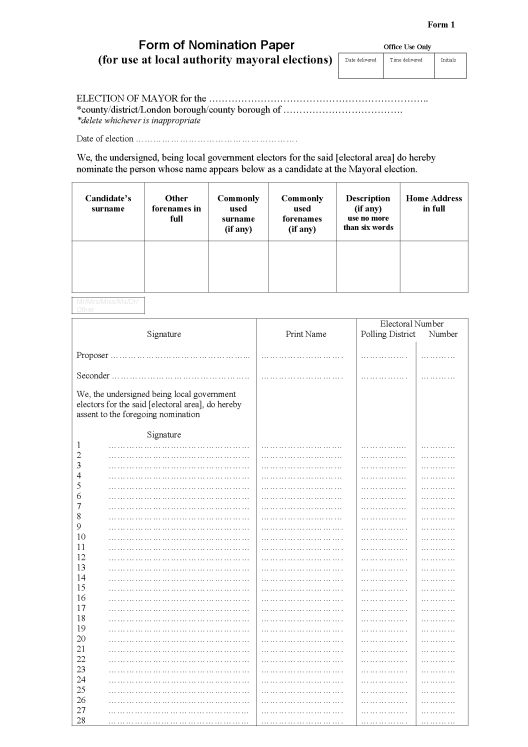
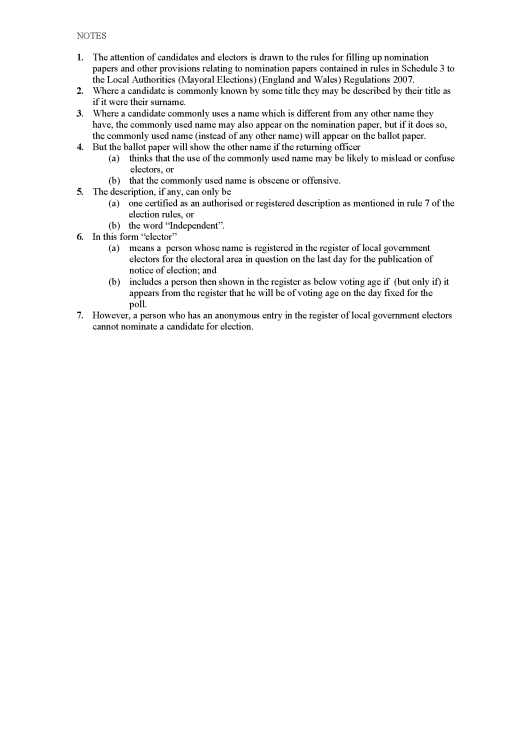


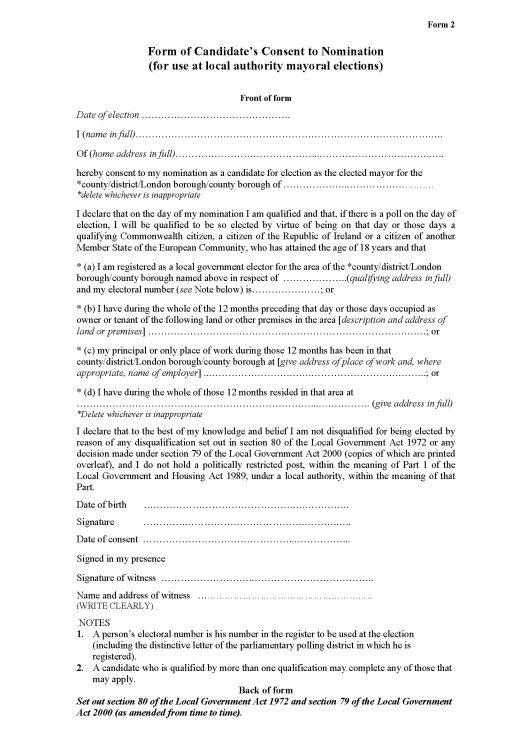


Number
Other unique identifying mark
Election of the Mayor for [insert name of authority]
on…………….20….


Number
Other unique identifying mark
Election of the Mayor for [insert name of authority]
on…………….20….


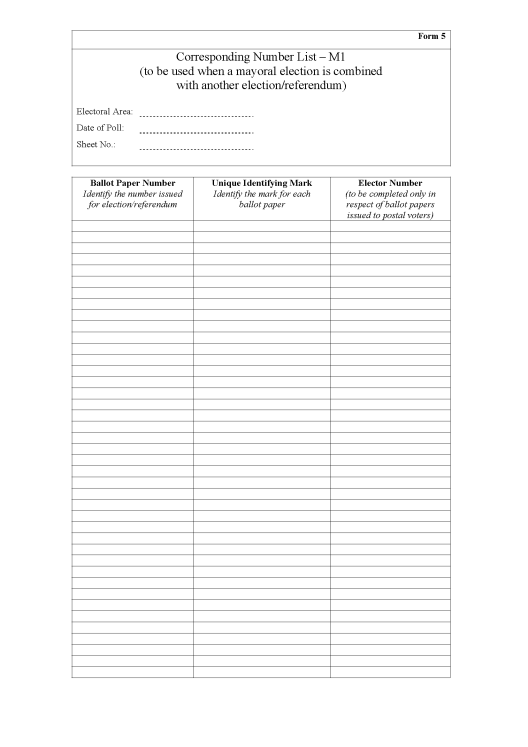
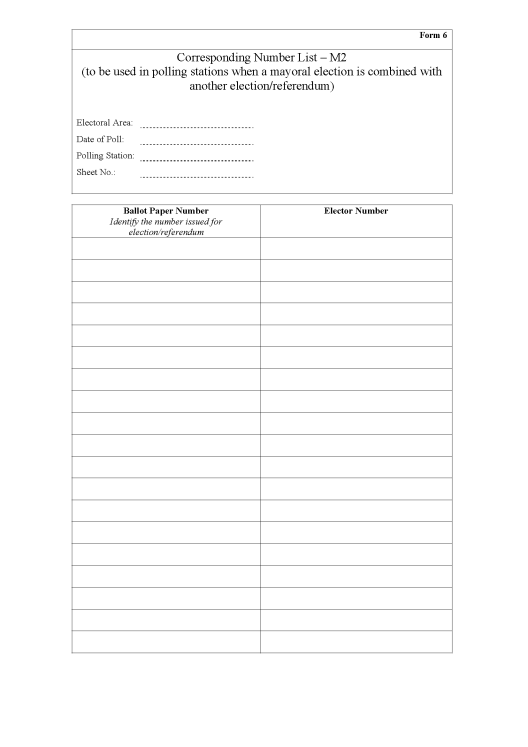


F329SCHEDULE 3AModifications to Schedule 3 where a mayoral election is taken together with a police and crime commissioner election
Interpretation
1.
In this Schedule, “the PCC Elections Order” means the Police and Crime Commissioner Elections Order 2012.
Modifications to Schedule 3
2.
The modifications referred to in regulation 4(2) are those in paragraphs 3 and 4 of this Schedule.
Notice to be displayed in polling station compartments
3.
In rule 28(10) of Schedule 3 (equipment of polling stations) from “there shall be exhibited the notice” to the end substitute “the notice at Form 21 in Part 4 of Schedule 4 to the PCC Elections Order must be exhibited”.
Forms
4.
In the Appendix of Forms in Schedule 3—
(a)
for Form 3 (ballot paper (two candidates)) including the directions as to printing, substitute Form 3 in the Appendix of Forms in Schedule 1 including the directions as to printing;
(b)
for Form 4 (ballot paper (three or more candidates)) including the directions as to printing, substitute Form 4 in the Appendix of Forms in Schedule 1 including the directions as to printing;
(c)
for Form 7(1) (postal voting statement for use when there is a joint issue and receipt of postal ballot papers) substitute Form 3 in Part 4 of Schedule 2 to the PCC Elections Order;
(d)
for Form 7(2) (postal voting statement for use when a mayoral election is combined with another poll but the postal ballot papers are not combined) substitute the form in the Appendix to this Schedule;
(e)
for Form 8 (official poll card) substitute Form 8 in the Appendix of Forms in Schedule 1;
(f)
for Form 9 (official postal poll card) substitute Form 9 in the Appendix of Forms in Schedule 1;
(g)
for Form 10 (official proxy poll card) substitute Form 10 in the Appendix of Forms in Schedule 1;
(h)
for Form 11 (official proxy postal poll card) substitute Form 11 in the Appendix of Forms in Schedule 1;
(i)
for Form 12 (directions for the guidance of voters) substitute Form 22 in Part 4 of Schedule 4 to the PCC Elections Order;
(j)
for Form 13 (certificate of employment) substitute Form 13 in the Appendix of Forms in Schedule 1;
(k)
for Form 14 (declaration to be made by the companion of a voter with disabilities) substitute Form 23 in Part 4 of Schedule 4 to the PCC Elections Order.
APPENDIX
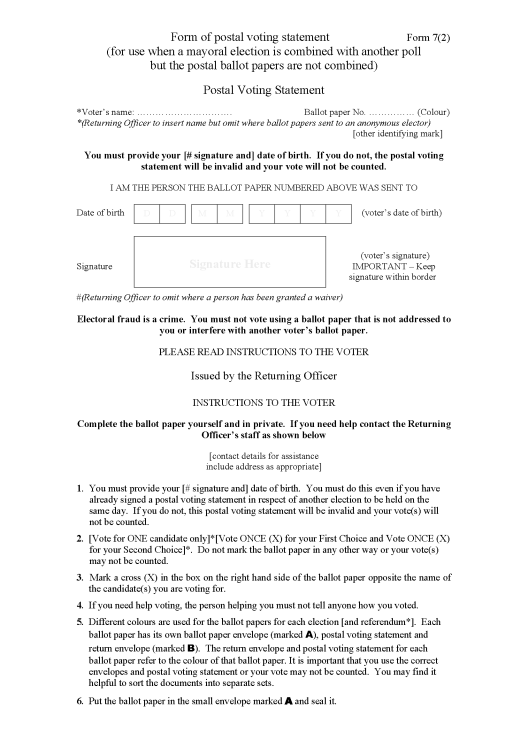
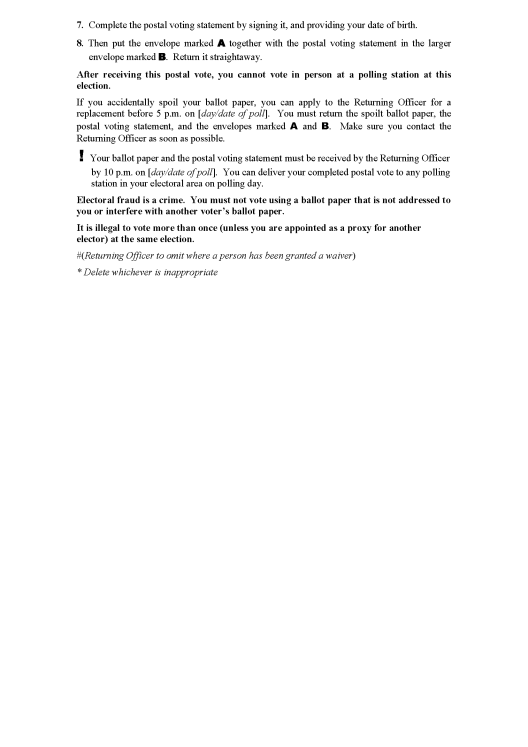
SCHEDULE 4Free delivery of election addresses
1.
In this Schedule—
“candidate” means a person who stands nominated as a candidate at the election;
“election” means an election for the return of an elected mayor;
“election address” shall be construed in accordance with paragraph 2;
“elector” in relation to an election, means a person entitled, in accordance with section F3309HD(1) or 43(1) of the 2000 Act, to vote at that election;
“election booklet” shall be construed in accordance with paragraph 5;
“print” means print by whatever means (and “printer” shall be construed accordingly); and
2.
For the purposes of regulation 6 and this Schedule, an election address, in relation to a candidate, is a statement prepared by the candidate’s election agent which complies with the provisions of paragraphs 3 and 4.
3.
(1)
An election address must contain matter relating to the election only.
(2)
In particular, an election address must not contain—
(a)
any advertising material (other than material promoting the candidate as a candidate at the election);
(b)
any other material appearing to be included with a view to commercial gain; or
(c)
any material referring to any other candidate.
(3)
An election address may include representations of the registered emblem, or (as the case may be) one of the registered emblems, of a registered political party if the address is prepared on behalf of an authorised party candidate.
(4)
(5)
In sub-paragraph (3) “authorised party candidate”, in relation to a registered political party, means a candidate who has been authorised to use the emblem or description in question by a certificate—
(a)
issued by or on behalf of the registered nominating officer of the party; and
(b)
received by the returning officer before the last time for the delivery of nomination papers for the election.
(6)
An election address must—
(a)
contain a statement to the effect that it has been prepared by the candidate’s election agent;
(b)
give the name and address of the election agent; and
(c)
give the name and address of the candidate on whose behalf it has been prepared.
F331(7)
Where a candidate’s home address has been withheld in accordance with rule 6(7) of Schedule 1 or Schedule 3 to these Regulations, the reference to the address of the candidate in sub-paragraph (6)(c) is to be read as a reference to the information mentioned in rule 6(7)(b).
4.
(1)
Subject to any requirements imposed by or under this paragraph, the format of a candidate’s election address may be determined by the candidate (and, in particular, may consist of a combination of words, pictures and artwork).
(2)
An election address must be printed on not more than two sides of A5 paper, but if such an address is printed on two sides of such paper—
(a)
it must, when submitted to the returning officer for inclusion in the election booklet, be accompanied by a second version printed on a single side of such paper; and
(b)
if the total number of candidates from whom election addresses have been accepted by the returning officer by the last time for delivery of nomination papers for the election exceeds 15, the version to be included in the election booklet shall be the second version.
(3)
An election address must—
(a)
comply with such requirements as to typographical layout, margins and use of colour as the returning officer may determine; and
(b)
comply with such other requirements as he may determine with a view to facilitating its reproduction as a page or pages of the election booklet.
(4)
An election address must, when submitted to the returning officer for inclusion in the election booklet, be accompanied—
(a)
where the address is to contain a photograph of the candidate, by two identical copies of the photograph, of which one is signed on the back by the candidate; and
(b)
in any case, by such copies of anything contained in the address as the returning officer may reasonably require in connection with the reproduction of the address.
5.
(1)
For the purposes of this Schedule, the election booklet is a document prepared by the returning officer which contains the election addresses of all candidates who—
(a)
desire their election addresses to be included in the booklet; and
(b)
have submitted—
(i)
those addresses, and
(ii)
any additional material required under paragraph 4(4),
to the returning officer before the last time for the delivery of nomination papers for the election.
(2)
If—
(a)
it appears to the returning officer that any of the requirements of paragraphs 3 and 4 has not been complied with in relation to an election address, or
(b)
a candidate fails to make the payment required by paragraph 8 in respect of an election address,
the returning officer shall decline to include the address in the election booklet.
6.
(1)
The order in which the candidates’ election addresses appear in the election booklet shall be determined by lot drawn by the returning officer as soon as reasonably practicable after the last time for the delivery of nomination papers for the election.
(2)
The election booklet may include, in addition to candidates’ election addresses, a statement by the returning officer—
(a)
explaining the nature and purpose of the election booklet;
(b)
listing in alphabetical order, the names of all the candidates at the election (whether or not their election addresses are included in the booklet); and
(c)
giving the date of the election and such other information about it as the returning officer may determine.
(3)
The election booklet must—
(a)
contain a statement that it has been published by the returning officer; and
(b)
give the name and address of the returning officer and those of the printer of the booklet.
(4)
Subject to sub-paragraphs (1) to (3), the form of the election booklet shall be determined by the returning officer.
(5)
The election agent of each candidate whose election address has been accepted by the returning officer for inclusion in the booklet shall be given an opportunity to attend at a time and place notified to him by the returning officer in order to check, and submit to the returning officer typographical corrections to, the proof of the candidate’s address.
(6)
If the election agent of any such candidate fails to avail himself of that opportunity, the returning officer may—
(a)
make such typographical corrections to the proof as appear to him to be appropriate; and
(b)
proceed with the printing and distribution of the election booklet without further reference to the candidate or his election agent (and without incurring any liability for any errors in the candidate’s address).
(7)
No person other than—
(a)
the candidate on whose behalf an election address included in the election booklet was prepared, or
(b)
the candidate’s election agent,
shall incur any civil or criminal liability in respect of the publication of that address in the election booklet or its dissemination in accordance with paragraph 7.
7.
(1)
Copies of the election booklet shall be delivered by the returning officer, in envelopes addressed to individual electors, at such time and by such means as the returning officer may determine.
(2)
The returning officer may disseminate the contents of the election booklet by such other means as he may determine.
8.
(1)
Each candidate by whom an election address is submitted to the returning officer for inclusion in the election booklet shall pay to the returning officer such reasonable sum (which shall be the same for each such candidate) as the returning officer may determine by way of contribution towards the expenses incurred by him in respect of the printing of the election booklet.
(2)
The payment required by sub-paragraph (1) shall be made at such time, and in such manner, as the returning officer may determine.
(3)
A candidate shall be entitled to a full refund of any such payment if, but only if, the candidate has given notice of withdrawal of his candidature before the last time for the withdrawal of candidates.
(4)
If the total amount of the payments made by candidates under this paragraph exceeds the total amount of the expenses incurred by the returning officer in respect of the printing of the election booklet, the returning officer shall
(a)
divide the amount of the excess between those candidates in equal shares, and
(b)
send to each of those candidates a payment in respect of his share.
9.
(1)
The amount of any payment made by a candidate under paragraph 8 (or, if sub-paragraph (4) of that paragraph applies, the net amount of any such payment after deducting the payment under that sub-paragraph) shall be taken, for the purposes of Part 2 (the Election campaign) of the 1983 Act (as modified for the purposes of mayoral elections by regulation 3(2) and (4) of, and Table 1 of Schedule 2 to, these Regulations), to be an amount of election expenses incurred by the candidate in relation to the election.
(2)
Nothing in section 75(1) (restriction on third party election expenditure) of the 1983 Act (as modified as mentioned in sub-paragraph (1)) shall be taken to apply, in relation to any candidate, to any expenses incurred by the returning officer in consequence of the relevant provisions.
These Regulations re-enact Regulations made in 2002 (“the 2002 Regulations”) to make provision for the conduct of elections of mayors of county, district and London borough councils (in England) and county and county borough councils (in Wales) under the Local Government Act 2000 (c. 2) (“the 2000 Act”).
The principal changes made to the 2002 Regulations are to implement the changes made by the Electoral Administration Act 2006 (c. 22) (“the 2006 Act”) for mayoral elections.
Regulation 3 and Schedules 1 and 2 provide for the conduct of a mayoral election. The changes which reflect the 2006 Act are summarised at the end of this note.
The Mayoral Elections Rules as contained in Schedule 1 are similar to those which apply in relation to the election of councillors at local authority elections. They apply when the mayoral election is not combined with any other poll. However, each candidate’s nomination paper must be subscribed by 30 electors, and a deposit of £500 must be paid. If there are three or more mayoral candidates, the elected mayor will be returned under the supplementary vote system, for which provision is made in section 42(3) of, and Schedule 2 to, the 2000 Act. (The supplementary vote system is also used for the election of the Mayor of London under the Greater London Authority Act 1999 where there are three or more candidates.)
Regulation 3 and Schedule 2 also apply other electoral legislation, with modifications, to facilitate the conduct of mayoral elections. The reference in the 2002 Regulations to the Political Parties, Elections and Referendums Act 2000 (c. 41) was unnecessary and in consequence has been omitted from these Regulations.
Regulation 4 makes provision for the rules for the conduct of mayoral elections to be modified when combined with other polls. The rules for conducting such elections are again set out in full (the Mayoral Elections (Combination of Polls) Rules), in Schedule 3.
Regulation 5 provides for mayoral elections to be questioned using the same procedures (in Part 3 of the Representation of the People Act 1983 (c. 3)) that apply to the questioning of local authority elections.
Regulation 6 and Schedule 4 provide for the free delivery of election addresses. The provisions are generally comparable to those that apply at Greater London Authority elections. Candidates at mayoral elections who wish to have their election addresses included in the election booklet prepared and distributed by the returning officer are required to pay a contribution of such reasonable amount as the returning officer may determine towards the expenses incurred by the returning officer in printing the election booklet.
The provisions of the Mayoral Elections Rules and the Mayoral Elections (Combination of Polls) Rules (collectively, “the Rules”) which reflect changes made by the 2006 Act include the following.
The Rules reflect changes made to nomination procedures. Candidates may use their common names on nomination forms and papers. The rules on the use of authorised descriptions by candidates standing on behalf of registered political parties are amended to reflect amendments made to the Political Parties, Elections and Referendums Act 2000 (c. 41) (in sections 28A and 28B). Returning officers will be able to correct minor errors on nomination papers.
The Rules reflect new security measures introduced by the 2006 Act. Security markings on ballot papers are provided for; so too are unique identifying marks. Counterfoils on ballot papers are replaced by corresponding number lists. Requirements are imposed requiring postal voters and postal proxies to provide both their signature and date of birth when returning postal ballot papers.
The Rules reflect alterations as to the circumstances in which a person may give a tendered vote. New requirements are introduced as to the information and accessibility of information to be provided by returning officers to electors.
The Rules reflect changes made as to the persons who may be admitted to a polling station and the count to observe elections.
Amendments are made to provide for transmission of information to a presiding officer of alterations to the electoral register taking effect on the day of the poll. Amendments consequential upon the introduction of a scheme for the anonymous registration of certain electors are made.
The Rules reflect changes made regarding the retention and inspection of election documents after the poll.
The new forms which are appended to the Rules reflect the changes made by the 2006 Act.