The Common Financial Tool etc. (Scotland) Amendment Regulations 2015
Citation and commencement1.
These Regulations may be cited as the Common Financial Tool etc. (Scotland) Amendment Regulations 2015 and come into force on 1st April 2015.
Amendment of the Common Financial Tool etc. (Scotland) Regulations 20142.
Contingency allowance etc.3.
(1)
In regulation 3(1) (common financial tool), for “regulation 4” substitute “regulations 3A and 4”.
(2)
“(3)
The Accountant in Bankruptcy, the trustee on variation or removal under section 32F of the 1985 Act5, the court, or the trustee acting under a protected trust deed—(a)
may allow an amount of expenditure to the debtor which exceeds those trigger figures if satisfied that the expenditure is reasonable; and
(b)
must allow the debtor to decide to retain an additional amount of income in accordance with regulation 3A towards contingencies which may arise.”.
(3)
In regulation 3(4) and (9), for “paragraph (3)” substitute “paragraph (3)(a)”.
(4)
“Common financial tool: contingency allowance3A.
(1)
The amount of income which the debtor may decide to retain towards contingencies under regulation 3(3)(b) is—
(a)
up to 10% of the weekly, fortnightly or monthly (or the equivalent amount for another period) debtor’s contribution assessed under regulation 3, before any calculation is made under this regulation for the purposes of regulation 3(3)(b);
(b)
subject to a maximum amount of £4.62 per week, £9.23 per fortnight, £20 per month or the equivalent maximum for such other period, as the case may be.
(2)
The amount to be retained under paragraph (1) must be treated as an item of expenditure for the purposes of the relevant form setting out the debtor’s expenditure in applying the common financial tool6.”.
Minor amendments4.
(1)
In regulation 2(1) (interpretation) omit “—(1)”.
(2)
In regulation 3(2) (debtor’s expenditure and trigger figures)—
(a)
for “The” substitute “Subject to paragraphs (3) and (7), the”; and
(b)
“(a)
the trigger figures for a reasonable amount of the debtor’s expenditure published from time to time as part of the Common Financial Statement; or
(b)
the debtor’s expenditure over that period (for each relevant Common Financial Statement category of expenditure).”.
(3)
In regulation 3(11)(c) (common financial tool guidance), for “the Act” substitute “the 1985 Act”.
(4)
In regulation 4 (supporting statements and evidence)—
(a)
in paragraph (2) for “Any statement” substitute “Any such statement”;
(b)
“(2A)
Paragraphs (1) and (2) do not apply to an application for review or appeal mentioned in paragraph (1) by an interested person other than the debtor or the trustee.”; and
(c)
in paragraph (3)—
(i)
after “Any statement” insert “for the purposes of assessment by the common financial tool”; and
(ii)
for “the purposes of this regulation” substitute “those purposes”.
(5)
“(h)
where a debtor who is a living individual makes a contribution from income,—
(i)
a statement that the amount of that contribution is in accordance with the common financial tool as assessed by the trustee; and
(ii)
any evidence or explanation required in applying the common financial tool.”.
(6)
“(2A)
If the trustee receives within 21 days after the date on which the Form 4 was sent notification in writing from—
(a)
a majority in number; or
(b)
not less than one third in value,
of creditors that they object to the recommended course of action in the Form 4 where the expected final dividend to ordinary creditors is 20% lower than the expected dividend to ordinary creditors set out in the Form 3, the trustee must request a direction under regulation 19(3) as to how the trust must be administered.”.
(7)
In regulation 9 (remuneration for outlays before grant of trust deed) for “any specified heritable estate” substitute “any item of the debtor’s heritable estate specified or valued in such a valuation”.
(8)
In the Schedule—
(a)
in Note 2 to Form 3 (trust deed protection proposal and trustee’s application) after “employed” insert “or engaged”; and
(b)
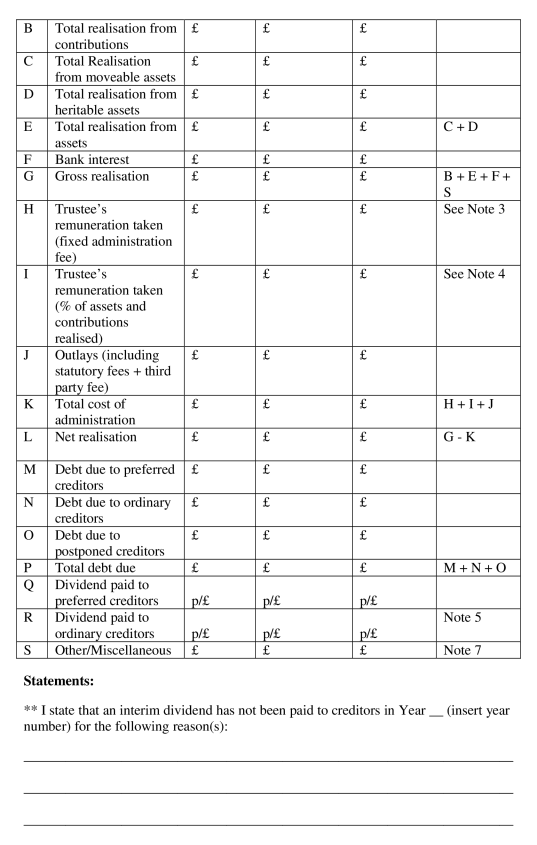
for Form 4 (trustee’s statement of status of a protected trust deed) substitute the Form 4 set out in the Schedule to these Regulations.
St Andrew’s House,
Edinburgh
SCHEDULETrustee’s statement of status of a protected trust deed – Form 4



These Regulations amend the method for determining an appropriate amount of a living debtor’s income to be paid to a trustee after sequestration of the debtor’s estate provided for in the Common Financial Tool etc. (Scotland) Regulations 2014 (“the CFT Regulations”). The CFT Regulations are made under the amendments to the Bankruptcy (Scotland) Act 1985 made by the Bankruptcy and Debt Advice (Scotland) Act 2014.
Regulation 2 adds to the common financial tool that the debtor can retain up to an amount subject to certain limits from regular payments towards an allowance for the debtor to meet contingencies which may arise for the debtor.
Regulation 3 and the Schedule make minor clarifications and corrections to the CFT Regulations, including as they amend the Protected Trust Deeds (Scotland) Regulations 2013.
The regulations to be amended will apply from 1st April 2015.
A Business and Regulatory Impact Assessment has been prepared for these Regulations. Copies can be obtained from the Accountant in Bankruptcy’s website: www.aib.gov.uk.