The Bankruptcy (Money Advice and Deduction from Income etc.) (Scotland) Regulations 2014
Citation and commencement1.
(1)
These Regulations may be cited as the Bankruptcy (Money Advice and Deduction from Income etc.) (Scotland) Regulations 2014.
(2)
They come into force on 1st April 2015.
Interpretation2.
In these Regulations—
“the Act” means the Bankruptcy (Scotland) Act 1985;
Money advisers
Approved categories of money advisers3.
Subject to regulation 4, the following classes of persons are prescribed for the purposes of section 5C(2)(b) of the Act as money advisers—
(a)
persons who—
(i)
(ii)
work for such an insolvency practitioner, who have been given authority by that insolvency practitioner to act on his or her behalf in providing money advice under the Act; and
(b)
persons who—
(i)
work as money advisers for organisations which have been awarded accreditation at Type 2 level or above against the Scottish National Standards for Information and Advice Provision; or
(ii)
(iii)
work as money advisers for a citizens advice bureau which is a full member of the Scottish Association of Citizens Advice Bureaux – Citizens Advice Scotland; or
(iv)
Persons who may not be approved money advisers4.
(1)
The following persons may not be approved money advisers—
(a)
a sheriff officer or messenger-at-arms, or an employee of such a person;
(b)
a person or body providing financial services, or financial advice other than money advice, in the course of a business or otherwise for profit, or an employee of such a person, unless the person is a—
(i)
solicitor;
(ii)
chartered or certified accountant;
(c)
a person providing debt collection services, or an employee of such a person;
(d)
a person convicted of an offence involving theft, fraud or other dishonesty;
(e)
(f)
(g)
(h)
persons whose approval is revoked or suspended under paragraph (2).
(2)
The Accountant in Bankruptcy may revoke or suspend the approval of a money adviser who fails without good cause—
(a)
to apply the common financial tool in accordance with the Common Financial Tool etc. (Scotland) Regulations 2014; or
(b)
to comply with regulation 6.
(3)
The Accountant in Bankruptcy must provide written notice to a debtor of the revocation or suspension of the approval of a money adviser to the debtor.
Other matters on which a debtor must obtain advice5.
The following are prescribed for the purposes of section 5C(1)(d) of the Act as matters on which the debtor must obtain advice from a money adviser—
(a)
the income and expenditure of the debtor in accordance with the common financial tool;
(b)
the evidence required to confirm the debts of the debtor in making the debtor application;
(c)
(d)
the options of a voluntary repayment plan, debt payment programme under the Debt Arrangement Scheme or a trust deed;
(e)
the consequences of sequestration and that an award of sequestration, if granted, is recorded in a public register and may result in one or more of—
(i)
the debtor being refused credit, or being offered credit at a higher rate, whether before or after the date of the debtor being discharged;
(ii)
the debtor not being able to remain in his or her current place of residence;
(iii)
the debtor being required to relinquish property which the debtor owns;
(iv)
the debtor requiring to make contributions from income for the benefit of creditors;
(v)
damage to the debtor’s business interests and employment prospects;
(vi)
the debtor still being liable for some debts;
(vii)
the debtor’s past financial transactions being investigated; and
(viii)
other restrictions or requirements imposed on the debtor as a result of the debtor’s own circumstances and actions.
Money advice on debtor applications: procedure on evidence and information6.
(1)
(2)
A money adviser must retain records in relation to the advice given to the debtor (including the evidence obtained under paragraph (1)) in making a debtor application, for 2 years from the date on which the advice was given.
(3)
A money adviser must provide as required by the Accountant in Bankruptcy, information about a debtor’s application (including evidence obtained under paragraph (1) or the debtor’s consent to the application).
Amendment of the Bankruptcy (Certificate for Sequestration) (Scotland) Regulations 20107.
(1)
(2)
Omit regulation 3 (authorised persons).
(3)
Omit regulation 4 (further provisions relating to certification).
(4)
In regulation 5 (form and manner of certificate)—
(a)
in paragraphs (1) and (2), for “an authorised person” each time it occurs substitute “a money adviser”; and
(b)
in paragraph (3)—
(i)
omit “in the case of the authorised person referred to in regulation 3(1)”;
(ii)
for “authorised person” both times it occurs substitute “money adviser”; and
(iii)
for “authorised person’s” substitute “money adviser’s”.
(5)
For the Form set out in the Schedule to those Regulations (form of certificate for sequestration), substitute the Form set out in Schedule 1 to these Regulations.
Deduction from debtor’s earnings and other income
Deduction from debtor’s earnings and other income8.
(1)
(2)
Except in the case of a subsequent variation under paragraph (7)—
(a)
an instruction given by the debtor under section 32E(2) must be in Form 1; and
(b)
an instruction given by the trustee under section 32E(4) must be in Form 2.
(3)
On delivery of the instruction and while the instruction is in effect, the—
(a)
person by whom the debtor is employed; or
(b)
third person required to pay to the trustee money otherwise due to the debtor by way of income (“third person”),
must deduct the sum specified in the instruction on every pay day or day on which a payment is to be made to the debtor, as the case may be, and pay the sum deducted to the trustee as soon as it is reasonably practicable to do so.
(4)
Where an employer or third person fails without good cause to make a payment due under an instruction, the employer or third person is—
(a)
liable to pay on demand by a trustee the amount that should have been paid; and
(b)
not entitled to recover from a debtor the amount paid to the debtor in breach of the instruction.
(5)
(6)
The trustee must, without delay after the end of the payment period for the debtor under section 32B, notify in writing any person who has received an instruction in accordance with paragraph (2) (or varied in accordance with paragraph (7)) that the instruction has been recalled.
(7)
Following any change to the debtor’s contribution, the debtor or trustee may give a variation instruction under section 32E(2) or (4) of the Act in accordance with that change to the instruction mentioned in paragraph (2) in Form 3 to the employer or third person.
(8)
In this regulation, references to Forms are to be construed as references to the form so numbered in Schedule 2 to these Regulations or a form substantially to the same effect, with such variation as circumstances may require.
Minor and consequential amendments
Amendment of the 1985 Act: family home not to reinvest (gratuitous alienation)9.
“(g)
the trustee has commenced an action under section 34 of this Act in respect of any right or interest mentioned in subsection (1) above or the trustee has not known about the facts giving rise to a right of action under section 34 of this Act, provided the trustee commences such an action reasonably soon after the trustee becomes aware of such right.”.
Revocations and debtor applications before 1st April 2015
Revocation10.
Debtor applications before 1st April 2015 (low income, low asset debtors)11.
The regulations revoked by regulation 10, except for regulation 4 of the 2008 Regulations, continue to apply to debtor applications made before 1st April 2015.
St Andrew’s House,
Edinburgh
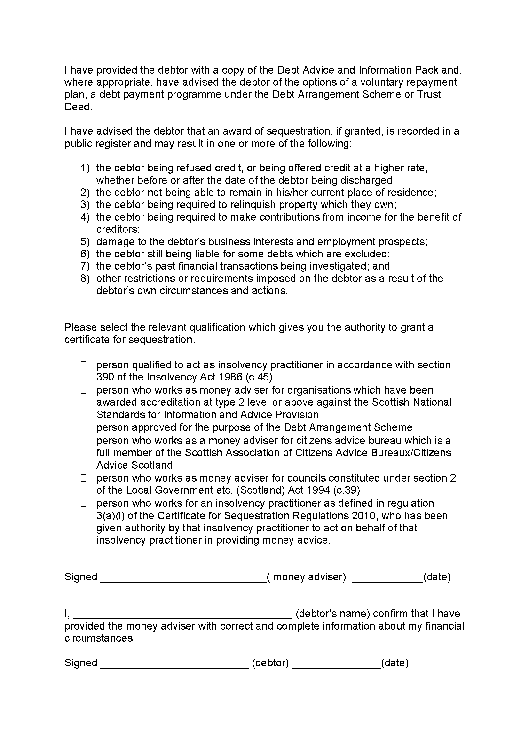
SCHEDULE 1Form - Certificate for Sequestration

SCHEDULE 2Forms – Deduction from Income


These Regulations make provision about various matters to implement provisions of the Bankruptcy and Debt Advice (Scotland) Act 2014 (“the 2014 Act”) which amended the Bankruptcy (Scotland) Act 1985 (“the 1985 Act”).
Regulations 3 and 4 prescribe persons who can act as money advisers in relation to sequestration under the 1985 Act, including the classes of—
insolvency practitioners and persons who work for them who have been given authority by the insolvency practitioner to act on behalf of that insolvency practitioner
persons approved for the purposes of the Debt Arrangement Scheme
persons working as money advisers for organisations awarded Type 2 against Scottish National Standards for Information and Advice Provision, full bureau members of the Scottish Association of Citizens Advice Bureaux – Citizens Advice Scotland; or councils.
Regulation 4 provides for who may not be a money adviser, including those whose approval is revoked by the Accountant in Bankruptcy in specific cases.
Regulations 5 prescribes additional matters on which debtors must obtain money advice in making a debtor application for sequestration. Regulation 6 sets out procedural requirements for obtaining money advice in connection with debtor applications under the 1985 Act.
Regulation 7 amends the Bankruptcy (Certificate for Sequestration) (Scotland) Regulations 2010 which provides for a certificate that the debtor has demonstrated he or she is not able to pay his or her debts as they become due, in consequence of the 2014 Act. Those authorised to grant certificates are replaced by money advisers under section 5C of the 1985 Act as amended by the 2014 Act. The form of the Certificate of Sequestration is replaced with the form in Schedule 1 to these Regulations, which can be included in the debtor application for sequestration.
Regulation 8 makes provision for the forms of instructions by the debtor or trustee under section 32E of the Act to an employer or third party due to make payment to the debtor for deductions from earnings or other income. It also provides for how the instruction affects the recipient and what happens if the employer or third person refuse to pay the deduction.
Regulations 10 revokes the Bankruptcy (Scotland) Act 1985 (Low Income, Low Asset Debtors etc.) Regulations 2008 in consequence of the 2014 Act. Regulation 9 continues in effect regulation 4 of those Regulations, amending section 39A of the Bankruptcy (Scotland) Act 1985 to add certain actions for gratuitous alienations to the circumstances which preclude a family home reinvesting in the debtor 3 years after sequestration. Regulation 11 saves the regulations relevant to low income, low asset debtors in respect of sequestrations where the debtor application was made before 1st April 2015, as those sequestrations will continue under the existing low income, low asset provisions to the end of those sequestrations.
A Business and Regulatory Impact Assessment has been prepared for these Regulations. Copies can be obtained from the Accountant in Bankruptcy’s website: http://www.aib.gov.uk.