Act of Sederunt (Sheriff Court Rules) (Miscellaneous Amendments) (No. 3) 2012
Citation, commencement and interpretation
1.
(1)
This Act of Sederunt may be cited as the Act of Sederunt (Sheriff Court Rules) (Miscellaneous Amendments) (No. 3) 2012 and comes into force on 1st November 2012.
(2)
A certified copy of this Act of Sederunt is to be inserted in the Books of Sederunt.
(3)
In this Act of Sederunt—
Lodging audio or audio-visual recordings of children
2.
(1)
The Ordinary Cause Rules are amended in accordance with the following subparagraph.
(2)
“CHAPTER 50LODGING AUDIO OR AUDIO-VISUAL RECORDINGS OF CHILDREN
Interpretation50.1.
In this Chapter “child” is a person under the age of 16 on the date of commencement of the proceedings and “children” shall be construed accordingly.
Lodging an audio or audio-visual recording of a child50.2.
(1)
Where a party seeks to lodge an audio or audio-visual recording of a child as a production, such party must—
(a)
ensure that the recording is in a format that can be heard or viewed by means of equipment available in court;
(b)
place the recording together with a copy of the relevant inventory of productions in a sealed envelope marked with—
(i)
the names of the parties to the court action;
(ii)
the case reference number;
(iii)
(where available) the date and time of commencement and of termination of the recording; and
(iv)
“recording of a child – confidential”.
(2)
The sealed envelope must be lodged with the sheriff clerk.
(3)
In the remainder of this Chapter a “recording of a child” means any such recording lodged under this rule.
Separate inventory of productions50.3.
(1)
On each occasion that a recording of a child is lodged, a separate inventory of productions shall be lodged in process.
(2)
The sheriff clerk will mark the date of receipt and the number of process on the sealed envelope containing a recording of a child.
Custody of a recording of a child50.4.
(1)
A recording of a child—
(a)
must be kept in the safe custody of the sheriff clerk;
(b)
subject to rule 50.5, will not form a borrowable part of the process.
(2)
The seal of the envelope containing a recording of a child shall be broken only with the authority of the sheriff and on such conditions as the sheriff thinks fit (which conditions may relate to listening to or viewing the recording).
Access to a recording of a child50.5.
(1)
A party may lodge a written motion to gain access to and listen to or view a recording of a child.
(2)
The sheriff may refuse a motion or grant it on such conditions as the sheriff thinks fit, including—
(a)
allowing only such persons as the sheriff may specify to listen to or view the recording;
(b)
specifying the location where such listening or viewing is to take place;
(c)
specifying the date and time when such listening or viewing is to take place;
(d)
allowing a copy of the recording to be made (in the same or different format) and arrangements for the safe-keeping and disposal of such copy;
(e)
arrangements for the return of the recording and re-sealing the envelope.
Incidental appeal against rulings on access to a recording of a child50.6.
(1)
Where a party is dissatisfied with the ruling of the sheriff under rule 50.5, such party may express immediately his or her formal dissatisfaction with the ruling and, with leave of the sheriff, appeal to the sheriff principal.
(2)
The sheriff principal must dispose of an appeal under paragraph (1) with the least possible delay.
Exceptions50.7.
(1)
The sheriff may, on the application of a party and on cause shown, disapply the provisions of this Chapter.
(2)
An application under paragraph (1) shall be made—
(a)
at the time of presenting the recording for lodging;
(b)
by letter addressed to the sheriff clerk stating the grounds on which the application is made.
Application of other rules50.8.
(1)
The following rules do not apply to a recording of a child—
(a)
rule 9A.2(2) (inspection of documents)6;(b)
rule 11.6(1) (intimation of parts of process and adjustments)7, in so far as it would otherwise require a party to deliver a copy of a recording of a child to every other party;(c)
rule 29.12(1) (copy productions)8.”.
3.
(1)
The Summary Application Rules are amended in accordance with the following subparagraph.
(2)
“Lodging audio or audio-visual recordings of children2.42.
(1)
In this rule “child” is a person under the age of 16 on the date of commencement of the proceedings and “children” shall be construed accordingly.
(2)
Except where the sheriff otherwise directs, where a party seeks to lodge an audio or audio-visual recording of a child as a production in a summary application, this shall be done in accordance with and regulated by Chapter 50 of the Ordinary Cause Rules.
(3)
A party who has lodged a recording of a child shall—
(a)
within 14 days after the final determination of the application, where no subsequent appeal has been marked, or
(b)
within 14 days after the disposal of any appeal marked on the final determination of the application,
uplift the recording from process.
(4)
Where a recording has not been uplifted as required by paragraph (3), the sheriff clerk shall intimate to—
(a)
the solicitor who lodged the recording, or
(b)
where no solicitor is acting, the party or such other party as seems appropriate,
that if he or she fails to uplift the recording within 28 days after the date of such intimation, it will be disposed of in such a manner as the sheriff directs.”.
4.
(1)
(2)
“Lodging audio or audio-visual recordings of children1.6.
(1)
In this rule “child” is a person under the age of 16 on the date of commencement of the proceedings and “children” shall be construed accordingly.
(2)
Except where the sheriff otherwise directs, where a party seeks to lodge an audio or audio-visual recording of a child as a production in an application under this Act of Sederunt, this shall be done in accordance with and regulated by Chapter 50 of the Ordinary Cause Rules.
(3)
A party who has lodged a recording of a child shall—
(a)
within 28 days after the final determination of the application, where no subsequent appeal has been marked, or
(b)
within 28 days after the disposal of any appeal marked on the final determination of the application,
uplift the recording from process.
(4)
Where a recording has not been uplifted as required by paragraph (3), the sheriff clerk shall intimate to—
(a)
the solicitor who lodged the recording, or
(b)
where no solicitor is acting, the party or such other party as seems appropriate,
that if he or she fails to uplift the recording within 28 days after the date of such intimation, it will be disposed of in such a manner as the sheriff directs.”.
(3)
In Schedule 3 (exclusion of enactments), in column 3 (extent of exclusion) after “Chapter 45 (Vulnerable Witnesses (Scotland) Act 2004)” insert “and Chapter 50 (lodging recordings of children)”.
5.
(1)
(2)
“Lodging audio or audio-visual recordings of children5A.
(1)
In this rule “child” is a person under the age of 16 on the date of commencement of the proceedings and “children” shall be construed accordingly.
(2)
Except where the sheriff otherwise directs, where a party seeks to lodge an audio or audio-visual recording of a child as a production in an application under these Rules, this must be done in accordance with and regulated by Chapter 50 of the Ordinary Cause Rules.
(3)
A party who has lodged a recording of a child shall—
(a)
within 14 days after the final determination of the application, where no subsequent appeal has been marked, or
(b)
within 14 days after the disposal of any appeal marked on the final determination of the application,
uplift the recording from process.
(4)
Where a recording has not been uplifted as required by paragraph (3), the sheriff clerk shall intimate to—
(a)
the solicitor who lodged the recording, or
(b)
where no solicitor is acting, the party or such other party as seems appropriate,
that if he or she fails to uplift the recording within 28 days after the date of such intimation, it will be disposed of in such a manner as the sheriff directs.”.
Treaty of Lisbon terminology
6.
(1)
The Ordinary Cause Rules are amended in accordance with the following subparagraphs.
(2)
(a)
in paragraph (1), in the definition of “reference”, at subparagraph (a), for “Article 234 of the E.E.C. Treaty” substitute “Article 267 of the Treaty on the Functioning of the European Union”;
(b)
in paragraph (2), omit ““E.E.C. Treaty”,”;
(c)
“(3)
In paragraph (1), “the Treaty on the Functioning of the European Union” means the treaty referred to in section 1(2)(s) of the European Communities Act 197214.”.
(3)
(a)
““the Treaty” means the Treaty on the Functioning of the European Union, as referred to in section 1(2)(s) of the European Communities Act 1972;”;
(b)
in paragraphs (2) and (3), for “Article 81 or 82” substitute “Article 101 or 102”.
(4)
The title of Chapter 43 becomes “CAUSES RELATING TO ARTICLES 101 AND 102 OF THE TREATY ON THE FUNCTIONING OF THE EUROPEAN UNION”.
(5)
7.
(1)
(2)
In rule 20.1 (interpretation of rules 20.2 to 20.5: European Court)—
(a)
in paragraph (1), in the definition of “reference”, at subparagraph (a), for “Article 234 of the E.E.C. Treaty” substitute “Article 267 of the Treaty on the Functioning of the European Union”;
(b)
in paragraph (2), omit ““E.E.C. Treaty”,”;
(c)
“(3)
In paragraph (1), “the Treaty on the Functioning of the European Union” means the treaty referred to in section 1(2)(s) of the European Communities Act 1972.”.
8.
(1)
(2)
In rule 18.1 (interpretation of rules 18.2 to 18.5: European Court)—
(a)
in paragraph (1), in the definition of “reference”, at subparagraph (a), for “Article 234 of the E.E.C. Treaty” substitute “Article 267 of the Treaty on the Functioning of the European Union”;
(b)
in paragraph (2), omit ““E.E.C. Treaty”,”;
(c)
“(3)
In paragraph (1), “the Treaty on the Functioning of the European Union” means the treaty referred to in section 1(2)(s) of the European Communities Act 1972.”.
Amendment of the Child Support Rules
9.
(1)
(2)
In paragraph (3) of rule 1 (citation and commencement) omit “the Commission” and its associated definition.
(3)
In each of the following places, for “Commission” substitute “Secretary of State”—
(a)
rule 2(1);
(b)
rule 5(2)(b);
(c)
rule 5AA(1);
(d)
rule 5AA(2)(b);
(e)
rule 5AB(1);
(f)
rule 5AB(2)(b);
(g)
rule 5AC(1);
(h)
rule 5AC(3)(b).
(4)
In the Schedule in each of the following forms, for “Child Maintenance and Enforcement Commission” substitute “Secretary of State” in every place where that expression appears—
(a)
Form 1;
(b)
Form 3;
(c)
Form 4;
(d)
Form 5;
(e)
Form 5AA;
(f)
Form 5AB;
(g)
Form 5AC;
(h)
Form 5AD;
(i)
Form 6;
(j)
Form 9;
(k)
Form 10.
(5)
In Form 5AC in paragraph numbered 5 for “its” substitute “[his or her]*”.
Applications under section 23B of the Regulation of Investigatory Powers Act 2000
10.
(1)
The Summary Application Rules are amended in accordance with the following subparagraphs.
(2)
“PART XLIIREGULATION OF INVESTIGATORY POWERS ACT 2000
Interpretation3.42.1.
In this Part—
“the 2000 Act” means the Regulation of Investigatory Powers Act 200021;and words and expressions used in this Part and in the 2000 Act shall have the same meaning given in the 2000 Act.
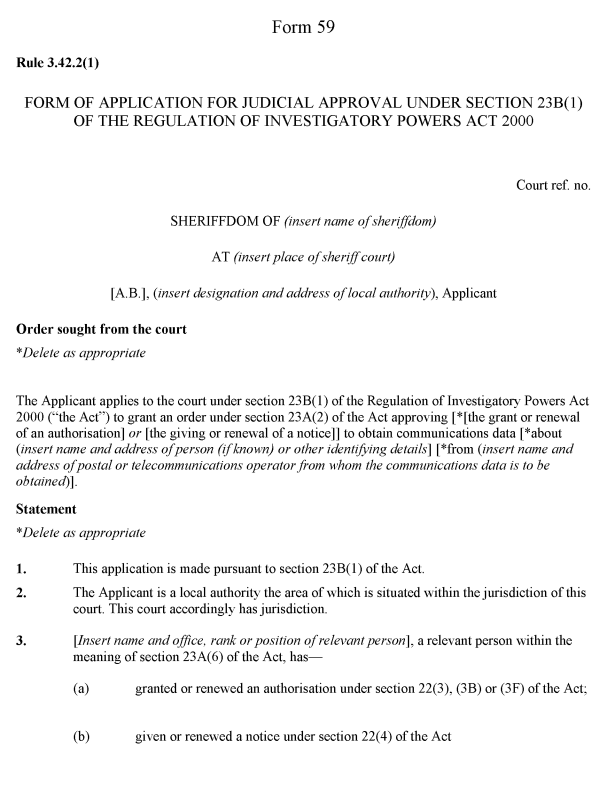
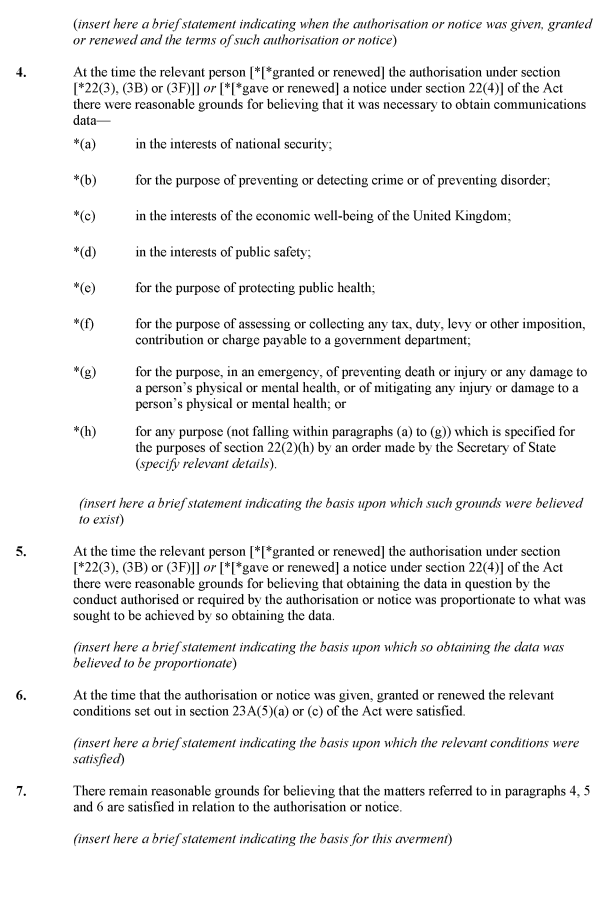
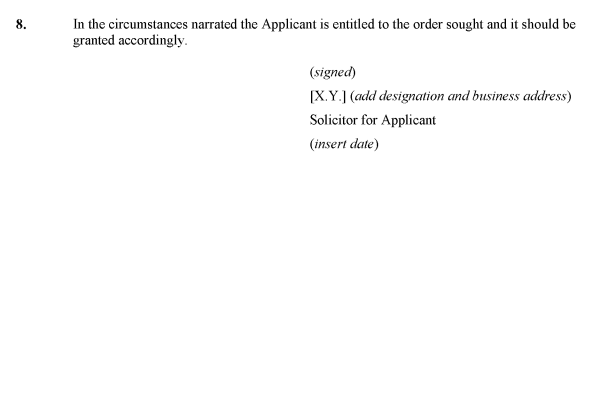
Authorisations requiring judicial approval3.42.2.
(1)
An application under section 23B(1) of the 2000 Act (procedure for judicial approval) for an order under section 23A(2) (authorisations requiring judicial approval)22—(a)
approving the grant or renewal of an authorisation; or
(b)
the giving or renewal of a notice,
shall be in Form 59, which must be signed by a solicitor on behalf of the local authority.
(2)
The application (and any order made in relation to it) must not be intimated to—
(a)
the person to whom the authorisation or notice which is the subject of the application or order relates; or
(b)
such person’s representatives.
(3)
The application must be heard and determined by the sheriff in private.
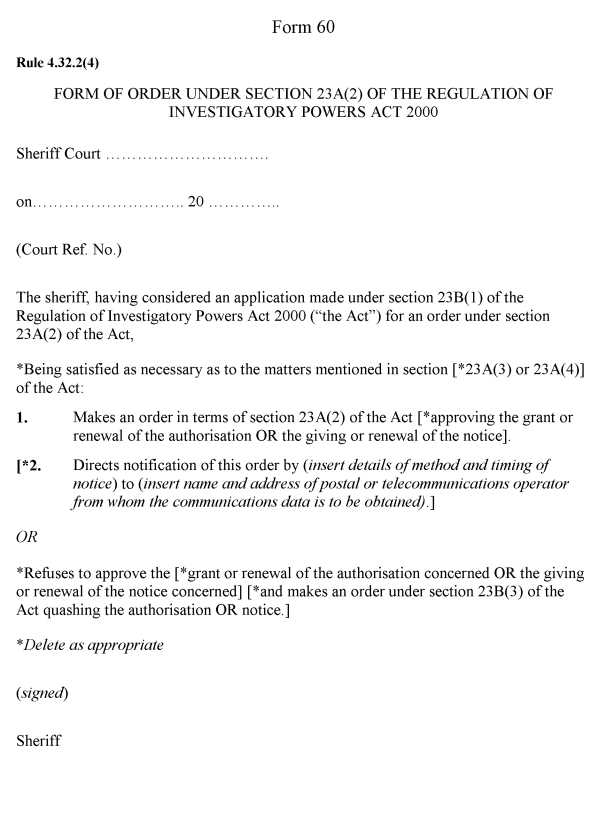
(4)
Where an application is granted by the sheriff the order shall be in Form 60.”.
(3)
Transitional and saving
11.
Edinburgh
SCHEDULE
This Act of Sederunt makes various amendments to the Ordinary Cause Rules; the Small Claim Rules, the Summary Application Rules; the Summary Cause Rules; the 1997 Act of Sederunt; the Sheriff Court Adoption Rules; and the Child Support Rules.
Paragraphs 2 to 5 amend the Ordinary Cause Rules, the Summary Application Rules, the 1997 Act of Sederunt and the Sheriff Court Adoption Rules to make provision in relation to audio and audio-visual recordings of children that are lodged as productions in court. The rules are introduced to ensure that such recordings are held securely and that access to such recordings is restricted. However, the sheriff may disapply the rules on cause shown where, for example, the recording of a child is not of a sensitive nature and does not need to be made subject to the safeguards.
Paragraphs 6 to 8 amend the rules to reflect changes in terminology arising out of the Treaty of Lisbon Amending the Treaty on the European Union and the Treaty Establishing the European Community signed at Lisbon on 13th December 2007.
Paragraph 6 amends rule 38.1, 43.1 and Form OFT1 in the Ordinary Cause Rules to reflect the terminology changes.
Paragraph 7 amends rule 20.1 of the Summary Cause Rules for the same purpose.
Paragraph 8 amends rule 18.1 of the Small Claim Rules for the same purpose.
Paragraph 9 amends the Child Support Rules in consequence of changes made by the Public Bodies (Child Maintenance and Enforcement Commission: Abolition and Transfer of Functions) Order 2012.
Paragraph 10 amends the Summary Application Rules in consequence of the amendments made to the Regulation of Investigatory Powers Act 2000 by the Protection of Freedoms Act 2012. Section 23A of the 2000 Act requires that judicial approval must be given in respect of local authorities obtaining or disclosing communications data. Section 77A of the 2000 Act sets out what is required in rules of court in connection with applications for judicial approval.
Paragraph 11 contains a transitional and saving provision.
The relevant sections of the 2012 Act bring the amendments to the 2000 Act into force on 1st November 2012, which is the same date that this Act of Sederunt comes into force.