The Debt Arrangement Scheme (Scotland) Regulations 2011
PART 1GENERAL
Citation and commencement1.
These Regulations may be cited as the Debt Arrangement Scheme (Scotland) Regulations 2011 and come into force on 1st July 2011.
Interpretation: general2.
(1)
In these Regulations—
“the Act” means the Debt Arrangement and Attachment (Scotland) Act 2002;
“the 1985 Act” means the Bankruptcy (Scotland) Act 1985;
“the 1986 Act” means the Insolvency Act 1986;
F1“AiB” has the meaning given in section 228 of the Bankruptcy (Scotland) Act 2016;
F2“appeal” means an appeal under regulation 47C;
F3“charity” means a body entered in the Scottish Charity Register under the Charities and Trustee Investment (Scotland) Act 2005;
“Common Financial Statement” means the style and format for income and expenditure categories under that title (and, where relevant, related spread sheets, budget sheets, trigger figures, guidance materials and notes) published by the Money Advice Trust;
“Common Financial Tool” means the method of assessing the amount of a debtor’s assets, income, liabilities and expenditure provided for under section 5D (assessment of debtor’s contribution) of the 1985 Act modified in accordance with Schedule A1;
“creditor” means, unless the context requires otherwise, a creditor other than a creditor in respect of—
(a)
a continuing liability
(b)
a sum secured by a standard security, other than a sum specified in regulation 3(1)(b); or
(c)
a contingent liability that has not become purified.
“continuing liability” means a payment due by a debtor, other than arrears of such a payment, in respect of—
(a)
a periodic payment due under a loan agreement secured by a standard security (mortgage payment);
(b)
rent;
(c)
an insurance premium;
(d)
a duty, local or general tax, or rate;
(e)
domestic water charge or domestic sewerage charge;
(f)
any aliment, periodical allowance, child maintenance or child support;
(g)
the supply of electricity, gas, or fixed line telephone services;
(h)
heating oil or solid fuel;
(i)
a hire purchase or conditional sale agreement; F4...
(j)
a criminal fine;F5and
(k)
a fee charged to a debtor by a money adviser;
“DAS Administrator” means—
(a)
the Scottish Ministers; or
(b)
“DAS Register” means the Debt Arrangement Scheme Register maintained under regulation 18;
F8“debtor” means—
(a)
an individual;
(b)
a legal person;
(c)
a trust; or
(d)
an unincorporated body of persons;
“declaration of viability” has the meaning given by regulation 22A(7)(c);
“decree” and “document of debt” are to be construed in accordance with section 10(5) (attachment) of the Act;
“joint debt payment programme” means a debt payment programme applied for by two debtors jointly in accordance with regulation 22;
F9“legal person” means—
(a)
a partnership;
(b)
a limited partnership within the meaning of the Limited Partnerships Act 1907; or
(c)
a corporate body other than a company registered under the Companies Act 2006;
“money adviser” has the same meaning as in section 9(1) (interpretation of Part 1) of the Act;
F10“nominated person” means a person specified by virtue of regulation 22A(7)(b);
“OSCR” means the Office of the Scottish Charity Regulator within the meaning of the Charities and Trustee Investment (Scotland) Act 2005;
“payments distributor” means a person or body approved under section 2(5) of the Act for the purpose of performing the functions of a payments distributor under the Act;
“protected trust deed” has the meaning given by section 73(1) of the 1985 Act;
“sheriff” means the sheriff of the sheriff court district in which a debtor habitually resides;
“standard security” means the form of heritable security enabled under section 9 of the Conveyancing and Feudal Reform (Scotland) Act 1970; and
F11(1A)
Any reference in these Regulations to a debtor (however described) does not include an entity referred to in section 6(2) of the 1985 Act (companies registered under the Companies Act 2006 or entities in respect of which an enactment provides, expressly or by implication, that sequestration is incompetent).
(2)
A form referred to by number in these Regulations means the form so numbered in Schedule 1.
(3)
Interpretation: debt3.
(1)
In these Regulations, “debt” includes any sum due by a debtor—
(a)
constituted by—
(i)
decree or document of debt;
(ii)
judicial or contractual interest;
(iii)
charges or penalties due under a contract on any default in respect, or breach of, that contract;
(iv)
lease or tenancy agreement;
(v)
enactment;
(b)
secured by a standard security, to the extent that the sum is arrears of a periodic payment due to be paid under a loan agreement so secured;
(c)
recoverable from the debtor as enforcement expenses.
(2)
In these Regulations, “debt” excludes any sum due by a debtor—
(a)
to the extent it is secured by a standard security, other than where that sum is included under paragraph (1)(b);
(c)
as a fee charged by a money adviser for the money adviser’s services in the debt payment programme in respect of which the services are provided;
F13(d)
in respect of a student loan made—
(i)
by virtue of regulations made under section 73(f) of the Education (Scotland) Act 1980;
(ii)
under section 1 of the Education (Student Loans) Act 1990;
(iii)
by virtue of regulations made under section 22 of the Teaching and Higher Education Act 1998; or
(iv)
by virtue of regulations made under Article 3 of the Education (Student Support) (Northern Ireland) Order 1998.
Dispensing power4.
The DAS Administrator may relieve any person from the consequences of any failure to comply with a provision of these Regulations that is shown to be due to mistake, oversight or other reasonable cause.
F14Correction of accidental errors4A.
(1)
The DAS Administrator may correct an accidental error in any determination, made by the DAS Administrator under these Regulations.
F15(1A)
In paragraph (1), “accidental error” includes an accidental error in any determination made by the DAS Administrator arising from the provision of incorrect information to the DAS Administrator by any third party.
(2)
The DAS Administrator must notify the correction in writing to any person notified of the determination.
(3)
A correction has effect—
(a)
as if the determination was made in corrected form on the date on which the original determination was made; and
(b)
where a debt payment programme was revoked in error, to restore that programme as if it had not been revoked.
(4)
A correction under paragraph (1) may not be made—
(a)
after 28 days from the date on which the error was made; or
(b)
where an application for review has been made under regulation 47 and a decision has not been made by the DAS Administrator F16, except with the agreement of the debtor (or of the money adviser acting on behalf of the debtor) or creditor who applied for the review.
Fees5.
(1)
A fee for consideration of an application for approval or variation of a debt payment programme must be paid to the DAS Administrator.
(2)
That fee may not be charged to the debtor and is to be charged to all creditors taking part in the debt payment programme.
(3)
The fee payable is 2% of any sum due to be paid to a creditor in a distribution made by the payments distributor, and must be paid from the sum due to be paid to each creditor.
(4)
The fee must be remitted to the DAS Administrator by the payments distributor for that programme.
Consequential amendments6.
Schedule 2, which contains amendments consequential on these Regulations, has effect.
PART 2MONEY ADVISERS
Debtor to have an approved money adviser7.
(1)
A debtor must take the advice of a money adviser in applying for a debt payment programme.
(2)
The money adviser who advises a debtor must not be an associate of the debtor within the meaning of section 74 of the 1985 Act.
F17(3)
The money adviser who advises a debtor and intends to resign must assist a debtor in finding a replacement money adviser before the money adviser resigns.
Approved categories of money advisers8.
A person, other than a person specified in regulation 10, is an approved money adviser if the person—
(a)
(b)
is an individual who works for such an insolvency practitioner and has been given authority by that practitioner to act on the practitioner’s behalf as a money adviser for the purposes of the debt arrangement scheme;
(c)
works as a money adviser for organisations which have been awarded accreditation at Type 2 level or above against the Scottish National Standards for Information and Advice Provision; or
(d)
works as a money adviser for a citizens advice bureau which is a full member of the Scottish Association of Citizens Advice Bureaux – Citizens Advice Scotland;
(e)
works as a money adviser for a local authority; or
(f)
is approved by the DAS Administrator under regulation 9.
F18Approved money advisers: legal persons and other entities8A.
Where the debtor is a legal person, trust or unincorporated body of persons, the money adviser who advises the debtor must be a money adviser in the category specified in regulation 8(a).
Approval of a money adviser9.
(1)
An application to the DAS Administrator for approval as a money adviser by a person other than those described in regulation 8(a) to (e), must—
(a)
be in writing on (or if sent electronically, incorporate an image of) the headed notepaper of any relevant organisation for which the applicant works, or, if none, state the applicant’s name and business address;
(b)
include a statement of the suitability of the applicant to act as money adviser for the purposes of the debt arrangement scheme;
(c)
provide evidence of any relevant training; and
(d)
be accompanied by a valid F19Level 2 disclosure within the meaning of section 8(1) of the Disclosure (Scotland) Act 2020 dated less than 12 months before the date of application.
F20(2)
The DAS Administrator may approve an application under paragraph (1), if satisfied that the applicant—
(a)
has undergone training on the matters specified in Schedule 3;
(b)
is not a person listed in regulation 10; F21...
(c)
is a fit and proper person to be a money adviser; F22and
(d)
has put in place appropriate arrangements (where applicable) to ensure compliance with rules made by the Financial Conduct Authority and to ensure that appropriate regard is had to guidance issued by the Financial Conduct Authority.
Persons who are not and may not be approved10.
The persons who are not money advisers, and may not be approved as such, are—
(a)
a sheriff officer or messenger-at-arms, or an employee of such a person;
(b)
a person or body providing financial services, or financial advice other than money advice, in the course of a business or otherwise for profit, or an employee of such a person, unless the person is a—
(i)
solicitor;
(ii)
chartered or certified accountant;
(c)
a person providing debt collection services, or an employee of such a person;
(d)
a person convicted of an offence involving theft, fraud or other dishonesty;
(e)
(f)
(g)
a person whose approval is revoked or suspended under regulation 11.
Revocation, or suspension, of approval of a money adviser11.
(1)
The DAS Administrator may revoke the approval of any money adviser where—
(a)
an adviser for a debtor fails without good cause to respond to a requirement by the DAS Administrator for the adviser to provide evidence or information relating to the operation of the debt payment programme of the debtor; or
(b)
in the opinion of the DAS Administrator the adviser—
(i)
has failed without good cause to carry out a function of an adviser under the Act or these Regulations; and
(ii)
continues to fail to carry out that function, after 2 weeks from the date of written notice to the adviser of that failure.
F23(1A)
The DAS Administrator may revoke the approval of any money adviser where the adviser fails to maintain appropriate arrangements (where applicable) to ensure compliance with rules made by the Financial Conduct Authority and to ensure that appropriate regard is had to guidance issued by the Financial Conduct Authority.
(2)
The DAS Administrator must provide written notice to a debtor of the suspension or revocation of the approval of the money adviser to that debtor.
Functions and duty of a money adviser12.
(1)
It is a function of a money adviser F24, using the Common Financial Tool in the case of a debt payment programme for an individual, to—
(a)
provide money advice to a debtor;
(b)
liaise with creditors on behalf of a debtor;
F25(c)
assist a debtor with, and advise on an application—
(i)
for approval, variation or revocation of a debt payment programme; or
(ii)
for review of a determination under regulation 47.
(d)
prepare and submit on behalf of a debtor an application under these Regulations F26, in accordance with the Common Financial Tool in the case of a debt payment programme for an individual;
(e)
provide, as required by the DAS Administrator, evidence of or information about the participation of a debtor in a debt payment programme (including the debtor’s consent to any application for approval, variation or revocation in relation to which the adviser provided money advice); and
(f)
act as a lay representative in a court, where the adviser has accepted instructions by a debtor to act.
F27(1A)
Where a money adviser—
(a)
provides ongoing advice to the debtor and carries out administrative functions during the period of the debt payment programme; or
(b)
advises a debtor which is a legal person, trust or unincorporated body of persons,
(“a continuing money adviser”), it is also a function of that adviser to carry out the functions in paragraph (3).
F28(2)
A money adviser must not charge a fee for the adviser’s services to a debtor who is an individual.
(3)
F29The functions of a continuing money adviser referred to in paragraph (1A) are, following the submission of an application under these Regulations—
(a)
(b)
as soon as reasonably practicable to provide written notice to the DAS Administrator of—
(i)
any appointment or resignation of the adviser F32or any nominated person under regulation 22A(7)(b);
(ii)
F35(iia)
on any resignation, the full name and business address of the replacement money adviser or nominated person; and
(iii)
any change of the debtor’s address F36; and
(c)
provide, as required by the DAS Administrator, information about the amount charged as a fee to a debtor for the adviser’s services in a debt payment programme.
(4)
Where there is no continuing money adviser for a debt payment programme under paragraph F37(1A), the DAS Administrator—
(a)
must in every twelfth month of the operation of the programme, invite the debtor to provide a statement of the debtor’s current financial circumstances; and
(b)
may, on receipt, notify the debtor that the debtor may wish to take the advice of a money adviser on a review of the programme.
(5)
A money adviser must have regard to guidance issued by the DAS Administrator when carrying out a function of an adviser.
F38Additional functions and duty of a money adviser: legal persons and other entities12A.
Where the debtor is a legal person, trust or unincorporated body of persons a money adviser must—
(a)
in any review under regulation 12(3)(a) include a declaration of viability;
(b)
if unable to make such a declaration because the money adviser considers the debtor does not meet the requirements contained in regulation 22A(7)(c), apply as soon as reasonably practicable for revocation under regulation 41; and
(c)
on becoming aware of information which causes the adviser to believe that a ground for revocation under regulation 42(1) is met, apply as soon as reasonably practicable for revocation under regulation 41.
PART 3PAYMENTS DISTRIBUTORS
Payments distributors for a debt payment programmeF3913.
. . . . . . . . . . . . . . . . . . . . . . . . . . . . . . . .
Approval of a payments distributor14.
(1)
An application to the DAS Administrator for approval as a payments distributor must be in writing.
F40(2)
. . . . . . . . . . . . . . . . . . . . . . . . . . . . . . . .
(3)
The DAS Administrator must approve an application under paragraph (1) if—
(a)
satisfied that the applicant is a fit and proper person or body to be a payments distributor; F41...
F41(b)
. . . . . . . . . . . . . . . . . . . . . . . . . . . . . . . .
(4)
Without prejudice to the generality of paragraph (3)(a), an applicant is not a fit and proper person if the person or body does not satisfy the criteria specified in Schedule 4.
(5)
The DAS Administrator may make approval under paragraph (3) subject to any reasonable condition.
(6)
Approval is for any period stated in that approval F42....
F43(7)
AiB may not exercise any function of the DAS Administrator in considering and determining any application under this regulation by AiB.
Revocation of approval of a payments distributor15.
The DAS Administrator may revoke the approval of a payments distributor where—
(a)
the distributor fails without good reason to comply with a condition attached to the approval;
(b)
the DAS Administrator is satisfied that the distributor is no longer a fit and proper person to be a distributor; or
(c)
in the opinion of the DAS Administrator the distributor—
(i)
has failed without good cause to carry out a function of a distributor under the Act or under these Regulations; and
(ii)
continues to fail to carry out that function, after 2 weeks from the date of written notice to the distributor of that failure;
(d)
in the opinion of the DAS Administrator the distributor fails to comply without good reason with any condition to which the approval is subject under regulation 14(5).
Functions and duty of a payments distributor16.
(1)
It is a function of a payments distributor F44on behalf of the debtor—
(a)
to assist the F45money adviser with, and advise on, payments distribution;
(b)
to distribute sums received in accordance with the debt payment programme;
(c)
to provide payment and distribution reports to the DAS Administrator F46and any continuing money advisor;
(d)
to provide information to the DAS Administrator about the exercise of a function of a payments distributor; and
(e)
to remit the fee payable in accordance with regulation 5 to the DAS Administrator.
(2)
On an approval being revoked under regulation 15 or a distributor otherwise ceasing to act, the distributor whose approval is revoked, or who ceases to act, must transfer to a substitute payments distributor specified by the DAS Administrator the debt payment programmes for which that first distributor is responsible, within a reasonable period specified by the DAS Administrator.
F47(2A)
Where the DAS Administrator specifies AiB as a substitute payments distributor under paragraph (2), AiB may at any time transfer on to an alternative payments distributor specified by the DAS Administrator the debt payment programmes for which AiB is responsible.
(3)
A payments distributor must have regard to guidance issued by the DAS Administrator when carrying out a function of a distributor.
Charges by a payments distributor17.
(1)
In the exercise of a function under the Act or these Regulations, a payments distributor—
(a)
must make no charge of any kind to a debtor for payments distribution; F48...
F49(b)
in the case of a debt payment programme for an individual, must charge an administration fee to a creditor taking part in a debt payment programme in accordance with paragraph (2); and
(c)
in the case of a debt payment programme for a legal person, trust or unincorporated body of persons, may charge an administration fee to a creditor taking part in a debt payment programme in accordance with paragraph (3).
F50(2)
In the case of a debt payment programme for an individual, the administration fee, including any VAT incurred, is 20% of the sum due to be paid to a creditor in a distribution by the distributor.
(3)
In the case of a debt payment programme for a legal person, trust or unincorporated body of persons, the administration fee, including any VAT incurred, must be no more than 8% of the sum due to be paid to a creditor in a distribution by the distributor.
PART 4DEBT ARRANGEMENT SCHEME REGISTER
Debt Arrangement Scheme Register18.
(1)
There is to be a F51public register of debt payment programmes, to be known as the Debt Arrangement Scheme Register (“the DAS Register”).
(2)
The DAS Administrator must maintain the DAS Register, which may be wholly or partially in electronic form.
Information on the DAS Register19.
(1)
Information in respect of the matters relating to debt payment programmes specified in paragraph (2) is to be held on the DAS Register.
(2)
The specified information is—
(a)
an intimation of intention to apply under F52section 4A(1) and 4B(1) of the 1985 Act or regulation 20(3);
(b)
an application under regulation 20 for a programme that has yet to be approved;
(c)
an intimation of withdrawal of application under regulation 20(4);
(d)
the date of any request under regulation 23(3);
(e)
a programme approved under regulation 24 or 25;
(f)
a notice of approval or rejection under regulation 29(1);
(g)
an application for variation under regulation 36;
(h)
variation of an approved programme under regulation 38; and
F53(ha)
correction of an accidental error under regulation 4A;
(hb)
variation of an approved programme under regulation 46D;
(hc)
an application for review under regulation 47;
(i)
an appeal to the sheriff under regulation F5447C.
(3)
The DAS Register is to include for each debtor who has given intimation under F55section 4A(1) and 4B(1) of the 1985 Act or regulation 20(3), who has applied for approval of a debt payment programme, or who is taking part in a programme F56, and for each individual who has consented in relation to that debtor under regulation 22A(2)(a), (3), (4) or (5), a record of—
(a)
the full name, including any former name;
(b)
the date of birth;
(c)
the home address or addresses, and any business F57name and address; and
(d)
the business address of any continuing money adviser.
F58(4)
Information need not be included on the DAS Register where the DAS Administrator is of the opinion that inclusion of the information would be likely to put any person at risk of violence or otherwise jeopardise the safety or welfare of any person.
PART 5APPROVAL OF DEBT PAYMENT PROGRAMMES
Application for approval20.
(1)
A debtor who is habitually resident in Scotland may apply to the DAS Administrator for approval of a debt payment programme.
(2)
An application under paragraph (1)—
(a)
must be made by a money adviser on behalf of the debtor in F59form 1 or form 1B as the case may be;
F60(aa)
. . . . . . . . . . . . . . . . . . . . . . . . . . . . . . . .
(b)
is competent if (instead of being signed by the debtor) it contains a declaration by the money adviser that the debtor has—
(i)
been given appropriate advice by the money adviser; and
(ii)
consented to proceed without signing the application;
(c)
is competent notwithstanding that the consent of the creditor under section 2(4) of the Act and regulation 23 is not incorporated in F61the form 1 or form 1B.
F62(2A)
The debt payment programme applied for under paragraph (1) must provide for the payment of all debts due by the debtor at the time of making the application which a debt payment programme can provide for payment of, subject to F63paragraph (2AA) and regulation 22A(8)(b).
F64(2AA)
Where the debtor is an individual, despite paragraph (2A) debts which are—
(a)
constituted by a lease or tenancy agreement; or
(b)
secured by a standard security (to the extent that the sum is arrears of a periodic payment due to be paid under a loan agreement so secured),
may be excluded from the debt payment programme, to the extent that such debts relate to the debtor’s sole or main residence.
F65(2B)
Where the debtor is an individual the application must also contain—
(a)
the statement of income and expenditure in form 1 as at that date completed in the style and format of the Common Financial Statement; and
(b)
a statement—
(i)
that the proposed payments are in accordance with the Common Financial Tool as assessed by the money adviser; and
(ii)
any evidence or explanation required in applying that tool.
F66(2C)
Where the debtor is a charity the application must also contain evidence that it has been intimated to OSCR.
F67(3)
On revocation of a joint debt payment programme on the grounds that conditions in regulations 22(1)(b) or (2) no longer apply or under regulation 40A(1), a debtor who intends to apply may give written intimation of that intention to the DAS Administrator within 12 months of giving notice under section 4A(1) of the 1985 Act.
(4)
The debtor may, at any time before the application is approved or rejected, intimate to the DAS Administrator in writing that the application is withdrawn.
F68(4A)
Where the debtor is a legal person, trust or unincorporated body of persons—
(a)
“habitually resident in Scotland” in paragraph (1) is to be taken to mean—
(i)
having an established place of business in Scotland; or
(ii)
constituted or formed under Scots law, and at any time carrying on business in Scotland; and
(b)
intimation under paragraph (4) may be given by a nominated person or a money adviser on the debtor’s behalf.
(5)
In section 3(2)(a) (money advisor declaration) of the Act, omit “signed”.
Debtors who may apply for approval21.
F69(1)
Subject to paragraphs (2) and (3), a debtor may apply for approval of a debt payment programme where the programme provides for the payment of one or more debts.
(2)
An application for approval may not be made where—
(a)
subject to paragraph (4), payment of a debt of a debtor is being made under a conjoined arrestment order;
(b)
a debtor is a party to a protected trust deed;
(c)
a debtor’s estate has been sequestrated, and the debtor has not been discharged under section 54 (automatic discharge after a year) or 75 (amendments, repeals and transitional provisions) of the 1985 Act;
(d)
a debtor is a bankrupt, who has not been discharged under sections 279 (duration) or 280 (discharge by order of the court) of the 1986 Act; or
(3)
An application for approval of a debt payment programme which provides for the payment of only one debt may not be made where, in respect of that debt, the debtor is involved in a—
(a)
(b)
(4)
An application may be made where a creditor, including a creditor of a debt being paid under a conjoined arrestment order in respect of another debt not so paid, has attempted to enforce a debt due by the debtor by any lawful means.
Joint debt payment programme22.
(1)
Two debtors may apply together for a joint debt payment programme—
F70(a)
if each of the debtors is liable for a debt which the programme would provide for the payment of; and
(2)
Both debtors must consent to any application for approval of a joint debt payment programme; and a declaration by a money adviser under regulation 20(2)(b) must declare that both debtors have consented.
(3)
Unless the context otherwise requires, references in these Regulations to “debtor” F73(including to a debtor who is an “individual” or “individuals”) in relation to a joint debt payment programme are to be taken to be references to both debtors.
F74Debt payment programme: legal persons and other entities22A.
(1)
This regulation applies to an application for a debt payment programme under regulation 20(1) by a debtor which is a legal person, a trust or an unincorporated body of persons.
(2)
In relation to a partnership—
(a)
every partner must consent to the application; and
(b)
the application may be combined with an application by any of the partners as an individual (but see paragraph (8)(b)).
(3)
In relation to a limited partnership, every general partner must consent to the application (and any limited partner in the partnership who at any time has taken part in the management of the firm).
(4)
In relation to a trust, the majority of trustees must consent to the application.
(5)
In relation to a corporate body (other than a company registered under the Companies Act 2006) or an unincorporated body of persons, a person authorised to act on behalf of the body must consent to the application.
(6)
Where paragraph (2)(a), (3), (4) or (5) applies, a declaration by a money adviser under regulation 20(2)(b) must declare that consent has been given as required.
(7)
Any application under this regulation must—
(a)
include evidence (including any founding documents) demonstrating the legal status of the debtor;
(b)
specify the full name and address of an individual who—
(i)
has been nominated by the debtor;
(ii)
with the agreement of the partners, trustees or authorised person mentioned in paragraph (2)(a) to (5) respectively,
to act on behalf of the legal person, trust or unincorporated body of persons; and
(c)
contain a report to the DAS Administrator by the money adviser in form 7 including a declaration that the debtor is viable (a “declaration of viability”) on the basis that, in the adviser’s opinion—
(i)
the programme has a reasonable prospect of being completed;
(ii)
the debtor can make all payments due under the programme within a period of 5 years after the date of the application; and
(iii)
the debtor is continuing to trade, where trading, as at the relevant date or otherwise operating at the relevant date.
(8)
Any debt for which both an individual debtor is liable and a legal person, trust or unincorporated body of persons is liable in relation to which that individual debtor is a person specified under paragraph (2)(a), (3), (4) or (5)—
(a)
must be disclosed both in any application by that individual or by that legal person, trust or unincorporated body of persons;
(b)
may be included in any application by that individual or by that legal person, trust or unincorporated body of persons and subsequently approved for payment, but may not be included in both such applications; and
(c)
may be taken into account by the DAS Administrator in determining whether a debt payment programme is fair and reasonable under regulation 25(1) in relation to an application by either an individual or a legal person, trust or unincorporated body of persons.
(9)
For the purposes of section 4(2) to (4) of the Act and regulations 33(1)(a) and 34 (effect on diligence), debts which are being paid under an approved debt payment programme by a legal person, trust or unincorporated body of persons are treated (notwithstanding paragraph (8)(b)), as if they are also being paid under an approved debt payment programme by the individuals specified under paragraph (2)(a), (3), (4) or (5) in relation to that legal person, trust or unincorporated body of persons.
(10)
Unless the context otherwise requires, where the debtor is a legal person, trust or unincorporated body of persons, notices and intimations given by or to a debtor under these Regulations may be given by or to the nominated person.
(11)
In relation to a charity, notification given under regulation 29, 44 and 46 must also be given to OSCR.
(12)
In paragraph (7)(c)(iii)—
“the relevant date” means—
(a)
in the case of a declaration contained in an application for approval of a debt payment programme, the date of the application; and
(b)
in any other case, when the declaration is required under these Regulations; and
“operating” means the debtor at the relevant time has office-holders or trustees in office or owns or holds property, and is active in fulfilling the purposes for which the legal person, trust or unincorporated body of persons was established.
Consent of creditors23.
F75(1)
Subject to paragraph (5), and regulation 25—
(a)
not less than 9/10 in value of the creditors of a debtor who is an individual must consent to an application by the debtor for approval of a debt payment programme,
(b)
each creditor of a debtor who is a legal person, trust or unincorporated body of persons must consent to an application by the debtor for approval of a debt payment programme.
(2)
In the case of a joint debt payment programme, the consent of F76the creditors of both debtors is relevant under paragraph (1).
(3)
A request to a creditor for consent is to be sent by the DAS Administrator, or as the case may be, a continuing money adviser F77....
F78(3A)
Where the debtor is a legal person, trust or unincorporated body of persons, a request to a creditor for consent must include a declaration of viability.
(4)
A continuing money adviser seeking the consent of a creditor (electronically or otherwise) must use the form provided by the DAS Administrator for that purpose.
(5)
A creditor who is requested to consent to an application for a programme which provides for the payment of more than one debt and who does not respond to that request within 21 days after the date of request is deemed to consent F79, irrespective of any assignation of the debt by that creditor.
(6)
Where a creditor does not consent to an application under paragraph (1), and that consent is not deemed as given, approval of a debt payment programme under regulation 24 or 25 is not invalid by reason only of the lack of consent provided the debtor did not know, and could not reasonably have known, the identity of the creditor.
(7)
The DAS Administrator is to maintain a record of creditor consents.
F80(8)
Where the rights to one or more debts included in the debt payment programme are assigned, the creditor must immediately notify the DAS Administrator in writing—
(a)
that the creditor has assigned the rights; and
(b)
of the details of the assignee.
F81Creditor’s authorised representative23A.
Where a creditor authorises another person to act on behalf of the creditor in relation to the debt arrangement scheme—
(a)
the authorised representative must, provide evidence of authority to act on behalf of the creditor to the DAS Administrator and any continuing money adviser; and
(b)
the creditor must notify the DAS Administrator and any continuing money adviser where the representative is no longer authorised.
Approval of agreed programmes24.
F82(1)
Subject to paragraph (1A), the DAS Administrator must approve a debt payment programme for an individual where not less than 9/10 in value of the creditors have consented under regulation 23 to an application for approval.
(1ZA)
The DAS Administrator must approve a debt payment programme for a legal person, trust or unincorporated body of persons where each creditor has consented under regulation 23 to an application for approval.
F83(1A)
In the case of a debt payment programme for an individual, the debt payment programme may only be approved in accordance with the Common Financial Tool.
(2)
Approval under paragraph (1) F84or (1ZA) may be made subject to a condition under regulation 28.
Approval by the DAS Administrator25.
(1)
Where approval cannot be given under regulation 24, the DAS Administrator must approve a debt payment programme that is fair and reasonable.
(2)
In determining whether a debt payment programme is fair and reasonable, the DAS Administrator is to have regard to—
F85(za)
where the debtor is an individual, the Common Financial Tool;
(zb)
where the debtor is an individual, any statement and evidence required under regulation 20(2B) to satisfy the DAS Administrator in applying the Common Financial Tool;
(a)
the total amount of debt;
(b)
the period over which a programme will operate;
(c)
the amount (if any) by which it appears to the DAS Administrator, on the basis of such information as the creditors and the debtor have provided, that the value of any land owned by the debtor exceeds so much of the total amount of debt as is secured by way of a standard security over any interest in that land;
(d)
the method, and frequency, of payments under a programme;
(e)
an earlier proposed programme that was not approved;
(f)
a matter specified in regulation 21(2) that would have prevented an application being made, where the matter no longer has that effect;
(g)
the involvement of the debtor in a—
(i)
debt payment arrangement, including a debt payment programme under these Regulations;
(ii)
(iii)
(h)
the extent to which creditors have consented (deemed or otherwise) to a programme;
(i)
any comment made by the money adviser; and
(j)
an asset of a debtor that could be realised to pay debts to be included in a programme.
(3)
In determining whether a debt payment programme is fair and reasonable, the DAS Administrator may have regard to any other factor that the DAS Administrator considers appropriate.
(4)
Approval under paragraph (1) may be made subject to a condition under regulation 28.
Notice of intention to approve, and approval of, a programme26.
(1)
The DAS Administrator must on a determination that a debt payment programme is to be approved, enter a notice to that effect in the DAS Register.
(2)
A debt payment programme shall be approved from midnight on the day immediately preceding that on which the notice is so entered.
Standard conditions27.
(1)
A debt payment programme approved under regulation 24 or 25 is to be subject to the conditions specified in paragraph (2).
(2)
The specified conditions are that a debtor must—
(a)
make the first payment under a programme during the period of F8642 days immediately following the date on which the debt payment programme is approved;
(b)
make all payments under a programme as they fall due;
(c)
pay a continuing liability when due for payment;
(d)
except for a continuing liability, make no payment to a creditor taking part in a programme other than a payment under the programme;
(e)
not apply for or obtain credit beyond that permitted by regulation 33(1)(b), or by a variation of a programme approved under regulation 38;
(f)
notify any continuing money adviser for the programme or the DAS Administrator of a—
(i)
change of address; and
(ii)
material change of circumstances, within 7 days of becoming aware of the change;
(g)
within 10 days after receipt by the debtor of a written request from a continuing money adviser for the programme or the DAS Administrator provide them with such information or evidence on their income, assets or liabilities as they may request;
(h)
make all payments in respect of credit obtained under regulation 33(1)(b) F87(ia), (iii), (iv) and (v) as they fall due;
(i)
give all notices and intimations which require to be given by a debtor under these Regulations;
(j)
complete, and submit when due, a tax or duty return or declaration; and pay the tax or duty so returned or declared; F88...
(k)
notify the DAS Administrator as soon as reasonably practicable of a money adviser ceasing to act for the debtor for any reason other than the resignation, or revocation or suspension of approval of, the adviser F89; and
(l)
in the case of a debtor which is a legal person, trust, or unincorporated body of persons—
(i)
declare all assets owned by that debtor to the money adviser by the date of the 12 monthly review under regulation 12(3)(a);
(ii)
not sell any non-trading asset during the period of the programme unless the money adviser has been notified of the proposed sale and expected return for the benefit of creditors and has agreed, in advance of entering into any sale agreement; and
(iii)
make all payments due under the programme within 5 years after the date of the application.
F90(3)
Where the debtor is a legal person, trust or unincorporated body of persons, in sub-paragraph (f)(ii) above—
(a)
“material change of circumstances” includes information which materially affects the declaration of viability; and
(b)
for 7 days read 14 days.
(4)
In sub-paragraph (l)(ii) above, “non-trading asset” means any asset owned by the debtor, other than—
(a)
current or circulating assets (for instance stock in trade, inventory);
(b)
where the debtor is engaged in trade, any article acquired by the debtor—
(i)
to be sold by the debtor (whether or not after adaptation), or
(ii)
as a material for a process of manufacturing for sale by the debtor,
in the ordinary course of that trade;
(c)
any article of a perishable nature or which is likely to deteriorate substantially and rapidly in condition or value;
(d)
any dwellinghouse or mobile home, unless the dwellinghouse or mobile home is used for the business or operations of the debtor;
(e)
any article within a dwellinghouse or mobile home other than implements, tools of trade, books or other equipment reasonably required for the use of the debtor or any employee of the debtor in the practice of the debtor’s profession, trade or business or for the purposes for which the debtor was established.
Discretionary conditions28.
(1)
A debt payment programme on approval under regulation 24 or 25, or approval of a variation under regulation 38, may be made subject to one or more of the conditions specified in paragraph (2).
(2)
A specified condition is that the debtor must—
(a)
realise, and distribute amongst the creditors the value of, an asset of the debtor other than an asset excepted by paragraph (3);
(b)
sign and deliver a payment instruction to an employer; or
(c)
be bound by any other reasonable condition intended to secure completion of the programme.
(3)
An excepted asset is—
(a)
F91subject to paragraph (4), a dwellinghouse or mobile home occupied by a debtor as the debtor’s sole or main residence;
(b)
an asset that is exempt from attachment under section 11 (articles exempt from attachment) of, or that is not a non-essential asset under schedule 2 (non essential assets) to, the Act.
F92(4)
Where the debtor is an individual and at the option of the debtor a debt payment programme referred to in paragraph (1) may be made subject to a condition that the debtor must realise and distribute amongst the creditors the value of a dwellinghouse or mobile home occupied by the debtor as the debtor’s sole or main residence.
Notification of approval or rejection29.
(1)
The DAS Administrator must send notice in writing to any continuing money adviser or to the debtor of the approval or rejection, on an application, of a debt payment programme.
(2)
Where the programme is rejected, the DAS Administrator must specify the reason for the rejection.
(3)
Where the programme is approved—
(a)
the DAS Administrator must intimate in writing any condition attached under regulation 28 to—
(i)
the debtor; and
(ii)
the money adviser who made the application for the programme; and
(b)
the programme shall have effect in accordance with regulation 26(2).
(4)
A continuing money adviser or the DAS Administrator must notify—
(a)
the approval of the programme—
(i)
to the debtor;
(ii)
in F93form 2 or form 2B as the case may be, to each creditor known to the continuing money adviser or the DAS Administrator;
(iii)
to the clerk of a court that has made—
(aa)
a conjoined arrestment order; or
(bb)
an order or direction specified in regulation 25(2)(g)(ii) and (iii);
(iv)
where payments are to be made under an earnings arrestment, to the employer of the debtor; and
(v)
to the payments distributor; or
(b)
the rejection of the programme—
(i)
to the debtor;
(ii)
to the money adviser who made the application for the programme; and
(iii)
to each creditor known to the continuing money adviser or the DAS Administrator.
Diligence or sequestration in the period before a debt payment programme is approved30.
(1)
It is not competent to serve a charge for payment in respect of, or to commence or execute any diligence to enforce payment of, any debt, or for a creditor to petition for sequestration—
F94(a)
. . . . . . . . . . . . . . . . . . . . . . . . . . . . . . . .
F95(b)
. . . . . . . . . . . . . . . . . . . . . . . . . . . . . . . .
F96(ba)
during the period immediately following an application by the debtor being entered in the DAS Register under regulation 19(2)(b) and ending on the earliest of the dates mentioned in paragraph (2A); or
(c)
during the period of 6 weeks immediately following revocation of a joint debt payment programme on the ground that conditions in regulation 22(1)(b) or (2) no longer apply.
F97(1A)
Where the debtor is a legal person, trust or unincorporated body of persons, for the purposes of paragraph (1)(ba) the restrictions in paragraph (1) apply to any debt for which both an individual debtor is liable and the legal person, trust or unincorporated body of persons is liable, in relation to which that individual debtor is a person specified under regulation 22A(2)(a), (3), (4) or (5).
F98(2)
. . . . . . . . . . . . . . . . . . . . . . . . . . . . . . . .
F99(2A)
The dates mentioned in paragraph (1)(ba) are—
(a)
that on which a notice that the debt payment programme is approved is entered in the DAS Register;
(b)
that occurring 14 days after the date on which notice of rejection of the debt payment programme, sent under regulation 29(1), is so entered;
(c)
that occurring 28 days after the date on which an application for review under regulation 47(1) is so entered; and
(d)
that on which the intimation of withdrawal of the application in respect of the debt payment programme, given under regulation 20(4), is so entered.
(2B)
Insofar as it relates to a period mentioned in paragraph (1)(ba) and (2A), this regulation does not apply while any period of protection applies under section 4D(1) of the 1985 Act to which subsections (7) and (8) of that section apply (moratorium on diligence under the 1985 Act extended on application for approval of debt payment programme).
(3)
During any period mentioned in paragraph (1), it is not competent in respect of the debt—
(a)
to make, under section 97(2) of the Bankruptcy and Diligence etc. (Scotland) Act 2007, an order granting warrant for sale of attached land; or
(b)
to make, under section 136(2) of that Act, a satisfaction order.
(4)
PART 6DEBT PAYMENT PROGRAMMES
Methods of payment31.
(1)
Subject to paragraph (2), a debtor must make a payment due under a debt payment programme to the payments distributor by means of—
(a)
a payment mandate to an employer; F100or
(b)
any other payment method agreed between the debtor and the payments distributor.
(2)
The DAS Administrator may approve a payment method other than a method specified in paragraph (1), if satisfied that successful completion of a programme is more likely by virtue of the use of that other payment method.
Payment instruction to employer32.
(1)
A payment instruction to an employer of a debtor in accordance with section 6(1) of the Act must be in form 3.
(2)
On delivery of the instruction, the employer of a debtor must while the instruction is in effect deduct the sum specified in the instruction on every pay day, and pay the sum deducted to the payments distributor as soon as it is reasonably practical to do so.
(3)
On delivery of an instruction, an employer must make the payments due under the instruction, until recall of the instruction by—
(a)
the debtor, where any other payment method approved under regulation 31 is substituted; or
(b)
notice from the DAS Administrator or the continuing money adviser under regulation 44 or 46(2).
(4)
An employer may on making a payment due under an instruction charge a fee equivalent to the fee chargeable for the time being under section 71 (employer’s fee for operating diligence against earnings) of the Debtor’s (Scotland) Act 1987, and deduct that fee from the balance then due to the debtor.
(5)
Subject to paragraph (7), where an employer fails without good cause to make a payment due under an instruction, the employer shall—
(a)
be liable to pay on demand by a payments distributor the amount that should have been paid; and
(b)
not be entitled to recover from a debtor the amount paid to the debtor in breach of the mandate.
(6)
The obligation of an employer to make a payment due under an instruction shall be extinguished one year after the date that the liability to pay arose, unless court proceedings for payment are commenced within that period.
(7)
This regulation applies to any payment instruction, whether made in accordance with a condition under regulation 28 or otherwise.
Effect on a creditor33.
(1)
Where a debt payment programme is approved—
(a)
without prejudice to section 4(2) of the Act, approval has the effect of a recall at the time specified in regulation 26(2) of any arrestment of the debtor’s income or property, and F101the continuing money adviser for the debtor, or where there is no continuing money adviser the DAS Administrator is to send notice of recall to each employer or party with possession of funds or property arrested as the case may be;
(b)
no body or person may give credit to the debtor, other than—
(i)
credit approved by a variation under regulation 38;
F102(ia)
where the debtor is an individual, credit (given either to the debtor alone, or jointly to the debtor and another person) up to an amount of £2,000 (except where, at the time the credit is obtained, the debtor has debts amounting to £1,000 or more, other than debts the payment of which is provided for by the debt payment programme and any debts excluded from the debt payment programme under regulation 20(2AA));
(ii)
further credit given as part of a cyclical loan arrangement in operation at the date of approval where the payment by the debtor does not vary by reason of that credit being given, for example a revolving credit agreement or a current account mortgage;
(iii)
subject to paragraph (2), trade credit incurred by the debtor in the ordinary course of a business;
(iv)
subject to paragraph (2), credit for an emergency repair; and
(v)
F103where the debtor is an individual, subject to paragraph (2), credit for reasonable funeral expenses in respect of an immediate family member;
(c)
a creditor must not attempt to persuade the debtor to withdraw from the programme, or to make additional payments in respect of a debt included in the programme; and
(d)
a creditor must—
(i)
on request by any continuing money adviser to the debtor or the DAS Administrator, provide a statement of all liabilities of the debtor; and
(ii)
notify any continuing money adviser or the DAS Administrator of any liability where the creditor has security against a co-obligant of the debtor.
(2)
The debtor must when applying for, or before obtaining, credit under paragraph (1)(b)(iii) to (v) give notice in writing of approval of the debt payment programme to any person who may give such credit.
(3)
Where a creditor gives credit to a debtor in an approved debt payment programme other than credit as specified in paragraph (1)(b), it shall not be competent to—
(a)
serve a charge for payment in respect of;
(b)
commence any diligence to enforce payment of; or
(c)
found on, in presenting a petition for the sequestration of the debtor’s estate,
the debt due to the creditor, as long as the programme is approved.
(4)
There is to be disregarded, for the purpose of the exercise by a creditor of any rights to enforce a debt (or remedies to like effect) any period during which a debt is subject to the restriction under paragraph (3).
(5)
In section 4 (effect of debt payment programmes) of the Act—
(a)
in subsection (2)—
(i)
in paragraph (b), at the beginning, insert “subject to subsection (2A),”; and
(b)
“(2A)
Despite subsection (2)(b), it is competent to—
(a)
auction an attached article where—
(i)
notice has been given to the debtor under section 27(4) below; or
(ii)
an article has been removed, or notice of removal has been given, under section 53 below;
(b)
implement a decree of furthcoming;
(c)
implement a decree or order for sale of a ship (or a share of it) or cargo.”.
(6)
In this regulation, an “emergency repair” is one required to maintain—
(a)
F104where the debtor is an individual, a dwellinghouse occupied by the debtor in wind and water tight condition;
F105(aa)
where the debtor is a legal person, trust or unincorporated body of persons, a building used only or principally for the debtor’s work;
(b)
in reasonable working order any item that is not a non-essential asset for the purpose of schedule 2 to the Act;
(c)
a vehicle required by the debtor for travelling to work, or other essential purpose.
Diligence: further provision as regards effect of debt payment programme34.
(1)
Where a debt payment programme is approved, it is not competent in respect of any debt—
(a)
to make, under section 97(2) of the Bankruptcy and Diligence etc. (Scotland) Act 2007, an order granting warrant for sale of attached land; or
(b)
to make, under section 136(2) of that Act, a satisfaction order.
(2)
If an arrestment mentioned in section 73J(1) of the Debtors (Scotland) Act 1987 (automatic release of arrested funds) has been granted in respect of funds due to the debtor, it is not competent, where a debt payment programme is approved, to release funds under subsection (2) of that section; but if the debt payment programme is revoked the period between its being approved and being revoked is to be disregarded for the purposes of determining whether the period mentioned in subsection (3) of that section has expired.
Effect on trust deeds which are not protected35.
Where a debt payment programme is approved in respect of a debtor who has granted a trust deed which is not a protected trust deed, the effect on the trust deed is as if an award of sequestration of the debtor’s estate on a debtor application had been granted as at the date of approval of the programme (but in relation to the scheme under Part 1 of the Act and these Regulations).
PART 7VARIATION OF DEBT PAYMENT PROGRAMMES
Application for variation36.
(1)
F106Subject to paragraph (5), an application to the DAS Administrator for variation of a debt payment programme may be made by—
(a)
a debtor or a money adviser on behalf of the debtor; or
(b)
subject to paragraph (2), a creditor.
(2)
A creditor may not apply for a variation unless the creditor has first made a reasonable attempt to agree the variation with the debtor.
(3)
An application under paragraph (1) must be made—
(a)
by the debtor in writing; or
(b)
by a money adviser or by a creditor in F107form 4 or form 4B as the case may be.
F108(3A)
An application by a creditor under paragraph (1)(b) for a variation under regulation 37(1)(e) which is made on a date later than 120 days after the approval of the debt payment programme must be accompanied by a statement by the creditor demonstrating—
(a)
why the debt which was omitted from or wrongly assessed for the programme could not have been reasonably established at the date of approval of the programme; and
(b)
why the application could not have been made on an earlier date.
(4)
Where an application has been made under paragraph (1), F109if applicable the continuing money adviser for that debtor, otherwise the DAS Administrator is to intimate the application to—
(a)
the debtor;
(b)
the payments distributor;
(c)
each creditor taking part in the programme; F110...
F110(d)
. . . . . . . . . . . . . . . . . . . . . . . . . . . . . . . .
F111(5)
An application under paragraph (1)(a)—
(a)
in relation to a joint debt payment programme refers to an application made by both debtors jointly; and
(b)
in relation to a debtor which is a legal person, trust or unincorporated body of persons must—
(i)
be made by a money adviser on behalf of the debtor; and
(ii)
include a declaration of viability F112, or if made on the grounds of regulation 37(1)(i), instead a declaration under paragraph (6).
F113(6)
A declaration under this paragraph is a declaration by the money adviser that in the money adviser’s opinion the debtor would still be viable despite the payment break applied for on the basis that—
(a)
the programme still has a reasonable prospect of being completed;
(b)
the debtor can make all payments due under the programme within the period of the programme (as extended); and
(c)
the debtor is continuing to trade, where trading, as at the date of applying for the variation, or otherwise operating at that date.
F114Proposal for variation: discharge of liability on compensation36A.
(1)
The DAS Administrator may propose a variation of a debt payment programme where a liability, or part of a liability, of the debtor is discharged by a creditor applying compensation between that debt, or part of that debt, and a liability owed by the creditor to the debtor.
(2)
The DAS Administrator may not do so unless it has made a reasonable attempt to agree a variation between the debtor and creditor.
(3)
The proposal must be intimated in writing to those mentioned in F115regulation 36(4)(a) to (c) and to the money adviser.
F116Proposal for variation: administrative changes or reduction in period36B.
(1)
Where the debtor is an individual, the DAS Administrator may, with the consent of the debtor, propose a variation of a debt payment programme—
(a)
for administrative purposes; or
(b)
which will have the effect of reducing the period of the debt payment programme.
(2)
A variation may not be proposed under paragraph (1) where there has been any change in the debtor’s financial circumstances.
(3)
The proposal must be intimated in writing to those mentioned in regulation 36(4)(a) to (c) and to the money adviser.
Grounds for variation37.
(1)
An application for variation of a debt payment programme may be made—
(a)
on agreement between a debtor and each creditor participating in the programme;
(b)
on agreement between a debtor and a creditor that a liability of the debtor to repay a sum is to be discharged;
(c)
so interest, fees, penalties and other charges are not payable as provided for in regulations under section 7A of the Act;
(d)
on a material change in the circumstances of a debtor;
(e)
where a debt due at the date of approval of that programme was omitted from, or was wrongly assessed for the programme due to a mistake, oversight, or other reasonable cause;
F117(ea)
under regulation 36A where liability of a debtor is discharged by a creditor applying compensation;
F118(eb)
in the case of a debtor who is an individual, under regulation 36B for administrative purposes or to reduce the period of the debt payment programme;
(f)
where a future or contingent debt, known but not quantifiable at the date of approval of the programme, is quantified and due for payment;
(g)
where a debtor requires credit to meet an essential requirement; F119...
(h)
F120in the case of a debtor who is an individual, where a debtor wishes to defer payments for a period F121not exceeding 6 months, with the period of the debt payment programme extended for F122a period equal to the period of deferment, where circumstances specified in paragraph (3) have resulted in a reduction in the debtor’s disposable income of 50% or more F123; and
(i)
in the case of a debtor which is a legal person, trust or unincorporated body of persons, where a debtor wishes to defer payments for a period not exceeding 6 months, with the period of the debt payment programme extended (subject to regulation 27(2)(l)(iii)) for a period equal to the period of deferment.
(2)
An application for variation shall not be made in respect of any other debt of a debtor.
(3)
The circumstances for the purposes of paragraph (1)(h) are—
(a)
a period of unemployment or change in employment;
(b)
a period of leave from employment for maternity, paternity, adoption or to care for a dependant;
(c)
a period of illness F124...;
(d)
divorce, dissolution of civil partnership or separation from a person to whom the debtor is married or the civil partner F125, or with whom the debtor is living together as if spouses or civil partners of each other;
(e)
death of a person with whom the debtor shared care (financial responsibilities or otherwise);
F126(f)
a reduction in social security benefits or tax credits (or both).
(4)
In paragraph (1)(h), “disposable income” means disposable income calculated on the same basis as set out in form 1 (on the basis of equivalent details provided on F127form 4).
Approval of a variation38.
(1)
F130(1A)
Where the debtor is an individual the DAS Administrator must approve any variation proposed under regulation 37(1)(d), (e), (f), (g), (h) or (i)—
(a)
where all creditors participating in the programme have consented to the variation; or
(b)
which will have the effect of reducing the period of the debt payment programme.
(1B)
For the purposes of paragraph (1A)(a), a creditor who is requested to consent to an application for variation of a programme which provides for a payment of more than one debt and who does not respond to that request within 21 days after the date of the request is deemed to consent to the variation, irrespective of any assignation of the debt by that creditor.
(2)
(3)
The DAS Administrator in determining whether a variation is fair and reasonable—
(a)
must have regard to—
(i)
the matters specified in regulation 25(2);
(ii)
the views of the debtor;
(iii)
the views of the other debtor in the case of a joint debt payment programme;
(iv)
the views of a creditor taking part in the programme and of any creditor making the application F133(including, where relevant, any statement made by the creditor under regulation 36(3A)); and
(v)
the views of any money adviser who has provided advice to the debtor;
(vi)
whether any expenditure of the debtor declared in assessing disposable income appears to be necessarily incurred by the debtor; and
(vii)
any variation previously approved under regulation 37(1)(h); and
(b)
may have regard to any other factor the DAS Administrator considers appropriate.
(4)
Approval of a variation may be made subject to a condition under regulation 28.
Notification of approval or rejection of a variation39.
F134A1
The DAS Administrator must intimate in writing the reasons for, and effect of, the approval or rejection of a variation (including any condition attached under regulation 28) to any continuing money adviser for the debtor.
(1)
F135The continuing money adviser for the debtor, or where there is no continuing money adviser the DAS Administrator, must intimate in writing the reasons for, and effect of, the approval or rejection of a variation (including any condition attached under regulation 28)—
(a)
to the debtor;
(b)
to the money adviser who made the application on behalf of the debtor;
(c)
to the payments distributor;
F138(e)
. . . . . . . . . . . . . . . . . . . . . . . . . . . . . . . .
F139(2)
. . . . . . . . . . . . . . . . . . . . . . . . . . . . . . . .
F140Short term financial crisis payment break39A.
(1)
A debtor who is an individual may make a request to the debtor’s money adviser for variation of a debt payment programme in the circumstances in paragraph (3).
(2)
A request under paragraph (1) in relation to a joint debt payment programme refers to a request made by both debtors jointly.
(3)
The circumstances referred to in paragraph (1) are that the debtor wishes to defer payments for a period not exceeding one month, with the period of the debt payment programme extended for a period equal to the period of deferment.
(4)
The money adviser may approve the variation in the circumstances in paragraph (5).
(5)
The circumstances referred to in paragraph (4) are that—
(a)
the money adviser is satisfied that the debtor has experienced or is experiencing a short term financial crisis;
(b)
the money adviser is satisfied that the debtor has resumed or will be able to resume payments following the proposed period of deferment; and
(c)
approval of the variation will not result in more than two such deferments occurring (whether consecutively or otherwise) in any period of 12 months.
(6)
Where a variation request under paragraph (1) is approved, if applicable the continuing money adviser for the debtor, otherwise the DAS Administrator, must intimate in writing the approval of the variation, to—
(a)
the DAS Administrator (as appropriate);
(b)
the payments distributor;
(c)
each creditor taking part in the programme; and
(d)
where there is a payment instruction under regulation 32, the employer.
(7)
Any payment which becomes due under a debt payment programme and in respect of which a variation request under paragraph (1) is approved by the money adviser before the next payment under the programme becomes due may be disregarded by the DAS Administrator for the purposes of regulation 42(1)(a) and (c).
(8)
For the avoidance of doubt, the provisions of regulations 36 (application for variation) and 37 (grounds for variation) do not apply for the purposes of requests for variation under paragraph (1).
PART 8REVOCATION OF DEBT PAYMENT PROGRAMMES
Revocation on sequestration or protected trust deed40.
A debt payment programme must be revoked by the DAS Administrator—
(a)
on an award of sequestration of the debtor’s estate on a debtor application within the meaning of the 1985 Act;
F141(aa)
on an award of sequestration of the debtor’s estate where a creditor presented, or concurred in the presentation of, the petition for sequestration before approval of the programme;
(b)
from when a protected trust deed by the debtor obtains that status.
F142Death of a debtor40A.
(1)
A debt payment programme must be revoked by the DAS Administrator on intimation to the DAS Administrator of the death of the debtor.
(2)
In paragraph (1), “the debtor” F143means a debtor who is an individual and in relation to a joint debt payment programme refers to either debtor.
Application for revocation41.
(1)
F144Subject to paragraph (3), an application to the DAS Administrator for revocation of a debt payment programme, may only be made by—
(a)
a debtor or a money adviser on behalf of the debtor;
(b)
a creditor taking part in the programme.
(2)
An application under paragraph (1)—
(a)
by a debtor, must be in writing;
F147(3)
An application under paragraph (1)(a)—
(a)
in relation to a joint debt payment programme refers to an application made by both debtors jointly, except that either debtor may apply only on grounds mentioned in regulation 42(1)(d); and
(b)
in relation to a debtor which is a legal person, trust or unincorporated body of persons may only be made by—
(i)
a money adviser or nominated person on behalf of the debtor; or
(ii)
a money adviser under regulation 12A(b) or (c).
Grounds for revocation42.
(1)
A debt payment programme may be revoked by the DAS Administrator (whether or not on an application under regulation 41) where—
(a)
a debtor fails without reasonable cause to satisfy a condition under regulation 27 or 28;
(b)
a debtor makes a statement in an application under these Regulations which the debtor knows to be untrue; F148...
(c)
a payment to be paid under the programme becomes due, and there remains unpaid a sum, due in respect of previous payments so due, of not less than the aggregate of two such payments; F148...
(d)
in the case of a joint debt payment programme, conditions in regulation 22(1)(b) or (2) no longer apply F149; or
(e)
in the case of a debtor which is a legal person, trust or unincorporated body of persons—
(i)
the format of that debtor changes during the period of the debt payment programme;
(ii)
a money adviser is unable to make a declaration of viability in accordance with regulation 12(3)(a) and 12A(a) because the money adviser considers the debtor no longer meets the requirements contained in regulation 22A(7)(c); or
(iii)
the consent of an individual who consented under regulation 22A(2)(a), (3), (4) or (5) is withdrawn.
(2)
If the DAS Administrator proposes to revoke a debt payment programme it must give written notice of that proposal to—
(a)
the debtor;
(b)
each creditor who is taking part in the programme;
(c)
any creditor who has made an application for variation of the programme; and
(d)
any continuing money adviser or money adviser who has made an application for revocation on behalf of the debtor,
and is not to implement the proposal until the expiry of a period of at least 4 weeks after the date on which notice is given.
(3)
A continuing money adviser given notice under paragraph (2) must notify all creditors taking part in the debt payment programme of the proposal to revoke the programme.
F150(4)
In this regulation, “the format of that debtor changes” means—
(a)
in the case of a partnership or limited partnership with less than 5 partners, membership of the partnership changes;
(b)
in the case of a trust with less than 5 trustees, when one of the trustees is divested of his interest in the trust;
(c)
in the case of a corporate body (other than a company registered under the Companies Act 2006) or an unincorporated body of persons, where there is a material change in the objects or membership of the body.
Determination of a revocation43.
(1)
The DAS Administrator in determining whether to revoke a debt payment programme is to have regard to—
(a)
any statement made by, or on behalf of, a debtor;
(b)
the nature of any failure, or untrue statement;
(c)
any factor that tends to indicate whether or not the programme will be successful; and
(d)
where notice of proposed revocation is given under regulation 42(2), any representations made by the debtor or by the creditors, as regards the proposal, during the period mentioned in that paragraph.
(2)
The DAS Administrator in determining whether to revoke a debt payment programme may have regard to any other factor that the DAS Administrator considers appropriate in all the circumstances.
Notification of revocation44.
(1)
The DAS Administrator must intimate in writing the revocation of the programme and the reasons to—
(a)
the debtor;
(b)
a money adviser who made the application on behalf of the debtor;
(c)
any continuing money adviser;
(d)
the payments distributor;
(e)
where there is a payment instruction under regulation 32, to the employer;
(f)
a creditor taking part in the programme; and
(g)
a creditor who applied for revocation.
(2)
A continuing money adviser notified under paragraph (1) must notify—
(a)
all creditors taking part in the programme; F151...
(b)
where there is a payment instruction under regulation 32, F152... the employer.
F153(c)
the debtor; and
(d)
the payments distributor.
F154Effect of revocation44A.
F155(1)
The revocation of a debt payment programme is to have no effect—
(a)
in the case of revocation where regulation 40A applies, for 6 weeks; and
(b)
in any other case, for 14 days,
immediately following the date on which the programme is revoked.
(2)
Where there is an application for review of a determination of the DAS Administrator to revoke a programme under regulation 47(3)9, the revocation of the programme is to have no effect for 28 days after the date on which the application is made.
Apparent insolvencyF15645.
. . . . . . . . . . . . . . . . . . . . . . . . . . . . . . . .
PART 9COMPLETION OF A DEBT PAYMENT PROGRAMME
Notice of completion46.
(1)
On completion of a debt payment programme the payments distributor must send notice of completion in writing to—
(a)
the DAS Administrator;
(b)
any continuing money adviser;
(c)
the debtor; and
(d)
each creditor taking part in the programme.
(2)
The DAS Administrator or the continuing money adviser must intimate the completion in writing to the employer where there is a payment F157instruction under regulation 32.
F158PART 9ACOMPOSITION
Offer of composition46A.
(1)
The DAS Administrator or a continuing money adviser may, with the consent of the debtor, make an offer of composition to each creditor taking part in the debt payment programme—
(a)
after a period of 12 years beginning with the approval of the debt payment programme; and
(b)
where 70% of the total amount of debt due under the programme when the programme was approved, has been paid.
F159(1A)
No offer of composition may be made in respect of a debt payment programme for which the debtor is a legal person, trust or unincorporated body of persons.
(2)
An offer under paragraph (1) must be made in form 6.
(3)
The period of 12 years in paragraph (1)(a) must not include any period of during which payments by the debtor were deferred under regulation 37(1)(h).
Acceptance of offer by creditors46B.
(1)
Where a creditor accepts the offer of composition, in respect of a debt or debts due to that creditor and included in the debt payment programme, the liability of the debtor to repay that debt is discharged.
(2)
A creditor who is made an offer of composition under regulation 46A(1) and who does not respond to that offer within 21 days after the date of the offer is deemed to accept the offer.
(3)
The DAS Administrator must maintain a record of acceptances by creditors.
Notice of completion on composition46C.
Where every creditor accepts (or is deemed to accept) the offer in respect of all of the debts in a debt payment programme the DAS Administrator must send notice in writing of completion of the programme—
(a)
to the debtor;
(b)
to any continuing money adviser;
(c)
to the payments distributor; and
(d)
to the employer where there is a payment instruction under regulation 32.
Variation on composition46D.
(1)
Where regulation 46C does not apply, the debt payment programme must be varied by the DAS Administrator in accordance with the acceptances (and deemed acceptances) made under regulation 46B.
(2)
The DAS administrator must intimate in writing the effect of the variation—
(a)
to the debtor;
(b)
to any continuing money adviser;
(c)
to the payments distributor;
(d)
to all creditors continuing to take part in the programme; and
(e)
to an employer if there is a payment instruction under regulation 32.
F160PART 10REVIEWS
Application for review47.
(1)
A debtor or a money adviser acting on behalf of a debtor may, on any ground which may be raised in an appeal, apply for review of a determination of the DAS Administrator not to approve a debt payment programme.
(2)
A creditor named in an application for a debt payment programme may, on any ground which may be raised in an appeal, apply for review of a determination of the DAS Administrator to—
(a)
dispense with the consent of the creditor;
(b)
approve a programme.
(3)
A debtor or a money adviser acting on behalf of a debtor, a creditor participating in a debt payment programme or a creditor who has applied for variation of a programme on the grounds in regulation 37(1)(e) or (f) may, on any ground which may be raised in an appeal, apply for review of a determination of the DAS Administrator to—
(a)
attach a condition under regulation 28;
(b)
approve, or refuse to approve, a variation of a programme;
(c)
revoke a programme F161(or not to revoke a programme in the circumstances in regulation 39A(7));
(d)
correct an accidental error in any determination and restore a debt payment programme under regulation 4A.
(4)
An application under this regulation must be made—
(a)
within 14 days after the date of intimation of the determination to the debtor or creditor; and
(b)
in writing.
(5)
Where an application has been made under this regulation, the DAS Administrator must intimate the application in writing to—
(a)
the debtor;
(b)
any creditor named in the application for a debt payment programme;
(c)
the money adviser who made the application for the programme;
(d)
each creditor taking part in the programme; and
(e)
any continuing money adviser for the debtor.
Procedure at review47A.
Where an application is made under regulation 47, the DAS Administrator must review the determination which is the subject of the application—
(a)
within 28 days of the application for review; and
(b)
on the basis of—
(i)
the information provided in the application; and
(ii)
any written representations received from the debtor, creditor or money adviser.
Decision47B.
(1)
Following review of a determination the DAS administrator may—
(a)
confirm its determination;
(b)
amend or alter its determination; or
(c)
revoke its determination and substitute a new determination.
(2)
The DAS administrator must intimate in writing the result and the effect of the decision—
(a)
to the debtor;
(b)
to any creditor named in the application for a debt payment programme;
(c)
to the money adviser who made the application for the programme;
(d)
to each creditor taking part in the programme;
(e)
to any continuing money adviser for the debtor;
(f)
to the payment distributor; and
(g)
where there is a payment instruction under regulation 32, to an employer.
PART 10AAPPEALS
Appeals47C.
(1)
A debtor or a creditor may appeal to the sheriff on a point of law against a decision of the DAS administrator under regulation 47B.
(2)
An appeal to the sheriff under paragraph (1)—
(a)
is to be by summary application; and
(b)
must be lodged within 14 days after the date of intimation to the appellant of the decision appealed against.
(3)
The decision of the sheriff is final.
PART 11REVOCATIONS, SAVING AND TRANSITIONAL ARRANGEMENTS
Revocation of Debt Arrangement Scheme regulations48.
The Regulations (or provisions of those Regulations) specified in Schedule 5 are revoked.
Savings and transitional arrangements49.
(1)
Any money adviser approved by the DAS Administrator immediately before 1st July 2011 continues to—
(a)
be approved as a money adviser for the purposes of these Regulations; and
(b)
act as a money adviser in respect of a debtor for any programme in effect at that date in accordance with the provisions of these Regulations (see in particular regulation 12 of these Regulations) unless the adviser resigns or otherwise ceases to act.
(2)
Any payments distributor approved by the DAS Administrator immediately before 1st July 2011 continues to—
(a)
act as payments distributor in respect of any programme in effect at that date (unless the payments distributor ceases to act); and
(b)
be approved as a payments distributor in relation to those programmes, and approval to act in relation to those programmes is regulated in accordance with the provisions of the Regulations revoked by these Regulations.
50.
(1)
Subject to regulation 49 and paragraph (2), the provisions of these Regulations apply to a debt payment programme approved before 1st July 2011 (or a programme approved under regulation 51); and an application for variation or revocation of such a programme can be made in accordance with these Regulations.
(2)
Despite paragraph (1), for such a programme—
(a)
no fee is payable under regulation 5(3) of these Regulations; and
(b)
the maximum administration fee payable under regulation 17(2) of these Regulations is 10% of the sum due to be paid to a creditor in a distribution by the distributor;
(c)
any composition or continuing liability can continue to be paid in accordance with regulation 24 or 34 respectively of the Regulations revoked by these Regulations.
51.
Debt payment programmes in respect of which a request for the consent of creditors was made before 1st July 2011 but which are not approved by that date are to be considered for approval in accordance with the provisions of the Regulations revoked by these Regulations.
St Andrew’s House,
Edinburgh
F162SCHEDULE A1Common Financial Tool
1.
Regulations 15 to 18 of the Bankruptcy (Scotland) Regulations 2016 (“the 2016 Regulations”) apply to the approval of a debt payment programme as they apply to assessing the appropriate amount of a living debtor’s income to be paid to a trustee after the sequestration of the debtor’s estate with the modifications set out in this schedule.
2.
Those Regulations apply as if for references to AiB, trustee or the court there were substituted references to the DAS Administrator or the court.
2A.
Regulation 15(2) (debtor’s contribution to be whole surplus income) of the 2016 Regulations applies as if the debtor may propose a contribution which is a proportion of the debtor’s whole surplus income.
3.
Regulation 15(7) (deeming income solely from benefits as making no contribution) does not apply.
4.
Regulation 15(8) to (10) (pensions and aliment under the Family Law (Scotland) Act 1985) does not apply.
5.
Regulation 15(11) (guidance) applies as if the guidance issued by AiB was guidance issued by the DAS Administrator under regulation 12(5) of these Regulations.
6.
Regulation 17 (supporting statements and evidence) applies as if for references to a debtor application, initial proposals or an application for review or appeal there were substituted a reference to an application for approval or variation of a debt payment programme.
7.
Regulation 18 (report on contravention of licence requirements) applies as if for references to a debtor application there were substituted a reference to an application for approval of a debt payment programme.
SCHEDULE 1FORMS


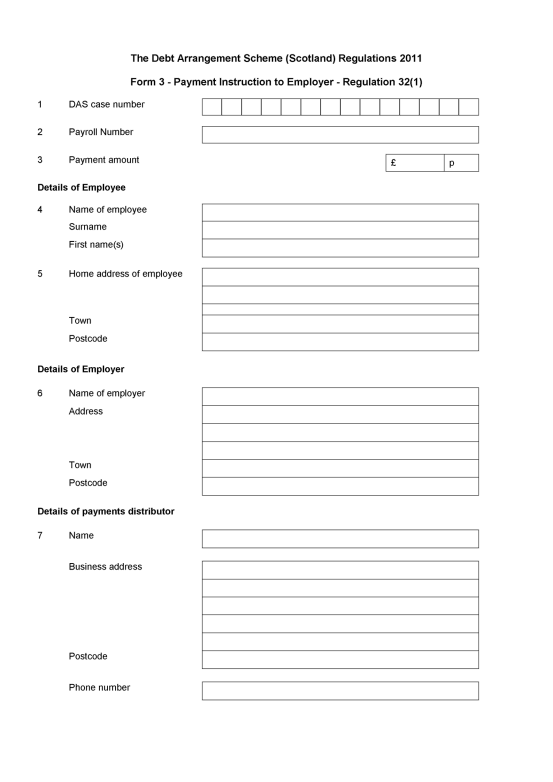


SCHEDULE 2CONSEQUENTIAL AMENDMENTS
Bankruptcy (Scotland) Act 1985
1.
“; and
(c)
a copy of the order to the DAS Administrator (as defined in regulation 2(1) of the Debt Arrangement Scheme (Scotland) Regulations 2011), where the debtor is taking part in a debt payment programme under Part 1 of the Debt Arrangement and Attachment (Scotland) Act 2002”.
2.
“(b)
forthwith send a copy of the order refusing or awarding sequestration—
(i)
to the Accountant in Bankruptcy; and
(ii)
where the debtor is taking part in a debt payment programme under Part 1 of the Debt Arrangement and Attachment (Scotland) Act 2002, to the DAS Administrator (as defined in regulation 2(1) of the Debt Arrangement Scheme (Scotland) Regulations 2011).”.
Debt Arrangement and Attachment (Scotland) Act 2002
3.
(a)
omit “and” immediately preceding paragraph (g); and
(b)
“; and
(h)
whether an application by the debtor for approval of a debt payment programme under Part 1 of this Act has been refused or approved, and if approved, whether that programme has been varied, or is revoked or completed.”.
Protected Trust Deed (Scotland) Regulations 2008
4.
SCHEDULE 3MONEY ADVISER TRAINING
1.
The relationship between prescription or limitation, and enforcement of debt.
2.
The consequences for a debtor—
(i)
sequestration;
(ii)
taking part in a debt payment programme;
(iii)
signing a trust deed;
(iv)
a trust deed becoming a protected trust deed; and
(v)
extra-judicial composition.
3.
The operation of—
(i)
an earnings arrestment;
(ii)
a furthcoming;
(iii)
an attachment, exceptional attachment and auction of moveables; and
(iv)
the debt arrangement scheme under Part 1 of the Act and prescribed by these Regulations.
4.
The nature of rights of appeal from the sheriff court.
5.
Assisting a client to—
(a)
respond to admitted money claims in the sheriff courts;
(b)
make or oppose an application in the sheriff courts for—
(i)
recall of decree;
(ii)
dismissal or absolvitor;
(iii)
continuation of a cause;
(iv)
a sist;
(c)
apply for recall or restriction of an arrestment;
(d)
(e)
apply for recall of an attachment, exceptional attachment, or an order under Parts 2 and 3 of the Act; or
(f)
make an application under these Regulations.
6.
Identifying the need to refer a case to an appropriate specialist, and know how to access specialist support.
SCHEDULE 4PAYMENTS DISTRIBUTORS
A payments distributor must—
F1821.
(1)
F183Be a person with permission under the Financial Services and Markets Act 2000 to carry on a regulated activity—
(a)
in relation to or in connection with a contract of the kind mentioned in paragraph 23 or paragraph 23B of Schedule 2 to that Act (credit agreements and contracts for hire of goods), or
(b)
of the kind mentioned in paragraph 24B (providing credit reference services) or 24C (providing credit information services) of that Schedule.
(2)
Sub-paragraph (1) must be read with—
(a)
section 22 of the Financial Services and Markets Act 2000,
(b)
any relevant order under that section, and
(c)
Schedule 2 to that Act.
F1842.
. . . . . . . . . . . . . . . . . . . . . . . . . . . . . . . .
3.
Make and maintain arrangements to ensure financial security of sums received from debtors for disbursement to creditors.
4.
Make and maintain appropriate arrangements to accept and disburse payments using all methods approved under regulation 31(1).
F1855.
Make and maintain appropriate arrangements to ensure compliance with rules made by the Financial Conduct Authority and to ensure that appropriate regard is had to guidance issued by the Financial Conduct Authority.
6.
Make and maintain appropriate arrangements for the issue of required reports.
7.
Provide an information technology system to transmit reports to debtors, creditors, money advisers, DAS Administrator by the preferred medium (e.g. text and or data files).
SCHEDULE 5REVOCATIONS
The Debt Arrangement Scheme (Scotland) Regulations 2004 (except for regulation 38(1)(ba), the reference to that sub-paragraph in regulation 39(1) and regulations 49A and 50(3A) and the reference to that paragraph in regulation 50(6)(a)30) | |
The Debt Arrangement Scheme (Scotland) Amendment Regulations 2004 | |
The Debt Arrangement Scheme (Scotland) Amendment (No. 2) Regulations 2007 |
These Regulations provide a scheme for repayment of debts in Scotland. They provide for procedure and forms in respect of a repayment arrangement under the scheme, which on approval is described as a debt payment programme (“a programme”).
The scheme is the responsibility of the DAS Administrator, who exercises the functions of the Scottish Ministers under the Debt Arrangement and Attachment (Scotland) Act 2002 (“the 2002 Act”). The Accountant in Bankruptcy of 1 Pennyburn Road, Kilwinning is the DAS Administrator, by virtue of an order under section 8 of the 2002 Act (S.S.I. 2004/448).
A person whose debts are being repaid under a programme is protected in terms of section 4 of the 2002 Act from enforcement measures (diligence and sequestration proceedings) and interest, fees, penalties and other charges that are otherwise available or due to creditors.
The Regulations are divided into 11 parts, and have 5 Schedules.
Part 1 provides definitions for terms used in the Regulations and for the forms in Schedule 1 (regulations 2 and 3), a dispensing power for the DAS Administrator so that procedural irregularities can be resolved administratively (regulation 4), for fees to be charged (regulation 5), and for consequential amendments to the 2002 Act and other enactments as set out in Schedule 2 (regulation 6).
Part 2 provides that a person whose debts are being repaid under a programme must have a money adviser in making an application (regulation 7), for approved categories of money adviser (regulation 8), for the method of applying to the DAS Administrator for, and the grounds for, approval (regulation 9 and Schedule 3), a list of persons who may not be approved as an adviser (regulation 10), for the grounds on which approval as an adviser may be revoked (regulation 11), for the functions of an adviser (or the DAS Administrator), and that a fee may not be charged unless information about free advice is given to the client (regulation 12).
Part 3 provides for who is to act as payments distributor and the method of applying for approval as, a payments distributor (regulations 13 and 14 and Schedule 4), the grounds on which approval as a distributor may be revoked (regulation 15), the functions of a distributor (regulation 16), and that an administration fee for distribution services may be charged to a creditor (regulation 17).
Part 4 provides that the DAS Administrator must maintain a register of programmes (regulation 18), and for the information to be held on that register (regulation 19).
Part 5 provides that a person who is habitually resident in Scotland may apply for approval of a programme (regulation 20). That person must be an individual by virtue of section 1 of the 2002 Act. It further provides that a person may not in general apply if debts are being managed in other ways, including sequestration or bankruptcy (regulation 21), for joint debt payment programmes (regulation 22), that each creditor (as defined in regulation 2) must consent to a programme, and for the conditions in which there can be deemed consent (regulation 23), that agreed programmes must be approved (regulation 24), that the DAS Administrator must approve a programme that is fair and reasonable using specified criteria (regulation 25), for notice of approval and the date of approval (regulation 26), and that approval is always subject to certain conditions (regulation 27) and may be subject to extra conditions (regulation 28), and for methods for the DAS Administrator and money adviser to notify interested parties about approval or rejection of a programme (regulation 29). Regulation 30 clarifies that it is incompetent to commence or execute diligence or to petition the court to sequestrate a debtor in the period before a debt payment programme commences.
Part 6 provides for specified methods of payment where a programme is approved, and for the DAS Administrator to be able to approve other methods (regulation 31), and in respect of payment mandates to an employer for the charges an employer may make and a penalty for default on employers (regulation 32). It also makes provision further to the 2002 Act for the effect of a programme, in particular that arrestments are recalled, and that if further credit is given to a person in a programme then diligence and sequestration may not be available to enforce payment (regulation 33(1) to (4)), that the protection from enforcement action under the 2002 Act is extended so that civil imprisonment is covered, and that a creditor can complete diligences that are at an advanced stage at the time of approval (regulation 33(5)), for the diligences of land attachment and arrestment (regulation 34), and that a trust deed for a creditor under the Bankruptcy (Scotland) Act 1985 is ended (regulation 35).
Part 7 provides that debtors, money advisers and creditors may apply for variation of a programme (regulation 36) on specified grounds (regulation 37), that the DAS Administrator shall approve a programme that is fair and reasonable using the criteria in regulation 25 (regulation 38), and the methods for the DAS Administrator and money adviser to notify interested parties about approval or rejection of a variation (regulation 39).
Part 8 provides for automatic revocation of a programme if the person applies for sequestration or a protected trust deed (regulation 40), that in other circumstances money advisers and creditors may apply for revocation (regulation 41), the grounds for revocation and the factors the DAS Administrator must consider (regulations 42 and 43), and the methods for the DAS Administrator and money adviser to notify interested parties about the revocation (regulation 44). It also provides for revocation to be a ground of apparent insolvency under the Bankruptcy (Scotland) Act 1985 (regulation 45).
Part 9 provides for the notices that are required when a programme is completed, whether by repayment in full or agreement amongst those with an interest (regulation 46).
Part 10 provides for the circumstances in which matters of law may be appealed to the sheriff or sheriff principal, as the case may be, and for the decision on appeal to be final (regulation 47).
Part 11 revokes the relevant provisions of Debt Arrangement Scheme (Scotland) Regulations 2004 as amended which are replaced by these Regulations (see Schedule 5), subject to transitional arrangements (regulations 49 to 51).
Related Regulations under section 7A of the 2002 Act provide for a moratorium on interest, fees, penalties and other charges for an approved debt payment programme.
A Business and Regulatory Impact Assessment of the effect which these Regulations are likely to have on business costs has been prepared and placed in the Scottish Parliament Information Centre. Copies may be obtained from the Accountant in Bankruptcy, 1 Pennyburn Road, Kilwinning.