The Bankruptcy (Certificate for Sequestration) (Scotland) Regulations 2010
In accordance with section 72(2) of that Act, a draft of these Regulations has been laid before and approved by resolution of the Scottish Parliament.
Citation and commencement1.
These Regulations may be cited as the Bankruptcy (Certificate for Sequestration) (Scotland) Regulations 2010 and come into force on 15th November 2010.
Interpretation2.
(1)
In these Regulations—
“the Act” means the Bankruptcy (Scotland) Act 1985;
(2)
Authorised persons3.
(1)
The following are classes of persons prescribed for the purposes of section 5B(5)(a) of the Act as persons authorised to grant a certificate for sequestration—
(a)
persons who—
(i)
(ii)
work for an insolvency practitioner as defined in regulation 3(1)(a)(i), who have been given authority by that insolvency practitioner to act on behalf of that insolvency practitioner in the granting of a certificate for sequestration; and
(b)
persons who—
(i)
work as money advisers for organisations which have been awarded accreditation at Type 2 level or above against the Scottish National Standards for Information and Advice Provision; or
(ii)
are approved for the purposes of the Debt Arrangement Scheme; or
(iii)
work as money advisers for a citizens advice bureau which is a full member of the Scottish Association of Citizens Advice Bureaux – Citizens Advice Scotland; or
(iv)
work as money advisers for councils constituted under section 2 of the Local Government etc. (Scotland) Act 1994 (c.39).
(2)
Further provisions relating to certification4.
Prior to granting a certificate for sequestration, an authorised person must—
(a)
provide the debtor with a copy of a Debt Advice and Information Package referred to in section 10(5) of the 2002 Act;
(b)
advise the debtor of the options of a voluntary repayment plan, a debt payment programme under the Debt Arrangement Scheme or a trust deed; and
(c)
advise the debtor of the consequences of sequestration and that an award of sequestration, if granted, is recorded in a public register and may result in one or more of—
(i)
the debtor being refused credit, or being offered credit at a higher rate, whether before or after the date of the debtor being discharged;
(ii)
the debtor not being able to remain in his/her current place of residence;
(iii)
the debtor being required to relinquish property which the debtor owns;
(iv)
the debtor requiring to make contributions from income for the benefit of creditors;
(v)
damage to the debtor’s business interests and employment prospects;
(vi)
the debtor still being liable for some debts;
(vii)
the debtor’s past financial transactions being investigated; and
(viii)
other restrictions or requirements imposed on the debtor as a result of the debtor’s own circumstances and actions.
The form and manner of certificate5.
(1)
A certificate for sequestration granted by an authorised person on the application of a debtor shall be in the form of the Form set out in the Schedule to these Regulations.
(2)
The certificate for sequestration must be signed and dated by an authorised person and signed and dated by the debtor to the effect provided in the form of the Form set out in the Schedule to these Regulations.
(3)
A valid certificate for sequestration must in the case of the authorised persons referred to in regulation 3(1) be printed on the headed notepaper of the organisation to which the authorised person belongs, where the authorised person belongs to an organisation, or in other cases on the authorised person’s headed notepaper.
Fees6.
A nil fee is chargeable for granting a certificate for sequestration.
The prescribed period7.
St Andrew’s House,
Edinburgh
SCHEDULE


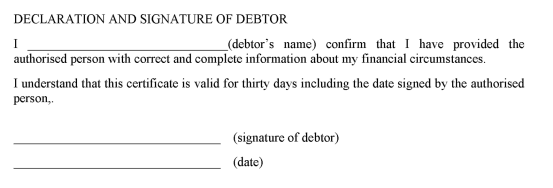
These Regulations make provision for a Certificate for Sequestration of a debtor’s estate to be granted by an authorised person who will certify that the debtor has demonstrated that he or she is not able to pay his or her debts as they become due under the Bankruptcy (Scotland) Act 1985 as amended by the Home Owner and Debtor Protection (Scotland) Act 2010.
An authorised person will be entitled to rely on statements and paperwork provided by the debtor in granting a certificate for sequestration. In particular, an authorised person is entitled to rely on the information provided by a debtor as to their financial circumstances as declared in the Certificate for Sequestration form set out in the Schedule to these Regulations.
In terms of Regulation 3(1)(a), insolvency practitioners are designated as persons authorised to grant a Certificate for Sequestration as are persons who work for an insolvency practitioner as defined in regulation 3(1)(a)(i), who have been given authority by that insolvency practitioner to act on behalf of that insolvency practitioner in the granting of a certificate of sequestration.
Regulation 3(1)(b) also includes persons approved for the purposes of the Debt Arrangement Scheme and persons working as money advisers for the organisations or persons listed in regulation 3(1)(b)(i), (iii) and (iv).
Regulation 7, and the form of the Certificate of Sequestration in the Schedule to these Regulations, refer to the prescribed period being 30 days ending on the date on which a debtor may make an application for sequestration. This is intended to allow the flexibility of the certificate and debtor application being signed on the same day.