Act of Adjournal (Criminal Procedure Rules Amendment No. 4) (Mental Health (Care and Treatment) (Scotland) Act 2003) 2005
Citation and commencement1.
(1)
This Act of Adjournal may be cited as the Act of Adjournal (Criminal Procedure Rules Amendment No. 4) (Mental Health (Care and Treatment) (Scotland) Act 2003) 2005 and shall come into force on 5th October 2005.
(2)
This Act of Adjournal shall be inserted in the Books of Adjournal.
Amendment of the Act of Adjournal (Criminal Procedure Rules) 19962.
(1)
(2)
“CHAPTER 7MENTAL DISORDER
Application for assessment orders7.1.
(1)
A written application under—
(a)
section 52B(1) of the Act of 1995 (assessment order: prosecutor)3; or(b)
section 52C(1) of the Act of 1995 (assessment order: Scottish Ministers),
shall be in Form 7.1.
(2)
Where an application is made under paragraph (1)—
(a)
the court shall appoint a diet for hearing the application; and
(b)
the clerk of court shall intimate the diet to the applicant, the person in respect of whom the application is made or the solicitor for that person, the governor of any institution in which the person in respect of whom the application is made is detained and, where the application is by the Scottish Ministers, the prosecutor.
Assessment orders ex proprio motu7.2.
Where the court considers making an assessment order under section 52E of the Act of 1995 (assessment order: ex proprio motu) and considers it appropriate to do so—
(a)
the court shall appoint a diet for parties to be heard; and
(b)
the clerk of court shall intimate the diet to the prosecutor, the person in respect of whom the order may be made or the solicitor for that person, and the governor of any institution in which the person in respect of whom the application is made is detained.
Applications for treatment orders7.3.
(1)
A written application under—
(a)
section 52K(1) of the Act of 1995 (treatment order: prosecutor); or
(b)
section 52L(1) of the Act of 1995 (treatment order: Scottish Ministers),
shall be in Form 7.3.
(2)
Where an application is made under paragraph (1)—
(a)
the court shall appoint a diet for hearing the application; and
(b)
the clerk of court shall intimate the diet to the applicant, the person in respect of whom the application is made or the solicitor for that person, the governor of any institution in which the person in respect of whom the application is made is detained, and where the application is by the Scottish Ministers, the prosecutor.
Treatment orders ex proprio motu7.4.
Where the court considers making a treatment order under section 52N of the Act of 1995 (treatment order: ex proprio motu) and considers it appropriate to do so—
(a)
the court shall appoint a diet for parties to be heard; and
(b)
the clerk of court shall intimate the diet to the prosecutor, the person in respect of whom the order may be made or the solicitor for that person, and the governor of any institution in which the person in respect of whom the application is made is detained.
Variation of assessment orders or review of treatment orders7.5.
Where the court receives a report under section 52G(9) (report for variation of assessment order) or section 52Q(1) (report for review of treatment order) of the Act of 1995—
(a)
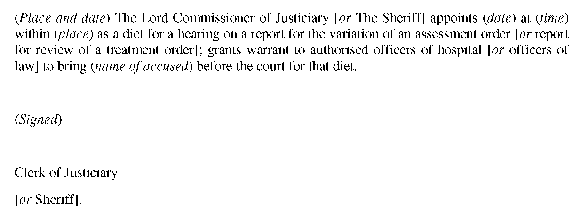
the court shall, by interlocutor in Form 7.5, appoint a hearing for parties to be heard and where appropriate, grant warrant to authorised officers of the hospital or officers of law, to bring the offender from the hospital to the court for that diet; and
(b)
the clerk of court shall intimate the diet to the prosecutor, the person in respect of whom the order has been made or the solicitor for that person.
Interim compulsion order7.6.
(1)
Subject to paragraph (2), where the court receives a report under section 53B(1) of the Act of 1995 (interim compulsion order)4 —(a)
the court shall—
(i)
by interlocutor in Form 7.6, appoint a hearing for parties to be heard and where appropriate, grant warrant to authorised officers of the hospital or officers of law, to bring the offender from the hospital to the court for that diet;
(ii)
discharge the diet already fixed; and
(b)
the clerk of court shall intimate the diet to the prosecutor, the person in respect of whom the order has been made or the solicitor for that person.
(2)
Where the report referred to in paragraph (1) is received within 14 days before the diet already fixed, paragraph (1) shall not apply.
Assessment, treatment and interim compulsion orders: specified hospital7.7.
Where the court makes a direction under section 52F(1)(b) (assessment order: specified hospital), section 52P(1)(b) (treatment order: specified hospital) or section 53A(1) (interim compulsion order: specified hospital)5 of the Act of 1995 the court shall send a copy of the direction to the person in respect of whom the order has been made, the solicitor for that person, the prosecutor and Scottish Ministers.Compulsion orders and hospital directions: specified hospital7.8.
Where the court makes a direction under 57D(1) (compulsion order: specified hospital)6 or specifies another hospital in a direction under section 59C(1) (hospital direction: specified hospital)7 of the Act of 1995 the court shall send a copy of the direction or specification, as the case may be, to the person in respect of whom the order has been made and the solicitor for that person.”.
(3)
In the appendix, for Forms 7.1-A and 7.1-B there shall be substituted the forms set out in the Schedule to this Act of Adjournal.
Edinburgh
SCHEDULE



This Act of Adjournal amends the Criminal Procedure Rules 1996 (S.I. 1996/513) (“the 1996 Rules”) to make provision consequential upon amendments to the Criminal Procedure (Scotland) Act 1995 (“the 1995 Act”) by the Mental Health (Care and Treatment) (Scotland) Act 2003 (asp 13) (“the 2003 Act”).
Paragraph 2(2) inserts new rules to set out procedure for a written application to the court for assessment orders or treatment orders under the 1995 Act. There are also provided rules of procedure for the court to make such orders ex proprio motu. A new rule is provided for procedure to allow the variation of an assessment order or review of a treatment order. New rule 7.6 sets out a procedure to allow an early diet to be fixed in certain circumstances where an interim compulsion order has been made by the court. Finally, rules provide for intimation on certain parties where the court changes the hospital specified in an assessment, treatment, interim compulsion, or compulsion order or hospital direction.
Paragraph 2(3) inserts forms into the appendix for a written application for an assessment or treatment order, and forms of interlocutor where a hearing has been fixed that include a warrant to bring the accused person or offender to court.