The Plastic Materials and Articles in Contact with Food (Amendment) (Scotland) Regulations 2000
Made
Laid before the Scottish Parliament
Coming into force
The Scottish Ministers, in exercise of the powers conferred by sections 6(4), 16(2), 17(1), 26(1)(a) and 48(1) of the Food Safety Act 19901 and of all other powers enabling them in that behalf, after having regard in accordance with section 48(4A)2 of that Act to relevant advice given by the Food Standards Agency and after consultation in accordance with section 48(4) and (4B)3 of that Act, hereby make the following Regulations:
Citation, commencement and extent
1.
(1)
These Regulations may be cited as the Plastic Materials and Articles in Contact with Food (Amendment) (Scotland) Regulations 2000 and shall come into force on 31st December 2000.
(2)
These Regulations extend to Scotland only.
Amendment of the principal Regulations
2.
The Plastic Materials and Articles in Contact with Food Regulations 19984 (“the principal Regulations”) shall be amended in accordance with the following regulations.
3.
In regulation 2 (interpretation), in the definition of “the Directive” for the words “and 96/11/EC” there shall be substituted “, 96/11/EC and 1999/91/EC5 (as corrected6)”.
4.
For sub paragraph (a) of regulation 3(4) (restriction on the use, sale or importation of plastic materials and articles) there shall be substituted–
“(a)
if–
(i)
(aa)
it has been manufactured with a prohibited monomer as described in regulation 4(1);
(bb)
it has been manufactured with a prohibited additive as described in regulation 5(1);
(cc)
being a product obtained by bacterial fermentation, it does not comply with regulation 5A; or
(dd)
it does not comply with regulation 4(5), 5(4) or 7, and
(ii)
no defence indicated in regulation 4(7), 5(2) or 7(5) would be available in proceedings for an offence under these Regulations relating to that manufacture or want of compliance; or”.
5.
In regulation 4 (restriction on manufacture with monomers)–
(a)
in paragraph (1)(c), for the words “restrictions (if any) specified” there shall be substituted the words “restrictions and specifications (if any) set out”; and
(b)
paragraph (3)(d) shall be omitted.
6.
In regulation 5 (restriction on manufacture with additives)–
(a)
for paragraph (1) there shall be substituted–
“(1)
Subject to the following paragraphs of this regulation, no person shall use in the manufacture of plastic materials or articles any prohibited additive, that is to say an additive identified by PM/REF No., CAS No. (if any) and name respectively in columns 1, 2 and 3 of Part I of Schedule 2 which–
(a)
is not of good technical quality; or
(b)
is not used in accordance with the restrictions and specifications (if any) set out in the corresponding entry in column 4 of the relevant section of that Part of that Schedule.”; and
(b)
there shall be inserted at the end the following paragraphs–
“(4)
Subject to paragraph (5) of this regulation, where column 4 of Part I of Schedule 2 expresses a migration limit of mg/kg in relation to any additive, no plastic material or article manufactured containing that additive shall be capable of transferring constituents of that additive to food with which that plastic material or article may come into contact in quantities exceeding the appropriate limit, and for the purposes of this paragraph the appropriate limit is–
(a)
the number of milligrams expressed therein released per kilogram of food in the case of any plastic material or article other than one specified in sub-paragraph (b) below; and
(b)
one sixth of the number of milligrams expressed therein per square decimetre of surface area of the plastic material or article if the plastic material or article comprises–
(i)
an article which is a container or is comparable to a container or which can be filled, with a capacity of less than 500 millilitres or more than 10 litres; or
(ii)
sheet, film or other material which cannot be filled or for which it is impracticable to estimate the relationship between the surface area of that material and the quantity of food in contact with that surface area.
(5)
A plastic material or article manufactured containing an additive in respect of which column 4 of Part 1 of Schedule 2 expresses a migration limit of mg/kg shall not be considered capable of transferring constituents of that additive to food with which that plastic material or additive may come into contact in quantities exceeding the appropriate limit in paragraph (4) of this regulation if the only food with which that plastic material or article may come into contact is food to which regulation 7(3) applies.”.
7.
After regulation 5 there shall be inserted the following regulation–
“Products obtained by bacterial fermentation5A.
A product obtained by bacterial fermentation complies with this regulation if it is–
(a)
of good technical quality;
(b)
identified by PM/REF No., CAS No. and name respectively in columns 1, 2 and 3 of Schedule 2A; and
(c)
in compliance with the restrictions and specifications set out in column 4 of that Schedule.”.
8.
After regulation 7 (transfer of constituents) there shall be inserted the following regulation–
“Specifications7A.
Schedule 2B shall have effect for the purpose of giving the specifications referred to in column 4 of Schedules 1, 2 and 2A.”.
9.
In regulation 10 (offences) the following paragraph shall be added at the end–
“(15)
In any proceedings for an offence under these Regulations it shall be a defence to prove that–
(a)
the act was committed in relation to a plastic material or article intended to come into contact with food which was manufactured in the European Community, or imported into the European Community, before 1st January 2003; and
(b)
the matters constituting the offence would not have constituted an offence under these Regulations before the amendments made by the Plastic Materials and Articles in Contact with Food (Amendment) (Scotland) Regulations 2000 came into force.”.
10.
In Schedule 1 (monomers) –
(a)
in Part I, in section A in column 4, for the heading “Restrictions” there shall be substituted the heading “Restrictions and specifications”;
(b)
the item number and letter, PM/REF No., CAS No., name and restriction and specification (if any) for each monomer identified in Part I of Schedule 1 to these Regulations shall be inserted in Section A of Part I of Schedule 1 to the principal Regulations at the place corresponding to the number and letter (if any) specified for that monomer in the column headed “Item” in Part 1 of Schedule 1 to these Regulations;
(c)
in Part I, in Section A, for the entries in column 4 (restrictions and specifications) against the items which correspond to the items listed in Part II of Schedule 1 to these Regulations, there shall be substituted the corresponding entries specified in column 4 of Part II of Schedule 1 to these Regulations;
(d)
in Part I, in Section A, in item 196 the entry in column 4 (restrictions and specifications) shall be omitted;
(e)
in Part I, in Section B, item number 67 and the entries for it shall be omitted;
(f)
in Part I, in Section B, for the entries in column 4 (restrictions and specifications) against the items which correspond to the items listed in Part III of Schedule 1 to these Regulations, there shall be substituted the corresponding entries specified in column 4 of Part III of Schedule 1 to these Regulations;
(g)
in Part I, in Section B, after the entries relating to item 77, there shall be inserted the item number and letter, PM/REF No., CAS No., name and restriction for the monomer listed in Part IV of Schedule 1 to these Regulations;
(h)
in Part I, the items in Section B which are listed in Part V of Schedule 1 to these Regulations, and the entries opposite to and corresponding to them, shall be omitted and there shall be inserted in Section A, at the place corresponding to the number and letter (if any) specified for each item in the column headed “Item No. for Section A” in Part V of Schedule 1 to these Regulations, the entries relating to that item listed in Part V of Schedule 1 to these Regulations; and
(i)
in Part II there shall be inserted at the end the following paragraph–
“4.
Where an entry in column 4 in Part I of this Schedule, includes a bracketed number, that entry shall be subject to the note relating to that number as follows:
(1)
Warning: there is a risk that the specific migration limit could be exceeded in fatty food simulants.
(2)
SML (T) in this specific case means that the restriction shall not be exceeded by the sum of the migration of the following substances mentioned as PM/REF Nos: 10060 and 23920.
(3)
SML (T) in this specific case means that the restriction shall not be exceeded by the sum of the migration of the following substances mentioned as PM/REF Nos: 15760, 16990, 47680, 53650, 89440.
(4)
SML (T) in this specific case means that the restriction shall not be exceeded by the sum of the migration of the following substances mentioned as PM/REF Nos: 19540, 19960.
(5)
SML (T) in this specific case means that the restriction shall not be exceeded by the sum of the migration of the following substances mentioned as PM/REF Nos: 14200, 14230.
(9)
SML (T) in this specific case means that the restriction shall not be exceeded by the sum of the migration of the following substances:–
However in aqueous food simulants, the SML (T) should also include Badge.2H2O(c) unless the material or article is labelled for use in contact only with those foods and beverages for which it has been demonstrated that the sum of the migration levels of the five above mentioned substa nces (a)(b)(d)(e)(f) cannot exceed 1mg/kg.”.
11.
In Schedule 2 (additives)–
(a)
in Part I there shall be added an extra column, numbered “4” and headed “Restrictions and specifications”;
(b)
the item number and letter, PM/REF No., CAS No., name and restriction and specification (if any) for each additive identified in Schedule 2 to these Regulations shall be inserted in Part I of Schedule 2 to the principal Regulations at the place corresponding to the number and letter specified for that additive in the column headed “Item” in Schedule 2 to these Regulations;
(c)
in Part I, for the entries in column 2 (CAS No.) for item 38 there shall be substituted the following:–
“087826–41–3
069158–41–4
054686–97–4
081541–12–0”;
(d)
in Part I, for the entries in column 3 (name) for item 38 there shall be substituted the following:–
“Bis (methylbenzylidene) sorbitol
" " " " "
" " " " "
" " " " "”;
(e)
in Part I, for the entry in column 2 (CAS No.) for item 179 there shall be substituted the entry “037244-96-5”;
(f)
in Part I, item 195 and the entries for it shall be deleted; and
(g)
in Part II, there shall be inserted at the end the following paragraph–
“4.
Where an entry in column 4 (restrictions and specifications) in Part I of this Schedule includes a bracketed number, that entry shall be subject to the note relating to that number as follows:
(1)
Warning: there is a risk that the specific migration limit could be exceeded in fatty food simulants.
(3)
SML (T) in this specific case means that the restriction shall not be exceeded by the sum of the migration of the following substances mentioned as PM/REF Nos: 15760, 16990, 47680, 53650, 89440.
(6)
SML (T) in this specific case means that the restriction shall not be exceeded by the sum of the migration of the following substances mentioned as PM/REF/Nos: 66560 and 66580.
(7)
SML (T) in this specific case means that the restriction shall not be exceeded by the sum of the migration of the following substances mentioned as PM/REF Nos: 30080, 42320, 45195, 45200, 53610, 81760, 89200, 92030.
(8)
SML (T) in this specific case means that the restriction shall not be exceeded by the sum of the migration of the following substances mentioned as PM/REF Nos: 85840 and 95725.
(10)
Warning: there is a risk that the migration of the substance deteriorates the organoleptic characteristics of the food in contact and then, that the finished product does not comply with regulation 4(2) of the Materials and Articles in Contact with Food Regulations 19877.”.
12.
After Schedule 2 there shall be inserted as Schedules 2A and 2B as set out in Schedules 3 and 4 to these Regulations.
13.
In Schedule 3 (provisions applicable when testing compliance with the migration limits)–
(a)
in paragraph 4(3) and (4), for “regulation 7 or Schedule 1” in each case there shall be substituted “regulation 7, Schedule 1 or Schedule 2”; and
(b)
in paragraph 7(2)(c) for “M1 and M2” there shall be substituted “M2 and M3”.
MALCOLM CHISHOLM
Authorised to sign by the Scottish Ministers
St Andrew’s House,
Edinburgh
SCHEDULE 1
Regulation 10
PART ILIST OF MONOMERS TO BE ADDED TO SECTION A OF PART I OF SCHEDULE 1 TO THE PRINCIPAL REGULATIONS
1
2
3
4
Item
PM/REF No.
CASNo.
Name
Restrictions and Specifications
28A
12761
000693-57-2
12-Aminododecanoic acid
The specific migration of this substance shall not exceed 0.05 mg/kg
35A
13180
000498-66-8
Bicyclo [2.2.1] hept-2-ene (=norbornene)
The specific migration of this substance shall not exceed 0.05 mg/kg
35B
13210
001761-71-3
Bis(4-aminocyclohexyl)methane
The specific migration of this substance shall not exceed 0.05 mg/kg
63A
14650
000079-38-9
Chlorotrifluoroethylene
The quantity of this substance in the finished plastic material or article shall not exceed 0.05 mg/6 dm2
68A
14841
000599-64-4
4-Cumylphenol
The specific migration of this substance shall not exceed 0.05 mg/kg
93A
16694
013811-50-2
N,N'-Divinyl-2-imidazolidinone
The quantity of this substance in the finished plastic material or article shall not exceed 5 mg/kg
93B
16704
000112-41-4
1-Dodecene
The specific migration of this substance shall not exceed 0.05 mg/kg
147A
22331
025513-64-8
Mixture of (40% w/w) 1,6-diamino-2,2,4-trimethylhexane and (60% w/w) 1,6-diamino-2,4,4-trimethylhexane
The quantity of this substance in the finished plastic material or article shall not exceed 5 mg/6 dm2
152A
22550
000498-66-8
Norbornene
The specific migration of this substance shall not exceed 0.05 mg/kg
163A
23175
000122-52-1
Phosphorous acid, triethyl ester
The quantity of this substance in the finished plastic material or article shall be not detectable (when measured by a method with a detection limit of 1 mg/kg)
169A
23547
009016-00-6 063148-62-9
Polydimethylsiloxane (MW>6800)
In compliance with the specifications laid down against item 2 in Schedule 2B
206A
25080
001120-36-1
1-Tetradecene
The specific migration of this substance shall not exceed 0.05 mg/kg
214A
25385
000102-70-5
Triallylamine
In compliance with the specifications laid down against item 3 in Schedule 2B
218A
25927
027955-94-8
1,1,1-Tris(4-hydroxyphenyl)ethane
The quantity of this substance in the finished plastic material or article shall not exceed 0.5 mg/kg For use only in polycarbonates
223
26155
001072-63-5
1-Vinylimidazole
The quantity of this substance in the finished plastic material or article shall not exceed 5 mg/kg
225
26320
002768-02-7
Vinyltrimethoxysilane
The quantity of this substance in the finished plastic material or article shall not exceed 5 mg/kg
PART IILIST OF MONOMERS IN SECTION A OF PART I OF SCHEDULE 1 TO THE PRINCIPAL REGULATIONS FOR WHICH THE CONTENT OF THE COLUMN “RESTRICTION AND SPECIFICATIONS” IS MODIFIED
SML (T) = 1 mg/kg (9) Authorised only until 1 January 2005
56
14200
000105-60-2
Caprolactam
SML (T) = 15 mg/kg (5)
57
14230
002123-24-2
Caprolactam, sodium salt
SML (T) = 15 mg/kg (5) (expressed as caprolactam)
79
15760
000111-46-6
Diethyleneglycol
SML (T) = 30 mg/kg (3)
98
16990
000107-21-1
Ethyleneglycol
SML (T) = 30 mg/kg (3)
102
17160
000097-53-0
Eugenol
The specific migration of this substance shall be not detectable (when measured by a method with a limit of detection of 0.02 mg/kg, analytical tolerance included)
The quantity of this substance in the finished plastic material or article shall not exceed 1 mg/kg (expressed as epoxy group, molecular weight = 43)
PART IIILIST OF MONOMERS IN SECTION B OF PART I OF SCHEDULE 1 TO THE PRINCIPAL REGULATIONS FOR WHICH THE CONTENT OF THE COLUMN “RESTRICTIONS AND SPECIFICATIONS” IS MODIFIED
1
2
3
4
Item
PM/REF No.
CASNo.
Name
Restrictions and Specifications
34
16690
001321-74-0
Divinylbenzene
The quantity of this material in the finished plastic material or article shall not exceed 1 mg/kg or the specific migration of this substance shall be not detectable (when measured by a method with a limit of detection of 0.02 mg/kg, analytical tolerance included)
56
20590
000106-91-2
Methacrylic acid, 2,3-epoxypropyl ester
The quantity of this material in the finished plastic material or article shall not exceed 5 mg/kg (expressed as epoxy group, molecular weight = 43)
68
22720
000140-66-9
4-tert-Octylphenol
The specific migration of this substance shall be not detectable (when measured by a method with a limit of detection of 0.01mg/kg, analytical tolerance included)
PART IVMONOMER TO BE ADDED TO SECTION B OF PART I OF SCHEDULE 1 TO THE PRINCIPAL REGULATIONS
The specific migration of this substance shall be not detectable (when measured by a method with a limit of detection of 0.01mg/kg, analytical tolerance included)
PART VLIST OF MONOMERS TRANSFERRED FROM SECTION B TO SECTION A OF PART I OF SCHEDULE 1 TO THE PRINCIPAL REGULATIONS
1
2
3
4
Item No. in Section B
Item No. in Section A
PM/REF No.
CASNo.
Name
Restrictions and Specifications
5
13A
11000
050976-02-8
Acrylic acid, dicyclopentadienyl ester
The quantity of this substance in the finished plastic material or article shall not exceed 0.05 mg/6 dm2
6
13B
11245
002156-97-0
Acrylic acid, dodecyl ester
The specific migration of this substance shall not exceed 0.05 mg/kg (1)
9
23A
12265
004074-90-2
Adipic acid, divinyl ester
The quantity of this substance in the finished plastic material or article shall not exceed 5 mg/kg; for use only as comonomer
12
33A
13060
004422-95-1
1,3,5-Benzenetricarboxylic acid trichloride
The quantity of this substance in the finished plastic material or article shall not exceed 0.05 mg/6 dm2 (measured as 1,3,5-benzenetricarboxylic acid)
16
49A
13780
002425-79-8
1,4-Butanediol bis(2,3-epoxypropyl) ether
The quantity of this substance in the finished plastic material or article shall not exceed 1 mg/kg (expressed as epoxy group, molecular weight equal to 43)
19
52A
14020
000098-54-4
4-tert-Butylphenol
The specific migration of this substance shall not exceed 0.05 mg/kg
22
73A
15130
000872-05-9
1-Decene
The specific migration of this substance shall not exceed 0.05 mg/kg
30
88A
16360
000576-26-1
2,6-Dimethylphenol
The specific migration of this substance shall not exceed 0.05 mg/kg
32
88B
16450
000646-06-0
1,3-Dioxolane
The specific migration of this substance shall not exceed 0.05 mg/kg
37
111A
18220
068564-88-5
N-Heptylaminoundecanoic acid
The specific migration of this substance shall not exceed 0.05 mg/kg (1)
41
118A
18820
000592-41-6
1-Hexene
The specific migration of this substance shall not exceed 3 mg/kg
42
121A
19060
000109-53-5
Isobutyl vinyl ether
The quantity of this substance in the finished plastic material or article shall not exceed 5 mg/kg
43
121B
19150
000121-91-5
Isophthalic acid
The specific migration of this substance shall not exceed 5 mg/kg
49
130A
19990
000079-39-0
Methacrylamide
The specific migration of this substance shall be not detectable (when measured by a method with a limit of detection of 0.02 mg/kg, analytical tolerance included)
50
131A
20050
000096-05-9
Methacrylic acid, allyl ester
The specific migration of this substance shall not exceed 0.05 mg/kg
55
135A
20530
002867-47-2
Methacrylic acid, 2-(dimethylamino)ethyl ester
The specific migration of this substance shall be not detectable (when measured by a method with a limit of detection of 0.02 mg/kg, analytical tolerance included)
61
145A
21730
000563-45-1
3-Methyl-1-butene
The quantity of this substance in the finished plastic material or article shall not exceed 0.006 mg/6 dm2 For use only in polypropylene
70
159A
22937
001623-05-8
Perfluoropropyl perfluorovinyl ether
The specific migration of this substance shall not exceed 0.05 mg/kg
71
173A
23770
000504-63-2
1,3-Propanediol
The specific migration of this substance shall not exceed 0.05 mg/kg
72
177A
23920
000105-38-4
Propionic acid, vinyl ester
SML (T) = 6 mg/kg (2) (expressed as acetaldehyde)
74
198A
24760
026914-43-2
Styrenesulphonic acid
The specific migration of this substance shall not exceed 0.05 mg/kg
83
224
26170
003195-78-6
N-Vinyl-N-methylacetamide
The quantity of this substance in the finished plastic material or article shall not exceed 2 mg/kg
SCHEDULE 2LIST OF ADDITIVES TO BE INSERTED IN PART I OF SCHEDULE 2 TO THE PRINCIPAL REGULATIONS
Regulation 11
1
2
3
4
Item
PM/REF No.
CASNo.
Name
Restrictions and Specifications
2A
30080
004180-12-5
Acetic acid, copper salt
SML (T) = 30 mg/kg (7) (expressed as copper)
7A
30610
Acids, C2-C24, aliphatic, linear monocarboxylic, from natural oils and fats and their mono-, di-and triglycerol esters (branched fatty acids at naturally occurring levels are included).
7B
30612
Acids, C2-C24, aliphatic, linear, monocarboxylic, synthetic and their mono-, di-and triglycerol esters
The specific migration of this substance shall be not detectable (when measured by a method with a limit of detection of 0.02 mg/kg, analytical tolerance included)
173A
67170
Mixture of (80 to100% w/w) 5,7-di-tert-butyl-3-(3,4-dimethylphenyl)-2(3H)-benzofuranone and (0-20% w/w) 5,7-di-tert-butyl-3-(2,3-di-methylphenyl)-2(3H)-benzofuranone
The specific migration of this substance shall not exceed 5 mg/kg
The specific migration of this substance shall not exceed 5 mg/kg (sum of phosphite and phosphate)
188A
71635
025151-96-6
Pentaerythritol dioleate
The specific migration of this substance shall not exceed 0.05 mg/kg; not for use with foods for which simulant D is laid down in Directive 85/572/EEC laying down the list of simulants to be used for testing migration of constituents of plastic materials and articles intended to come into contact with foodstuffs9.
191A
73720
000115-96-8
Phosphoric acid, trichloroethyl ester
The specific migration of this substance shall be not detectable (when measured by a method with a limit of detection of 0.02 mg/kg, analytical tolerance included)
The specific migration of this substance shall not exceed 5 mg/kg (covering the sum of phosphite and phosphate)
195A
76721
009016-00-6 063148-62-9
Polydimethylsiloxane (MW > 6800)
In compliance with the specifications laid down against item 5 in Schedule 2B
195B
76865
Polyesters of 1,2-propanediol and/or 1,3-and/or 1,4-butanediol and/or polypropyleneglycol with adipic acid, also end-capped with acetic acid or fatty acids C10-C18 or n-octanol and/or n-decanol
The specific migration of this substance shall not exceed 30 mg/kg
The specific migration of this substance shall not exceed 0.05 mg/kg for crotonic acid (as impurity) and in compliance with the specifications laid down against item 1 in Schedule 2B”
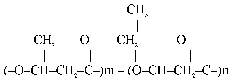
These copolymers are produced by the controlled fermentation of Alcaligenes eutrophus using mixtures of glucose and propanoic acid as carbon sources. The organism used has not been genetically engineered and has been derived from a single wild-type organism Alcaligenes eutrophus strain H16 NCIMB 10442. Master stocks of the organism are stored as freeze-dried ampoules. A submaster/working stock is prepared from the master stock and stored in liquid nitrogen and used to prepare inocula for the fermenter. Fermenter samples will be examined daily both microscopically and for any changes in colonial morphology on a variety of agars at different temperatures. The copolymers are isolated from heat treatment bacteria by controlled digestion of the other cellular components, washing and drying. These copolymers are normally offered as formulated, melt formed granules containing additives such as nucleating agents, plasticisers, fillers, stabilisers and pigments which all conform to the general and individual specifications.
where n/(m+n) greater than 0 and less or equal to 0.25
Average molecular weight
Not less than 150,000 Daltons (measured by gel permeation chromatography).
Assay
Not less than 98% poly (3–D–hydroxybutanoato–co–3–D– hydroxypentanoate) analysed after hydrolysis as a mixture of 3–D–hydroxybutanoic and 3–D–hydroxypentanoic acids.
Description Characteristics
White to off–white powder after isolation.
Identification tests:
Solubility
Soluble in chlorinated hydrocarbons such as chloroform or dichloromethane but practically insoluble in ethanol, aliphatic alkanes and water.
Migration
The migration of crotonic acid should not exceed 0.05 mg/kg food.
Purity
Prior to granulation the raw material copolymer powder must contain:
– Nitrogen
Not more than 2,500 mg/kg of plastic
– Zinc
Not more than 100 mg/kg of plastic
– Copper
Not more than 5 mg/kg of plastic
– Lead
Not more than 2 mg/kg of plastic
– Arsenic
Not more than 1 mg/kg of plastic
– Chromium
Not more than 1 mg/kg of plastic
2
23547
POLYDIMETHYLSILOXANE (Mw> 6800)
Minimum viscosity 100 x 10-6 m2/s (=100 centistokes) at 25°C
3
25385
TRIALLYLAMINE
40 mg/kg hydrogel at a ratio of 1 kg food to a maximum of 1.5 grams of hydrogel. For use only in hydrogels intended for non–direct food contact use.
Not more than 0.05% w/w (quantity of substance used/quantity of the formulation)
5
76721
POLYDIMETHYLSILOXANE (Mw>6800)
Minimum viscosity 100 x 10-6 m2/s (=100 centistokes) at 25°C
6
88640
SOYBEAN OIL, EPOXIDIZED
Oxirane <8%, iodine number < 6
7
95859
WAXES, REFINED, DERIVED FROM PETROLEUM BASED OR SYNTHETIC HYDROCARBON FEEDSTOCKS
The product should have the following specifications:
Content of mineral hydrocarbons with carbon number less than 25: not more than 5% (w/w)
Viscosity not less than 11 x 10-6 m2/ s (=11 centistokes) at 100°C
Average molecular weight not less than 500
8
95883
WHITE MINERAL OILS, PARAFFINIC DERIVED FROM PETROLEUM BASED HYDROCARBON FEEDSTOCKS
The product should have the following specifications:
Content of mineral hydrocarbons with carbon number less than 25: not more than 5% (w/w)
Viscosity not less than 8.5 x 10⁻⁶ m2/ s (=8.5 centistokes) at 100°C
Average molecular weight not less than 480”
(This note is not part of the Regulations)
These Regulations, which extend to Scotland only, amend the Plastic Materials and Articles in Contact with Food Regulations 1998 (“the 1998 Regulations”). These Regulations implement Commission Directive 1999/91/EC amending Directive 90/128/EEC relating to plastic materials and articles intended to come into contact with foodstuffs.
These Regulations–
(a)
update the lists of monomers and additives which can be used in the manufacture of plastic materials and articles intended to come into contact with food (regulations 10 and 11 and Schedules 1 and 2);
(b)
impose restrictions and specifications in respect of some of those monomers and additives (regulations 5(a), 6, 8, 10, 11 and 12 and Schedules 1, 2 and 4); in particular, a new type of restriction for additives is introduced (maximum permitted quantity of the substance in the finished material or article expressed as mg per 6 dm2 of the surface in contact with food);
(c)
bring products obtained by bacterial fermentation within the scope of the 1998 Regulations and impose restrictions and specifications for such products (regulations 4, 5(b), 7 and 12 and Schedule 3);
(d)
include a transitional provision (regulation 9); and
(e)
make some consequential amendments (regulations 3 and 13(a)) and correct two errors in the 1998 Regulations (regulations 10(d) and 13(b)).
A Regulatory Impact Assessment, which includes a compliance cost assessment of the effect which these Regulations have on business costs, has been prepared and has been placed in the Scottish Parliament Information Centre. Copies may be obtained from the Food Standards Agency, 6th Floor, St Magnus House, 25 Guild Street, Aberdeen AB11 6NJ.