The Magistrates’ Courts (Banning Orders) Rules (Northern Ireland) 2011
Citation, commencement and interpretation1.
(1)
(2)
In these Rules—
(a)
“the 2011 Act” means the Justice Act (Northern Ireland) 2011 and expressions used in these Rules and in the 2011 Act have the same meaning as in the 2011 Act;
(b)
“P” means the person who is subject to the banning order; and
(c)
a reference to a Form by number means the Form so numbered in the Schedule to these Rules or a Form to the like effect.
Forms2.
(1)
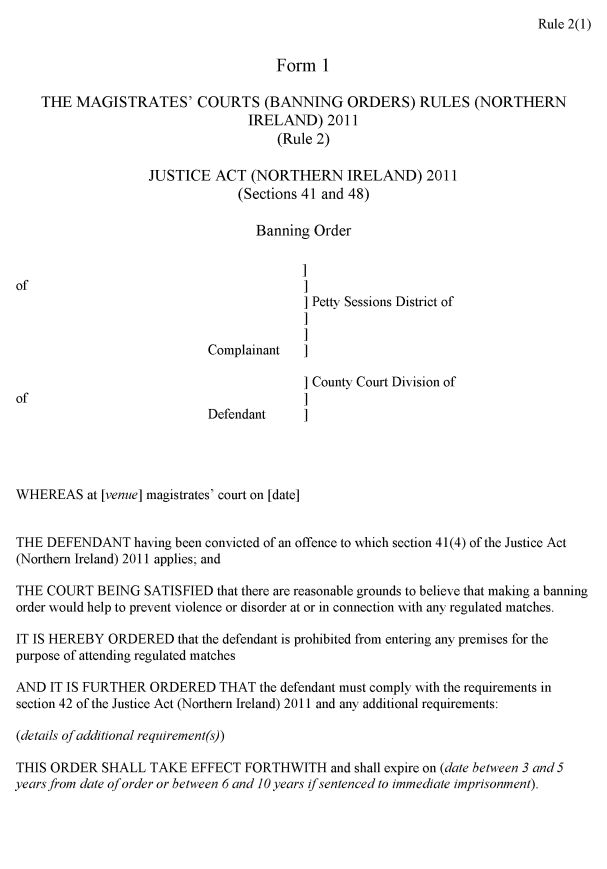
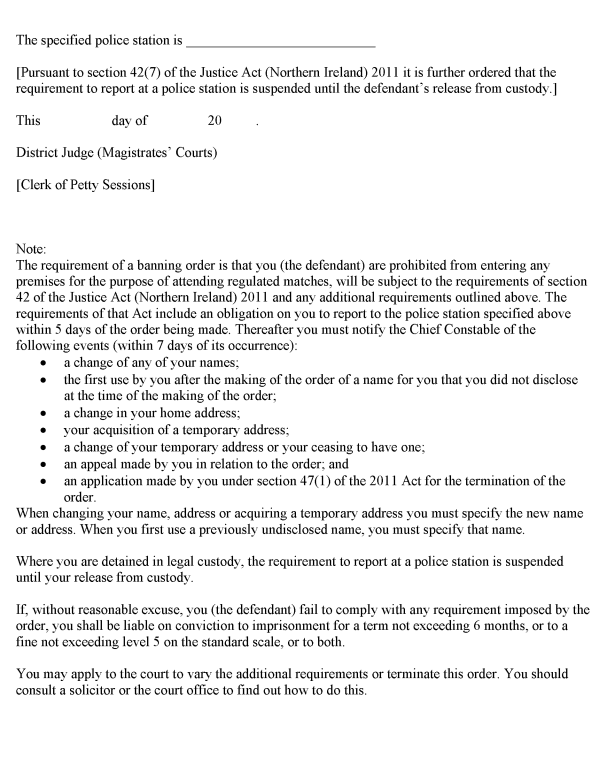
A banning order under section 41 of the 2011 Act shall be in Form 1.
(2)
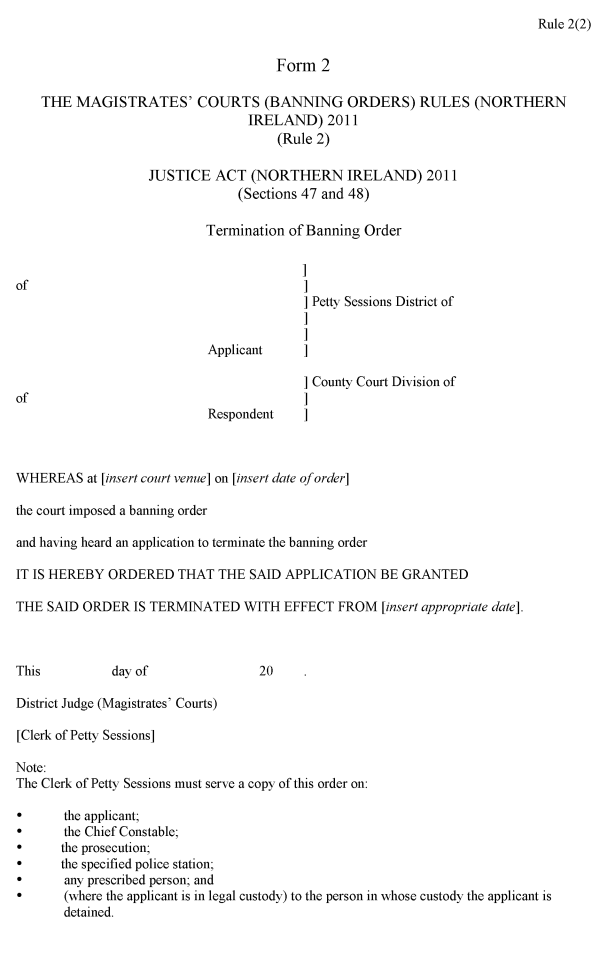
An order terminating a banning order under section 47 of the 2011 Act shall be in Form 2.
(3)
An order varying a banning order under section 46 of the 2011 Act shall be in Form 3.
Application to vary or terminate a banning order3.
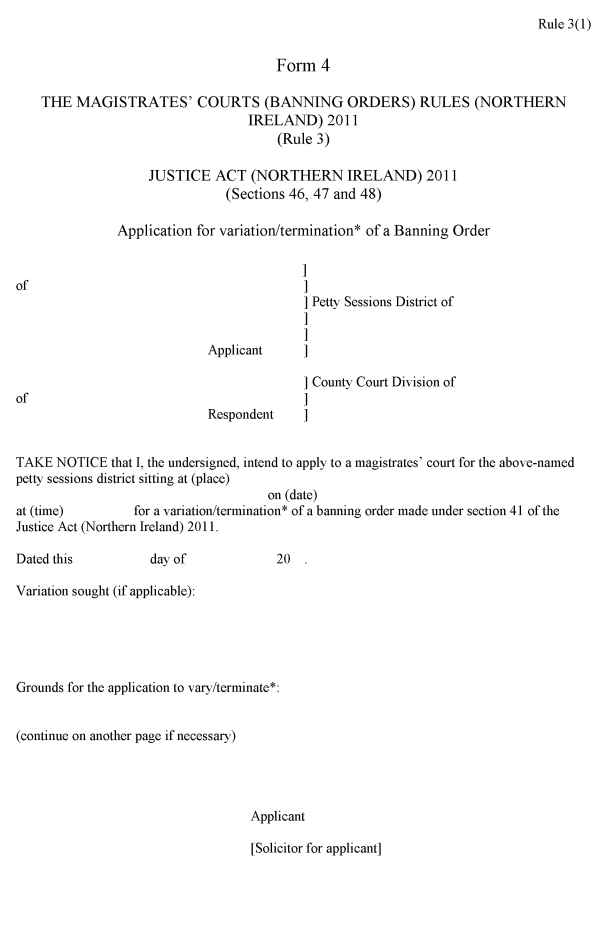
(1)
An application to—
(a)
vary a banning order under section 46 of the 2011 Act; or
(b)
terminate a banning order under section 47 of the 2011 Act,
shall be in Form 4.
(2)
An application under paragraph (1) shall be served by the applicant on—
(a)
the clerk of petty sessions F1...;
(b)
the respondent; and
(c)
the Chief Constable.
(3)
The respondent shall, within seven days of the date the notice was served on him, notify the applicant and the clerk of petty sessions, in writing, of his opposition and give reasons for it.
(4)
Except where notice is received in accordance with paragraph (3), a magistrates’ court may—
(a)
determine the application in favour of the applicant without a hearing; or
(b)
direct a hearing.
(5)
Where a hearing is directed, the clerk of petty sessions shall notify each party to the proceedings of the time and place of the hearing.
(6)
Without prejudice to the foregoing provisions of this rule the court may direct that a copy of the notice be served upon any person whom the court may consider a proper person to be served.
(7)
In this rule “respondent” means either P or the prosecution.
Service of orders4.
(1)
As soon as reasonably practicable after:
(a)
the making of a banning order under section 41 of the 2011 Act;
(b)
the variation of a banning order under section 46 of the 2011 Act; or
(c)
the termination of a banning under section 47 of the 2011 Act,
the clerk of petty sessions shall serve a copy of that order on the parties set out in paragraph (2).
(2)
An order under paragraph (1) shall be served on:
(a)
P;
(b)
the Chief Constable;
(c)
the prosecution;
(d)
the police station (addressed to the officer responsible for the police station) at which P is to report under section 42(3) of the 2011 Act;
(e)
(in a case where P is detained in legal custody) the person in whose custody P is detained; and
(f)
any prescribed person.
(3)
An order under paragraph (1) shall be served on:
(a)
P,
(i)
if present in court, in person if practicable; or
(ii)
otherwise by sending it by ordinary first class post to P at his last known address (in which case the order shall be deemed to have been received by him in the ordinary course of post unless P proves that he did not receive it); and
(b)
all other parties by ordinary first class post.
Appeal by the prosecution5.
(1)
An appeal by the prosecution, against a failure by the court to make a banning order under section 43 of the 2011 Act, shall be in Form 5.
(2)
A notice of appeal in Form 5 shall, within 14 days commencing on the day on which the decision of the magistrates’ court was made,
(a)
be served personally on the offender; and
(b)
a copy of the notice lodged with the clerk of petty sessions for the court which failed to make the order, endorsed with the date upon which and the manner in which it was served on the offender.
(3)
The clerk of petty sessions shall, as soon as practicable, send to the chief clerk F2...—
(a)
the copy of the notice of appeal;
(b)
all other proceedings in the case (including any written statements admitted in evidence under section 1 of the Criminal Justice (Miscellaneous Provisions) Act (Northern Ireland) 1968 and any pre-sentence report or medical report, within the meaning of the Criminal Justice (Northern Ireland) Order 1996 or the Criminal Justice (Northern Ireland) Order 2008 which was considered at the trial of the offender).
(4)
After the county court has decided the appeal, the chief clerk F3... shall within seven days of such decision certify the decision.
SCHEDULE



These Rules prescribe the procedure for applications under the Justice Act (Northern Ireland) 2011 (2011 C.24 (N.I.)) relating to banning orders. A banning order, which may only be made on conviction, prohibits a person from entering any premises for the purpose of attending regulated matches. Specifically,
Rule 2 provides the forms to be used when a banning order, an order terminating a banning order or an order varying a banning order has been made.
Rule 3 prescribes the procedure for making an application to vary or terminate a banning order.
Rule 4 outlines the provisions in relation to the service of the various orders.
Rule 5 provides the procedure for the prosecution to appeal against the failure of a court to make a banning order.