- Latest available (Revised)
- Original (As adopted by EU)
Commission Regulation (EU) 2016/631Show full title
Commission Regulation (EU) 2016/631 of 14 April 2016 establishing a network code on requirements for grid connection of generators (Text with EEA relevance)
You are here:

What Version
Advanced Features
- Show Geographical Extent(e.g. England, Wales, Scotland and Northern Ireland)
- Show Timeline of Changes
Opening Options
More Resources
Legislation originating from the EU
When the UK left the EU, legislation.gov.uk published EU legislation that had been published by the EU up to IP completion day (31 December 2020 11.00 p.m.). On legislation.gov.uk, these items of legislation are kept up-to-date with any amendments made by the UK since then.


This item of legislation originated from the EU
Legislation.gov.uk publishes the UK version. EUR-Lex publishes the EU version. The EU Exit Web Archive holds a snapshot of EUR-Lex’s version from IP completion day (31 December 2020 11.00 p.m.).
Changes over time for: CHAPTER 2
Changes to legislation:
There are currently no known outstanding effects by UK legislation for Commission Regulation (EU) 2016/631,
CHAPTER 2
.
Changes to Legislation
Revised legislation carried on this site may not be fully up to date. At the current time any known changes or effects made by subsequent legislation have been applied to the text of the legislation you are viewing by the editorial team. Please see ‘Frequently Asked Questions’ for details regarding the timescales for which new effects are identified and recorded on this site.
CHAPTER 2 U.K. Requirements for synchronous power-generating modules
Article 17U.K.Requirements for type B synchronous power-generating modules
1.Type B synchronous power-generating modules shall fulfil the requirements listed in Articles 13, except for Article 13(2)(b), and 14.
2.Type B synchronous power-generating modules shall fulfil the following additional requirements relating to voltage stability:
(a)with regard to reactive power capability, the relevant system operator shall have the right to specify the capability of a synchronous power-generating module to provide reactive power;
(b)with regard to the voltage control system, a synchronous power-generating module shall be equipped with a permanent automatic excitation control system that can provide constant alternator terminal voltage at a selectable setpoint without instability over the entire operating range of the synchronous power-generating module.
3.With regard to robustness, type B synchronous power-generating modules shall be capable of providing post-fault active power recovery. The relevant TSO shall specify the magnitude and time for active power recovery.
Article 18U.K.Requirements for type C synchronous power-generating modules
1.Type C synchronous power-generating modules shall fulfil the requirements laid down in Articles 13, 14, 15 and 17, except for Article 13(2)(b) and 13(6), Article 14(2) and Article 17(2)(a).
2.Type C synchronous power-generating modules shall fulfil the following additional requirements in relation to voltage stability:
(a)with regard to reactive power capability, the relevant system operator may specify supplementary reactive power to be provided if the connection point of a synchronous power-generating module is neither located at the high-voltage terminals of the step-up transformer to the voltage level of the connection point nor at the alternator terminals, if no step-up transformer exists. This supplementary reactive power shall compensate the reactive power demand of the high-voltage line or cable between the high-voltage terminals of the step-up transformer of the synchronous power-generating module or its alternator terminals, if no step-up transformer exists, and the connection point and shall be provided by the responsible owner of that line or cable;
(b)with regard to reactive power capability at maximum capacity:
(i)
the relevant system operator in coordination with the relevant TSO shall specify the reactive power provision capability requirements in the context of varying voltage. For that purpose the relevant system operator shall specify a U-Q/Pmax-profile within the boundaries of which the synchronous power-generating module shall be capable of providing reactive power at its maximum capacity. The specified U-Q/Pmax profile may take any shape, having regard to the potential costs of delivering the capability to provide reactive power production at high voltages and reactive power consumption at low voltages;
(ii)
the U-Q/Pmax-profile shall be specified by the relevant system operator in coordination with the relevant TSO, in conformity with the following principles:
the U-Q/Pmax-profile shall not exceed the U-Q/Pmax-profile envelope, represented by the inner envelope in Figure 7,
the dimensions of the U-Q/Pmax-profile envelope (Q/Pmax range and voltage range) shall be within the range specified for each synchronous area in Table 8, and
the position of the U-Q/Pmax-profile envelope shall be within the limits of the fixed outer envelope in Figure 7;
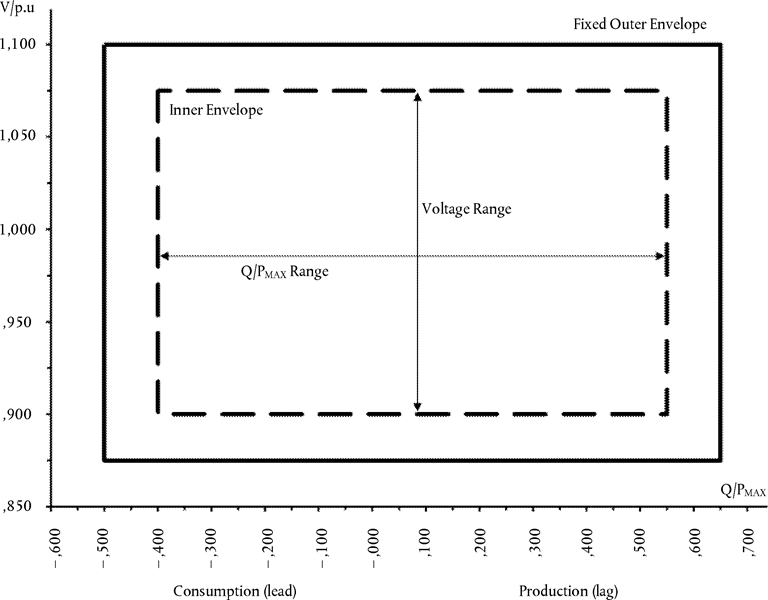
The diagram represents boundaries of a U-Q/Pmax-profile by the voltage at the connection point, expressed by the ratio of its actual value and the reference 1 pu value, against the ratio of the reactive power (Q) and the maximum capacity (Pmax). The position, size and shape of the inner envelope are indicative.
(iii)
the reactive power provision capability requirement applies at the connection point. For profile shapes other than rectangular, the voltage range represents the highest and lowest values. The full reactive power range is therefore not expected to be available across the range of steady-state voltages;
(iv)
the synchronous power-generating module shall be capable of moving to any operating point within its U-Q/Pmax profile in appropriate timescales to target values requested by the relevant system operator;
(c)with regard to reactive power capability below maximum capacity, when operating at an active power output below the maximum capacity (P < Pmax), the synchronous power-generating modules shall be capable of operating at every possible operating point in the P-Q-capability diagram of the alternator of that synchronous power-generating module, at least down to minimum stable operating level. Even at reduced active power output, reactive power supply at the connection point shall correspond fully to the P-Q-capability diagram of the alternator of that synchronous power-generating module, taking the auxiliary supply power and the active and reactive power losses of the step-up transformer, if applicable, into account.
Textual Amendments
F1Figure 7 amended (E.W.S.) (31.12.2020) by The Electricity and Gas (Internal Markets and Network Codes) (Amendment etc.) (EU Exit) Regulations 2020 (S.I. 2020/1006), reg. 1(2), Sch. 1 para. 17(a) as follows:
(i) for “1,100” substitute “1.100”;
(ii) for “1,050” substitute “1.050”;
(iii) for “1,000” substitute “1.000”;
(iv) for “,950” substitute “.950”;
(v) for “,900” substitute “.900”;
(vi) for “,850” substitute “.850”;
(vii) for “-,600” substitute “-.600”;
(viii) for “-,500” substitute “-.500”;
(ix) for “-,400” substitute “-.400”;
(x) for “-,300” substitute “-.300”;
(xi) for “-,200” substitute “-.200”;
(xii) for “-,100” substitute “-.100”;
(xiii) for “-,000” substitute “-.000”;
(xiv) for “,100” substitute “.100”;
(xv) for “,200” substitute “.200”;
(xvi) for “,300” substitute “.300”;
(xvii) for “,400” substitute “.400”;
(xviii) for “,500” substitute “.500”;
(xix) for “,600” substitute “.600”;
(xx) for “,700” substitute “.700”
F2Words in Art. 18(2) Table 8 omitted (E.W.S.) (31.12.2020) by virtue of The Electricity and Gas (Internal Markets and Network Codes) (Amendment etc.) (EU Exit) Regulations 2020 (S.I. 2020/1006), reg. 1(2), Sch. 1 para. 17(b)(i)
F3Words in Art. 18(2) Table 8 omitted (E.W.S.) (31.12.2020) by virtue of The Electricity and Gas (Internal Markets and Network Codes) (Amendment etc.) (EU Exit) Regulations 2020 (S.I. 2020/1006), reg. 1(2), Sch. 1 para. 17(b)(ii)
F4Word in Art. 18(2) Table 8 substituted (E.W.S.) (31.12.2020) by The Electricity and Gas (Internal Markets and Network Codes) (Amendment etc.) (EU Exit) Regulations 2020 (S.I. 2020/1006), reg. 1(2), Sch. 1 para. 17(b)(iii)(aa)
F5Word in Art. 18(2) Table 8 substituted (E.W.S.) (31.12.2020) by The Electricity and Gas (Internal Markets and Network Codes) (Amendment etc.) (EU Exit) Regulations 2020 (S.I. 2020/1006), reg. 1(2), Sch. 1 para. 17(b)(iii)(bb)
F6Words in Art. 18(2) Table 8 omitted (E.W.S.) (31.12.2020) by virtue of The Electricity and Gas (Internal Markets and Network Codes) (Amendment etc.) (EU Exit) Regulations 2020 (S.I. 2020/1006), reg. 1(2), Sch. 1 para. 17(b)(iv)
F7Words in Art. 18(2) Table 8 omitted (E.W.S.) (31.12.2020) by virtue of The Electricity and Gas (Internal Markets and Network Codes) (Amendment etc.) (EU Exit) Regulations 2020 (S.I. 2020/1006), reg. 1(2), Sch. 1 para. 17(b)(v)
Article 19U.K.Requirements for type D synchronous power-generating modules
1.Type D synchronous power-generating modules shall fulfil the requirements laid down in Article 13, except for Article 13(2)(b), (6) and (7), Article 14 except for Article 14(2), Article 15, except for Article 15(3), Article 16, Article 17, except for Article 17(2) and Article 18.
2.Type D synchronous power-generating modules shall fulfil the following additional requirements in relation to voltage stability:
(a)the parameters and settings of the components of the voltage control system shall be agreed between the power-generating facility owner and the relevant system operator, in coordination with the relevant TSO;
(b)the agreement referred to in subparagraph (a) shall cover the specifications and performance of an automatic voltage regulator (‘AVR’) with regard to steady-state voltage and transient voltage control and the specifications and performance of the excitation control system. The latter shall include:
(i)
bandwidth limitation of the output signal to ensure that the highest frequency of response cannot excite torsional oscillations on other power-generating modules connected to the network;
(ii)
an underexcitation limiter to prevent the AVR from reducing the alternator excitation to a level which would endanger synchronous stability;
(iii)
an overexcitation limiter to ensure that the alternator excitation is not limited to less than the maximum value that can be achieved whilst ensuring that the synchronous power-generating module is operating within its design limits;
(iv)
a stator current limiter; and
(v)
a PSS function to attenuate power oscillations, if the synchronous power-generating module size is above a value of maximum capacity specified by the relevant TSO.
3.The relevant TSO and the power-generating facility owner shall enter into an agreement regarding technical capabilities of the power-generating module to aid angular stability under fault conditions.
Options/Help
Print Options
PrintThe Whole Regulation
PrintThe Whole Title
PrintThis Chapter only
Legislation is available in different versions:
Latest Available (revised):The latest available updated version of the legislation incorporating changes made by subsequent legislation and applied by our editorial team. Changes we have not yet applied to the text, can be found in the ‘Changes to Legislation’ area.
Original (As adopted by EU): The original version of the legislation as it stood when it was first adopted in the EU. No changes have been applied to the text.
See additional information alongside the content
Geographical Extent: Indicates the geographical area that this provision applies to. For further information see ‘Frequently Asked Questions’.
Show Timeline of Changes: See how this legislation has or could change over time. Turning this feature on will show extra navigation options to go to these specific points in time. Return to the latest available version by using the controls above in the What Version box.
Opening Options
Different options to open legislation in order to view more content on screen at once
More Resources
Access essential accompanying documents and information for this legislation item from this tab. Dependent on the legislation item being viewed this may include:
- the original print PDF of the as adopted version that was used for the EU Official Journal
- lists of changes made by and/or affecting this legislation item
- all formats of all associated documents
- correction slips
- links to related legislation and further information resources
Timeline of Changes
This timeline shows the different versions taken from EUR-Lex before exit day and during the implementation period as well as any subsequent versions created after the implementation period as a result of changes made by UK legislation.
The dates for the EU versions are taken from the document dates on EUR-Lex and may not always coincide with when the changes came into force for the document.
For any versions created after the implementation period as a result of changes made by UK legislation the date will coincide with the earliest date on which the change (e.g an insertion, a repeal or a substitution) that was applied came into force. For further information see our guide to revised legislation on Understanding Legislation.
More Resources
Use this menu to access essential accompanying documents and information for this legislation item. Dependent on the legislation item being viewed this may include:
- the original print PDF of the as adopted version that was used for the print copy
- correction slips
Click 'View More' or select 'More Resources' tab for additional information including:
- lists of changes made by and/or affecting this legislation item
- confers power and blanket amendment details
- all formats of all associated documents
- links to related legislation and further information resources
 All content is available under the Open Government Licence v3.0 except where otherwise stated. This site additionally contains content derived from EUR-Lex, reused under the terms of the Commission Decision 2011/833/EU on the reuse of documents from the EU institutions. For more information see the EUR-Lex public statement on re-use.