Commission Decision (EU) 2018/859
of 4 October 2017
on State aid SA.38944 (2014/C) (ex 2014/NN) implemented by Luxembourg to Amazon
(notified under document C(2017) 6740)
(Only the French text is authentic)
(Text with EEA relevance)
THE EUROPEAN COMMISSION,
Having regard to the Treaty on the Functioning of the European Union, and in particular the first subparagraph of Article 108(2) thereof,
Having regard to the Agreement on the European Economic Area, and in particular Article 62(1)(a) thereof,
Whereas:
By letter of 21 November 2014, Luxembourg submitted its comments to the Opening Decision. That submission included, inter alia, a transfer pricing report prepared by [Advisor 2] on behalf of Amazon (‘the TP Report’), which had not been previously submitted to the Commission.
By letter of 13 February 2015, the Commission sent an additional request for information to Luxembourg. In that letter, the Commission also asked Luxembourg to agree that it could contact Amazon directly to obtain the requested information if that information was not in Luxembourg's possession. On 24 February 2015, Luxembourg requested an extension of deadline to reply to the Commission's request for information.
By letter of 5 March 2015, Amazon submitted its observations on the Opening Decision. Comments on the Opening Decision were also submitted by the following third parties: Oxfam on 14 January 2015, the Bundesarbeitskammer on 4 February 2015, Fedil on 27 February 2015, the Booksellers Association (‘BA’) on 3 March 2015, le Syndicat de la librairie française (‘SLF’) on 4 March 2015, the European and International Booksellers Federation (‘EIBF’) on 4 March 2015, ATOZ S.A. on 5 March 2015, the Computer and Communications Industry Association (‘CCIA’) on 5 March 2015 and the European Policy Information Center (‘EPICENTER’) on 5 March 2015. In addition, the Federation of European Publishers (‘FEP’) on 5 March 2015 and le Syndicat des Distributeurs de Loisirs Culturels (‘SDLC’) on 5 March 2015 expressed their support of the EIBF's position.
On 12 March 2015, a telephone conference took place between the Commission and Luxembourg in which the latter assured the former that it would be able to provide a complete reply to the Commission's request for information of 13 February 2015 by 17 March 2015.
By letter of 17 March 2015, Luxembourg partially replied to the Commission's request for information of 13 February 2015. It further explained that outstanding information, in particular that concerning certain contractual relationships between Amazon entities in Luxembourg and third parties, was not in its possession.
On 19 March 2015, the Commission transmitted the comments of third parties on the Opening Decision to Luxembourg.
By email exchanges of 18, 19 and 20 March 2015, the Commission indicated to Luxembourg that its reply of 17 March 2015 to the Commission's request for information of 13 February 2015 was incomplete and it posed further questions for clarification.
By letter of 20 April 2015, Luxembourg requested the Commission to explain the purpose of a meeting the latter had held with Oxfam and Eurodad, of which Luxembourg had not been informed. It also submitted a request not to publish the decision to send the MIT request.
On 4 May 2015, Amazon partially replied to the Commission's request for information of 26 March 2015. Amazon also confirmed that its structure in Luxembourg had changed in 2014 and that a new ruling was granted by Luxembourg on that basis, but explained that the change was irrelevant for the purposes of the Commission's investigation.
On 8 May 2015, a meeting was held between the Commission, Luxembourg and Amazon. By letter of 12 June 2015, Amazon submitted further comments following that meeting. Amazon also submitted a list of IP agreements, referred to by Amazon as the ‘M.com Agreements’, pursuant to which Amazon made IP related to its platform technology available to unrelated third parties.
By letter of 13 May 2015, Luxembourg submitted its observations on the third party comments on the Opening Decision.
By letter of 3 July 2015, the Commission reminded Amazon to provide certain outstanding information, in particular on the IP agreements, and asked for additional information.
By letter of 10 July 2015 (again submitted on 23 July 2015), Luxembourg submitted a statement concerning the non-retroactive application of a final negative decision of the Commission.
By letter of 31 July 2015, the Commission reminded Amazon to provide all requested information, in particular complete information on all IP agreements concluded by Amazon since 2000. It also requested Amazon to provide the new ruling granted to it by Luxembourg in 2014, to which a reference was made in Luxembourg's letter of 4 August 2014 and Amazon's letter of 4 May 2015.
By letter of 21 August 2015, Amazon replied to the Commission's request, except for the submission of information on the remaining IP agreements.
On 8 September 2015, a meeting took place between the Commission and Amazon of which Luxembourg was informed. Following that meeting, the Commission reminded Amazon by email of 8 September 2015 about the outstanding request for information concerning the IP agreements.
By email of 14 September 2015, Amazon explained that no other agreements exist pursuant to which the same intellectual property as that covered the License Agreement was or will be made available to related or unrelated parties. At the same time, Amazon informed the Commission that it was preparing a list of intra-group IP agreements, regardless of whether they relate to the EU or intellectual property covered by the License Agreement between LuxSCS and LuxOpCo. That list was submitted to the Commission on 17 September 2015.
By email of 23 September 2015, Amazon submitted a list of agreements by means of which intellectual property was licensed in from or licensed out to third parties.
By email of 29 September 2015, the Commission reminded Amazon to submit the IP agreements as requested by the Commission on 26 March and 3 July 2015 on the basis of the lists provided by Amazon on 17 and 23 September 2015. In addition, the Commission requested further information from Amazon concerning the cost sharing reports and LuxOpCo's customers per website.
By e-mails of 30 September and 1, 2, 12, 13, 20 and 27 October 2015, Amazon submitted information.
On 28 October 2015, a meeting took place between the Commission, Luxembourg and Amazon.
By email of 20 November 2015, the Commission reminded Amazon about the scope of its request for information of 26 March 2015 regarding Amazon's internal and external IP agreements and requested Amazon to submit additional information.
During a meeting on 27 November 2015, a company which requested its name not to be revealed (‘Company X’) provided the Commission with market information in relation to the Commission's investigation. In a conference call on 15 January 2016, Company X provided additional information on the e-commerce business in Europe. By email of 25 January 2016 regarding the minutes of the conference call, Company X provided additional information.
On 30 November 2016, Amazon submitted additional information.
By email of 1 December 2015, Amazon requested an extension to reply to the Commission's request for information dated 20 November 2015.
On 4 December 2015, Amazon submitted the information requested by the Commission in its email of 20 November 2015 and asked for an extension of deadline for the remaining responses.
By letters of 10 and 28 December 2015, Luxembourg submitted its observations following the meeting of 28 October 2015.
By email of 11 December 2015, the Commission reminded Amazon about the outstanding replies from its information request of 20 November 2015 and sent a further request for information with additional questions to Amazon.
On 18 December 2015, Amazon provided further responses to the Commission's request for information of 20 November 2015.
By email of 18 December 2015, the Commission invited Luxembourg to submit its observations and comments on the information submitted by Amazon to the Commission by that point of the investigation.
On 12 and 15 January 2016, Amazon submitted partial responses to the Commission's information request of 11 December 2015 and asked for an extension of deadline for the outstanding information.
On 18 January 2016, Amazon submitted further information.
By email of 19 January 2016, the Commission informed Amazon that certain replies to questions of previous requests for information were still outstanding. In addition, the Commission requested clarification and further information.
On 22 January 2016, Amazon partially replied to the Commission's request for information of 19 December 2015. On 28 January 2016, Amazon submitted a partial reply to the Commission's request for information of 11 December 2015. By letters of 5, 15, 19 and 24 February 2016, Amazon submitted partial replies to the Commission's request for information of 19 January 2016.
On 26 February 2016, the Commission sent a reminder to Amazon requesting it to reply to outstanding questions concerning the requests for information of 20 November 2015, 11 and 18 December 2015 and 19 January 2016.
On 4 and 21 March 2016, Amazon submitted partial replies to the Commission's request for information of 11 December 2015.
By email of 11 March 2016, Amazon submitted a partial reply to the Commission's request for information of 26 February 2016.
By email of 22 March 2016, Amazon submitted a partial reply to the Commission's requests for information of 19 January 2016 and 26 February 2016.
By email of 8 March 2016, Amazon agreed to waive confidentiality claims previously made vis-à-vis Luxembourg in a letter of 22 January 2016 for certain information submitted and committed to share this information with Luxembourg.
On 14 March 2016, Amazon confirmed to have shared its latest submission to the Commission with Luxembourg.
On 1 April 2016, the Commission requested Company X to agree that certain market information provided by it would be shared with Luxembourg. On 5 April 2016, Company X provided its agreement.
On 8 April 2016, the Commission inquired with Amazon about the information that Amazon had shared with Luxembourg by that point of the investigation. The Commission also informed Amazon that certain information of the Commission's request for information of 11 February 2015 was still outstanding. In addition, the Commission addressed a request for further clarification and information to Amazon.
By email of 11 April 2016, Amazon confirmed what information it had shared with Luxembourg.
By letter of 18 April 2016, the Commission inquired with Luxembourg what information had been shared with it by Amazon and invited Luxembourg to submit its comments on those submissions. The Commission further recalled its email of 18 December 2015, by which it had invited Luxembourg to comment on Amazon's submissions. Finally, the Commission shared the market information as agreed with Company X with Luxembourg and asked Luxembourg for its comments.
On 22 April 2016, Amazon submitted a partial reply to the Commission's request for information of 8 April 2016 and requested an extension of the deadline for the remaining replies.
By letter of 2 May 2016 (again submitted on 10 May 2016), Luxembourg confirmed receipt of the information submitted by Amazon by that point of the investigation and submitted its observations on Amazon's submissions. As regards the market information of Company X, Luxembourg informed the Commission that it had shared that information with Amazon, since Amazon would be in a better position to comment.
By email of 2 May 2016, Amazon submitted a partial reply and acknowledged the outstanding replies to questions raised in the Commission's request for information dated 8 April 2016, as mentioned in the letter of 22 April 2016.
By email of 17 May 2016, the Commission clarified the scope of the information it previously requested from Amazon and recalled that certain information was still outstanding from its requests for information of 11 December 2015 and 8 April 2016.
By email of 24 May 2016, Amazon submitted its reply to the Commission's email of 17 May 2016.
On 26 May 2016, a meeting between the Commission, Luxembourg and Amazon took place. During that meeting and in the draft minutes thereof, the Commission raised further questions to Amazon. By letter of 20 June 2016, Amazon replied to those questions.
By letter of 21 June 2016, Amazon submitted its comments to the market information of Company X. It also requested access to the complete submission of Company X and the disclosure of its identity.
On 7 July 2016, the Commission provided its comments to the amended minutes of the meeting of 26 May 2016 to Amazon. In addition, the Commission requested further information from Amazon.
By email of 22 July 2016, Amazon submitted a partial reply to the Commission's request for information of 7 July 2016. In its reply, Amazon informed the Commission about the protective order covering documents used in US Tax Court proceedings. Therefore, Amazon suggested submitting redacted documents, since these were available to Amazon.
By email of 27 July 2016, the Commission reminded Amazon about outstanding information following its request for information of 7 July 2016 and accepted to receive temporarily documents from the US Tax Court proceedings in a redacted version. In addition, the Commission requested further clarification and information from Amazon.
By email of 29 July 2016, Amazon submitted a partial reply to the Commission's request for information of 7 July 2016 and requested an extension of the deadline to reply to the remaining questions. By letter of 12 August 2016, Amazon submitted a partial reply to the Commission's request for information of 7 July 2016 and 27 July 2016.
By email of 19 August 2016, the Commission requested further clarification and information from Amazon concerning Amazon's replies to the request for information of 7 July 2016.
By email of 19 August 2016, and again by letter of 22 August 2016, the Commission sent a request for information to Amazon asking for the entire redacted documents of the US Tax Court proceedings.
On 26 August 2016, Amazon submitted a partial reply to the Commission's request for information of 7 July 2016 and requested an extension of the deadline to complete its reply.
By email of 30 August 2016, Amazon informed the Commission about its successful application concerning access to the documents used in the US Tax Court proceedings and announced the upcoming submission of unredacted documents.
On 9 September 2016, Amazon submitted a partial reply to the Commission's request for information dated 19 August 2016.
On 30 September 2016, Amazon submitted the unredacted documents as produced in the US Tax Court proceedings, as requested by the Commission on 22 August 2016.
By e-mails of 7 and 19 December 2016, the Commission asked Amazon for additional information concerning the US Tax Court proceedings. On 20 December 2016, Amazon submitted its reply.
On 21 December 2016, the Commission sent a request for information to Amazon to which Amazon submitted a partial reply on 20 January 2017. By email of 2 February 2017, the Commission sent Amazon further clarifications concerning its request for information of 21 December 2017. On 6, 8 and 27 February and 6 March 2017, Amazon submitted further information and partial replies to the Commission. By email of 13 March 2017, the Commission reminded Amazon to submit outstanding information.
On 14 March 2017, the Commission sent a request for information to Amazon.
By email of 24 March 2017, Amazon submitted the opinion of the US Tax Court of 23 March 2017 to the Commission.
By email of 27 March 2017, the Commission requested further information from Amazon concerning the US Tax Court's opinion.
On 28 March 2017, Amazon replied to the Commission requesting more time to answer due to the ongoing post-trial procedures in the US.
By email of 4 April 2017, Amazon submitted a partial reply to the Commission's request for information of 14 March 2017.
By email of 7 April 2017, the Commission informed Luxembourg and Amazon that it was obliged to decline Amazon's request to grant full access to the submissions of Company X.
On 11 April 2017, Amazon submitted another partial reply to the Commission's request for information of 14 March 2017 and requested an extension of the deadline for some remaining parts of its reply.
By email of 12 April 2017, Amazon submitted a partial reply to the Commission.
On 17 April 2017, Amazon submitted further information concerning the post-trial procedure in the US.
On 18 May 2017, Amazon sent another partial reply and thus completed its reply to the Commission's request for information of 14 March 2017.
By email of 19 May 2017, the Commission sent a request for information to Amazon.
On 29 May 2017, Amazon submitted further information to the Commission.
By email of 7 June 2017, Amazon submitted its reply to the Commission's request for information of 19 May 2017.
By email of 14 June 2017, the Commission requested Amazon to confirm that all information submitted by Amazon to the Commission in 2016 and 2017 had also been shared with Luxembourg and invited Luxembourg to submit its observations on the information submitted to the Commission by Amazon at that point of the investigation. On 19 June 2017, Amazon confirmed to have shared all information submitted to the Commission in 2016 and 2017 with Luxembourg. By email of 21 June 2017, Luxembourg confirmed to have received all documents that were submitted to the Commission by Amazon in 2016 and 2017 and that Luxembourg had no further comments in relation to Amazon's submissions to the Commission in 2016 and 2017 except for Amazon's submissions of 30 September 2016 and 20 January 2017.
On 22 June 2017, a meeting was held between the Commission, Luxembourg and Amazon.
On 6 July 2017, Luxembourg submitted its comments to submissions made by Amazon on 30 September 2016 and 20 January 2017.
On 6 July 2017, the Commission sent a request for information to Amazon to which Amazon replied on 10 and 27 July, and 4 and 7 August 2017.
By email of 9 August 2017, the Commission sent a request for information to Amazon. On 7 September 2017, Amazon submitted its reply.
On 12 September 2017, Luxembourg confirmed by email that it had no further comments to Amazon's submissions of 10 and 27 July, 4 and 7 August and 7 September 2017.
The Amazon group consists of Amazon.com, Inc. and all companies directly or indirectly controlled by Amazon.com, Inc. (collectively referred to as ‘Amazon’ or the ‘Amazon group’). Amazon is headquartered in Seattle, Washington, United States of America.
Amazon operates retail and service businesses.
Finally, Amazon manufactures and sells hardware products, such as Amazon Kindle, Amazon Fire and Amazon Echo devices.
The North America segment's sales primarily consist of retail sales of consumer products (including by third-party sellers) and subscriptions through North America-focused websites such as www.amazon.com, www.amazon.ca, and www.amazon.com.mx. That segment also includes export sales from those websites.
The International segment's sales primarily consist of retail sales of consumer products (including by third-party sellers) and subscriptions through international websites such as www.amazon.com.au, www.amazon.com.br, www.amazon.cn, www.amazon.in, www.amazon.co.jp, the EU websites and www.amazon.nl. That segment also includes export sales from these international websites (including export sales from these sites to customers in the U.S., Mexico, and Canada), but excludes export sales from Amazon's North American websites.
The AWS segment consists of global sales of computer, storage, database, and other service offerings for start-ups, enterprises, government agencies, and academic institutions. Through AWS, Amazon provides access to technology infrastructure for different types of business.
‘After having made myself acquainted with the letter of october [sic] 31, 2003, directed to me by [Advisor 1] just as with your letter of octobre [sic] 23, 2003 and dealing with your position regarding Luxembourg tax treatment within the framework of your future activities, I am pleased to inform you that I may approve the contents of the two letters.’
In its letter of 31 October 2003 to the Luxembourg tax administration (‘Amazon's letter of 31 October 2003’), Amazon sought confirmation of the tax treatment of LuxSCS, its US-based partners and dividends received by LuxOpCo under that structure. That letter explains that LuxSCS, as a Société en Commandite Simple, is not deemed to have a separate tax personality from that of its partners and, as a result, it is not subject to corporate income tax or net wealth tax in Luxembourg.
That letter refers to an ‘economic analysis’ attached thereto, which sets out ‘the functions and risks that LuxOpCo was anticipated to undertake, as well as the nature and extent of the Intangibles that are anticipated to be the subject of the Intangibles License’ concluded between LuxSCS and LuxOpCo. On the basis of that analysis, a transfer pricing arrangement was proposed under which the level of the annual royalty (referred to in the letter as the ‘License Fee’) that LuxOpCo would be required to pay to LuxSCS for the use of the Intangibles was established.
- ‘1.
Compute and allocate to LuxOpCo the ‘LuxOpCo Return’, which is equal to the lesser of (a) [4-6] % of LuxOpCo's total EU Operating Expenses for the year and (b) total EU Operating Profit attributable to the European Web Sites for such year;
- 2.
The License Fee shall be equal to EU Operating Profit minus the LuxOpCo Return, provided that the License Fee shall not be less than zero;
- 3.
The Royalty Rate for the year shall be equal to the License Fee divided by total EU Revenue for the year;
- 4.
Notwithstanding the foregoing, the amount of the LuxOpCo Return for any year shall not be less than 0,45 % of EU Revenue, nor greater than 0,55 % of EU Revenue;
- 5.
- (a)
In the event that the LuxOpCo Return determined under step (1) would be less than 0,45 % of EU Revenues, the LuxOpCo Return shall be adjusted to equal the lesser of (i) 0,45 % of Revenue or EU Operating Profit or (ii) EU Operating Profit;
- 6.
- (b)
In the event that the LuxOpCo Return determined under step (1) would be greater than 0,55 % of EU Revenues, the LuxOpCo Return shall be adjusted to equal the lesser of (i) 0,55 % of EU Revenues or (ii) EU Operating Profit.’
‘EU COGS’ means Costs of Goods Sold, computed using US GAAP (Generally Accepted Accounting Principles), attributable to LuxOpCo's operation of the European Web Sites.
‘EU Operating Expense’ means LuxOpCo's total costs, including intercompany expenses, but excluding: EU COGS, the License Fee, currency gains and losses and interest expense, calculated under U.S. GAAP.
‘EU Revenues’ means total net sales revenue earned by LuxOpCo through the EU Web Sites, which shall be equal to the sum of (a) the total sales prices of products sold by LuxOpCo, stated on the invoices which are issued to customers, including revenue attributable to gift wrapping and shipping and handling, less: value added taxes, returns and other allowances, and (b) total services revenue earned by LuxOpCo in connection with the sale of products or services by unrelated parties through the EU Web Sites, less value added taxes.
‘EU Operating Profit’ means EU Revenue minus: EU COGS and EU Operating Expenses.
Section 3 of the TP Report provides a functional analysis of LuxSCS and LuxOpCo.
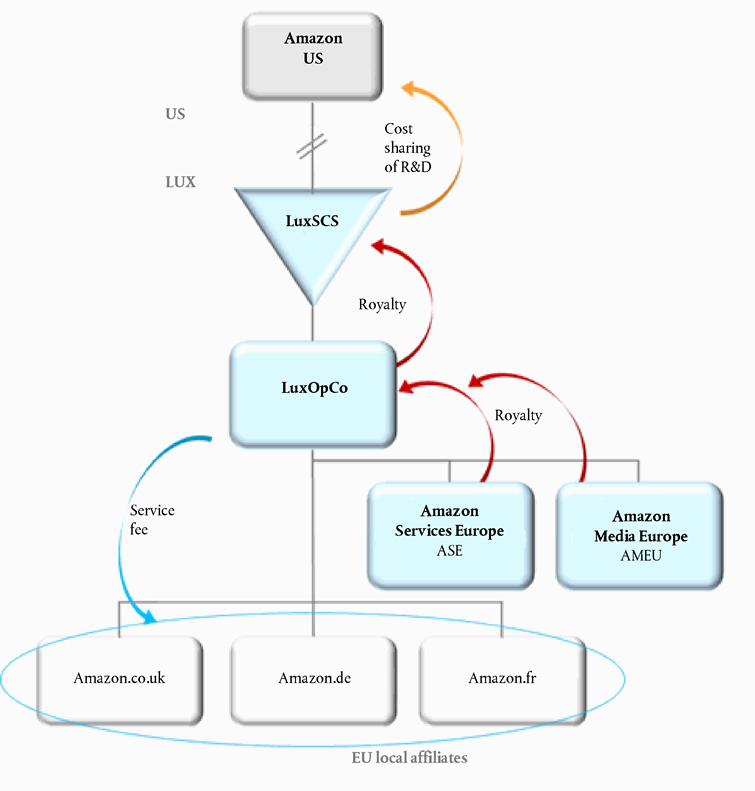
LuxOpCo was to contract with ASE, which would act as a service commission agent in its own name but for the benefit of LuxOpCo, in connection with Amazon's third-party seller programs in Europe. ASE's services would primarily consist of certain order processing services associated with the service business.
Section 5 of the TP Report deals with the selection of the most appropriate transfer pricing method for determining the arm's length nature of the Royalty Rate.
Section 6.1 of the TP Report calculates an arm's length range for royalty on the basis of the CUP method.
First of all, searches were performed for comparable transactions in Amazon's own internal database of license agreements and an external agency was commissioned to conduct a search for license agreements involving intangible assets similar to those of Amazon. The transactions identified as a result of the searches were not considered sufficiently comparable and were therefore rejected for the purpose of the CUP analysis.
To make that compensation comparable to the License Fee (referred to in the TP Report as the ‘Royalty Rate’), the set-up fees were amortized and allocated to each of the four periods referred to in the agreement and, together with the annual basic fee, they were converted into a percentage of sales (ranging from 3,4 % to 7,2 %). Since the commission fee included in the [A] Agreement ranged from 4 % to 5 % of sales, the TP Report's first conclusion was that the implied royalty rate in the [A] Agreement ranged from 8,4 % to 11,7 % of sales. However, [A] had also committed to pay Amazon certain fees to compensate for both excess order capacity and excess inventory level. Those fees, referred to in the agreement, were also converted into a percentage of sales, ranging from 1,2 % to 0,7 %. Therefore, the arm's length range for the Royalty Rate was initially calculated to be between 9,6 % and 12,6 % of sales.
Finally, since the [A] Agreement did not provide [A] with access to Amazon's customer data, the TP Report included an adjustment to align the CUP with the fact that LuxSCS granted LuxOpCo access to Amazon's customer data. Accordingly, using the information available in the [B] Agreement, an upward adjustment of 1 % was proposed, resulting in an arm's length range for the Royalty Rate between 10,6 % and 13,6 % of LuxOpCo's sales.
(EUR million) | ||||||||
1 | 2 | 3 | 4 | 5 | 6 | 7 | 8 | 9 |
|---|---|---|---|---|---|---|---|---|
2005 | 2006 | 2007 | 2008 | 2009 | 2010 | |||
a | Revenue | 3 154,2 | 4 299,9 | 5 073,9 | 5 987,1 | 7 064,7 | 8 336,3 | |
b | COGS | 2 446,9 | 3 332,7 | 3 932,6 | 4 640,5 | 5 475,8 | 6 461,4 | |
c | Gross Profit | a – b | 707,3 | 967,2 | 1 141,3 | 1 346,6 | 1 588,9 | 1 874,9 |
d | Operating expense | 89,9 | 106,0 | 121,7 | 143,7 | 171,2 | 204,2 | |
e | Intercompany (co.uk, .de, .fr) | 279,4 | 338,4 | 395,6 | 456,2 | 524,1 | 602,7 | |
f | LUX Commissionaire expense | 2,8 | 3,4 | 4,1 | 4,9 | 5,9 | 7,0 | |
g | Operating expense (incl. Intercompany) | d + e + f | 372,1 | 447,8 | 521,4 | 604,8 | 701,2 | 813,9 |
h | Estimated Operating Net Profit (Loss) before Routine Return | c – g | 335,2 | 519,4 | 619,9 | 741,8 | 887,7 | 1 061,0 |
i | Routine Return to LuxASE | 0,14 | 0,17 | 0,20 | 0,24 | 0,29 | 0,35 | |
j | Routine Return to LuxOpCo | [4 – 6] % × g | 16,8 | 20,2 | 23,5 | 27,2 | 31,6 | 36,6 |
k | Estimated Residual Profit Payable to LuxSCS | h – i – j | 318,3 | 499,1 | 596,2 | 714,3 | 855,8 | 1 024,0 |
l | Effective Royalty Rate (as % of Revenue) | k/a | 10,1 % | 11,6 % | 11,8 % | 11,9 % | 12,1 % | 12,3 % |
Summarising the transfer pricing analyses of the License Agreement using the CUP method and the residual profit split method, the TP Report considered that the results converge and indicated that an arm's length range for the Royalty Rate from LuxOpCo to LuxSCS under that agreement is 10,1 % to 12,3 % of LuxOpCo's sales.

(EUR million) | ||||||||
Luxembourgish fiscal unity group | 2006 | 2007 | 2008 | 2009 | 2010 | 2011 | 2012 | 2013 |
|---|---|---|---|---|---|---|---|---|
Total revenue | 1 979,4 | 3 545,7 | 4 298,6 | 5 605,4 | 7 628,8 | 10 086,3 | 13 312,1 | [15 000 – 15 500] |
Net COGS | 1 610,8 | 2 828,3 | 3 406,1 | 4 421,6 | 6 084,4 | 8 078,0 | 10 486,6 | [11 500 – 12 000] |
Total operating expense | 262,5 | 476,8 | 530,0 | 637,6 | 918,3 | 1 461,7 | 2 252,9 | [3 000 – 3 500] |
Thereof | ||||||||
Expenses applicable to mark-up | 262,5 | 439,9 | 493,6 | 597,0 | 801,9 | 1 313,1 | 2 041,7 | [2 500 – 3 000] |
Thereof | ||||||||
LuxOpCo - OpEx | 78,6 | 162,6 | 203,6 | 258,4 | 317,7 | 483,1 | 662,7 | [800 – 900] |
LuxOpCo - Intercompany | 183,8 | 277,3 | 290,0 | 338,6 | 484,1 | 830,1 | 1 379,0 | [1 500 – 2 000] |
Expenses excluded from mark-up (Mngt and RSU) | 0,0 | 36,9 | 36,4 | 40,6 | 116,4 | 148,5 | 211,2 | [200 – 300] |
Resulting operating profit | 106,1 | 240,5 | 362,6 | 546,2 | 626,1 | 546,6 | 572,7 | [600 – 700] |
Estimated Total Return to Lux Fiscal Unity Group at [4-6] % of adjusted OpEx | 11,8 | 19,8 | 22,2 | 26,9 | 36,1 | 59,1 | 91,9 | [100 – 200] |
Ceiling/floor analysis | ||||||||
Profit ceiling (0,55 % of revenue) | 10,9 | 19,5 | 23,6 | 30,8 | 42,0 | 55,5 | 73,2 | [80 – 90] |
Profit floor (0,45 % of revenue) | 8,9 | 16,0 | 19,3 | 25,2 | 34,3 | 45,4 | 59,9 | [60 – 70] |
Luxembourg consolidated Profit - per Ceiling/Floor and Return | 10,9 | 19,5 | 22,2 | 26,9 | 36,1 | 55,5 | 73,2 | [80 – 90] |
Royalty payment (Lux fiscal unity group to LuxSCS) | 95,2 | 221,0 | 340,4 | 519,3 | 590,0 | 491,1 | 499,4 | [500 – 600] |
The application of the [4-6] % mark-up on the sum of LuxOpCo's operating expenses and intercompany expenses produces the Estimated Total Return To Lux Fiscal Unity Group. This result is then tested against the ceiling and the floor criteria (0,55 % and 0,45 % of revenues respectively). In cases where the Estimated Total Return was higher than 0,55 % of the revenues (as in years 2006, 2007, 2011, 2012 and 2013), the application of the ceiling was determinant for assessing LuxOpCo's taxable income in Luxembourg, referred to in Table 2 as the ‘Luxembourg consolidated Profit – per Ceiling/Floor and Return’.
Finally, the Luxembourg consolidated Profit (referred to as the LuxOpCo return in the ruling request) is subtracted from the operating profit (referred to as the ‘EU Operating profit’ in the ruling request) to determine the License Fee due to LuxSCS.
During the course of the investigation, Amazon provided information on the European online retail market, on its business model in general and on its European operations in particular, on the IP licensing agreements it concluded with unrelated entities, and on its new corporate and tax structure in Luxembourg with effect from June 2014. That information complements the information already presented in Sections 2.1 and 2.2.
- (a)
Software platform: the software code developed by Amazon to operate its web sites consists of complex software tools that run the various features of the websites, such as search and navigation, order processing and personalisation. The software tools at the root of the platform form an integrated system that is constantly being improved, reinforced and modified. The main features include operating speed, extent of functions and flexibility in the response to users' needs.
- (b)
Appearance of the website: the design creates a unique ‘presentation’ of the website.
- (c)
Catalogue software: the catalogue consists of all the information on the products sold by Amazon on its websites. Amazon's catalogue is notable for the extent of the information on products that it can obtain through querying other services, such as availability and pricing data.
- (d)
Search and navigation function software: the software tools supporting the search and navigation functions of the websites allow the large quantity of information contained in the product catalogues to be flexibly and logically organised and sorted. The site navigation developers use these tools to organise the data so that they can maximise the likelihood that customers will find what they are looking for.
- (e)
Logistics software: the logistics process uses software developed by Amazon to manage the inventory, supply chain, logistics and restocking.
- (f)
Order processing software: order processing uses software developed by Amazon to perform certain functions, in particular communication with Amazon order management centres to confirm product availability, validate dispatch, estimate the delivery date, and communicate gift packaging requirements and other customer preferences.
- (g)
Customer service software: the customer service representatives use software developed by Amazon to monitor customer orders and respond fully and quickly to the wide variety of these.
- (h)
Personalisation functions software: Amazon has developed, and is continuing to develop software tools that enable the Amazon databases to store, organise and retrieve a large amount of data on the preferences and purchase history of individual customers. This function results in a better experience for users and is more likely to generate repeat purchases.
In its submissions of 18 December 2015 and 15 January 2016, Amazon presented an overview of the organisational structure of LuxOpCo as of the end of 2013, describing the departments of the company.
[…]
(EUR million) | ||||||||
LuxOpCo profit and loss | 2006 | 2007 | 2008 | 2009 | 2010 | 2011 | 2012 | 2013 |
|---|---|---|---|---|---|---|---|---|
Turnover | n.a. | n.a. | n.a. | n.a. | n.a. | 9 130,1 | 11 892,9 | [13 500 – 14 000] |
COGS | n.a. | n.a. | n.a. | n.a. | n.a. | 7 078,4 | 9 171,9 | [10 000 – 10 500] |
Net turnover | 1 930,1 | 3 426,7 | 4 031,6 | 5 191,1 | 7 042,1 | 2 051,7 | 2 721,0 | [3 000 – 3 500] |
Staff costs | 2,2 | 5,1 | 7,5 | 11,4 | 14,0 | 23,4 | 40,7 | [60 – 70] |
Value adjustments on assets | 4,0 | 14,9 | 16,1 | 15,9 | 31,8 | 81,8 | 254,4 | [200 – 300] |
Other operating income | 91,3 | 128,6 | 211,7 | 286,6 | 451,0 | 724,6 | 1 183,1 | [1 500 – 2 000] |
Thereof | ||||||||
Royalty received from ASE | 78,6 | 126,1 | 196,2 | 285,6 | 449,8 | 694,3 | 1 072,3 | [1 500 – 2 000] |
Royalty received from AMEU | 2,5 | 7,5 | 0,0 | 0,0 | 21,9 | 95,9 | [100 – 200] | |
Other operating (external) charges | 1 979,5 | 3 546,8 | 4 188,5 | 5 416,5 | 7 418,2 | 2 647,3 | 3 726,2 | [4 500 – 5 000] |
Thereof | ||||||||
COGS | 2 608,4 | 3 058,4 | 3 952,6 | 5 458,1 | ||||
Royalty paid to LuxSCS | 95,2 | 257,9 | 341,4 | 519,3 | 590,0 | 491,1 | 499,4 | [500 – 600] |
Interest receivable and similar income | 10,9 | 22,7 | 29,7 | 19,2 | 23,8 | 65,4 | 131,1 | [40 – 50] |
Interest payable and similar charges | 30,4 | 16,5 | 35,5 | 38,3 | 33,1 | 60,5 | 80,0 | [70-80] |
(19,5) | 6,2 | (5,7) | (19,1) | (9,3) | 4,9 | 51,1 | [30 – 40] | |
Tax on profit and similar charges | 4,6 | (1,6) | 6,7 | 4,2 | 5,5 | 8,2 | 2,2 | [0 – 10] |
Profit (loss) for the financial year | 11,6 | (3,7) | 18,8 | 10,6 | 14,4 | 20,4 | (68,3) | [20 – 30] |
LuxOpCo balance sheet | 2006 | 2007 | 2008 | 2009 | 2010 | 2011 | 2012 | 2013 |
|---|---|---|---|---|---|---|---|---|
Assets | ||||||||
Fixed assets | 190 | 209 | 275 | 304 | 547 | 915 | 1 361 | [1 500 – 2 000] |
Intangible fixed assets | 0 | 0 | 0 | 0 | 0 | 2 | 121 | [100 – 200] |
Tangible fixed assets | 6 | 5 | 1 | 1 | 3 | 5 | 8 | [0-10] |
Financial fixed assets | 184 | 203 | 274 | 303 | 544 | 908 | 1 232 | [1 500-2 000] |
Current assets | 887 | 1 171 | 1 518 | 2 396 | 3 255 | 4 113 | 4 851 | [5 000-5 500] |
Inventories | 185 | 227 | 245 | 384 | 591 | 990 | 1 350 | [1 500-2 000] |
Debtors | 152 | 255 | 266 | 320 | 511 | 798 | 916 | [1 000 – 1 500] |
Transferable securities | 99 | 112 | 376 | 1 049 | 1 348 | 1 182 | 924 | [800-900] |
Cash at bank, cash in postal cheque account, cheques and cash in hand | 451 | 577 | 632 | 644 | 805 | 1 143 | 1 661 | [1 500-2 000] |
Prepayments | 0 | 0 | 1 | 1 | 5 | 3 | 16 | [10-20] |
Total assets | 1 077 | 1 380 | 1 794 | 2 702 | 3 807 | 5 031 | 6 228 | [7 000 – 7 500] |
Liabilities | ||||||||
Capital and reserves | 35 | 41 | 73 | 89 | 117 | 185 | 109 | [100 – 200] |
Non-subordinated debt | 1 011 | 1 302 | 1 676 | 2 521 | 3 553 | 4 636 | 5 817 | [6 500 – 7 000] |
Trade creditors | 397 | 597 | 779 | 1 136 | 1 661 | 2 187 | 2 910 | [3 000 – 3 500] |
Amounts owed to affiliated companies | 550 | 632 | 833 | 1 285 | 1 712 | 2 109 | 2 460 | [2 500-3 000] |
Tax and social security debts | 2 | 6 | 5 | 3 | 1 | 116 | 121 | [100-200] |
Other creditors and accruals | 61 | 68 | 59 | 96 | 179 | 224 | 327 | [100-200] |
Deferred income | 31 | 37 | 46 | 92 | 137 | 210 | 301 | [300-400] |
Total liabilities | 1 077 | 1 380 | 1 794 | 2 702 | 3 807 | 5 031 | 6 228 | [7 000-7 500] |
(EUR thousand) | |||||||||
2006 | 2007 | 2008 | 2009 | 2010 | 2011 | 2012 | 2013 | 2014 | |
|---|---|---|---|---|---|---|---|---|---|
Value adjustments in respect of the current assets | n.a. | 8 043 | 12 556 | 15 343 | 170 176 | 54 908 | 80 858 | [70 000 – 80 000] | [40 000 – 50 000] |
Thereof: | |||||||||
Inventories | 12 694 | 45 664 | 68 251 | [60 000 – 70 000] | |||||
Trade debtors | 4 382 | 9 244 | 12 607 | [10 000 – 20 000] | |||||
Provisions for value adjustments: | |||||||||
For inventory | 16 525 | 19 340 | 25 127 | 35 482 | 48 320 | 91 060 | 152 543 | [200 000 – 300 000] | [200 000 – 300 000] |
Trade debtors – doubtful accounts | 6 022 | 11 019 | 13 739 | 9 019 | 11 739 | 1 653 | 16 042 | [10 000 – 20 000] | [20 000 – 30 000] |
(EUR million) | ||||||||
2006 | 2007 | 2008 | 2009 | 2010 | 2011 | 2012 | 2013 | |
|---|---|---|---|---|---|---|---|---|
Net sales proceeds | 1 798,9 | 3 152,7 | 3 849,4 | 5 019,6 | 6 751,5 | 8 741,0 | 11 166,3 | [12 000 – 12 500] |
Marketplace | 71,0 | 158,1 | 216,2 | 302,5 | 467,0 | 721,9 | 1 105,8 | [1 500 – 2 000] |
Digital | 0,0 | 23,2 | 28,7 | 26,6 | 58,9 | 146,2 | 369,5 | [500-600] |
Fulfillment by Amazon | 0,0 | 0,1 | 0,4 | 4,2 | 53,6 | 80,5 | 175,6 | [400-500] |
Prime subscription | 0,0 | 0,4 | 5,8 | 25,8 | 60,4 | 77,3 | 113,2 | [100-200] |
Transportation costs recharge | 74,8 | 135,1 | 125,9 | 124,9 | 117,8 | 160,2 | 208,9 | [100 – 200] |
Gift packaging | 2,9 | 4,4 | 4,6 | 5,4 | 11,7 | 14,6 | 24,4 | [20-30] |
Ancilliary revenues | 30,1 | 71,7 | 67,6 | 96,4 | 107,9 | 144,5 | 148,5 | [100-200] |
1 977,7 | 3 545,7 | 4 298,7 | 5 605,4 | 7 628,8 | 10 086,3 | 13 312,1 | [15 000 – 15 500] | |
(EUR million) | ||||||||
LuxOpCo external operating charges | 2006 | 2007 | 2008 | 2009 | 2010 | 2011 | 2012 | 2013 |
|---|---|---|---|---|---|---|---|---|
Building costs | 1,2 | 2,4 | 4,3 | 3,6 | 3,9 | 8,0 | 8,9 | [10-20] |
COGS | 1 486,6 | 2 608,4 | 3 058,4 | 3 952,6 | 5 458,1 | 0,0 | 0,0 | [20-30] |
Consulting, legal and other | 1,5 | 4,3 | 5,6 | 4,9 | 8,8 | 16,2 | 21,2 | [30 - 40] |
Employee | 2,5 | 2,4 | 3,2 | 3,3 | 4,7 | 11,7 | 25,2 | [20-30] |
Fulfillment | 3,1 | 6,0 | 8,1 | 10,1 | 15,2 | 25,2 | 42,9 | [60-70] |
Intercompany | 267,2 | 544,3 | 665,3 | 870,6 | 1 127,4 | 976,3 | 1 591,3 | [2 000-2 500] |
Marketing | 47,3 | 63,7 | 85,6 | 123,9 | 155,0 | 259,5 | 386,6 | [400-500] |
Others | 0,6 | – 0,3 | 11,3 | 2,0 | – 7,4 | – 4,6 | – 6,6 | – [0 – 10] |
Receivables and Credit Card fees | 24,7 | 46,0 | 47,5 | 49,0 | 60,4 | 57,6 | 55,9 | [60-70] |
Royalty | 0,0 | 0,3 | 2,0 | 29,9 | 66,1 | 0,0 | 0,5 | [0-10] |
Transportation | 145,0 | 269,2 | 297,2 | 366,6 | 525,9 | 794,3 | 1 065,9 | [1 000-1 500] |
Total | 1 979,5 | 3 546,8 | 4 188,5 | 5 416,5 | 7 418,2 | 2 144,1 | 3 191,8 | [4 000 – 4 500] |
(EUR million) | ||||||||
LuxOpCo marketing costs | 2006 | 2007 | 2008 | 2009 | 2010 | 2011 | 2012 | 2013 |
|---|---|---|---|---|---|---|---|---|
Ad placement | 0,0 | 0,9 | – 0,1 | 0,0 | 0,0 | 19,7 | 57,5 | [60-70] |
Associates | 29,7 | 42,9 | 57,1 | 71,0 | 77,7 | 101,8 | 136,1 | [100-200] |
Coop vendor | – 0,4 | 0,0 | 0,0 | – 2,3 | – 4,5 | – 8,9 | – 14,4 | – [20 – 30] |
DVDs Disposal | 3,8 | 0,5 | – 0,1 | 0,0 | 0,0 | 0,0 | 0,0 | [0 – 10] |
DVDs License fees | 0,4 | 0,2 | 0,0 | 0,0 | 0,0 | 0,0 | 0,0 | [0 – 10] |
DVDs Taxes | 0,3 | 0,1 | 0,0 | 0,0 | 0,0 | 0,0 | [0 – 10] | |
Editorial | 1,1 | 1,1 | 1,1 | 1,4 | 1,2 | 1,4 | 2,1 | [0-10] |
Free sample | 0,0 | 0,0 | 0,0 | 0,0 | 0,0 | 0,0 | [0 – 10] | |
Online adds | 0,0 | 0,0 | 0,1 | 0,2 | 2,6 | 9,4 | [20-30] | |
Promotions | 0,1 | 0,2 | 0,1 | 0,2 | 0,2 | 10,2 | 18,6 | [10-20] |
Research | 0,0 | 0,2 | 0,5 | 0,5 | 0,7 | 2,3 | 0,7 | [0 – 10] |
Sponsored links | 12,6 | 17,2 | 26,9 | 52,9 | 79,5 | 130,4 | 176,2 | [200-300] |
Synd Ad expense | 0,0 | 0,0 | 0,0 | 0,0 | 0,0 | 0,3 | [0-10] | |
Syndicated store | 0,0 | 0,0 | 0,0 | 0,0 | 0,0 | 0,0 | [0 – 10] | |
Others | 0,0 | 0,0 | 0,0 | 0,0 | 0,0 | 0,0 | 0,0 | [0 – 10] |
Total | 47,3 | 63,7 | 85,6 | 123,9 | 155,0 | 259,5 | 386,6 | [400-500] |
(EUR million) | ||||||||
2006 | 2007 | 2008 | 2009 | 2010 | 2011 | 2012 | 2013 | |
|---|---|---|---|---|---|---|---|---|
Advertising | 0,1 | 0,1 | – 0,1 | – 0,9 | 25,8 | 39,6 | [30-40] | |
Application Development Expense | 1,4 | [0-10] | ||||||
Customer Service | 10,9 | 18,5 | 17,7 | 22,2 | 54,7 | 47,7 | 74,6 | [100-200] |
Data Center | 14,0 | 24,4 | 27,8 | 27,7 | 35,1 | 67,7 | 107,4 | [100-200] |
Fulfillment Center | 106,6 | 175,0 | 188,3 | 228,1 | 313,1 | 576,3 | 973,0 | [1 000-1 500] |
Marketing | 27,9 | 50,1 | 24,2 | 28,3 | ||||
Operations | 0,1 | 0,0 | 0,0 | 0,2 | 0,2 | 0,2 | 0,2 | [0 – 10] |
Shared services center | 2,0 | 6,2 | [10-20] | |||||
Support Service | 0,2 | – 0,2 | 31,9 | 32,1 | 80,9 | 107,9 | 172,3 | [200-300] |
159,8 | 268,0 | 289,9 | 338,4 | 483,1 | 827,6 | 1 374,7 | [1 500 – 2 000] | |
(EUR thousand) | |||||||||
LuxSCS balance sheet | |||||||||
|---|---|---|---|---|---|---|---|---|---|
2005 | 2006 | 2007 | 2008 | 2009 | 2010 | 2011 | 2012 | 2013 | |
CAPITAL | |||||||||
Subscribed capital | 1 | 4 | 4 | 4 | 4 | 4 | 4 | 4 | [0-10] |
Share premium | 116 204 | 417 587 | 417 587 | 417 587 | 417 587 | 417 587 | 464 363 | 549 035 | [500 000-600 000] |
Revaluation reserve | 690 | [400-500] | |||||||
Profit (loss) brought forward and of the financial year | – 149 362 | – 191 242 | – 26 127 | 275 480 | 684 473 | 1 125 172 | 1 426 951 | 1 544 845 | [1 500 000 – 2 000 000] |
CREDITORS | |||||||||
Amounts owed to affiliated companies | 33 185 | 171 406 | 25 525 | 26 292 | 28 013 | 37 549 | 65 931 | 138 006 | [100 000-200 000] |
Other creditors and accruals | 0 | 13 540 | 49 | 1 095 | 208 | 629 | 327 | 515 | [1 000-10 000] |
Total liabilities | 28 | 411 294 | 417 037 | 720 457 | 1 130 285 | 1 580 941 | 1 957 577 | 2 233 094 | [2 000 000-2 500 000] |
ASSETS | |||||||||
Shares in affiliated undertakings | 25 | 24 184 | 24 184 | 24 184 | 25 909 | 42 176 | 104 652 | 130 152 | [100 000-200 000] |
Intangible assets (acquired) and goodwill | 18 978 | 116 101 | [90 000-100 000] | ||||||
Amounts owed by affiliated companies | 0 | 387 053 | 392 810 | 696 227 | 1 104 283 | 1 538 640 | 1 833 863 | 1 986 763 | [2 000 000-2 500 000] |
Other debtors and cash | 3 | 57 | 42 | 47 | 93 | 125 | 84 | 79 | [300-400] |
Total assets | 28 | 411 294 | 417 037 | 720 457 | 1 130 285 | 1 580 941 | 1 957 577 | 2 233 094 | [2 000 000-2 500 000] |
(EUR thousand) | |||||||||
LuxSCS Profit and loss | |||||||||
|---|---|---|---|---|---|---|---|---|---|
2005 | 2006 | 2007 | 2008 | 2009 | 2010 | 2011 | 2012 | 2013 | |
INCOME | |||||||||
Other operating income | 0 | 78 598 | 274 558 | 390 593 | 519 316 | 582 731 | 491 107 | 493 317 | [500 000 – 600 000] |
Interest receivable and similar income | 681 | 25 178 | 27 312 | 30 035 | 32 373 | 28 282 | 44 064 | 56 026 | [40 000 – 50 000] |
CHARGES | |||||||||
Other charges and other operating charges | 147 259 | 135 211 | 132 461 | 114 338 | 105 133 | 166 143 | 230 355 | 409 977 | [400 000 – 500 000] |
Value adjustments | 1 826 | 18 557 | [20 000 – 30 000] | ||||||
Interest payable and similar charges | 524 | 10 445 | 4 294 | 4 683 | 2 363 | 4 171 | 1 211 | 2 915 | [600 – 700] |
Profit of the financial year | – 147 101 | – 41 881 | 165 115 | 301 607 | 444 193 | 440 699 | 301 779 | 117 894 | [100 000 – 200 000] |
(EUR thousand) | |||||||||
2006 | 2007 | 2008 | 2009 | 2010 | 2011 | 2012 | 2013 | ||
|---|---|---|---|---|---|---|---|---|---|
Description | Counterparty | ||||||||
Accounting fees | External | 2 | 3 | ||||||
Bank charges | External | 1 | 2 | 1 | 1 | 1 | 0 | 0 | [0-10] |
Courier charges | External | 0 | |||||||
Domain licenses | External | 285 | |||||||
Legal fees - general corporate | External | 111 | 232 | 537 | 617 | 875 | |||
Outside Services | External | 0 | |||||||
Miscellaneous gains/losses | Various | 0 | 0 | – 2 | 0 | ||||
Intercompany - sale of inventory | Amazon.de GmbH | 1 468 | |||||||
LuxOpCo | 2 205 | ||||||||
Amazon.co.uk Ltd | 522 | ||||||||
Buy-in payments | Amazon Technologies , & A9.com, & Audible | 68 271 | 42 274 | 27 209 | 9 439 | 39 957 | 26 803 | 56 975 | [1 000 – 10 000] |
Cost sharing agreement | Amazon Technologies , & A9.com, & Audible | 62 630 | 89 956 | 86 593 | 95 076 | 12 561 | 202 286 | 351 497 | [400 000 – 500 000] |
As further illustrated in Table 10, the costs borne by LuxSCS do not include any recharge of costs incurred by LuxOpCo related to the development, enhancement, or management of the Intangibles or recharge of any costs borne by LuxOpCo due to the operation of the EU on-line retail or service business, such as bad debts, inventory write-downs, marketing costs, etc. LuxSCS also did not incur any costs related to remuneration of the sole manager.
(in millions) | ||||||
2006 | 2007 | 2008 | 2009 | 2010 | 2011 | |
|---|---|---|---|---|---|---|
Buy-In Payment (in USD) | 82,68 | 54,95 | 28,26 | 11,04 | 2,28 | 1,08 |
Buy-In Payment (EUR equivalent) | 68,34 | 42,27 | 19,15 | 8,45 | 2,40 | 0,79 |
(EUR million) | |||||||||
2006 | 2007 | 2008 | 2009 | 2010 | 2011 | 2012 | 2013 | Total | |
|---|---|---|---|---|---|---|---|---|---|
CSA Payment by LuxSCS | 63 | 90 | 87 | 95 | 125 | 202 | 351 | [400-500] | [1 000-1 500] |
No. | Functions of LuxSCS | Risks to be assumed by LuxSCS |
|---|---|---|
1 | [LuxSCS] shall conduct Development Program either directly or indirectly through its subsidiaries, within the European Territory and share the results of its activities with [A9 and ATI]. | All business risks relating to European Territory, including, but not limited to, credit risk, collections risk, market risk, risk of loss, risks relating to maintaining a workforce capable of efficiently and timely selling goods and providing services in the European Territory. |
2 | [LuxSCS] shall perform sales and marketing activities within the European Tenitory215. | Risk associated with the Development Program risks, including risk of failure or untimely development of products or provision of services for the European Territory. |
3 | [LuxSCS] shall perform strategic planning activities on customer needs and product requirements relating to Development Program within its Territory. | Products related market risks within the European Territory and impact on success of Research Program216 including:
|
4 | [LuxSCS] shall perform budgeting and planning activity associated with the Development Program. | Legal and regulatory risks associated with operating an on-line business. |
5 | [LuxSCS] shall manage strategic acquisitions of technologies that fall within the scope of the Development Program. | Brand development and brand recognition risks within the European Territory. |
6 | [LuxSCS] shall perform quality control and assurance functions. | Key personnel risks, quality control risks and product safety and liability risks (including warranty and liability risks) within the European Territory. |
7 | [LuxSCS] shall sell select, hire, and supervise employees, contractors and sub-contractors to perform any of the above activities. | Acquisition risks, including the ability to timely and successfully incorporate any acquired technology successfully. |
The second amendment, signed in February 2014 and effective as of 1 January 2014, changed the method to determine the share of the Development Costs to be borne by LuxSCS under the CSA. As a result, LuxSCS's cost share percentage is determined by the proportion of Amazon's gross profit attributable to Europe to the global group's gross profit in a given year.
More specifically, in its US income tax returns Amazon reported the Buy-In Payments received from LuxSCS under the Buy-In Agreement to receive the right to use pre-existing IP (the ‘Buy-In’) of around USD 217 million and CSA Payments received from LuxSCS under the CSA of around USD 116 million in 2005 and USD 77 million in 2006. The IRS contested both the amount of the Buy-In Payments and the CSA Payments. Based on an expert report dated 2011, the IRS considered USD 3,6 billion to be the correct amount of Buy-In Payments for the IP. This amount was adjusted to USD 3,468 billion by the IRS in the course of the court proceedings. The IRS expert used the discounted cash-flow method applied to the expected cash flows from the European business to arrive at that value. The assumptions on which that valuation was based deviated significantly from those of Amazon. In particular, the IRS experts considered Amazon's IP to have unlimited useful life, while Amazon considered it short-lived. As regards the CSA Payments, the IRS considered that 100 % of costs captured in the ‘Technology and Content’ cost centre should have been included in the pool of costs to be shared under the CSA.
To better understand the functions of LuxSCS and its subsidiaries in Europe in relation to the development, enhancement, management, and exploitation of the Intangibles, the Commission requested information produced in the context of the US Tax Court proceedings regarding the payments made by LuxSCS under the Buy-In Agreement and the CSA. Amazon submitted all information used and produced for the litigation before the US Tax Court to the Commission.
During the relevant period, LuxSCS received IP from affiliated companies and third parties at several instances which it, however, never acquired at its own initiative.
In other instances, the company holding the IP was acquired by another Amazon entity and its IP then transferred to ATI. This was the case when LuxOpCo acquired the [acquisition Q] group which held IP consisting not only of digital content rights, but also some technology. The technology component of the [acquisition Q] IP was sold to ATI, which then contributed it to the CSA in return for a buy-in payment from LuxSCS.
Date | Type of decision | Summary | |
|---|---|---|---|
07/06/2004 | Written resolution of the sole manager of LuxSCS ([…]as proxyholder) | Approving all necessary actions as regard the post-formation steps; Ratification of the opening of the bank account with [bank]; Approving entering into a domiciliation agreement with [service company]; Incorporation of LuxOpCo. | |
14/01/2005 | Written resolution of the sole manager of LuxSCS ([…] as vice President) | Ratification of two cost sharing agreements and a buy-in agreement; Adopting amendments to LuxSCS' articles of association, in order to resolve the adoption of certain specific rights of the shares on dividends and other distributions, and the adoption of specific share premium accounts; Increase of LuxSCS' share capital by way of an all assets and liabilities contribution to be undertaken by ACI Holdings Limited, a Gibraltar company (‘ACI’); Approving the appointment of […] as additional manager of LuxOpCo and an amendment of the corporate object of LuxOpCo; Assigning a note receivable to Amazon.com International Sales, Inc.; Granting a loan to LuxOpCo. | |
17/01/2005 | Minutes of extraordinary General Meeting ([…] as president, […] as secretary, […] as scrutineer) | Adoption of new articles of association, in order to resolve the adoption of some specific rights of the shares on dividends and other distributions; Increase of share capital | |
07/06/2005 | Written resolution of the sole manager of LuxSCS ([…] as vice President) | Transfer of the registered address of LuxSCS. | |
22/06/2005 | Minutes of General Meeting ([…] as president, […] as secretary, […] as scrutineer) | Waiver of notice of rights; Approval of the annual accounts as of 31 December 2004; Discharge of the sole manager, Amazon Europe Holding, Inc. for the financial year ending on 31 December 2004. | |
22/06/2005 | Written resolution of the sole manager of LuxSCS ([…] as vice president) | Settlement of LuxSCS's accounts as of 31 December 2004 and resolution to submit such accounts to the LuxSCS's shareholders for approval; Discharge of the sole manager of LuxSCS for the accounting year ending on 31 December 2004. | |
06/02/2006 | Written resolution of the sole manager of LuxSCS ([…] acting on behalf) | Adopting an increase of the share capital of LuxSCS by a contribution in kind of shares held by Amazon.com, Inc. in Amazon.fr Holdings SAS having a value of USD 1 017 240 in consideration of limited shares of LuxSCS; Approving the entering into one or more share transfer agreements in order to acquire 100 % off the shares of Amazon.co.uk Ltd and Amazon.de GmbH held by Amazon.com, Inc. and 95,8 % of the shares of Amazon.fr Holdings SAS held by Amazon.com, Inc., in consideration of a promissory note in principal amount of USD 194 672 760,0; Adoption of increase of the share capital by way of an all assets and liabilities contribution to be undertaken by ACI Holdings in consideration of limited shares of LuxSCS. | |
06/02/2006 | Minutes of the extraordinary General Meeting of LuxSCS ([…] as president, […] as secretary, […] as scrutineer) | Increase of the share capital of LuxSCS; Resolution to accept the subscription and payment by Amazon.com, Inc. of new limited shares by way of a contribution in kind; Increase of the share capital of LuxSCS; Subscription and payment by ACI Holdings Limited of new limited shares by way of a contribution in kind; Cancellation of 900 limited shares in LuxSCS; New composition of the shareholding of LuxSCS. | |
07/02/2006 | Written resolution of the sole manager of LuxSCS ([…] acting on behalf) | Approving the entering into share transfer agreement in order to sell 100 % of the shares of Amazon.de GmbH and 8 724 191 of the shares (representing 93,1471 %) of Amazon.co.uk Ltd, in consideration of a note amounting to EUR 136 828 362; Proposal to contribute 6,8529 % of the shares of Amazon.co.uk Ltd and 100 % of the shares of amazon.fr Holdings SAS to LuxOpCo,; Granting a loan to LuxOpCo. | |
18/04/2006 | Written resolution of the sole manager of LuxSCS ([…] acting on behalf) | Resolution to split into three different promissory notes a promissory note issued by the LuxSCS on February 6, 2006 in the principal amount of USD 194 672 760 to the benefit of Amazon.com. Inc.; Increase the share capital of LuxSCS by a contribution in kind to LuxSCS by ACI of the UK Note and the DE Note in consideration of the issuance of limited shares of LuxSCS. | |
19/04/2006 | Minutes of the extraordinary General Meeting of LuxSCS ([…] as president, […] as secretary, […] as scrutineer) | Increase of the share capital of LuxSCS; Resolution to accept subscription and payment by Amazon.com, Inc. of new limited shares by way of contribution in kind; New composition of LuxSCS; Amendment of the articles of association. | |
28/04/2006 | Written resolution of the sole manager of LuxSCS ([…] as vice president) | Acknowledgement of the resignation of […]as manager of LuxOpCo and of the appointment of […] and […] as managers of LuxOpCo; Adopting an increase of the share capital of [LuxSCS] by way of an all assets and liabilities contribution to be undertaken by ACI Holdings Limited, a Gibraltar company (‘ACIH’) in consideration of limited shares of LuxSCS; Approving the assignment of certain IP rights from Amazon.co.uk Ltd, Amazon.fr Holdings SAS and Amazon.de GmbH; Approving the acquisition of the EU Retail Business of Amazon.com Int'l Sales, Inc., and the subsequent transfer of the same to LuxOpCo; Approving intellectual property license agreements with LuxOpCo; Merger of certain limited shareholders of LuxSCS; Loan to LuxOpCo. | |
28/04/2006 | Minutes of the extraordinary General Meeting of LuxSCS ([…] as president, […] as secretary, […] as scrutineer) | Increase of share capital; Resolution to accept subscription and payment by ACI Holdings Limited of all the 3 750 limited shares; Cancellation of 1 993 shares; New composition of the shareholding of LuxSCS; Amendments of the articles of Association. | |
09/05/2006 | Minutes of the General Meeting of LuxSCS ([…] as president, […] as secretary, […] as scrutineer) | Waiver of notice rights; Amendment to the articles of association of LuxSCS further to the merger of Amazon.com Int'l Marketplace, Inc. into Amazon Int'l Sales. | |
27/06/2006 | Minutes of the extraordinary General Meeting of LuxSCS ([…] as president, […] as secretary, […] as scrutineer) | Decrease of the personal share premium account of ACI Holdings limited further to the final valuation of the 28 April 2006 contribution. | |
22/05/2007 | Written resolution of the shareholders of LuxSCS ([…] as vice President, […] as vice president, […] as treasurer and director) | Settlement of LuxSCS' annual accounts as of 31 December 2005 and resolution to submit the annual accounts to the sole shareholder of LuxSCS and to discharge the sole manager of LuxSCS for the accounting year ending on 31 December 2005. | |
22/05/2007 | Written resolution of the shareholders of LuxSCS ([…] as vice President, […] as vice president, […] as vice president, treasurer and director) | Approval of the annual accounts as of 31 December 2005 and allocation of the result; Discharge of the managers for the financial year ending on 31 December 2005. | |
25/04/2008 | Written resolution of the sole manager of LuxSCS ([…] as vice president) | Settlement of LuxSCS's annual accounts as of 31 December 2006 and resolution to submit such annual accounts to LuxSCS's shareholders for approval; Resolution to discharge to the sole manager of LuxSCS for the accounting year ending on 31 December 2006. | |
25/04/2008 | Written resolution of the shareholders of LuxSCS ([…] as vice President, […] as vice president, […] as vice president, treasurer and director) | Approval of the annual accounts as of 31 December 2006 and allocation of the result and resolution to submit the annual accounts to the shareholders of LuxSCS; Discharge of the sole manager of the manager for the financial year ending on 31 December 2006. | |
18/06/2008 | Written resolution of the sole manager of LuxSCS ([…] as vice President) | Approval of the annual accounts as of 31 December 2006 of LuxOpCo and amendment and adoption of its signatory delegation policies; Approval of the annual accounts as of 31 December 2006 of Amazon Eurasia Holdings Sarl (‘AEH’) and amendment and adoption of its signatory delegation policies. | |
23/03/2009 | Written resolution of the sole manager of LuxSCS ([…] as vice president) | Resolution to contribute an aggregate amount of EUR 25 000 to AEH in consideration for the issuance of new shares by AEH. | |
25/06/2009 | Written resolution of the shareholders of LuxSCS ([…] as vice president, […] as president, […] as vice president, treasurer and director) | Approval of the annual accounts as of 31 December 2008 and allocation of the result; Discharge of the sole manager of the manager for the financial year ending on 31 December 2008. | |
25/06/2009 | Written resolution of the sole manager of LuxSCS ([…] as president) | Settlement of LuxSCS's annual accounts as of 31 December 2009 and resolution to submit such annual accounts to LuxSCS's shareholders for approval; Proposal to give discharge to the sole manager of LuxSCS for the accounting year ending on 31 December 2008; Approval of the annual accounts as of 31 December 2008 of LuxOpCo; Approval of the annual accounts as of 31 December 2008 of AEH; Proposal to increase the share capital of AEH by a contribution in cash. | |
06/07/2009 | Written resolution of the sole manager of LuxSCS ([…] as president, […] as vice president, […] as vice president, treasurer and director) | Approval of the annual accounts as of 31 December 2008 and allocation of the result; Discharge of the sole manager of the manager for the financial year ending on 31 December 2008. | |
31/08/2009 | Written resolution of the sole manager of LuxSCS ([…] as president) | Convening of an extraordinary general meeting of LuxSCS regarding from 1 September 2009 regarding: Waiver of notice rights; Amendment to the articles of association of LuxSCS further to the liquidation of ACI Holdings Limited and the related transfer of its 3 750 limited shares held in LuxSCS to its parent company Amazon.com Int'l Sales, Inc. | |
11/09/2009 | Minutes of the General Meeting of LuxSCS ([…] as president, […] as secretary, […] as scrutineer) | Waiver of notice rights; Amendment to the articles of association of LuxSCS further to the liquidation of ACI Holdings Limited and the related transfer of its 3 750 limited shares held in LuxSCS to its parent company Amazon.com Int'l Sales, Inc. | |
07/12/2009 | Written resolution of the sole manager of LuxSCS ([…] as president) | Resolution on increase of the share capital of AEH by a contribution in cash. | |
22/12/2009 | Written resolution of the shareholders of LuxSCS ([…] as president, […] as vice president, […] as vice president and treasurer) | Approval of the distribution of interim dividends of LuxSCS. | |
22/12/2009 | Written resolution of the sole manager of LuxSCS ([…] as president) | Distribution of an interim dividend to the Shareholders of LuxSCS. | |
30/04/2010 | Written resolution of the sole manager of LuxSCS ([…] as president) | Approval of LuxOpCO's annual accounts as of 31 December 2009; Approval of AEH's annual accounts as of 31 December 2009. | |
28/05/2010 | Written resolution of the sole manager of LuxSCS ([…] as president) | Settlement of LuxSCS' annual accounts as of 31 December 2009 and resolution to submit it to the shareholders of LuxSCS and to discharge the sole manager of LuxSCS for the accounting year ending on 31 December 2009; Acknowledgement of the change of registered office of LuxSCS' shareholders and sole manager. | |
14/06/2010 | Written resolution of the shareholders of LuxSCS ([…] as president, […] as vice president, […] as vice president and treasurer) | Approval of the annual accounts as of 31 December 2009 and allocation of the result; Discharge of the sole manager for the financial year ending on 31 December 2009. | |
05/07/2010 | Written resolution of the sole manager of LuxSCS ([…] as president) | Ratification of shareholder's advances in cash made by the LuxSCS to AEH; Approval of increase the share capital of AEH by way of a contribution in kind of a receivable. | |
13/12/2010 | Written resolution of the sole manager of LuxSCS ([…] as president) | Ratification of shareholder's advances in cash made by the LuxSCS to AEH; Proposal to increase the share capital of AEH by way of a contribution in kind of a receivable; Powers of attorney to […], […] and […] to act on behalf of LuxSCS in this respect. | |
07/04/2011 | Written resolution of the shareholders of LuxSCS ([…] as president, […] as vice president) | Approval of the allocation of the EUR equivalent of GBP 41 M to a special reserve of LuxSCS further to the contribution by Amazon.com Int'l Sales, Inc., of 3 115 shares it holds in Video Island Entertainment Ltd | |
07/04/2011 | Written resolution of the shareholders of LuxSCS ([…] as president) | Resolution to recommend to the shareholders of LuxSCS the allocation of the EUR equivalent of GBP 41 M to a special reserve of LuxSCS further to the contribution by Amazon.com Int'l Sales, Inc., of 3 115 shares it holds in Video Island Entertainment Ltd; Approval of the contribution by LuxSCS to its wholly owned subsidiary LuxOpCo of 3 115 shares held in video Island Entertainment Limited. | |
23/05/2011 | Written resolution of the shareholders of LuxSCS ([…] as president, […] as vice president, […] as vice president and treasurer) | Approval of the annual accounts as of 31 December 2010 and allocation of result; Discharge of the sole manager for the financial year ending on 31 December 2010. | |
23/05/2011 | Written resolution of the sole manager of LuxSCS ([…] as president) | Settlement of LuxSCS 's annual accounts as of 31 December 2010 and resolution to submit such annual accounts to the LuxSCS's shareholders for approval; Proposal to give discharge to the sole manager of LuxSCS for the accounting year ending on 31 December 2010. | |
01/07/2011 | Written resolution of the sole manager of LuxSCS ([…] as president) | Ratification of a shareholder's advance in cash made by LuxSCS to AEH; Approval, as sole shareholder, of the increase of the share capital of AEH by way of a contribution in kind of a receivable. | |
25/01/2012 | Written resolution of the sole manager of LuxSCS ([…] as president) | Acknowledgement of the resignation of Mr […] as manager of LuxOpCo and AEH approval of the granting of discharge; Acknowledgement of the appointment of Mr […] as new manager of LuxOpCo and AEH; Approval of the amendment of the corporate signatory policy of LuxOpCo and AEH; Ratification of the shareholder's advance in cash made by the sole shareholder to LuxSCS; Approval of the increase of the share capital of AEH by way of a contribution in kind of a claim; Ratification of the entering by the LuxSCS into amended and restated credit facility agreement; Ratification of the entering by the LuxSCS into an IP assignment agreement dated March 28, 2011 with [acquisition Q]. | |
23/04/2012 | Written resolution of the sole manager of LuxSCS ([…] as president) | Settlement of LuxSCS' annual accounts as of 31 December 2011 and discharge of the sole manager of LuxSCS for the accounting year ending on 31 December 2011; Approval as shareholder of LuxOpCo of the annual accounts as of 31 December 2011; Approval as shareholder of AEH of the annual accounts as of 31 December 2011. | |
27/04/2012 | Written resolution of the shareholders of LuxSCS ([…] as president, […] as vice president, […] as vice president and treasurer) | Approval of the annual accounts as of 31 December 2011 and allocation of the result; Discharge of the sole manager for the financial year ending on 31 December 2011. | |
27/08/2012 | Written resolution of the sole manager of LuxSCS ([…] as president) | Approval of the resignation of Mr […] as manager of LuxOpCo and AEH; Approval of the appointment of Mr […] and Mr […] as new managers of LuxOpCo and AEH and the amendment of the corporate signatory delegation policy of LuxOpCo and AEH; Ratification of the shareholder's advance in cash made by LuxSCS to AEH; Approval of an increase of the share capital of AEH by way of a contribution in kind. | |
12/12/2012 | Written resolution of the sole manager of LuxSCS (represented by […] by virtue of a delegation of authority) | Ratification of the appointment of Mr […] as new manager of LuxOpCo and AEH; Approval of the amendment of the corporate signature policy of LuxOpCo and AEH; Approval of the resignation of Mr […] as manager of LuxOpCo and AEH. | |
02/04/2013 | Written resolution of the sole manager of LuxSCS (represented by […] by virtue of a delegation of authority) | Settlement of LuxSCS' annual accounts as of 31 December 2012 and discharge of the sole manager of LuxSCS; Approval as shareholder of AEH of the annual accounts as of 31 December 2012; Approval as shareholder of LuxOpCo of the annual accounts as 31 December 2012; Ratification of the entry by LuxSCS into an asset purchase agreement for the acquisition of certain assets from [acquisition W1] and [acquisition W2]; Approval of the entering by LuxSCS into an amendment to an IP assignment agreement with Elkotob.com LLC. | |
08/04/2013 | Written resolution of the shareholders of LuxSCS (represented by […] by virtue of a delegation of authority, […] as vice president, […] as vice president and treasurer) | Approval of the annual accounts as of 31 December 2012 and allocation of the result; Discharge of the sole manager for the financial year ending on 31 December 2012. |
As illustrated in Table 14, the written resolutions of the sole manager, and the minutes from general meetings of LuxSCS from its incorporation in 2004 to 2013 indicate that the sole manager and the partners of LuxSCS principally dealt only with topics related to the monitoring of their investments in their capacity as partners in LuxSCS, such as share capital changes, capital contributions, granting of loans to affiliated companies and other financial decisions related to LuxSCS and its subsidiaries. The decisions reflected in the written resolutions and minutes also concerned the appointments of managers in the subsidiaries, their discharge and resignations, amendments of articles of association and approval of the accounts.
On 14 January 2005, the sole manager of LuxSCS approved and ratified that LuxSCS had already entered into the Buy-In Agreement and two cost sharing agreements (including the CSA) during December 2004 and January 2005.
On 28 April 2006, within the context of the reorganisation of the European retail operations, the sole manager of LuxSCS approved the assignment of the editorial contents, trademarks and domain names from Amazon.co.uk Ltd, Amazon.fr Holding SAS and Amazon.de GmbH to LuxSCS as well as the conclusion of the License Agreement with LuxOpCo. The sole manager was further authorised to execute those agreements.
On 25 January 2012, the sole manager of LuxSCS approved and ratified the IP assignment agreement with [acquisition Q] as entered into by LuxSCS and effective as of 29 March 2011. The sole manager was further authorised to execute the IP assignment agreement.
On 2 April 2013, it was reported that LuxSCS and ATI had entered into an asset purchase agreement dated 1 March 2013 to acquire certain assets from a third party comprising software codes and all related intellectual property rights. The sole manager of LuxSCS ratified the asset purchase agreement and the license to LuxOpCo.
The M.com Agreements referred to in the TP Report are described in more detail in Recitals 223 to 229.
(USD) | ||||||
Variable unit fees (USD/units) | Year 1 | Year 2 | Year 3 | Year 4 | Year 5 | Year 6 |
|---|---|---|---|---|---|---|
Sortable | 2,36 | 2,36 | 2,10 | 1,87 | 1,78 | 1,78 |
Conveyable | 3,83 | 3,83 | 3,57 | 3,27 | 3,13 | 3,13 |
Non-sortable or non-conveyable | 4,83 | 4,83 | 4,81 | 4,48 | 4,28 | 4,28 |
Drop-ship units | 0,75 | 0,75 | 0,75 | 0,75 | 0,75 | 0,75 |
[…] Gift Card Drop-Ship Units | 0,75 | Gift Card free | ||||
Customer Return Processing | Same as variable unit fee for each such […] product returned to Amazon or its affiliates | |||||
Vendor Return Processing | 1,00 | 1,00 | 1,00 | 1,00 | 1,00 | 1,00 |
(%) | ||||||
Year 1 | Year 2 | Year 3 | Year 4 | Year 5 | Year 6 | |
|---|---|---|---|---|---|---|
Product Sales Commission (other than catalogue-branded […] products) | 5,0 | 5,0 | 4,5 | 4,0 | 4,0 | 4,0 |
Additional Apparel Product Sales Commission | 2,5 | 2,5 | 3,0 | 3,5 | 3,5 | 3,5 |
Product Sales Commission (catalogue-branded […] products) | 2,0 | 2,5 | 2,5 | 2,5 | 3,0 | 3,0 |
For its part, Amazon was to pay [A] a referral fee for Amazon products displayed for sale on the [A] website. This fee amounted to 5 % on sales in 2001 and 2002, 4,5 % on sales in 2003, and 4 % on sales from 2004 to 2006.
Under the [I] Agreement, Amazon did not provide an e-commerce platform for [I], but agreed that [I] products would be listed for sale and integrated into the search and browse features of the Amazon website. [I] was to pay a remuneration of 8 % to 9 % of sales generated via the Amazon website.
Amazon submitted all IP license agreements concluded with third parties since 2000. None of those agreements concerned a transfer of IP comparable to that in the License Agreement. The agreements submitted do not cover any transfer of the Amazon trademark, e-platform technology or customer database. They concern either the licensing of a registered patent or the digital content.
In May 2014, Amazon received a new tax ruling from the Luxembourg tax administration concerning changes made to its corporate and tax structure in Luxembourg. Under the new corporate structure, the role of LuxSCS […]. The principal change to that structure was the creation of a new […] company […], which was inserted in the existing structure between […].
- (1)The lower listing fee ‘reflects the […] financial situation and outlook [description of the state of the Retail business market and Amazon's strategy]’262.
- (2)[Description of Amazon's commercial strategy]. If […] were to charge a listing fee of [4-6] % to cover its costs of providing the platform service [Amazon projections], both of which would be detrimental to […]. On the other hand, the discount […] will be required to grant will be limited by […]. Given that the allocation of technology and platform expenses is about [4-6] percent of LuxOpCo's projected retail revenues in 2014 it is […]. Thus, a listing fee that is less than [4-6] percent would appear to be a better alternative for LuxOpCo than LuxOpCo investing in the technology and platform itself263.
Under the new corporate structure, the role of ASE remains unchanged. It will continue to operate and manage the European Marketplace business. Instead of paying a royalty to LuxOpCo for the totality of sub-licensed Intangibles, it now pays a […] fee […].
The role of the EU Local Affiliates also remained unchanged the under new corporate structure.
The ordinary rules of corporate taxation in Luxembourg are to be found in the Luxembourg Corporate Income Tax Code (loi modifiée du 4 décembre 1967 concernant l'impôt sur le revenue, the ‘LIR’).
Article 18(1) LIR provides the method to establish a corporate taxpayer's annual profit: ‘The profit is determined as the difference between net assets as of the end and net assets as of the beginning of the reporting period, increased by the withdrawals of business cash or other assets by the taxpayer for its personal use or any other uses which are not intended in the interests of the company and decreased by additional contributions performed during the reporting period’.
As of 1 January 2017, a new article 56bis LIR explicitly formalises the application of the arm's length principle under Luxembourg tax law. With the effect of the same date, the above mentioned Circulars were replaced by the Circulaire du directeur des contributions LIR no 56/1 – 56bis/1 du 27 décembre 2016.
When independent companies transact with each other on the market, the conditions of that transaction, including the prices of the goods transferred or the services provided, are normally determined by external market forces. When companies integrated in a multinational corporate group transact with companies from the same group (‘associated group companies’), their commercial and financial relations may not be determined by external market forces, but may, in some cases, be influenced by a common interest to minimise the tax liabilities of the group.
The CUP method, the TNMM and the profit split method are relevant for the present Decision and are therefore described in more detail in Recitals 253 to 256.
The 2010 JTPF Report further found that, based on the experience of the national tax administrations, an appropriate mark-up for low value adding services would typically fall within a range of 3 % to 10 %, and often around 5 %. However, where the facts and circumstances of the specific transaction support a different mark-up, that should be taken into consideration.
A brief overview of financial indicators and accounting concepts frequently used in this Decision is given below.
A typical profit and loss account first records the income that a company receives from its normal business activities, usually from the sale of goods and services to customers. This accounting item is referred to as ‘Sales’ or ‘Turnover’ or ‘Revenue’.
Cost of goods sold (‘COGS’) represents mainly the value of material used for the production of goods (raw materials) or the purchase price of goods that have been resold if the company does not process the goods sold. COGS is deducted from sales to calculate gross profit.
Sales (or Turnover or Revenue)
Cost of goods sold (COGS)
Gross Profit
Operating Expense (OpEx)
Operating profit (EBITDA)
Earnings before interest and taxes (EBIT) or operating income
Interest and and exceptional or extraordinary income
Taxable income
Tax
Net profit
Performance and profitability is often measured using ratios presented as ‘margins’ or ‘mark-ups’. Margins are also used in peer comparisons in transfer pricing.
In transfer pricing, gross margins can be calculated as gross profit divided by sales (or COGS), and net margins as the operating profit divided by sales (or total costs, i.e. sum of COGS and Operating Expenses), in particular when the transactional net margin method is used. Therefore, when using the ‘net margin’ method the numerator of the profit level indicator would be the operating profit.
First, the Commission criticised the fact that the contested tax ruling appeared to have been granted in the absence of a transfer pricing report. It further observed that the ruling had been granted within eleven working days from the receipt of the first letter constituting the ruling request.
Second, the Commission criticised the fact that the transfer pricing arrangement endorsed in the contested tax ruling did not seem to be based on any of the generally accepted transfer pricing methods set out in the OECD TP Guidelines.
Third, the Commission criticised the fact that, contrary to recommendations contained in paragraph 6.16 of the 1995 and 2010 OECD TP Guidelines, the royalty payment approved by the contested tax ruling was not related to output, sales or profit. Instead, the royalty was calculated as the residual profit from LuxOpCo's intra-group transactions, which was determined by deducting a routine return attributable to LuxOpCo's functions from LuxOpCo's actually recorded profit.
Fourth, the Commission questioned whether it was correct to consider LuxOpCo as performing less complex functions when compared to LuxSCS. Based on the description of functions performed by LuxOpCo and the risks assumed by it, those functions and risks appeared to be more complex than those performed by LuxSCS. The specific functions related to the Intangibles, for which LuxSCS is allegedly remunerated, were not described in the ruling request, nor by the Luxembourg tax administration in the contested tax ruling. Furthermore, although LuxSCS was said to retain all risks associated with the ownership of that IP in the ruling request, the risks to be assumed by LuxSCS while holding the Intangibles were not specified, in particular as compared to the entrepreneurial risks assumed by LuxOpCo.
Sixth, the Commission observed that while the contested tax ruling was granted in 2003, it appeared to be still in force in 2014. The Commission expressed doubts whether it was correct to consider the remuneration accepted in the ruling to still be at arm's length more than 10 years later without any review or obligation to notify the administration, should any critical circumstances have changed in the meantime.
In light of these criticisms, the Commission came to the provisional conclusion that the contested tax ruling conferred a selective advantage on Amazon in that it resulted in a royalty payment for LuxSCS and a remuneration for LuxOpCo that deviated from an arm's length outcome. Since all the other conditions of Article 107(1) of the Treaty appeared to have been fulfilled and there was no apparent compatibility basis pursuant to Article 107(2) or (3) of the Treaty, the Commission came to the provisional conclusion that the contested tax ruling constituted State aid incompatible with the internal market.
Luxembourg's comments to the Opening Decision focus, first, on alleged procedural shortcomings of the Commission's preliminary investigation, second, on alleged legal errors in the Opening Decision and, third, on the doubts expressed by the Commission in the Opening Decision.
Luxembourg alleged that the Opening Decision was adopted in an extremely short period of time and on the basis of insufficient information. Luxembourg considered the Commission not to have exhausted its possibilities to gather the necessary information to assess the measure during the preliminary investigation.
First, Luxembourg argued that the Commission infringed the principles of sincere cooperation and impartiality, in particular by not responding to its offers to meet so as to allow Luxembourg to discuss the information provided before it took the decision to initiate the formal investigation procedure.
Luxembourg also referred to Articles 5(2) and 12(3) of Regulation (EU) 2015/1589. It observed that, in the present case, no reminder or information injunction was sent to Luxembourg.
Luxembourg considered the Opening Decision to be vitiated by a number of legal errors.
First, Luxembourg considered that decision to constitute an interference of its sovereign powers in the area of direct taxation. In particular, it considered the Commission to have exceeded its powers in the field of State aid by developing and imposing its own interpretation of the arm's length principle. In this manner, the Commission is seeking to latently harmonise direct taxation rules in breach of Articles 113 and 115 of the Treaty, since the Union can only harmonise substantive law on taxation through unanimously adopted legislative measures.
Second, Luxembourg argued that the precedents relied upon by the Commission in the Opening Decision differ from the contested tax ruling in that they concerned schemes which contained elements leading to an advantage irrespective of the individual circumstances of taxpayers. The advantages offered under those schemes were accessible only to a certain group of companies, whereas the contested tax ruling does not concern the whole tax system, but its application to the individual case of Amazon.
Third, Luxembourg alleged that the Opening Decision lacks a selectivity analysis and, more specifically, it does not identify the reference tax system or the reference group of taxpayers with regard to which Amazon's tax treatment should be compared. Consequently, no derogation from the reference tax system applied to Amazon and advantage was identified.
Luxembourg also specifically addressed the doubts expressed by the Commission in the Opening Decision regarding the contested tax ruling's compliance with the arm's length principle.
First, in response to the Commission's criticism that the contested tax ruling was approved in only 11 working days, Luxembourg argued that the process took much longer and involved meetings with Amazon representatives on 9 and 11 September 2003 as well as scrupulous examination by the tax authorities of the approach, Amazon's letters of 23 and 31 October 2003, and the transfer pricing report submitted by Amazon's tax adviser.
Second, Luxembourg argued that the Commission's concern that the contested tax ruling was granted in the absence of the required economic analysis is unfounded. A transfer pricing report was prepared to substantiate the transfer pricing arrangement proposed in the ruling request. It contains such standard elements as a functional analysis of both parties to the transaction (LuxOpCo and LuxSCS), the description of the underlying transaction and the relevant intellectual property, as well as selection of the transfer pricing methods and an assessment of the arm's length price.
Luxembourg explained that when the contested tax ruling was approved in 2003, Amazon's activities were new and increasing rapidly, with priority being given to long-term investment over short-term profitability. In 2003, Amazon recorded a loss and it was envisaged that Amazon would continue to invest heavily in technology for the immediate future. Since online retail is an activity with low margins subject to fierce competition, Amazon's strategy was to differentiate itself through technological innovation. As a consequence, the Intangibles were considered to be the essential source of value in Amazon's activities. The technology needed for the processes is highly sophisticated and continually improved through significant investment by LuxSCS.
According to the functional analysis presented in the TP Report, LuxSCS is responsible for maintaining and continually developing the Intangibles; LuxOpCo manages, operates and develops the retail trade and service activities through the EU websites using the Intangibles licensed from LuxSCS. According to Luxembourg, the economic life of the Intangibles was limited and required continual improvement and significant investment. Luxembourg added that LuxOpCo has not held and does not hold any intangible assets on its own. Under the terms of the IP License Agreement, any derived intangible asset developed by LuxOpCo is legally attributed and held by LuxSCS.
Luxembourg submitted that the contested tax ruling endorses a transfer pricing arrangement based on the TNMM to determine the level of the arm's length royalty paid by LuxOpCo to LuxSCS. The TNMM is a transfer pricing method which corresponds to Luxembourg transfer pricing rules and administrative practice. It is commonly used in tax rulings in Luxembourg and accepted by the 1995 OECD TP Guidelines. The acceptance of the TNMM by the Luxembourg tax administration reflected the functional analysis included in the transfer pricing report: LuxSCS holds, maintains and develops the business' most strategic elements, namely the Intangibles, which are hard to value. Luxembourg further argues that according to the License Agreement LuxOpCo only has limited rights and responsibilities with regards to the Intangibles and does not hold any IP itself. As a consequence, LuxSCS has viable alternatives for using the Intangibles to create a prosperous business; LuxOpCo, on the other hand, does not have any such alternatives. Therefore, LuxOpCo is regarded as being the less complex entity in comparison with LuxSCS and has been properly selected as the tested party. Luxembourg further claimed that, since online retail generates low margins, the choice of other methods could have exposed LuxOpCo to a risk of losses. The choice of the TNMM guaranteed that LuxOpCo's future profits would be more stable and in line with its profile. It also guaranteed that LuxOpCo's results would increase in line with the growing dimension of its activities in Luxembourg and in the EU and ensured legitimate predictability with regard to LuxOpCo's remuneration. Other methods would have produced more volatile results. In light of these considerations, Luxembourg claimed that the contested tax ruling cannot be regarded as accepting ‘the lowest possible outcome’ for LuxOpCo.
Third, in response to the Commission's doubt expressed in the Opening Decision that the royalty paid by LuxOpCo to LuxSCS is not related to output, sales, or profit, Luxembourg confirmed that the royalty is calculated as a residual profit. However, Luxembourg considered such an outcome inherent in the application of the TNMM and compliant with the functional and risk analyses.
Fourth, Luxembourg claimed that LuxOpCo's real financial return for each year of the relevant period fully complies with the arm's length principle. The arm's length remuneration for LuxOpCo was considered to lie in the interquartile range between [2-2,5] % and [5-10] % with a median value of [4-4,5] %, as indicated in the comparative analysis of the TP Report.
Fifth, as regards the doubt expressed on the relevance of the floor and cap for LuxOpCo's remuneration, Luxembourg argued that since Amazon made a loss in 2003 and companies in the comparative analysis were also loss-making, the floor guaranteed a positive remuneration increasing in line with expanding business. Furthermore, the cap and the ceiling encouraged LuxOpCo to manage its activities efficiently. Without this cap and this ceiling, LuxOpCo could simply increase its costs to increase its result. Given that the margin obtained by LuxOpCo over the period 2006-2013 was on average [3,5-4] % and was each year within the limits of the interquartile range, Luxembourg concludes that the ceilings and caps did not have any real and practical impact.
(%) | |||||||||
Year | 2006 | 2007 | 2008 | 2009 | 2010 | 2011 | 2012 | 2013 | Total(2006-2013) |
|---|---|---|---|---|---|---|---|---|---|
(a) | 13,8 | 12,0 | 10,9 | 10,4 | 11,4 | 11,5 | 11,0 | [10 – 15] | [10 - 15] |
(b) | 4,1 | 4,4 | 4,2 | 4,2 | 3,9 | 3,8 | 3,2 | [2,5 – 3] | [3,5 – 4] |
Luxembourg submitted its comments on the M.com Agreements, the intragroup license agreements, IP license agreements between Amazon group entities and third parties, and other internal financial and legal information of LuxOpCo, LuxSCS, AMEU and ASE, such as external valuation reports or TP reports regarding IP acquisition transactions, minutes of board meetings and general meetings of LuxOpCo's shareholders.
Luxembourg stated that its transfer pricing rules are indistinctly applicable to all groups of companies, domestic or international, and that Amazon was not treated more favourable than other groups, because Luxembourg applied its transfer pricing rules consistently.
Luxembourg questioned the relevance of the M.com Agreements for the case at hand. Except for the Target Agreement, they were concluded after Luxembourg issued its tax ruling. After reviewing the M.com Agreements, Luxembourg stated that it shares Amazon's view that the M.com Agreements reflect a business model that differs from the model put in place between LuxSCS and LuxOpCo. Therefore those agreements, including the agreements between Amazon and Borders, Circuit City, Target, ToysRUs and Waterstones, cannot be used for the purposes of a CUP analysis.
Luxembourg further claimed that Amazon's intragroup agreements are also not adequate for a CUP analysis, since these intra-group agreements are by definition not uncontrolled.
On 6 July 2017, Luxembourg submitted its comments to Amazon's submissions to the Commission concerning documents used and created for the litigation procedure before the US Tax Court.
In its comments, Luxembourg supports Amazon's comments and conclusions and highlights that the Buy-in of LuxSCS values only the intangible assets themselves, separate from all other assets, functions and risks associated with Amazon's business.
According to Luxembourg, the US Tax Court's analysis established that [4,5-5] % of the gross merchandise sales (‘GMS’) would be an appropriate arm's length royalty rate for the Intangibles used to operate Amazon's European business, which is based on the most relevant benchmarks.
Luxembourg observes that LuxSCS received royalties from LuxOpCo corresponding to [3-3,5] % of the GMS, thus below the arm's length royalty rate as established by the US Tax Court. Consequently, if the US Tax Court's rate were to be applied, LuxOpCo would owe royalty payments to LuxSCS, thereby lowering its taxable income in Luxembourg.
Luxembourg therefore considers that LuxOpCo's taxable base was not unduly reduced as implied by the Commission in its Opening Decision, which is why the contested tax ruling did not confer a selective advantage on LuxOpCo.
Amazon's comments on the doubts expressed in the Opening Decision largely coincide with those of Luxembourg, insofar as it also argued that the ruling request was accompanied by a transfer pricing report and that that request was vigorously scrutinised.
Amazon further argued that the application of the CUP method to determine a fixed-rate royalty would have produced more volatile results, exposing LuxOpCo to the risk of incurring losses, and that therefore that method was abandoned. In any event, the Luxembourg tax administration has to start the transfer pricing analysis on the basis of the methodology selected by the taxpayer.
Amazon recalled that the application of any transfer pricing method typically produces a range of figures, all of which are equally reliable. Transfer pricing is not an exact science and any transfer pricing analysis will inherently result in a range of arm's length outcomes and a conclusion on an arm's length price and not the arm's length price. Moreover, referring to the OECD TP Guidelines, Amazon argued that transfer pricing requires the exercise of judgement. Therefore, a certain margin of appreciation is essential to keep the corporate tax system manageable.
Whereas the CCIA advocates for an effective State aid control, it considered the current investigations are focusing on politically convenient targets. The CCIA considered that using State aid rules in the present case will create legal and business uncertainty in Europe. The CCIA expressed its worries on the application of the prudent independent market operator test and requires the strict application of the national transfer pricing rules as the benchmark for assessing selectivity. It also argued that the application of the arm's length principle usually results in an arm's length range instead of a single arm's length price.
ATOZ's main argument relates to the legal basis of the Commission assessment. According to ATOZ, the Luxembourg tax legislation did not include any provision specifying the application of the arm's length principle when the tax ruling was approved. Therefore, ATOZ argued that is not correct to consider the OECD transfer pricing rules incorporated in the Luxembourg legislation at that time. ATOZ thinks that the Commission's approach will create, amongst others, legal uncertainty among multinationals.
According to Fedil, State aid investigations might undermine the legal certainty that tax rulings intend to provide to taxpayers. In Fedil's opinion, the assessment of the measure should be based on the Luxembourg legislation and administrative practice at the time, which did not include a general reference to the OECD TP Guidelines. Fedil argued that the Commission takes the view that there is a single truth in transfer pricing, which makes it impossible for companies to obtain upfront legal certainty.
Oxfam expressed support for the Commission's investigation, encouraging the Commission to increase its investigation capacity also in view of the fact that it may be better placed than national bodies to structurally assess the tax ruling practices of the Member States. It called on the Commission to ensure that adequate sanctions are adopted in cases where selective advantages are confirmed and that harmful tax practices are phased out quickly.
According to the BA, Amazon's tax arrangements with Luxembourg allow an unfair advantage that is not available to independent booksellers in the UK. The BA stressed that, by routing all of its European sales through its Luxembourg headquarters, Amazon benefits from a significantly lower tax burden, regarding both VAT and corporate taxation. Therefore, the BA urges the Commission to challenge those tax deals which distort fair competition.
The EIBF advocates for a level playing field for all book retailers and therefore welcomes the investigation by the Commission concerning Amazon's tax practices. The EIBF reiterated that it stands for a free and open market space which benefits the consumers.
The SLF, the FEP and the SDLC expressed their agreement with the EIBF's comments on the Opening Decision.
The Austrian Bundesarbeitskammer supports the Commissions arguments from the Opening Decision and argues that, in general, those sorts of agreements and legal structures lower the worldwide taxes paid.
Company X, which is a competitor of Amazon active in the online retail business in an EU market and does not want its identity to be disclosed, submitted market information to the Commission in relation to the investigation.
According to Company X, overall estimates about the relative importance of different cost positions in the online retail business is 50 % customer satisfaction, 30 % technology and 20 % physical structure and logistics. Although a solid IT platform is essential in the first phase of the launch of an e-commerce business, the main drivers for a successful and durable online retail operator are clients and marketing. Thus, the key assets to ensure growth in this market are a solid client database and the financial capability to undertake significant investments in marketing. The combination of those factors allows for the achievement of scale effects that are necessary to offset the significant fixed cost structure needed to run the online retail operations.
According to Company X, investment in technology for an online retail operator consists of around 4-5 % of turnover in a maintenance situation and 5-8 % when the operator is in an innovative phase. Amazon benefits from its existing technology, which gave it an advantage over competitors in Europe. The technology is constantly improved and adapted to customer needs. Amazon has been very aggressive in investing in technology. Its large investments are what allowed it to develop its platform, which today presents a hard-to-match competitive advantage. Company X has so far invested EUR 30-35 million cumulatively to develop its platform. However, the scale of the company is smaller than Amazon in its national market; the comparison in terms of size is about 1 to 6.
While Amazon's investments in logistics in the national market of Company X are substantial, the ability to undertake very significant investments in marketing, such as free shipping, and to undercut product prices is significantly more instrumental to Amazon's success.
If companies want to achieve scale and compete in the e-commerce business, they should develop a direct channel to own the customer base needed to build up a market share and compete in that business. Fully relying on Amazon is not consistent with the strategy of a company intending to become a leader in the e-commerce sector. However, competing with Amazon requires significant investments in building up the client base and, in most cases, the supporting technology and processes.
Small retailers (merchants) that sell products on Amazon's third-party platform Marketplace do not own the client's personal/transaction data from their transactions as a result of Amazon's contractual conditions. Amazon owns and collects the data on the customers. In particular, it is forbidden for merchants to solicit customers with new offers or promotions (e.g. newsletters).
While not always necessary, most retailers willing to achieve some relevance and build unique value propositions need to undertake significant investments in technology and operations. They might use Amazon's platform instead, but they would not own a valuable segment of the value chain and depend upon a direct competitor.
Marketing in the e-commerce business requires substantial investments. E-commerce companies normally invest around 30-35 % of their gross profit in marketing, depending on which scale they could reach in the market (obviously the bigger you become, the lower the percentage you have to dedicate to marketing). A more aggressive marketing strategy goes up to invest 2-3 times more, at significant losses for the company, thus requiring significant financial backing. Amazon Prime is one of Amazon's main marketing tools, the commercial program which offers free shipping for most items purchased through Amazon.
By letter dated 20 April 2015, Luxembourg expressed its agreement to the comments submitted by Amazon, FEDIL, CCIA, ATOZ and EPICENTER, whereas it considered that the other comments submitted in response to the Opening Decision were not relevant to the case.
In particular, Luxembourg indicated that Oxfam's observations did not refer to the Amazon case in particular, but were formulated in a general manner. Luxembourg considered the BA not to have commented on the information included in the Opening Decision, but on issues that are outside the scope of the present investigation. Luxembourg does not consider the comments of the EIBF and its members to provide new relevant information to the case. Finally, Luxembourg considered Bundesarbeitskammer's comments to be unfounded and inaccurate.
On 2 May 2016, Luxembourg submitted its comments to Company X's submission. Luxembourg stated that Amazon, being a market operator, is better placed to provide comments to Company X's submission. Therefore Luxembourg has shared a non-confidential version of Company X's submission with Amazon and understands that Amazon will provide its own comments.
In its submission of 18 January 2016, Amazon provided supplementary information to justify that the remuneration for LuxSCS and LuxOpCo endorsed by the contested tax ruling was at arm's length.
First, on the transfer pricing method used to determine the remuneration of LuxSCS and LuxOpCo, Amazon explained that the residual profit split method was chosen, since no sufficiently reliable comparable uncontrolled transaction was found to apply the CUP method. If the less reliable CUP method had been applied, it would have led to higher yearly royalty payments. Amazon further explained that, at the first stage of the residual profit split method, the TP Report applied the TNMM to determine LuxOpCo's arm's length remuneration as the tested party. The reason why LuxOpCo was chosen as the tested party is because LuxOpCo performs non-unique functions relative to LuxSCS, which owns the unique key value drivers of the European business. At the second stage of the residual profit split method, any residual profit or loss is allocated among the parties consistently with their functions and risks. Logically, the more unique a party's functions and risks, the greater the remuneration that it is justified to receive under the residual profit split method. The TP Report allocated the residual profit to LuxSCS in the view of its unique functions and significant risks relative to those of LuxOpCo.
Second, on the economic rationale underlying the transfer pricing methodology, Amazon explained that LuxSCS wants to incentivise its contractors to act in such a manner that contributes to the success of Amazon's global strategy. Thus, if Amazon had entered into a license agreement with a third party, it would have been rational and necessary to provide the licensee with the ability and incentives to undertake all the necessary investments and also to ensure that the correct incentives existed for the licensee to follow Amazon's strategy of maximising selection and price leadership.
According to Amazon, the royalty methodology ensures that LuxOpCo is profitable and does not have a risk of becoming loss-making. This was a real risk since, at the time the contested tax ruling was requested, the online retail market was not yet developed, online retailers were loss-making and LuxOpCo operated in a market with intense competition and low margins. In this respect, a return to the licensee on its cost base incentivises growth rather than a focus on short-term profit.
Amazon questions whether Company X is actually comparable to LuxOpCo. Moreover, Amazon argues that the information provided by Company X should not be considered for the purposes of assessing the contested tax ruling, since neither Amazon nor the Luxembourg authorities had that information at the time the 2003 tax ruling request was made or when it was renewed in 2011.
In any event, Amazon considers that the information submitted by Company X does not support the finding that the contested tax ruling resulted in the grant of State aid to LuxOpCo. In particular, LuxOpCo agrees with Company X that e-commerce is a thin margin business. Indeed, LuxOpCo could not survive or grow on the market without the Intangibles it licensed from LuxSCS.
Amazon states that its business model revolves around technological innovation, such as search and browse tools, order processing and fulfilment, catalogue functions, customer service support and data management and analysis tools.
Amazon considers that the customer data that LuxSCS licenses to LuxOpCo is a key component of marketing and the scope of Amazon's Prime programme goes far beyond free shipping as it includes a variety of services and requires a complex underlying technology.
For Amazon, customer satisfaction is primarily driven by technology and by customer information, both made available to LuxOpCo as part of the Intangibles.
Consolidating and developing the customer base and the brand rests crucially on the Intangibles. Amazon considers that Company X confirmed that the Intangibles, constantly developed and improved, are key for a successful e-commerce operation such as LuxOpCo's, which supports that LuxOpCo is the tested party, because LuxSCS' contribution is more important.
Amazon considers that the royalty calculation method as endorsed by the contested tax ruling preserves LuxOpCo's long term viability, because the royalty rate is not excessively high and allows LuxOpCo to earn a return on its costs. Furthermore, the method incentivises LuxOpCo to create value from the use of the Intangibles by growing the business as much as possible, maximising selection and keeping price leadership, and the royalty rate calculation method incentivises LuxSCS to continue its investment into the Intangibles long-term.
Finally, Amazon concludes that Company X' statements about the shares of turnover which should be invested into technology for an e-commerce company amounting to 4 % to 8 % of sales confirm that LuxOpCo's royalty rate paid to LuxSCS, which amounts to an average of [5-10] % of LuxOpCo's turnover between 2006 and 2014 or [3-3,5] % of GMS and which includes a comprehensive bundle of Intangibles demonstrates that the royalty rate paid by LuxOpCo can be considered an arm's length rate and does not constitute a manifest departure from a reliable approximation of a market-based outcome.
Amazon states that its e-commerce business must be available at all time with high speed response time to avoid customer dissatisfaction. Given its constant expansion, its technology infrastructure must be scalable and flexible. Therefore Amazon's software has a service-oriented architecture. The functions that Amazon's business operations require are developed as componentized pieces that can be combined for interaction and cooperation. Such an architecture has many advantages, such as individual optimisation, and maintenance of certain software being possible. This architecture also facilitates the launch of new services and improvements. If Amazon were to refrain from maintaining and updating its underlying technology, customers would notice as the e-tail experience that carries Amazon's commercial success would change and Amazon's business operations would fail.
The Amazon websites and mobile applications encompass several functionalities, such as obtaining and maintaining customer identity information, creating and maintaining a catalogue, creating and displaying web and mobile app pages, searching and browsing, constructing and placing orders, payment processing, interaction with fulfilment centres, customer reviews, personalisation and community features.
Other technology tools are website administration tools, the configuration repository, tools for the operation and analytics of the website, vendor and seller management software, inventory management software, catalogue software and pricing software. As regards the latter, Amazon states that 99 % of prices are set by an automated process, while there are also cases of manual price setting, albeit exceptional. All manual price changes in Europe have to be approved by the European Price Manager of LuxOpCo.
Amazon also has marketing software, aimed at generating traffic to its websites, internal and external marketing techniques, such as search marketing (through cooperation with search engines such as Google), search engine optimisation tools, paid search advertising tools, and email marketing tools.
Further technology includes order fulfilment software, such as for the European Fulfilment Network (‘EFN’), picking and packaging software and customer service software.
Amazon develops the key software for its e-tailing business in-house. Amazon states that technology development activities are overseen by teams in the US. Testing and bug-fixing of the websites and the software tools is entirely done in the US. Over [60-65] % of its [30 000-40 000] R & D employees are located in the US. Of the [1 000-10 000] R & D employees active in Europe, [100-200] are based in Luxembourg.
Finally, Amazon states that every aspect of the traditional retailing has been rethought to make it more efficient, less costly and more serving customer needs. Surrounded by a wide e-commerce environment, Amazon's customer experience created by its technology is setting Amazon apart from its competitors and strengthens its brands. Even brief time lags in ordering or minor hiccups in fulfilment undermine the customer experience, harm Amazon's brand and lead to a loss of sales because customers turn away.
Amazon states that its trademark-related intangibles had a useful life of 10-15 years as of 1 January 2005. The customer database had an estimated useful life of 6-10 years, and the Technology had a useful life of two to five years as of 1 January 2005.
In its submission of 27 February 2017, Amazon submitted to consider the following three critical threats for its European businesses:
Competition: the loss of business to competition is Amazon's main business threat, since e-commerce is highly competitive. Competition is largely driven by innovation and competitors that did not innovate left the market. Amazon faces different pressure and competitors in various markets and there are local specificities in relation to risks from competition.
Customer adoption of new products, services and technologies: Amazon's growth and its expansion into new categories and geographic regions entails the risk that customers do not adopt the new offerings or products. In the same vein, Amazon bears the risk of website outages, which can have significant costs for its business.
Finally, local economic and political conditions and changes to the legal framework constitute a risk or could be a threat for Amazon's European business. Low degrees of internet use and credit card use pose significant challenges to Amazon, making it impossible to create a growing business. Government regulation may render Amazon's business model impracticable.
On 29 May 2017, Amazon submitted a statement to the US Tax Court procedure and a newly commissioned transfer pricing report.
Amazon stated that LuxSCS' acquisition of the rights to the technology, brand and customer information was recognized by all parties to the US litigation procedure. Therefore, Amazon refers to the [4,5-5] % royalty rate of GMS as a benchmark for the appropriate arm's length royalty to be received by LuxSCS. Moreover, according to Amazon, the benchmark should be seen as minimum, taking into account that this royalty rate does not consider goodwill and the enhancements to the intangibles made under the CSA after 2005/2006, which LuxOpCo received.
Amazon therefore claims that the aggregate royalty rate that LuxSCS received over the relevant period 2006 to 2014 was in fact lower than the royalty rate as determined by the US Tax Court, namely [3-3,5] % of GMS. Based on Amazon's comments on the US Tax Court judgement, LuxSCS therefore received a too low royalty rate from LuxOpCo and thus Amazon considers that the 2003 tax ruling could not entail any advantage for LuxOpCo.
Amazon considered that an exhaustive evaluation of trial-tested facts was carried out during the US litigation procedure including expert records. The decision of the US Tax Court confirmed previous submissions of Amazon, in particular that technology is a key value driver for Amazon's business, which required investment and continuous innovation and that the integration of Amazon's European operations responded to business needs and finally that the European e-commerce environment was subject to intense competition and characterised by low margins during the relevant period.
The conclusion of the CUP analysis in the 2017 ex post TP Report is that the aggregate royalty paid by LuxOpCo to LuxSCS during the relevant was ‘reasonable and in line with economic reality’.
The functional analysis of LuxOpCo was performed on the basis of its role within the European value chain as of June 2014, since it was considered that following the gradual increase of LuxOpCo's staff over the whole period under review, its functional profile as of June 2014 would reflect the maximum contribution to value creation by LuxOpCo during that period. According to the 2017 ex post TP Report, LuxOpCo heavily relied on tools and technology to manage related business risks and did not autonomously manage or assume any significant risks. It also did not create a working capital need beyond those falling within its functional scope as a management company. LuxOpCo's main activities were managerial oversight over the procurement, sale, marketing, and distribution of products to third party customers via the European Web Sites. Those activities were heavily dependent on the Intangibles which related, inter alia, to the pricing of goods, inventory management, support for fulfilment centre activities, online payment processing, fraud detection, customer service operations, logistics, and advertising licensed to LuxOpCo. LuxOpCo did not own, nor develop or invest in the development of any of the Intangibles during the period under review. Instead, LuxOpCo only held standard business equipment assets and inventory related to Amazon's European retail business. Over the relevant period, LuxOpCo was confronted with various strategic, financial, operational, etc. risks in its day-to-day operations. Most of the risks relate directly or indirectly to the technology underpinning Amazon's offering or its global strategy of expanding into new product categories and services. To manage and control these risks effectively, Amazon implemented strict management policies at group level. Finally, in a business driven by technology, LuxOpCo did not independently assume or manage any significant business risks and instead relied on the technology to manage or assume the related business risks.
As regards LuxSCS, the 2017 ex post TP Report only points to the fact that it holds the Intangibles as a result of its participation in the CSA.
The report then proceeds to update the economic analyses made in 2003 and in 2014, determining benchmark returns for activities comparable to those of LuxOpCo and carrying out a new analysis to determine benchmark returns. Based on these analysis, it was found that in all years from 2006 to June 2014, LuxOpCo's remuneration was within the interquartile range resulting from benchmark returns earned for activities comparable to those of LuxOpCo. Therefore, the 2017 ex post TP Report concludes that LuxOpCo's remuneration was at arm's length.
According to Article 107(1) of the Treaty, any aid granted by a Member State or through State resources in any form whatsoever which distorts or threatens to distort competition by favouring certain undertakings or the provision of certain goods shall be incompatible with the internal market, in so far as it affects trade between Member States.
As regards the first condition, the contested tax ruling was issued by the Luxembourg tax administration, which is an organ of the Luxembourg State. That ruling entailed an acceptance by that administration of a transfer pricing arrangement which enabled LuxOpCo to assess its corporate income tax liability in Luxembourg on an annual basis during the relevant period. LuxOpCo subsequently filed its annual corporate income tax declaration on the basis of that arrangement, which was in turn accepted by the Luxembourg tax administration as corresponding to its corporate income tax liability in Luxembourg. The contested measure is therefore imputable to Luxembourg.
As regards the third condition for a finding of aid, the function of a tax ruling is to establish in advance the application of the ordinary tax system to a particular case in view of its specific facts and circumstances. However, like any other fiscal measure, the grant of a tax ruling must respect the State aid rules. Where a tax ruling endorses a result that does not reflect in a reliable manner what would result from a normal application of the ordinary tax system, without justification, that ruling will confer a selective advantage on its addressee in so far as that selective treatment results in a lowering of that taxpayer's tax liability in the Member State as compared to companies in a similar factual and legal situation. As the Commission will demonstrate in Sections 9.2 and 9.3, the contested tax ruling confers a selective advantage on Amazon in the form of a lowering of its corporate income tax liability in Luxembourg as compared to corporate taxpayers in a comparable factual and legal situation.
Nevertheless, for the sake of completeness, the Commission will also examine the contested tax ruling against that three-step selectivity analysis to demonstrate that it is also selective under that analysis. In Section 9.3.2.1 it will demonstrate that the advantage granted by the contested tax ruling is selective in nature because it favours Amazon as compared to other corporate taxpayers subject to corporate income tax in Luxembourg whose taxable profit reflects prices negotiated at arm's length on the market. In Section 9.3.2.2 it will further demonstrate that the advantage granted by the contested tax ruling is selective in nature because it favours Amazon as compared to other corporate taxpayers belonging to a multinational corporate group that engage in intra-group transactions and that, by virtue of Article 164(3) LIR, must estimate the prices for their intra-group transactions in a manner that reflects prices negotiated by independent parties at arm's length on the market.
Consequently, to establish that the contested tax ruling confers an economic advantage, the Commission must demonstrate that the transfer pricing arrangement it endorses produces an outcome that departs from a reliable approximation of a market-based outcome resulting in a reduction of LuxOpCo's taxable basis for corporate income tax purposes. The Commission considers the contested tax ruling to produce such an outcome.
In addition, by a subsidiary line of reasoning and without prejudice to the conclusion in the previous Recital, the Commission concludes that even if the Luxembourg tax administration were right to have accepted the inaccurate and unsubstantiated claim that LuxSCS would perform unique and valuable functions in relation to the Intangibles, which the Commission contests, the transfer pricing arrangement endorsed by the contested tax ruling is nevertheless based on improper methodological choices that produce an outcome departing from a reliable approximation of a market-based outcome, which also confer an economic advantage on LuxOpCo in the form of a reduction of its taxable base for corporate income tax purposes. The subsidiary line of reasoning is developed in Section 9.2.2.
Since the essence of the arm's length principle is to reflect the economic realities of the controlled taxpayer's particular conditions and apply as a benchmark the conditions applied in comparable transactions between independent parties, the first step of a transfer pricing analysis is to identify the commercial and financial conditions between the taxpayer requesting a transfer pricing ruling and its associated companies in the transaction (or transactions) under analysis. As acknowledged by the TP Report, the intra-group transaction being priced by the contested tax ruling is the License Agreement concluded between LuxSCS and LuxOpCo.
The Commission does not agree with this functional analysis, as will be explained in detail in Sections 9.2.1.1 and 9.2.1.2.
Had a proper functional analysis been performed for the purposes of obtaining the contested tax ruling, the Luxembourg tax administration should have concluded that LuxSCS does not perform any unique and valuable functions in relation to the Intangibles for which it merely holds the legal title by virtue of the Buy-In Agreement and the CSA. In particular, LuxSCS does not conduct or control any of the activities related to the development, management, protection and exploitation of the Intangibles, but passes those functions on to LuxOpCo under the License Agreement, without any reservation of LuxSCS supervising LuxOpCo's activities in that respect. LuxSCS has no employees who would be able to control those functions, nor does LuxSCS incur the cost related to the performance of those functions.
Instead, it is LuxOpCo that performs unique and valuable functions in relation to the Intangibles, that uses all assets associated with those functions, and that assumes substantially all the risks associated therewith. In addition, it is LuxOpCo, supported by the EU Local Affiliates, that performs unique and valuable functions in the operation of Amazon's European online retail and service business which are of strategic and vital importance to the generation of profits from that business, that uses all assets associated with those functions, and that assumes substantially all risks associated therewith.
None of the information provided to the Commission demonstrates that LuxSCS performed, or had the capacity to perform any active and critical functions in relation to the development, enhancement, management, and exploitation of the Intangibles which would justify attributing to it almost all of the profit generated by LuxOpCo in the operation of Amazon's European retail and service business (Recitals 419 to 429). Nor could LuxSCS have been considered to have outsourced those functions to another party and it did not have the capacity to control or supervise the execution of thereof (Recitals 427 to 428). LuxSCS also did not use any valuable assets in relation to that business, but merely held the Intangibles in a passive manner as the legal owner thereof (Recitals 431 to 435). Finally, LuxSCS did not assume, nor did it have the capacity to assume and control, the associated risks in this regard (Recitals 436 to 445).
As regards the Intangibles, Amazon argues that LuxSCS ‘uses’ those assets by licensing them to LuxOpCo. However, pursuant to the License Agreement, LuxSCS granted LuxOpCo an exclusive and irrevocable license to the economic exploitation of the Intangibles in Europe and a right to further develop, manage and exploit the Intangibles for their entire lifetime for the purposes of operating Amazon's European retail and service business, without any reservation for LuxSCS to be eligible to still use the Intangibles or to manage and control their use.
In any event, since LuxSCS did not in fact use, nor did it have the capacity to use, the Intangibles, as explained in Recitals 421 to 427, the Intangibles cannot be said to have been used by LuxSCS in the execution of the License Agreement for transfer pricing purposes.
Consequently, LuxSCS cannot be said to have effectively assumed the risks associated with the development, enhancement, management, and exploitation of the Intangibles, nor did it have the financial capacity to assume such risks.
A functional analysis of LuxSCS demonstrates that during the relevant period it was not entitled to perform, it did not perform or outsource, nor did it have the capacity to perform or outsource, any unique and valuable functions in relation to the development, enhancement, management, and exploitation of the Intangibles. It further demonstrates that during that period, LuxSCS did not use any assets in relation to those activities, but merely held the ownership and license to the Intangibles with reference to the CSA, nor did it assume, effectively control or have the operational and financial capacity to assume or control the risks associated with those activities. In reality, LuxSCS could at most be said to have performed certain functions necessary to the maintenance of its legal ownership to the Intangibles, as detailed in Recital 428.
In Section 9.2.1.2.1, the Commission will assess the functions performed by LuxOpCo in relation to the Intangibles. In Section 9.2.1.2.2, it will assess the functions performed by LuxOpCo in relation to the operation of Amazon's European retail and service business. In Section 9.2.1.2.3, it will assess the assets used by LuxOpCo in the performance of both sets of functions. In Section 9.2.1.2.4, it will assess the risks assumed by LuxOpCo in the performance of both sets of functions.
During the relevant period, LuxOpCo actively performed the aforementioned functions, both in a general manner and as regards each of the three components of the Intangibles: Technology, Customer Data and Trademarks, as explained in more detail in Recitals 452 to 472.
In sum, during the relevant period, LuxOpCo undertook significant developments and enhancements in relation to the Technology, which it also managed and controlled. It did not merely exploit the Technology for the operation of the EU websites, but actively contributed to its development, enhancement and management during the relevant period.
(in million) | ||||||||||
2005 | 2006 | 2007 | 2008 | 2009 | 2010 | 2011 | 2012 | 2013 | 2014 | |
|---|---|---|---|---|---|---|---|---|---|---|
Amazon.co.uk | 8,3 | 9,9 | 11,9 | 14,0 | 17,3 | 20,2 | 24,1 | 27,5 | [30-40] | [30-40] |
Amazon.de | 7,3 | 8,5 | 10,3 | 12,3 | 14,8 | 17,5 | 20,3 | 23,6 | [20-30] | [20-30] |
Amazon.fr | 1,4 | 1,9 | 2,5 | 3,2 | 4,3 | 5,5 | 7,0 | 8,7 | [10-20] | [10-20] |
As explained in Recital 167, selection is created by Amazon through: (i) the acquisition of other retailers active in the market, (ii) partnerships with suppliers and (iii) third-party programmes, such as Marketplace. In all three instances, the role played by LuxOpCo, with the support of its EU Local Affiliates, was decisive for ensuring the success of Amazon's European operations.
LuxOpCo uses significant assets to perform the functions described in Sections 9.2.1.2.1 and 9.2.1.2.2.
In sum, none of costs incurred by LuxOpCo in the performance of functions in relation to the development, enhancement, management and exploitation of Intangibles can be said to have been incurred on LuxSCS's behalf. Had that been the case, those costs should have been rebilled to LuxSCS and included in the cost pool under the CSA as LuxSCS's contribution thereto. Rather, the cost structure suggests that LuxSCS in fact acted as a service provider to LuxOpCo by holding the Intangibles on its behalf. Thus, LuxOpCo was the entity effectively carrying out the activities in relation to the Intangibles in its own name and for its own risk, while LuxSCS's payments under the Buy-In Agreement and CSA to the Amazon entities in the US were covered with the royalty payments from LuxOpCo, being LuxSCS's primary source of income. Accordingly, LuxOpCo effectively incurred the relevant costs in relation to the economic exploitation of the Intangibles as well as the development, enhancement, and management thereof, and assumed the relevant risks in that respect.
In any event, Amazon's claim cannot be accepted for the following reasons.
Third, even if LuxOpCo did, to a certain extent, rely on the Technology to manage its business risks, it would only be due to a strategic decision taken by LuxOpCo, which has the capacity to manage and control the outcome of these automation processes potentially limiting its business risks.
Other risks mentioned in Amazon's 2013 Form 10-K are also managed and controlled by LuxOpCo. For example, the reputational risk concerning the European operations is assumed by LuxOpCo. In case of website outages, the EU Local Affiliates turn to LuxOpCo for support. Failure to meet demand and delivery dates in Christmas season, which lead to returns of goods delivered too late in the short-term and to the loss of sales potential in longer term, affect first and foremost the seller of record itself, i.e. LuxOpCo. LuxOpCo also assumes the cost and risk of sales, bad debts and inventory. In particular, the costs of returns of damaged goods are absorbed by LuxOpCo.
A functional analysis of LuxOpCo demonstrates that during the relevant period it performed active and critical functions in relation to the development, enhancement, management and exploitation the Intangibles as well as active and critical functions in relation to the headquarter function and the operation of Amazon's European retail and service business. LuxOpCo used its license to the Intangibles for the operation of Amazon's European retail and service business and ultimately bore the costs associated with their further development, enhancement, management, and exploitation. LuxOpCo also used a range of tangible assets and was the ultimate carrier of the costs associated with Amazon's European retail and service business in general. Finally, LuxOpCo assumed and controlled the substantial risks associated with the Intangibles and all the relevant business and entrepreneurial risks in relation to Amazon's European retail and service business.
The M.com Agreements also oblige Amazon US to provide many more activities beyond the licensing of IP. Despite Amazon's view that those agreements cover the access to certain IP, the contracts have a broader scope, in so far as they include services provided by Amazon US to the M.com partners, such as the hosting and maintenance of e-commerce websites, shipping and handling packages, conducting sales, etc. Moreover, while the provision of services pursuant to the M.com Agreements is mainly ensured by Amazon US, which is simultaneously acting as licensor and the user of the intangibles, in the case of the License Agreement it is LuxOpCo that uses the Intangibles in its capacity as a licensee and, that ensures the development, management, hosting and operation of the EU websites. LuxSCS, which is the licensor of the Intangibles under the License Agreement, does not have any employees and therefore lacks the capacity to perform any functions similar to those performed by Amazon US under the M.com Agreements.
As regards the second criterion, i.e the functional analysis, the Commission has already established that LuxSCS does not perform any functions that add value to the Intangibles. In particular, LuxSCS was neither in charge of the development, enhancement, management or exploitation of the Intangibles, nor did it undertake any kind of marketing activities. Under the M.com Agreements, Amazon US was not only the creator and developer of the IP used in the context of the transaction, but also the provider of many services, including the provision of e-commerce services, which are performed by LuxOpCo, not LuxSCS, under the License Agreement.
As regards the fourth criterion, i.e. economic circumstances, the Commission notes that the majority of the M.com Agreements relate to the territory of the United States of America, and concern significantly lower sales volumes.
As a preliminary matter, the Commission observes that the Buy-In Agreement was concluded in 2005 and that the Luxembourg tax administration was informed about its existence in Amazon's letter of 20 April 2006. If Amazon and Luxembourg considered the value of the Buy-In under that agreement to be a reliable comparable, that information should have been taken into consideration by the Luxembourg tax administration when re-confirming the contested tax ruling in December 2006.
Most important, the Buy-In Payments relate to a one-off transfer of the rights to pre-existing Intangibles. They do not take into account the functions related to the further development, enhancement, and management of the Intangibles, and the risks associated therewith, which were set out in the CSA and were performed by LuxOpCo. Those functions not only create value for LuxOpCo, but also for LuxSCS's counterparties to the CSA: ATI and A9.
This is evidenced by the terms of the License Agreement, pursuant to which LuxOpCo obtained an exclusive and irrevocable license to all existing and future intangible property rights of LuxSCS for an unlimited period of time, and by the functional analysis performed in Sections 9.2.1.1 and 9.2.1.2. While a licensing arrangement similar to the relationship between the licensor and the licensee in the [A] Agreement may be concluded between independent and related parties on at arm's length, a sub-license agreement comparable to the License Agreement is hard to conceive between independent parties.
In light of the functional analysis conducted in Sections 9.2.1.1 and 9.2.1.2, the Commission agrees that only one of the parties to the License Agreement performs unique and valuable contributions, and accordingly, that the TNMM is the more appropriate transfer pricing method to assess the remuneration to be paid under the License Agreement. However, as evidenced above, the party performing unique and valuable functions in this transaction is LuxOpCo, not LuxSCS. On that basis, the tested party for the application of the TNMM should be LuxSCS, not LuxOpCo, as further explained in Section 9.2.1.4.
As explained in Recital 255, the application of the TNMM requires, first, the selection of the tested party and, second, the choice of an appropriate profit level indicator that examines the profits to be generated on the basis of the functions performed by the tested party in the controlled transaction, taking into account the assets used and the risks assumed by it.
Consequently, in addition to the re-charge of the pass through costs it bore in relation to the Buy-In Agreement and the CSA (i.e. the Buy-In and CSA Costs), LuxSCS should be remunerated with a mark-up on a cost-base consisting solely of the costs incurred for the external services acquired to maintain its legal ownership of the Intangibles, as described in Recital 429, to the extent that those costs actually represents actual functions carried out by LuxSCS. That level of remuneration ensures an outcome in line with the arm's length principle since it appropriately reflects LuxSCS's contributions to the License Agreement.
In light of the foregoing analysis, an arm's length remuneration for LuxSCS under the License Agreement (i.e. the License Fee) equals the sum of Buy-In and CSA Costs incurred by LuxSCS in relation to the Intangibles, without a mark-up, plus any relevant costs incurred directly by LuxSCS as described in Recital 429 to which a mark-up of 5 % should be applied to the extent that those costs may be considered to reflect actual functions performed by LuxSCS.
That level of remuneration fits the economic reality of the controlled transaction as properly remunerating the functions performed by the parties thereto, taking into account the assets used and the risks assumed by them. It reflects what an independent party in a position similar to that of LuxOpCo would be willing to pay for the rights and obligations assumed by it under the License Agreement. That level of remuneration provides LuxSCS with sufficient means to cover its payment obligations under the Buy-In Agreement and the CSA and the costs it incurs in the performance of its administrative functions (if any) over any given period. LuxSCS would be ensured that remuneration in full on an annual basis, independently of LuxOpCo's business results (including periods in which LuxOpCo is loss-making). Such a level of remuneration appropriately reflects the fact that LuxOpCo develops, enhances, manages, and exploits the Intangibles in relation to Amazon's European retail and service business, takes all relevant strategic decisions in relation to that business, and assumes and controls the relevant risks in this respect, while LuxSCS does not perform any value adding functions in relation to the Intangibles or that business.
Considering that this level of remuneration is lower than the level of remuneration for LuxSCS resulting from the transfer pricing arrangement endorsed by the contested tax ruling, according to which it was attributed the entire residual profit generated by LuxOpCo in excess of a routine remuneration for allegedly routine functions, the Commission concludes that the contested tax ruling conferred an economic advantage on LuxOpCo in the form of a reduction of its taxable base for Luxembourg corporate income tax purposes as compared to the income of companies whose taxable profit reflects prices negotiated at arm's length on the market.
Without prejudice to the assessment in Section 9.2.1, the Commission considers, by way of a subsidiary line of reasoning, that even if Luxembourg were right to have accepted the unsubstantiated and inaccurate assumption that LuxSCS performed unique and valuable functions in relation to the Intangibles, which the Commission contests, the transfer pricing arrangement endorsed by the contested tax ruling still confers an economic advantage on LuxOpCo, since it is based on inappropriate choices leading to a reduction of that company's taxable income.
More specifically, the Commission identified the following inappropriate methodological choices underpinning the contested tax ruling that result in a taxable income for LuxOpCo that departs from a reliable approximation of a market-based outcome in line with the arm's length principle: (i) LuxOpCo was inaccurately considered to perform only ‘routine’ functions, as a result of which the whole of the residual profit was attributed to LuxSCS; (ii) the profit level indicator selected for the purposes of the transfer pricing arrangement endorsed by the contested tax ruling should have been based on total costs not operating expenses; and (iii) there is no economic justification for the inclusion of a ceiling in that transfer pricing arrangement. Each of those inappropriate methodological choices independently lead to the conclusion that the transfer pricing arrangement endorsed by the contested tax ruling produces a result that departs from a reliable approximation of an arm's length outcome.
The purpose of the assessment undertaken in this Section is not to determine a precise arm's length remuneration for LuxOpCo. For the reasons set out in Section 9.2.1, the Commission considers that the Luxembourg tax administration should not have accepted a transfer pricing arrangement based on the unsubstantiated and inaccurate assumption that LuxSCS performed unique and valuable functions in relation to the Intangibles. Rather, the purpose of this assessment is to demonstrate that, even if that administration were right to have accepted that assumption, which the Commission contests, the contested tax ruling still confers an economic advantage on LuxOpCo since the transfer pricing arrangement it endorses is based on the three aforementioned inappropriate methodological choices which result in a lowering of LuxOpCo's taxable income as compared to companies whose taxable profit reflects prices negotiated at arm's length on the market.
As explained in Section 9.2.1.2, far from performing solely ‘routine’ management functions, LuxOpCo performed a range of unique and valuable functions in relation to the Intangibles and Amazon's European business operations during the relevant period.
Nevertheless, even if the Luxembourg tax administration were right to accept the unsubstantiated and inaccurate assumption that LuxSCS performed unique and valuable functions in relation to the Intangibles, the fact that LuxOpCo also performed such functions means that it was inappropriate to endorse a transfer pricing arrangement according to which the entire residual profit generated by LuxOpCo in excess of [4-6] % of its operating expenses was attributed to LuxSCS.
The application of the contribution analysis to the present case would have led to a remuneration for LuxOpCo corresponding to all the functions it performs (as set out in Sections 9.2.1.2.1 and 9.2.1.2.2), the assets used by it (as set out in Sections 9.2.1.2.3) and the risk assumed by it (as set out in Sections 9.2.1.2.4), which would have been greater than the remuneration resulting from the transfer pricing arrangement endorsed by the contested tax ruling, since that arrangement was based on the incorrect assumption that LuxOpCo performs solely ‘routine’ management functions. Consequently, by endorsing that transfer pricing arrangement, the contested tax ruling confers an economic advantage on LuxOpCo, since it results in a lowering of LuxOpCo's taxable income as compared to companies whose taxable profit reflects prices negotiated by contrast at arm's length on the market.
Even if the Luxembourg tax administration were right to accept the unsubstantiated and inaccurate assumption that LuxSCS performed unique and valuable functions in relation to the Intangibles, and even if it were subsequently right to accept that LuxOpCo performed solely ‘routine’ management functions, the Commission considers the choice of a profit level indicator based on operating costs in the transfer pricing arrangement endorsed by the contested tax ruling to be inappropriate.
As explained in Recital 550, the choice of profit level indicator in the application of the TNMM must reflect the value of the functions performed by the tested party in the controlled transaction, taking into account the assets used and the risks assumed by it, it must be based on objective data, and it must be capable of being measured in a reasonably reliable and consistent manner.
(EUR million) | |||||||||
2006 | 2007 | 2008 | 2009 | 2010 | 2011 | 2012 | 2013 | Total | |
|---|---|---|---|---|---|---|---|---|---|
Profit attributed to LuxOpCo according to the contested | 11 | 20 | 22 | 27 | 36 | 55 | 73 | [80-90] | [300-400] |
Profit of LuxOpCo at [4-6] % of total costs (no ceiling/foor) | 84 | 147 | 177 | 228 | 315 | 429 | 573 | [600-700] | [2 500-3 000] |
According to the comparables search in the TP Report, a mark-up on total costs would produce a remuneration for LuxOpCo in line with the arm's length principle. Consequently, by endorsing a transfer pricing arrangement based on a mark-up on operating expense, the contested tax ruling confers an economic advantage on LuxOpCo by inappropriately lowering its annual taxable income.
The Commission also considers the transfer pricing arrangement's inclusion of a ceiling to determine LuxOpCo's taxable base to produce an outcome that departs from a reliable approximation of a market-based outcome. More specifically, according to that arrangement, LuxOpCo's arm's length remuneration cannot exceed 0,55 % of its annual sales. As a matter of fact, in financial years 2006, 2007, 2011, 2012 and 2013, the Luxembourg tax administration effectively accepted tax declarations by LuxOpCo in which its taxable income was determined by the ceiling of 0,55 % of its annual sales, instead of being determined as [4-6] % of its operating expenses.
The Commission observes, first and foremost, that the inclusion of that ceiling is not justified in the TP Report. Nor do any of the ex post transfer pricing studies submitted by Amazon in the course of the investigation justify that inclusion from a transfer pricing perspective.
Consequently, the inclusion of a ceiling in the transfer pricing arrangement endorsed by the contested tax ruling confers an economic advantage on LuxOpCo since it produces an outcome that departs from a reliable approximation of an arm's length outcome and results in a lowering of its taxable income.
The presence of the aforementioned methodological inconsistencies underlying the contested tax ruling means that, even if the Luxembourg tax administration were right to accept the unsubstantiated and inaccurate assumption that LuxSCS performed unique and valuable functions in relation to the Intangibles, that ruling nevertheless confers an economic advantage in LuxOpCo since it produces an outcome that departs from a reliable approximation of a market-based outcome which results in a lowering of LuxOpCo's taxable income and thus its corporate income tax liability in Luxembourg as compared to companies whose taxable profit reflects prices negotiated at arm's length on the market.
The contested tax ruling is an individual measure. It is addressed only to Amazon.com Inc., it concerns only the tax situation of LuxOpCo and LuxSCS, it can be used only by LuxOpCo to assess its yearly taxable income and its corporate income tax liability in Luxembourg, and any reduction of its tax revenue is based individually on that company's results.
Given that the contested tax ruling is an individual measure, the Commission may presume that it is selective in nature, since it has demonstrated in Section 9.2 that it confers an advantage on LuxOpCo by endorsing a transfer pricing arrangement producing an outcome that departs from a reliable approximation of a market-based outcome which results in a lowering of LuxOpCo's taxable base and thus its corporate income tax liability in Luxembourg.
The contested tax ruling was granted to Amazon in order to allow its Luxembourg subsidiary, LuxOpCo, to assess its annual taxable profit for the purposes of determining its corporate income tax liability under the ordinary rules of taxation of corporate profit in Luxembourg. The Commission therefore considers the reference system in the present case to be composed of those rules, i.e. the general Luxembourg corporate income tax system. It is thus against that system that it must be determined whether that ruling constitutes a derogation giving rise to a favourable treatment compared to other undertakings in a comparable factual and legal situation.
Luxembourg and Amazon argue that, in order to determine whether LuxOpCo has been selectively favoured as a result of the contested tax ruling, its fiscal treatment by the Luxembourg tax administration should be compared only to other Luxembourg corporate taxpayers forming part of a multinational corporate group. They argue that the contested tax ruling concerns transfer pricing and, since only multinational corporate groups are confronted with pricing cross-border intra-group transactions, companies belonging to such groups are in a different factual and legal situation to independent companies. With that argument, Luxembourg and Amazon advocate for a reference system limited to Article 164(3) LIR, the provision of Luxembourg tax law that was considered to lay down the arm's length principle for the purposes of pricing cross-border intra-group transactions during the relevant period.
The Commission does not agree that the reference system should be so limited in the present case.
First, companies belonging to a multinational corporate group do not need to resort to transfer pricing to assess their taxable income in all instances. Where a group company transacts with non-associated companies (either independent standalone companies or companies forming part of another multinational corporate group) its profit from those transactions reflects prices negotiated at arm's length on the market, just like for independent companies transacting between themselves. It is only in those instances where a group company transacts with associated companies that it must estimate the prices it charges for those intra-group transactions. However, the fact that a group company might resort to transacting with associated companies and, in those situations where it does, it must resort to transfer pricing does not mean that group companies are in a different factual and legal situation to other taxpayers for corporate income tax purposes in Luxembourg.
Second, profit derived from transactions concluded between unrelated companies and profit derived from intra-group transactions between related companies are taxed in the same way and under the same corporate income tax rate in Luxembourg. The fact that profit has been generated from an intra-group transaction that is subject to Article 164(3) LIR does not mean it is subject to special exemptions or a different tax rate. Consequently, the different manner in which the taxable profit is necessarily arrived at in the case of controlled and uncontrolled transactions has no bearing for the determination of the reference system in the present case. Since the profit of all corporate taxpayers is taxed in the same manner under the Luxembourg corporate income tax system, without any distinction as to its origin, all corporate taxpayers should be considered to be in a similar factual and legal situation.
Third, all corporate taxpayers, whether they operate independently on the market or form part of a multinational corporate group, are taxed on the same taxable event – the generation of profit – and at the same tax rates under the Luxembourg corporate income tax system. By limiting the reference system only to companies forming part of a multinational corporate group, an artificial distinction is introduced between integrated companies and standalone companies based on their company structure which the Luxembourg corporate income tax system does, in general, not take into account when taxing the profits of companies falling within its tax jurisdiction.
Fourth, by virtue of Article 164(3) LIR, profit derived from intra-group transactions is in fact determined in exactly the same manner as income derived from transactions between unrelated companies: while the latter depend on prices negotiated on the market, the former depend on market conform prices, so that in both instances the profit being taxed is ultimately determined (directly or indirectly) by the market. Seen in this light, Article 164(3) LIR is merely the means to ensure that group companies behave for tax purposes in the same manner as independent companies in similar circumstances when it comes to setting prices, terms and conditions of intra-group transactions, so that the portion of their taxable profit resulting from those transactions can be taxed in the same manner and at the same corporate income tax rate under the ordinary rules of taxation of corporate profits. The purpose of Article 164(3) LIR is therefore to align the tax treatment of transactions concluded between associated group companies with the tax treatment of transactions concluded between independent companies, so that the former are treated no more favourably than the latter under the Luxembourg corporate income tax system.
Fifth, accepting the argument that the reference system should be limited to companies belonging to a multinational corporate group simply because Article 164(3) LIR only applies to those companies would open the door to Member States to adopt fiscal measures that blatantly favour multinationals over independent companies. Companies belonging to a multinational corporate group can and do engage in the same activities as independent companies and those two types of companies can and do compete with one another. Since both types of companies are taxed on their total taxable profit at the same corporate income tax rate under the general Luxembourg corporate income tax system, any measure allowing the former to reduce its taxable base upon which that tax rate is applied grants it a favourable tax treatment in the form of a reduction of its corporate income tax liability as compared to the latter, which in turn distorts competition and affects intra-EU trade.
In light of the foregoing, the Commission concludes that the applicable reference system is the general Luxembourg corporate income tax system and not Article 164(3) LIR. As demonstrated in Section 9.2, the contested tax ruling endorses a transfer pricing arrangement producing a taxable profit for LuxOpCo that departs from a reliable approximation of a market-based outcome in line with the arm's length principle which lowers its taxable base for corporate income tax purposes. By contrast, independent companies, companies belonging to a multinational corporate group that transact exclusively with unrelated parties, and companies belonging to a multinational corporate group that employ arm's length transfer prices in their intra-group transactions are all taxed on a level of profit in Luxembourg that, as a starting point, reflects prices negotiated at arm's length on the market. The contested tax ruling can thus be said to derogate from the general Luxembourg corporate income tax system in that it grants a favourable tax treatment to LuxOpCo that is unavailable to other corporate taxpayers in Luxembourg whose taxable profit reflects prices negotiated at arm's length on the market. That ruling can therefore be said to confer a selective advantage on LuxOpCo under the general Luxembourg corporate income tax system.
Without prejudice to the conclusion in the preceding Recital, the Commission further concludes that even if the reference system is to be limited to Article 164(3) LIR and only companies belonging to a multinational corporate group can be considered to be in a similar factual and legal situation, as Luxembourg and Amazon argue, the contested tax ruling should be considered to favour LuxOpCo as compared to those taxpayers as well.
During the period that the contested tax ruling was in force, Article 164(3) LIR was considered to lay down the arm's length principle under Luxembourg tax law. Pursuant to that provision, companies belonging to a multinational corporate group that transact with associated companies must determine their transfer prices in line with that principle. As demonstrated in Section 9.2, the transfer pricing arrangement endorsed by the contested tax ruling produces a taxable income for LuxOpCo that does not reflect prices negotiated at arm's length on the market. It therefore lowers LuxOpCo's corporate income tax liability in Luxembourg as compared to companies belonging to a multinational corporate group that determine their transfer prices in compliance with Article 164(3) LIR.
In light of the foregoing, the Commission concludes that the advantage identified in Section 9.2 is selective in nature because it favours Amazon as compared to other corporate taxpayers belonging to a multinational corporate group that engage in intra-group transactions and that, by virtue of Article 164(3) LIR, must estimate the prices for their intra-group transactions in a manner that reflects prices negotiated by independent parties at arm's length on the market.
Neither Luxembourg nor Amazon has advanced any possible justification for the favourable treatment caused by the contested tax ruling in favour of LuxOpCo. The Commission recalls, in this respect, that the burden of establishing such a justification lies with the Member State.
In light of the foregoing, the Commission concludes that the advantage identified in Section 9.2 which the contested tax ruling confers on LuxOpCo is selective in nature.
Since the contested tax ruling fulfils all the conditions of Article 107(1) of the Treaty, it must be considered to constitute State aid within the meaning of that provision. That aid results in a reduction of charges that should normally be borne by LuxOpCo in the course of its business operations and should therefore be considered as granting operating aid to LuxOpCo.
The Commission considers the contested tax ruling to grant a selective advantage to LuxOpCo within the meaning of Article 107(1) of the Treaty, since it leads to a lowering of that entity's taxable profit and thus its corporate income tax liability in Luxembourg. However, the Commission notes that LuxOpCo forms part of a multinational corporate group, i.e. the Amazon group.
Luxembourg has not invoked any of the grounds for a finding of compatibility under either of those provisions for the State aid it has granted through the contested tax ruling.
Moreover, as explained in Recital 606, the aid granted by the contested tax ruling constitutes operating aid. As a general rule, such aid can normally not be considered compatible with the internal market under Article 107(3) of the Treaty in that it does not facilitate the development of certain activities or of certain economic areas, nor are the tax advantages in question limited in time, declining or proportionate to what is necessary to remedy to a specific market failure in the areas concerned.
Consequently, the State aid granted to LuxOpCo and the Amazon group by Luxembourg is incompatible with the internal market.
According to Article 108(3) of the Treaty, Member States are obliged to inform the Commission of any plan to grant aid (notification obligation) and they may not put into effect any proposed aid measures until the Commission has taken a final position decision on the aid in question (standstill obligation).
The Commission notes that Luxembourg did not notify the Commission of any plan to grant the contested aid measure, nor did it respect the standstill obligation laid down in Article 108(3) of the Treaty. Therefore, in accordance with Article 1(f) of Regulation (EU) 2015/1589, the contested tax ruling constitutes unlawful aid, put into effect in contravention of Article 108(3) of the Treaty.
In accordance with Article 17 of Regulation (EU) 2015/1589, the power of the Commission to recover aid is subject to a limitation period of 10 years. The limitation period begins on the day on which the unlawful aid is awarded to the beneficiary either as individual aid or as aid under an aid scheme. Any action taken by the Commission or by a Member State, acting at the request of the Commission, with regard to the unlawful aid interrupts the limitation period. Each interruption starts time running afresh. The limitation period is suspended for as long as the decision of the Commission is the subject of proceedings pending before the Court of Justice. Finally, any aid with regard to which the limitation period has expired is deemed to be existing aid.
Amazon argues that any aid granted under the contested tax ruling is existing aid, because the contested tax ruling is an individual measure granted to it more than 10 years before the Commission started its State aid investigation into that ruling. The contested tax ruling was indeed issued more than 10 years before the Commission started its investigation, namely on 6 November 2003. However, contrary to what Amazon claims, that does not mean that all and any aid granted under it constitutes existing aid that cannot be recovered.
All aid granted to LuxOpCo and the Amazon group by way of the contested tax ruling therefore constitutes new aid.
Article 16(1) of Regulation (EU) 2015/1589 provides that the Commission shall not require recovery of the aid if this would be contrary to a general principle of Union law.
Luxembourg's subsequent claim that the Commission adopted a novel approach for a finding of State aid to the present case cannot be accepted.
First, the Code of Conduct and the State aid rules pursue different objectives: while the Code of Conduct aims at tackling harmful tax competition between Member States, the State aid rules seek to address distortions of competition that result from favourable treatment by Member States, also in the form of tax reductions, of certain undertakings.
Second, the Code of Conduct is not a legally binding instrument. It is a forum of discussion for Member States on measures which have, or may have, a significant impact on the location of businesses within the Union. While the Code of Conduct group enjoys a certain margin of discretion, the Commission enjoys no discretion in determining whether a tax measure falls to be considered State aid, since that notion is an objective one.
Fourth, the Code of Conduct considered the Circulars on intra-group financing in general, whereas this Decision examines a specific tax ruling granted in favour of a specific company not related to intra-group financing. Even if those Circulars could be said not to give rise to harmful tax competition that does not mean that an individual transfer pricing ruling granted to Amazon does not.
In conclusion, no general principle of law prevents recovery in the present case.
The obligation on a State to abolish unlawful aid regarded by the Commission as being incompatible with the internal market is designed to re-establish the previously existing competitive situation on the market. In this context, the Court of Justice has stated that that objective is attained once the recipient has repaid the amounts granted by way of unlawful aid, thus forfeiting the advantage which it has enjoyed over its competitors on the market, and the situation prior to the payment of the aid is restored.
The remuneration of LuxSCS should reflect the fact that it performs an intermediary function in relation to the Intangibles, in that it merely holds the legal ownership and the licenses to the Intangibles owned by ATI and A9 but passes on the rights to develop, enhance, manage and exploit the Intangbles to LuxOpCo for the purpose of LuxOpCo's operation of Amazon's European retail business. It should also reflect the fact that LuxSCS itself at most performs solely limited functions in the form of general administrative services necessary to maintain its legal ownership of the Intangibles, which appear to be provided by external providers on LuxSCS's behalf (see Recital 429).
It is the difference between (iii) and (iv) that constitutes the amount of aid to be recovered to eliminate the selective advantage granted by Luxembourg as a result of the contested tax ruling.
Luxembourg claimed that some of the information relied upon by the Commission during the formal investigation was not available to its tax administration on the date on which it adopted the contested tax ruling and that, therefore, the Commission enjoys the benefit of hindsight when examining that ruling.
The Commission observes that the arguments on which it bases its findings of advantage were available at that time. This relates, in particular, to the functional analysis in the ruling request and the TP Report. In those documents, LuxSCS is clearly described as having neither employees nor a physical presence and its principal activities are described as being limited to those of an intangible holding company, and contract party to the CSA, to which it was supposed to contribute only financially. By contrast, LuxOpCo is described as performing the functions of the European headquarters, assuming the risks and managing the strategic decision-making and key physical components of the Amazon's online retail business in Europe. These descriptions should have made the Luxembourg tax administration call into question the inaccurate and unsubstantiated assumption that LuxSCS would perform unique and valuable functions in relation to the Intangibles which underpins the transfer pricing arrangement endorsed by the contested tax ruling.
In any event, as explained in Recital 620, the moment at which aid is granted to a taxpayer in the case of a tax ruling that endorses a method for determining its taxable income is each year that that taxpayer uses that ruling to determine its annual corporation tax liability and the tax administration accepts a declaration of taxable income determined on the basis of that method. Consequently, any information that subsequently called into question the critical assumptions on which that ruling were based should have led either to a revision of that ruling or to a refusal by the Luxembourg tax administration to accept a tax declaration relying upon the transfer pricing arrangement endorsed in that ruling in the more than eight years in which LuxOpCo relied upon it to determine its corporate income tax liability in Luxembourg.
In conclusion, the Commission finds that Luxembourg, in breach of Articles 107(1) and 108(3) of the Treaty, has unlawfully granted State aid to LuxOpCo and the Amazon group by way of the contested tax ruling and by accepting each year a corporate income tax declaration based thereon which Luxembourg is required to recover by virtue of Article 16 of Regulation (EU) 2015/1589 from LuxOpCo and, if the latter fails to repay the full amount of the aid, from the Amazon group or any of its successors, or group companies for the outstanding amount of aid. Accordingly, the Commission,
HAS ADOPTED THIS DECISION:
Article 1
The tax ruling of 6 November 2003, by virtue of which Luxembourg endorsed a transfer pricing arrangement proposed by Amazon.com, Inc. that allowed Amazon EU S.á.r.l. to assess its corporate income tax liability in Luxembourg from 2006 to 2014 and the subsequent acceptance of the yearly corporate income tax declaration based thereon constitutes aid within the meaning of Article 107(1) of the Treaty on the Functioning of the European Union that is incompatible with the internal market and that was unlawfully put into effect by Luxembourg in breach of Article 108(3) of the Treaty on the Functioning of the European Union.
Article 2
1.
Luxembourg shall recover the incompatible and unlawful aid referred to in Article 1 from Amazon EU S.á r.l.
2.
Any sums that remain unrecoverable from Amazon EU S.á r.l., following the recovery described in the preceding paragraph, shall be recovered from the Amazon group.
3.
The sums to be recovered shall bear interest from the date on which they were put at the disposal of the beneficiaries until their actual recovery.
4.
The interest shall be calculated on a compound basis in accordance with Chapter V of Regulation (EC) No 794/2004.
Article 3
1.
Recovery of the aid granted referred to in Article 1 shall be immediate and effective.
2.
Luxembourg shall ensure that this Decision is implemented within four months following its date of notification.
Article 4
1.
Within two months following notification of this decision, Luxembourg shall submit information regarding the methodology used to calculate the exact amount of aid.
2.
Luxembourg shall keep the Commission informed of the progress of the national measures taken to implement this Decision until recovery of the aid granted referred to in Article 1 has been completed. It shall immediately submit, on simple request by the Commission, information on the measures already taken and planned to comply with this Decision.
Article 5
This Decision is addressed to the Grand Duchy of Luxembourg.
Done at Brussels, 4 October 2017.
For the Commission
Margrethe Vestager
Member of the Commission